Laws and decrees

Ordinance Reich Minister of the Interior (Frick) and Reich Minister of Finance (Schwerin von Krosigk), under § 17 of the Civil Service Law

First Implementing Ordinance to the Civil Service Law

Erste Verordnung zur Durchführung des Gesetzes zur Wiederherstellung des Berufsbeamtentums

First Ordinance for the Implementation of the Law for the Restoration of the Professional Civil Service

Four days after the Civil Service Law, this ordinance supplied the first legal definition of ‘non-Aryan’ in Nazi Germany: anyone descended from ‘non-Aryan’, in particular Jewish, parents or grandparents, one such parent or grandparent being enough, with membership of the Jewish religion taken as the test. Officials appointed after 1 August 1914 had to prove ‘Aryan’ descent, or front-line service or a father or son killed in the war, with birth and marriage certificates and military papers; doubtful cases went to the Interior Ministry’s expert on ‘race research’. All Communist officials were to be dismissed, and every official could be required to list past party memberships, including the Reichsbanner, the Republican Judges’ Association and the League for Human Rights.

Dated
Tuesday 11 April 1933
Published in
Reichsgesetzblatt Teil I, no. 37, Tuesday 11 April 1933, p. 195
Citation
RGBl. I S. 195
In force
not stated in the ordinance

On the day pages

  1. Published Day 72, Tuesday 11 April 1933
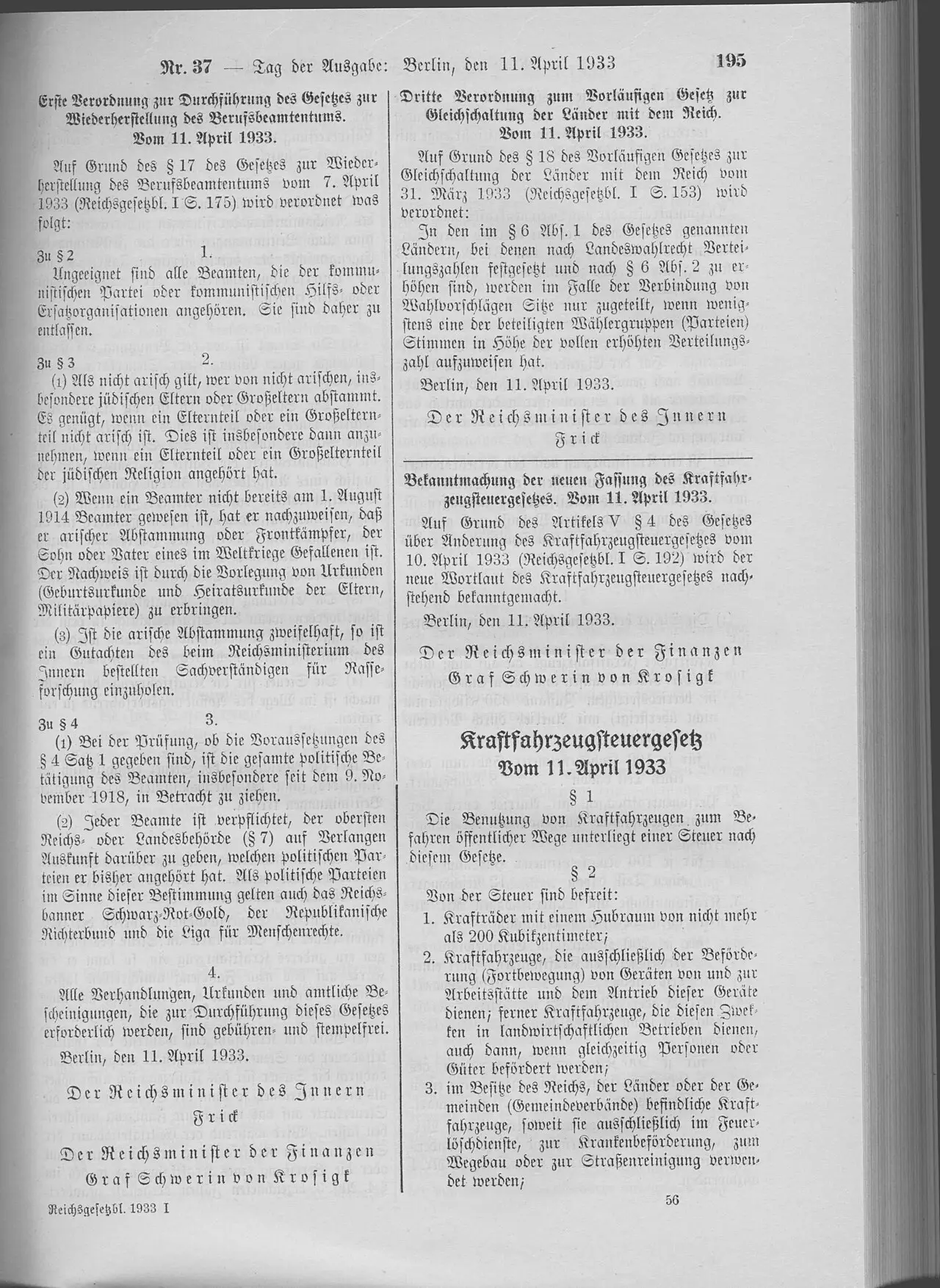
The Reichsgesetzblatt Teil I page on which the measure was published
RGBl. I S. 195. Commons record

The text

Erste Verordnung zur Durchführung des Gesetzes zur Wiederherstellung des Berufsbeamtentums.
First Ordinance for the Implementation of the Law for the Restoration of the Professional Civil Service.
Vom 11. April 1933.
Of 11 April 1933.
Auf Grund des § 17 des Gesetzes zur Wiederherstellung des Berufsbeamtentums vom 7. April 1933 (Reichsgesetzbl. I S. 175) wird verordnet was folgt:
On the basis of § 17 of the Law for the Restoration of the Professional Civil Service of 7 April 1933 (Reichsgesetzbl. I p. 175), the following is ordained:
Zu § 2
On § 2
1. Ungeeignet sind alle Beamten, die der kommunistischen Partei oder kommunistischen Hilfs- oder Ersatzorganisationen angehören. Sie sind daher zu entlassen.
1. All civil servants who belong to the Communist Party or to Communist auxiliary or substitute organisations are unsuitable. They are therefore to be dismissed.
Zu § 3
On § 3
2. (1) Als nicht arisch gilt, wer von nicht arischen, insbesondere jüdischen Eltern oder Großeltern abstammt. Es genügt, wenn ein Elternteil oder ein Großelternteil nicht arisch ist. Dies ist insbesondere dann anzunehmen, wenn ein Elternteil oder ein Großelternteil der jüdischen Religion angehört hat.
2. (1) A person is deemed non-Aryan who is descended from non-Aryan, in particular Jewish, parents or grandparents. It is sufficient if one parent or one grandparent is non-Aryan. This is to be assumed in particular if one parent or one grandparent has belonged to the Jewish religion.
(2) Wenn ein Beamter nicht bereits am 1. August 1914 Beamter gewesen ist, hat er nachzuweisen, daß er arischer Abstammung oder Frontkämpfer, der Sohn oder Vater eines im Weltkriege Gefallenen ist. Der Nachweis ist durch die Vorlegung von Urkunden (Geburtsurkunde und Heiratsurkunde der Eltern, Militärpapiere) zu erbringen.
(2) If a civil servant was not already a civil servant on 1 August 1914, he must prove that he is of Aryan descent, or a front-line combatant, or the son or father of a man killed in the World War. The proof is to be furnished by producing documents (birth certificate and marriage certificate of the parents, military papers).
(3) Ist die arische Abstammung zweifelhaft, so ist ein Gutachten des beim Reichsministerium des Innern bestellten Sachverständigen für Rasseforschung einzuholen.
(3) If Aryan descent is in doubt, an expert opinion is to be obtained from the expert on race research appointed at the Reich Ministry of the Interior.
Zu § 4
On § 4
3. (1) Bei der Prüfung, ob die Voraussetzungen des § 4 Satz 1 gegeben sind, ist die gesamte politische Betätigung des Beamten, insbesondere seit dem 9. November 1918, in Betracht zu ziehen.
3. (1) In examining whether the conditions of § 4, sentence 1, are met, the whole of the civil servant’s political activity, in particular since 9 November 1918, is to be taken into consideration.
(2) Jeder Beamte ist verpflichtet, der obersten Reichs- oder Landesbehörde (§ 7) auf Verlangen Auskunft darüber zu geben, welchen politischen Parteien er bisher angehört hat. Als politische Parteien im Sinne dieser Bestimmung gelten auch das Reichsbanner Schwarz-Rot-Gold, der Republikanische Richterbund und die Liga für Menschenrechte.
(2) Every civil servant is obliged, on request, to inform the supreme Reich or state authority (§ 7) which political parties he has belonged to until now. The Reichsbanner Black-Red-Gold, the Republican Judges’ Association and the League for Human Rights also count as political parties within the meaning of this provision.
4. Alle Verhandlungen, Urkunden und amtliche Bescheinigungen, die zur Durchführung dieses Gesetzes erforderlich werden, sind gebühren- und stempelfrei.
4. All proceedings, documents and official certificates that become necessary for the implementation of this law are exempt from fees and stamp duty.
Berlin, den 11. April 1933.
Berlin, 11 April 1933.
Der Reichsminister des Innern Frick
The Reich Minister of the Interior Frick
Der Reichsminister der Finanzen Graf Schwerin von Krosigk
The Reich Minister of Finance Graf Schwerin von Krosigk

About this text

The full text is given. Transcribed from the RGBl. scan (issue 37, p. 195); compared word by word with documentArchiv.de, which has two differences from the gazette (‘alle Beamte’ for ‘alle Beamten’ in no. 1, and ‘im Weltkrieg’ for ‘im Weltkriege’ in no. 2, para. 2); the gazette’s wording is kept.

The English translation was made for this site and is not an official translation. The marginal references ‘Zu § 2’, ‘Zu § 3’ and ‘Zu § 4’ point to the sections of the Civil Service Law of 7 April 1933 that each numbered provision implements: § 2 (officials appointed since November 1918 without the usual qualifications or ‘suitability’), § 3 (the ‘Aryan paragraph’) and § 4 (political unreliability). ‘Nicht arisch’ is translated literally as ‘non-Aryan’, as the brief requires.

German laws and decrees are official works and not protected by copyright (§ 5 UrhG).

Terms

nicht arisch, arische Abstammung
‘Non-Aryan’, ‘Aryan descent’: pseudo-scientific racial categories with no basis in biology. This ordinance gave the first statutory definition of ‘non-Aryan’; because ancestry could not be measured, it fell back on the religion of parents and grandparents. One Jewish grandparent was enough, a wider net than the definition of ‘Jew’ adopted under the Nuremberg Laws in 1935.
Frontkämpfer
Front-line combatant: the exemption for veterans of the First World War and for the fathers and sons of the fallen had been written into § 3 of the Civil Service Law at President Hindenburg’s insistence.
Sachverständiger für Rasseforschung
Expert on race research: the post at the Reich Interior Ministry was held by Achim Gercke, a Nazi genealogist, and became the Reich Office for Kinship Research (Reichsstelle für Sippenforschung).
Reichsbanner Schwarz-Rot-Gold
The mass organisation, led mainly by Social Democrats, that defended the Weimar Republic; its colours were those of the republican flag.
Republikanischer Richterbund, Liga für Menschenrechte
The Republican Judges’ Association, a small group of democratic judges and lawyers, and the German League for Human Rights, a pacifist civil-liberties organisation; listing them made membership grounds for suspicion.

Sources

  1. Reichsgesetzblatt 1933 Teil I, Nr. 37 (11. April 1933), S. 195 (Reichsministerium des Innern; scan on Wikimedia Commons)
  2. Erste Verordnung zur Durchführung des Gesetzes zur Wiederherstellung des Berufsbeamtentums (11.04.1933) (transcription) (documentArchiv.de)

Gazette scans: public domain, via Wikimedia Commons.