Day 72 of 100
Police and SA search and seal the Bauhaus in Berlin-Steglitz
Police and SA searched the Bauhaus school in its converted telephone factory in Berlin-Steglitz, sealed the building and arrested 32 students; the school never taught there again. The first implementing ordinance of the Civil Service law defined anyone with a single Jewish grandparent as ‘non-Aryan’, Göring was named Prussian Minister President, and the SS took over the Dachau camp. Newspapers printed Goebbels’s reply to the conductor Wilhelm Furtwängler, who had objected to artists such as Bruno Walter being driven from the platform, and most Jewish members of the Berlin club Tennis Borussia left it.
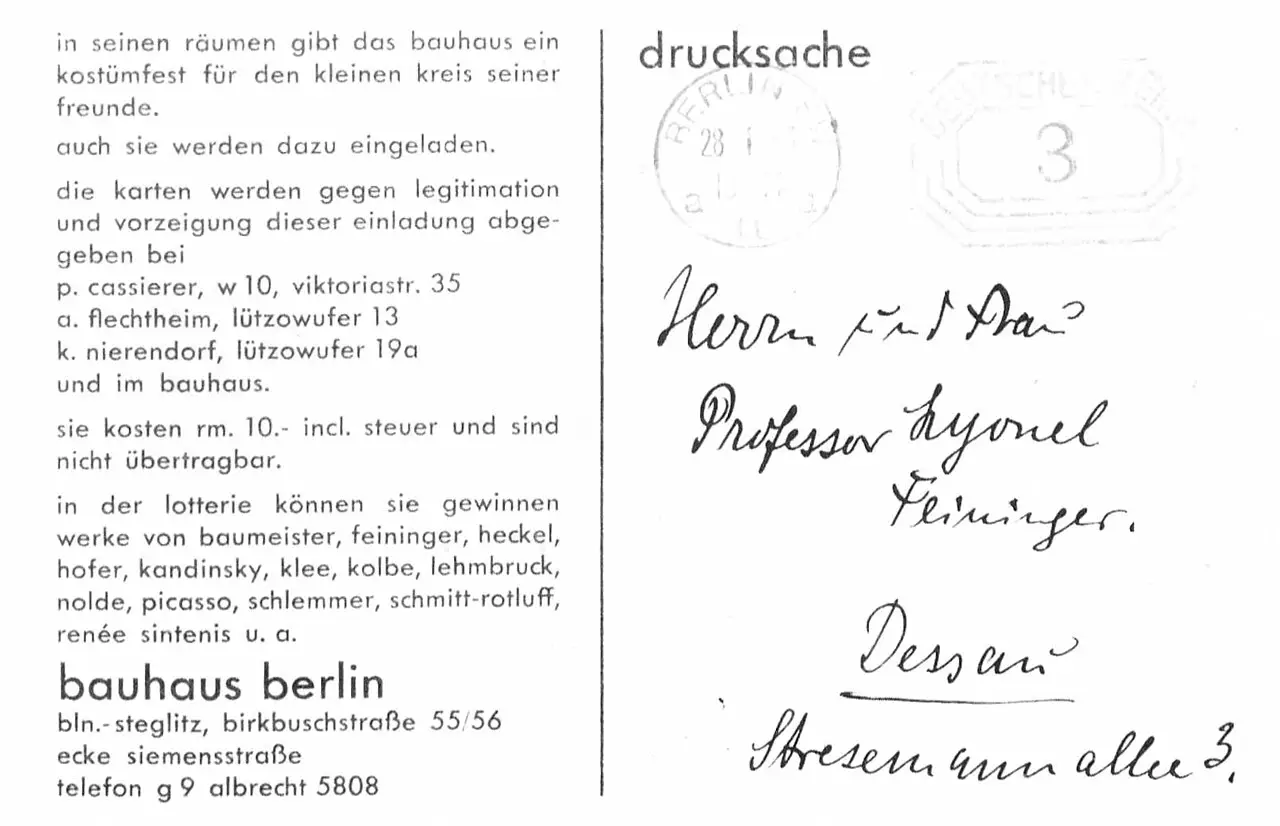

The raid ended the Bauhaus in practice. Closed in Dessau in September 1932 after the NSDAP had won control of the town council, the school had resumed work in October under its third director, Ludwig Mies van der Rohe, in an empty telephone factory on Birkbuschstraße in Steglitz. After police and SA had searched and sealed the premises, reopening was offered only on political conditions Mies would not accept, and on 20 July 1933 the masters dissolved the school themselves. Many of its teachers and students emigrated and carried its ideas abroad.
The ordinance issued the same day turned the Civil Service law’s undefined word ‘non-Aryan’ into a working rule: descent from one Jewish parent or grandparent was enough, and the religion of that ancestor was to be taken as proof. Officials appointed after August 1914 now had to document their descent, and doubtful cases went to a ‘race research’ expert at the Interior Ministry. The definition was soon copied into the rules for lawyers, doctors and students.
Laws and decrees
Erste Verordnung zur Durchführung des Gesetzes zur Wiederherstellung des Berufsbeamtentums
First Implementing Ordinance to the Law for the Restoration of the Professional Civil Service
Defined as ‘non-Aryan’ anyone descended from non-Aryan, in particular Jewish, parents or grandparents, one such parent or grandparent being enough. Officials appointed after 1 August 1914 had to prove ‘Aryan’ descent or veteran status with documents, and doubtful cases went to the Interior Ministry’s expert on ‘race research’. All Communist officials were to be dismissed, and officials had to declare their past party memberships, including the Reichsbanner and the League for Human Rights. Dated and promulgated on 11 April.4,5
Gesetz über die Einführung eines Feiertags der nationalen Arbeit
Law introducing a Holiday of National Labour
Made 1 May a public holiday with the legal status of New Year’s Day, under rules to be set by the Interior and Propaganda ministers. Signed on 10 April and promulgated in the Reichsgesetzblatt on 11 April.5
Politics and power
Government, terror and persecution
-
Persecution Berlin-Steglitz, Birkbuschstraße
Bauhaus searched, sealed and 32 students arrested
Police and SA searched the building of the Bauhaus in Berlin-Steglitz, which had moved there from Dessau the previous October, and sealed the premises. Thirty-two students were arrested.1
-
Government Berlin
Göring becomes Prussian Minister President
Acting as Reich governor for Prussia under the new law of 7 April, Hitler appointed Hermann Göring, until then Reich Commissioner for the Prussian Interior Ministry, as Prussian Minister President by telegram. The government published the letters behind the change: Papen had written on 7 April asking to give up his post as Reich Commissioner for Prussia, Hitler had passed the request to Hindenburg with warm thanks to Papen, and Hindenburg had released him by telegram to Rome.6
-
Terror Dachau
SS takes over Dachau as new prisoners arrive from Nuremberg
The SS took over the running of the Dachau camp from the Bavarian state police. Among the prisoners brought to the camp that day were Rudolf Benario, 24, who had taken his doctorate in political science in January and led the young socialists in Fürth before joining the KPD, and Arthur Kahn, 21, a medical student from Würzburg, delivered on a Nuremberg police lorry. Both had been arrested in March; both were Jewish; both were murdered the next day.8,9
-
Opposition Berlin
Nationalist Reichstag group drops Oberfohren
The German National People’s Party (DNVP) group in the Reichstag chose the deputy Schmidt (Hannover) as chairman in place of Dr Oberfohren, who had given up his seat. The party leader, Hugenberg, told the meeting that the Prussian authorities had searched the home of Oberfohren’s Berlin secretary without his knowledge as a minister.6,7
-
Persecution Berlin
No new Jewish panel doctors
Official sources stated that new admissions of doctors to practice under the health insurance funds had been suspended by the Reich Labour Ministry, so that new admissions of Jewish doctors were out of the question.6
Everyday life
What else was happening in Germany
-
Music Berlin
Goebbels answers Furtwängler
Newspapers printed Goebbels’s reply to the conductor Wilhelm Furtwängler, who had written asking that the only line drawn in music be between good and bad art. Goebbels rejected this, said art must be ‘close to the people’ and combative, and found complaints that ‘men such as Walter, Klemperer, Reinhardt’ had had to cancel concerts out of place at that moment.7
-
Education Schneidemühl
Prussian teachers’ association joins the ‘national uprising’
As its delegates gathered at Schneidemühl on 11 April, the board of the Prussian Teachers’ Association declared that it placed the association ‘wholly’ at the service of the ‘national uprising’ (nationale Erhebung) and authorised its leaders to negotiate with the National Socialist Teachers’ League on merging into a single body, to be completed at an extraordinary meeting in Magdeburg at Whitsun.6
-
Sport Berlin
Jewish members leave Tennis Borussia
At an extraordinary general meeting of Tennis Borussia Berlin, a club in which roughly 15 to 20 per cent of members were Jewish, Herr Rüdiger opened proceedings by saying that politics had now reached the club: the board members of Jewish faith had given up their posts and most Jewish members had resigned, among them the founder Alfred Lesser. The minutes record his regret at losing ‘some very deserving members’; the club’s historian, Jan Buschbom, stresses that the departures cannot be called voluntary.3
Voices
The period between 21 March of this year (the day the Reichstag opened) and 1 April was a true time of terror for all the Jews of Germany, and for those of Regensburg in particular.
Art in the absolute sense, as liberal democracy knows it, must not be allowed to exist.
Elsewhere in the world
-
Italy
French draft for the Four-Power Pact handed to Mussolini
Mussolini received the French ambassador, de Jouvenel, who handed over a French draft of the proposed Four-Power Pact between Britain, France, Germany and Italy, with a covering letter.6
In Berlin today
_Bauhaus_Berlin.jpg)
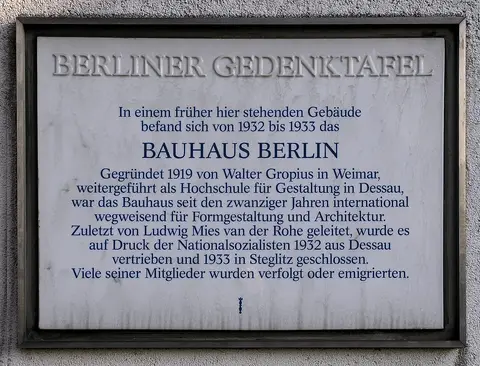
Bauhaus Berlin (former telephone factory)
Birkbuschstraße 49, 12167 Berlin (Lankwitz, Steglitz-Zehlendorf)
- Then
- The last home of the Bauhaus, in a disused telephone factory, was searched by police and SA on 11 April 1933 and sealed; 32 students were arrested.1,2
- Today
- The factory building no longer stands. A Berlin memorial plaque at Birkbuschstraße 49, unveiled on 30 November 1989, records that the Bauhaus was closed here in 1933 and that many of its members were persecuted or emigrated.
More pictures

Sources
- Berlin (1932–1933) Bauhaus Kooperation Berlin Dessau Weimar, Section on the Berlin phase
- Gedenktafeln in Berlin: Bauhaus Berlin Gedenktafeln in Berlin
- Aus dem Spiel genommen taz, die tageszeitung, 31 October 2018, on Jan Buschbom's exhibition about Jewish members of Tennis Borussia Berlin; minutes of the meeting of 11 April 1933
- Erste Verordnung zur Durchführung des Gesetzes zur Wiederherstellung des Berufsbeamtentums (11.04.1933) documentArchiv.de, Full text; source RGBl. 1933 I S. 195
- Deutscher Reichsanzeiger und Preußischer Staatsanzeiger, 12 April 1933 Deutsche Digitale Bibliothek, Zeitungsportal (Universitätsbibliothek Mannheim), p. 1, notice on Reichsgesetzblatt Part I No. 37, issued 11 April 1933
- Kölnische Zeitung, 11 and 12 April 1933 Deutsche Digitale Bibliothek, Zeitungsportal, 12 April, morning edition, p. 1 (Göring appointment and correspondence; Mussolini and de Jouvenel), p. 2 (DNVP), p. 3 (panel doctors); 11 April, p. 6 (Prussian Teachers' Association)
- Hamburger Fremdenblatt, 11 and 12 April 1933 Deutsche Digitale Bibliothek, Zeitungsportal, 11 April, p. 12 (Goebbels's letter to Furtwängler); 12 April, evening edition, p. 8 (DNVP group)
- Wie der junge Arthur Kahn aus der Semmelstraße das erste Würzburger Todesopfer der Nazis wurde Schreib das auf – Würzburger Geschichten, Sections 'Die SS übernimmt das KZ Dachau' and 'Hetzjagd auf jüdische Studenten'
- Häftlinge im Porträt: Rudolf Benario KZ-Gedenkstätte Dachau
- Bericht von Alfred Binswanger über seine Verhaftung im März 1933 Jüdisches Museum Berlin, Online-Schaukasten 1933
Spotted a mistake? Send a correction.