Day 9 of 100
Social Democrats fill the Lustgarten as the KPD leadership meets in secret at Ziegenhals
In rain and wind, the Social Democrats and the Iron Front marched into the Lustgarten for their largest rally of the campaign, where Otto Wels declared that the workers’ front stood unbroken. Outside Berlin, the Communist Party’s central committee met secretly in an inn at Ziegenhals to hear Ernst Thälmann. In the Reichstag building, Nazi deputies broke up the committee meant to guard parliament’s rights. In Berlin the flu returned with more than a thousand new cases in a day.
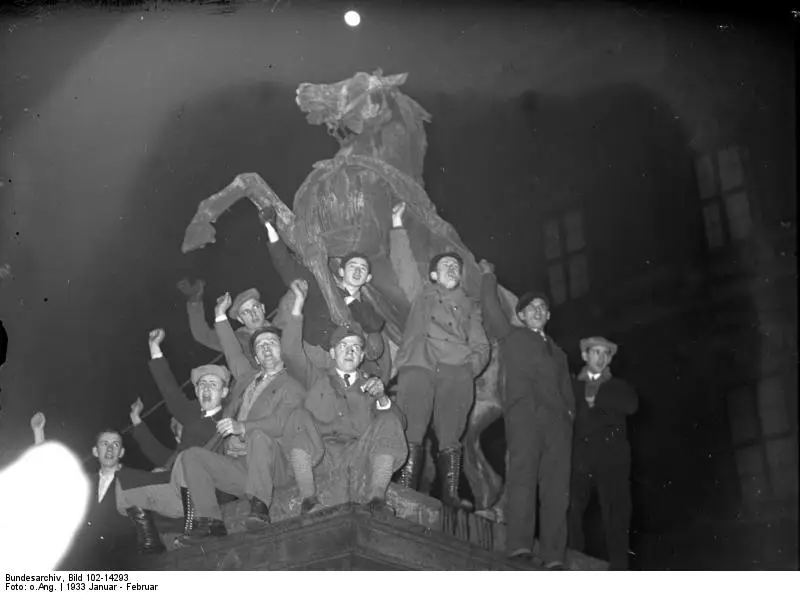

The emergency decree of 4 February came into force on this day, but the left still had its own spaces. The SPD’s Berlin organisation had called its members to march into the Lustgarten at 18:00 from assembly points across the city, from Wedding to Spandau, to show that “Berlin stays red”. The Vorwärts, back on the streets after its ban, described a sea of people and claimed hundreds of thousands; the KPD meanwhile tried, and failed, to have its deputy Ernst Torgler read a leaflet on a united front from the platform. The same day the KPD’s leadership met illegally outside the city.
Laws and decrees
Verordnung des Reichspräsidenten zum Schutze des deutschen Volkes
Decree of the Reich President for the Protection of the German People
Came into force on the day after its promulgation of 6 February, giving the police and state authorities powers to ban meetings and newspapers, seize printed matter and hold suspects for up to three months.7
Zweite Verordnung zur Durchführung der Verordnung zum Schutze des deutschen Volkes
Second implementing ordinance to the Decree for the Protection of the German People
Laid down the procedure of the Reich Court senate that heard appeals against newspaper bans: it would decide on the documents, could hear witnesses, and was to rule within a week by simple majority.8
Dritte Verordnung zur Durchführung der Verordnung zum Schutze des deutschen Volkes
Third implementing ordinance to the Decree for the Protection of the German People
Added the Reich commissioners running the Prussian ministries, among them Göring, to the “leading officials” whose insult could justify dissolving meetings or banning newspapers.9
Politics and power
Government, terror and persecution
-
Opposition 18:00, Berlin, Lustgarten
Iron Front rally in the Lustgarten
Columns of Social Democrats, trade unionists and Reichsbanner members marched from every district into the Lustgarten for 18:00. Franz Künstler opened by honouring Hermann Kasten, Reichsbanner men killed in Breslau and Chemnitz, and Anna Röder; the party chairman Otto Wels then spoke. The organisers had told marchers that “provocative” shouts were not allowed and that their cry was to be “Freedom!”1,2
Sources disagree. The Vorwärts spoke of hundreds of thousands present; no independent count was found.
-
Opposition Ziegenhals near Königs Wusterhausen
KPD central committee meets at Ziegenhals
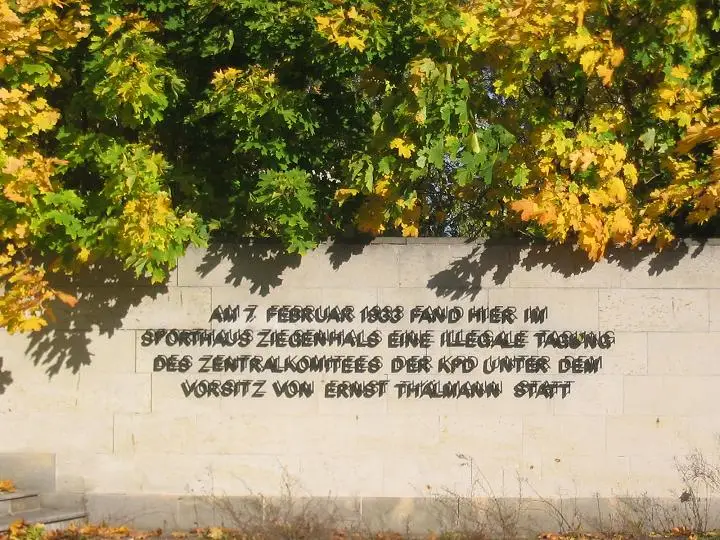
Some forty leading Communists, among them the party chairman Ernst Thälmann, Wilhelm Pieck, Walter Ulbricht, Hans Beimler, Karl Barthel and John Schehr, met illegally in the Sporthaus Ziegenhals, an inn near Königs Wusterhausen, to discuss the party’s course after the Nazi takeover; Herbert Wehner had arranged the meeting. It was Thälmann’s last address to the leadership: he was arrested on 3 March and shot in Buchenwald concentration camp in August 1944.3,4
Sources disagree. A remembrance project gives about forty participants; a GDR-era caption held by the Bundesarchiv gives thirty-five members of the central committee.
-
Parliament Berlin
Nazi deputies break up the Reichstag’s standing committee
The committee for safeguarding the rights of parliament, which sits when the Reichstag is dissolved, met to discuss an SPD motion on protecting free elections. The Nazi deputy Frank refused to sit under the chairman, the Social Democrat Löbe, who had called Hitler “Adolf the Slovak” during the Lippe campaign; as the Social Democrats left the room, Nazi members shouted abuse at them, including “Jew boys”. Frank, as deputy chairman, then adjourned the committee indefinitely.5
-
Terror early hours, Harburg-Wilhelmsburg
Worker shot dead in Harburg
In the early hours, outside the pub “Stadt Hannover” at the Großer Schippsee in Harburg-Wilhelmsburg, National Socialists attacked the locksmith Martin Leuschel, said to be a Communist, and another worker. Leuschel was killed by a shot in the abdomen and his companion wounded.6
Everyday life
What else was happening in Germany
-
Weather Berlin
Rain and wind for the marchers
The SPD’s call to march spoke of rain and storm, and the forecast printed that evening promised milder weather for Berlin, mostly overcast with occasional light rain and moderate south-westerly winds, with rain spreading across eastern Germany.1,6
-
Society Berlin
A second flu wave
After a brief lull, new influenza cases registered with the Berlin AOK rose on Tuesday from 938 to 1,060. District medical officers closed more than 50 school classes in the morning and another 11 in the afternoon, in Zehlendorf, Dahlem, Lankwitz and Lichterfelde. In December the fund had seen about 40 flu notifications a day.2
Voices
The workers’ front stands! It stands unbroken and more united than ever!
More pictures

Sources
- Vorwärts, Morgenausgabe Nr. 59–63, 7 February 1933 Deutsche Digitale Bibliothek, Zeitungsportal, p. 1, call to the Lustgarten rally ('Das rote Berlin kämpft für die Freiheit')
- Vorwärts, Morgenausgabe Nr. 65, 8 February 1933 Deutsche Digitale Bibliothek, Zeitungsportal, p. 1, report of the rally ('Die Kundgebung'; speeches of Künstler and Wels); p. 3, 'Neue Grippewelle'
- Zentralkomitee der KPD tagt in Ziegenhals, 7. Februar 1933 Erinnern vor Ort – Brandenburg 1933 (brandenburg-33.de)
- Bundesarchiv Bild 183-T0201-0310, Niederlehme, Jugendstunde, Thälmann-Gedenkstätte Ziegenhals (ADN caption, 1 February 1978) Bundesarchiv, via Wikimedia Commons, archive caption: 35 members of the KPD central committee met here on 7 February 1933
- Akten der Reichskanzlei. Regierung Hitler 1933–1945, Bd. I, Nr. 17: Ministerbesprechung vom 8. Februar 1933, 16.30 Uhr Bundesarchiv / Historische Kommission bei der Bayerischen Akademie der Wissenschaften, item 5, notes 18–19 (Reichsanzeiger report of 8 February 1933)
- Vorwärts, Abendausgabe Nr. 64, 7 February 1933 Deutsche Digitale Bibliothek, Zeitungsportal, p. 2, 'SA.-Bluttat in Harburg'; p. 3, 'Wetter für Berlin'
- Verordnung des Reichspräsidenten zum Schutze des Deutschen Volkes. Vom 4. Februar 1933 documentArchiv.de, § 26 and note 3
- Zweite Verordnung zur Durchführung der Verordnung zum Schutze des deutschen Volkes. Vom 7. Februar 1933 documentArchiv.de, RGBl. 1933 I S. 53–54
- Dritte Verordnung zur Durchführung der Verordnung zum Schutze des deutschen Volkes. Vom 7. Februar 1933 documentArchiv.de, RGBl. 1933 I S. 54

Spotted a mistake? Send a correction.