Day 62 of 100
Nazi boycott of Jewish shops, doctors and lawyers: SA pickets stand across Germany
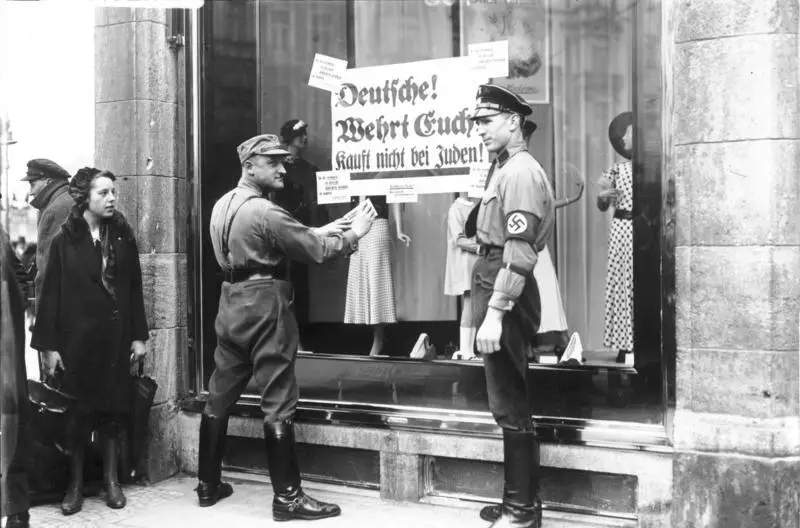
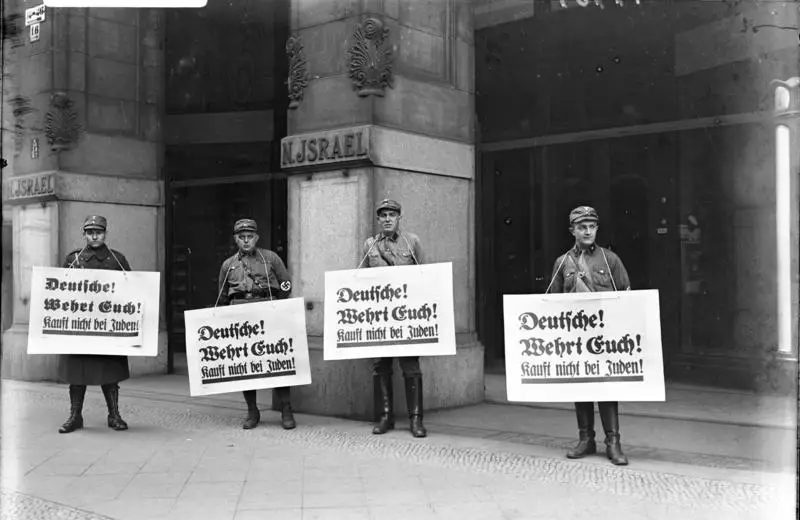
At 10:00 SA and SS men took up posts outside Jewish-owned shops, department stores, surgeries and law offices throughout Germany, carrying placards reading ‘Germans! Defend yourselves! Don’t buy from Jews!’. In Berlin some 60,000 to 70,000 SA men were deployed; Tietz, Wertheim and Israel shut their doors, and only a small quota of Jewish lawyers was readmitted to the courts. In Kiel the Jewish lawyer Friedrich Schumm was murdered in police custody. The flags also flew for Bismarck’s birthday, and Viktoria 89 won a football final.
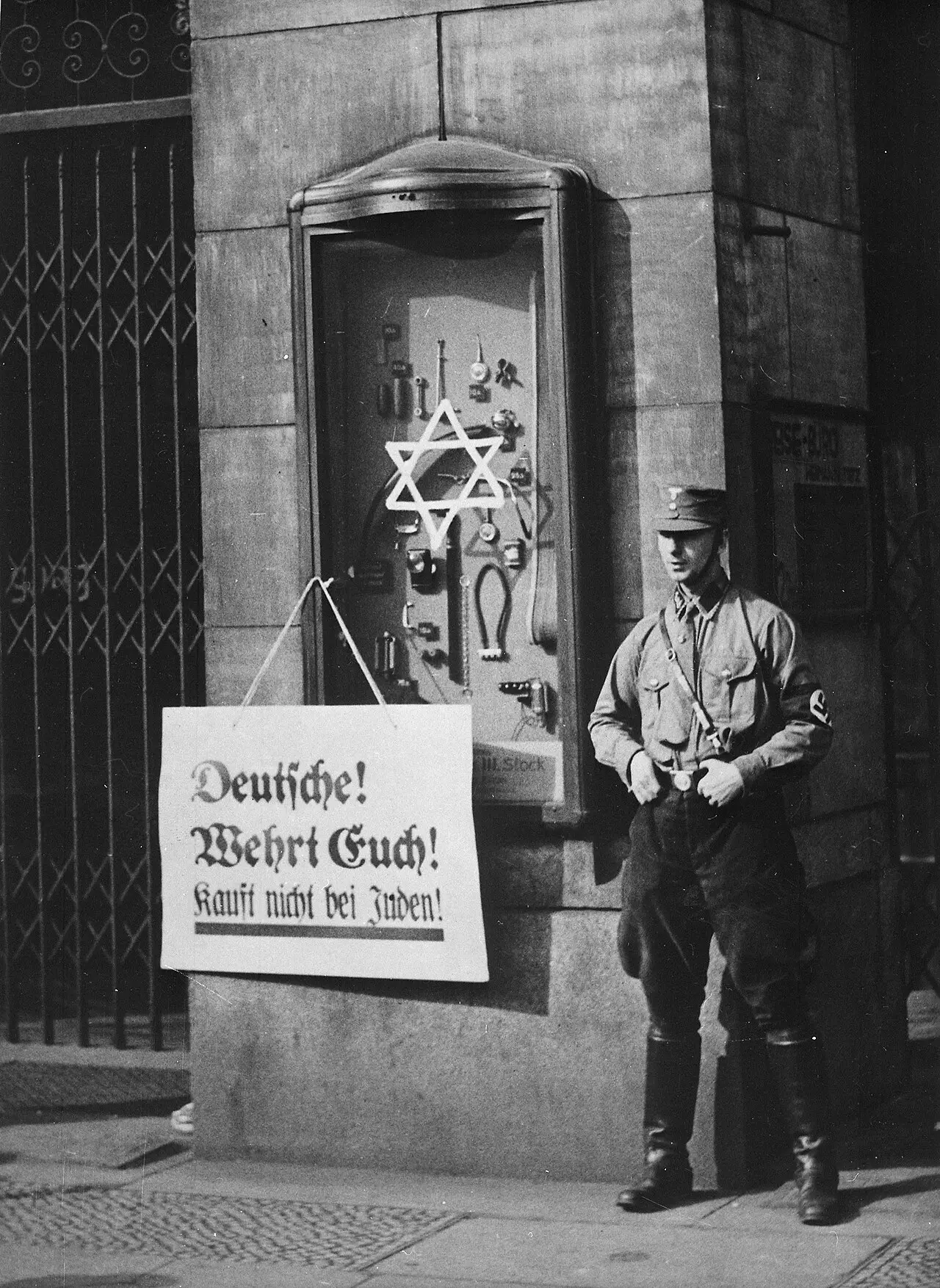

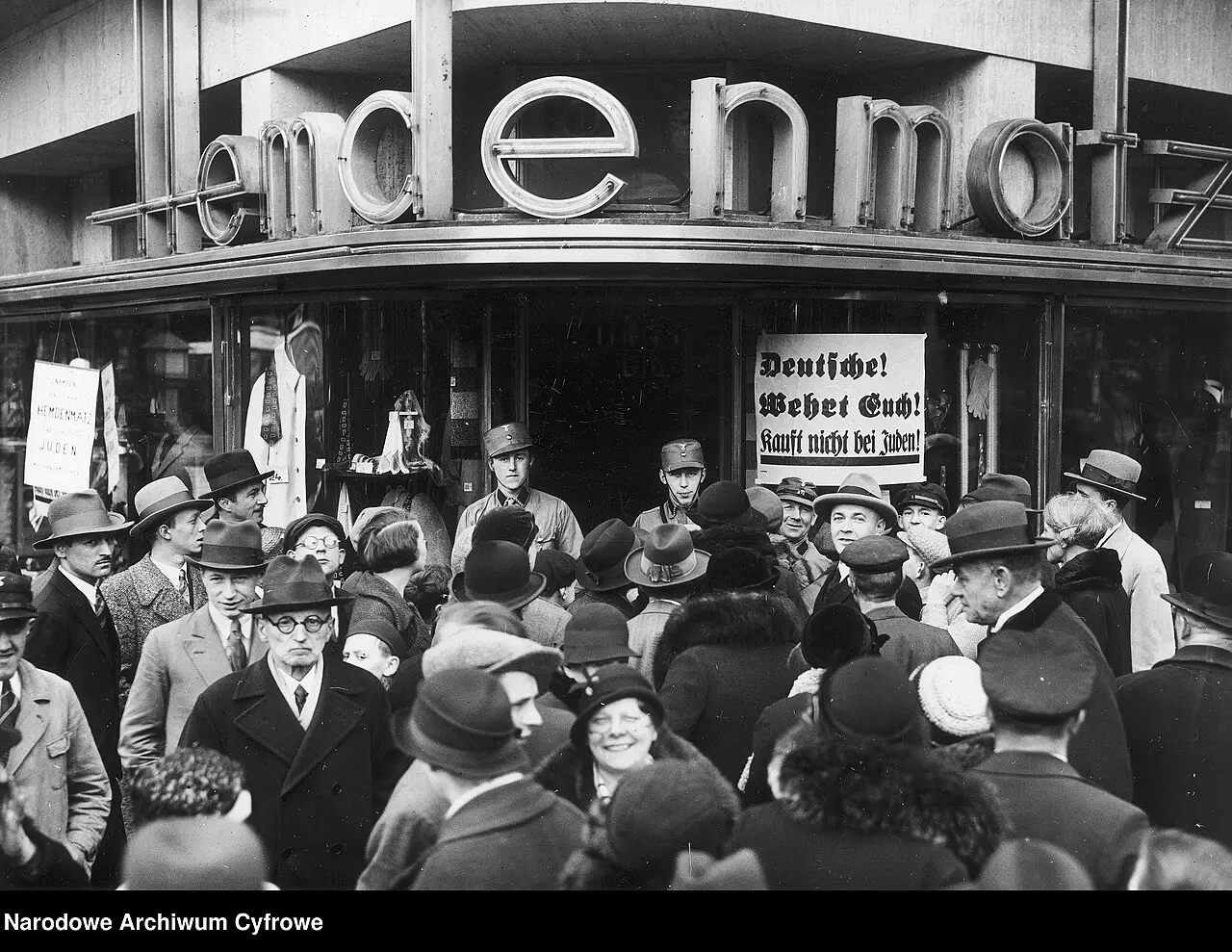
The boycott of 1 April was organised nationwide by the Nazi party leadership against Germany’s Jews as a group. The Nazi party presented it as ‘defence’ against foreign ‘atrocity propaganda’ (Greuelpropaganda, its word for foreign reports of Nazi violence), but its targets were German citizens: shopkeepers, department-store owners, doctors and lawyers, and the employees who worked for them. Posters had gone up on Berlin’s advertising pillars the evening before. On Saturday morning shops opened as usual between 8 and 9; between half past nine and ten the picture changed, as cars full of SA men drove through the city centre chanting slogans and pickets with placards took up position at the doors.
In Berlin the reports name the places. Crowds gathered outside Wertheim on Leipziger Platz, where SA men guarded the entrances; Tietz on Dönhoffplatz lowered its iron doors; the N. Israel store on Spandauer Straße closed under its pickets. Clothing, cigar and jewellery shops owned by Jews pulled down their shutters, the big cafés on the Kurfürstendamm closed, and the garment district around Hausvogteiplatz and in the Jewish quarter near Alexanderplatz, which the press called the ‘ghetto’, almost every shop was shut. SA men checked papers at the entrances to the University, where posters announced that Jews were forbidden to enter. At the Schöneberg district court a crowd burned the court’s black-red-gold republican flag.
The professions were hit as hard as trade. That afternoon several hundred lawyers queued at the Berlin bar association for the passes now needed to enter the courts; non-Jewish lawyers received theirs at once, while the applications of Jewish lawyers were to be dealt with in writing. Only about 35 lawyers of Jewish descent were to be admitted to the Berlin courts, including the Kammergericht, in proportion to the Jewish share of the population. The same day the Prussian Academy of Sciences, through the official press service, denounced Albert Einstein, who had already resigned, and the political police blocked his Berlin bank account.
Violence was not the exception the regime claimed. In Kiel the Jewish lawyer Friedrich Schumm, visiting his parents, became involved in a scuffle with the SS men posted outside their furniture shop in which an SS man was shot; he gave himself up to the police and was murdered in his cell by a mob of SA and SS men. In Berlin several Jews were taken into ‘protective custody’ (Schutzhaft, imprisonment without trial). The Nazi-controlled press reported perfect order and a united public; Goebbels wrote of ‘exemplary discipline’. In fact many Jewish-owned shops stayed open and many Berliners went on shopping in them, and the boycott lasted only this one day.
Politics and power
Government, terror and persecution
-
Persecution 10:00, Berlin and throughout Germany
The boycott begins at 10:00
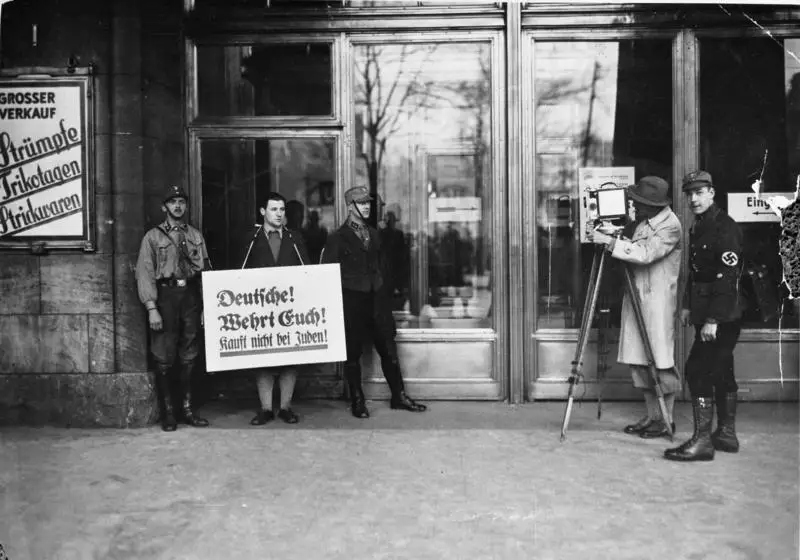
Across the Reich SA, SS and party pickets stood outside Jewish-owned shops, department stores and one-price stores, doctors’ surgeries and law offices, with placards and leaflets urging the public not to buy from Jews. In Berlin, where between 60,000 and 70,000 SA men took part, cars flying black-white-red and swastika flags patrolled the boycott and newsreel crews filmed the scenes. Trams and buses carried black-white-red and swastika pennants.1,2,3
Sources disagree. Agency reports differ on when Wertheim and Israel, which first stayed open, closed: one version says shortly after 10:00, another shortly after 13:00.
-
Persecution Berlin
Berlin courts admit only a quota of Jewish lawyers
Only a small number of Jewish lawyers, in proportion to the Jewish share of the population, were to be allowed into the Berlin courts; the bar association put the figure at about 35, including the Kammergericht. Hundreds of lawyers queued for entry passes on Saturday afternoon. Outside the Schöneberg district court in Grunewaldstraße a crowd watched for Jewish judges and lawyers entering and burned the court’s black-red-gold flag while singing the Horst Wessel song.4,2
-
Persecution Berlin
All Jewish teachers in Berlin’s schools sent on leave
Dr Meinshausen, state commissioner running Berlin’s municipal school administration, ordered all district offices to put every teacher ‘Jewish by blood’ at every Berlin school on leave at once and until further notice, ‘to keep all unrest away from the schools’, and to report the names within three days.3
-
Terror late morning, Kiel
Friedrich Schumm lynched in Kiel police prison
Friedrich Schumm, a Jewish lawyer, had come to Kiel to visit his parents, who ran a furniture shop in Kehdenstraße. When he tried to enter the shop, guarded by SS men, a scuffle broke out and a shot wounded one of them. Schumm later gave himself up to the police; a mob of SA and SS men stormed the Kiel police prison and killed him in his cell with some thirty shots. No police officer protected him, no one stopped the killers, and no one was ever held to account. The same day a Frankfurt special court sentenced a man named Löwenstein to a year in prison under the decree against ‘malicious attacks’ for spreading reports of atrocities, among them that a Jewish lawyer in Kiel had been shot by SA men.5,3
Sources disagree. The official statement claimed that Schumm shot the SS man Walter Asthalter ‘without good reason’; later accounts describe a scuffle in which a shot went off.
-
Propaganda Berlin
Prussian Academy denounces Einstein
The official Prussian press service published a statement of the Prussian Academy of Sciences declaring its ‘indignation’ at Einstein’s alleged part in ‘atrocity agitation’ in America and France. It noted that he had resigned, saying he could no longer serve the Prussian state under its present government, and declared that the Academy had no reason to regret his departure. The same day the political police blocked Einstein’s account at a Berlin bank and seized 25,000 marks in securities and 5,000 marks in cash.6
-
Government Berlin; Wilhelmshaven
Hindenburg and Hitler made freemen of Berlin; a new warship launched
By decision of the city council and the municipal executive, Reich President Hindenburg and Chancellor Hitler were made honorary citizens of Berlin. At Wilhelmshaven the new armoured ship (Panzerschiff) Deutschland was commissioned, and her sister ship Admiral Scheer was launched.3
Everyday life
What else was happening in Germany
-
Society evening, Berlin, Müggelberge and Lustgarten
Flags and bonfires for Bismarck’s birthday
1 April was the anniversary of Bismarck’s birth in 1815, and black-white-red and swastika flags were hoisted for it. In the evening thousands marched with bands to the floodlit Bismarck tower in the Müggelberge in south-east Berlin, among them SA, SS and Stahlhelm men, students, police and youth groups, while young people gathered round a great bonfire in the Lustgarten.3,4
-
Film Berlin
The boycott on newsreel
Cars carrying cameramen pushed slowly through the crowds in Friedrichstraße and the city centre, filming the pickets and the people outside the shops, and SA men with their own cameras photographed shoppers. The surviving newsreel shows a curious, wary crowd rather than one cheering the SA.1,2,7
-
Sport
Viktoria 89 win the first Brandenburg final
In the first match of the final round for the Brandenburg football championship, Viktoria 89 beat Stettiner SC only narrowly, 2–1.10
Voices
The boycott against the world atrocity agitation has broken out in Berlin and throughout the Reich in full force. To get my bearings I drive along the Tauentzienstraße. All the Jewish shops are closed. SA posts stand at the entrances. The public has everywhere declared its solidarity. Exemplary discipline prevails.
Elsewhere in the world
-
Vatican
Pope Pius XI opens the Holy Year
In bright sunshine Pius XI opened the Holy Year with the traditional ritual opening of the holy doors of the patriarchal basilicas; some 50,000 people attended the ceremony in St Peter’s.6
In Berlin today
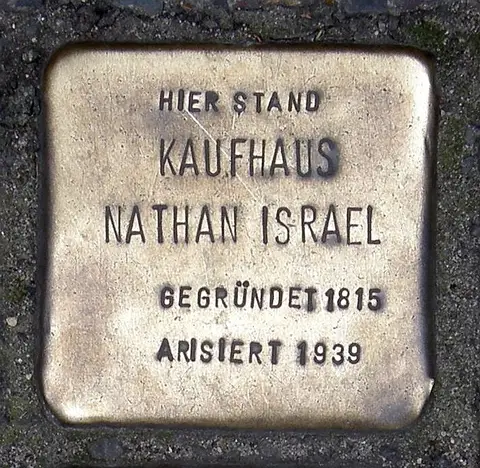

Kaufhaus N. Israel (site)
Spandauer Straße 26–32, corner of Rathausstraße, 10178 Berlin-Mitte
_Denkzeichen_Modezentrum_Hausvogteiplatz.jpg)
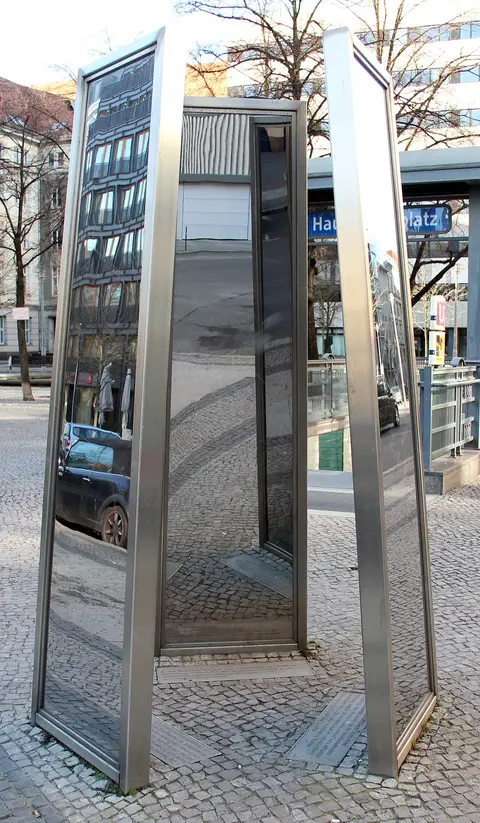
Hausvogteiplatz
Hausvogteiplatz, 10117 Berlin-Mitte
- Then
- The centre of Berlin’s garment industry, built up largely by Jewish manufacturers and merchants, fell silent as its Jewish-owned firms closed for the boycott.1,9
- Today
- Since July 2000 the ‘Denkzeichen Modezentrum Hausvogteiplatz’ by Rainer Görß, three tall mirrored panels at the U-Bahn exit, and the names of Jewish fashion firms on the steps of the station recall the owners and employees who were driven out.
More pictures




Sources
- Zwönitztaler Anzeiger, 3 April 1933: ‘Völlige Ruhe in Berlin’ (Berlin, 1 April) Deutsche Digitale Bibliothek, Zeitungsportal, p. 2
- Dresdner Neueste Nachrichten, 2 April 1933: ‘Der Boykott in Berlin’ (own wire report, Berlin, 1 April) Deutsche Digitale Bibliothek, Zeitungsportal, p. 1
- Westfälische Zeitung (Bielefeld), 3 April 1933: ‘Der Verlauf des Boykotts’, ‘Kundgebung im Lustgarten’, Kiel official statement; ‘Ehrenbürger von Berlin’ Deutsche Digitale Bibliothek, Zeitungsportal, pp. 1–3
- Dortmunder Zeitung, 3 April 1933: ‘Nur 35 jüdische Anwälte an Berliner Gerichten’; Bismarck celebrations Deutsche Digitale Bibliothek, Zeitungsportal, pp. 1–3
- Den Opfern ein Gesicht geben: Friedrich Schumm (75 Jahre Landespolizei) Landespolizei Schleswig-Holstein (schleswig-holstein.de)
- Hamburger Fremdenblatt, 2 April 1933: ‘Die preußische Akademie der Wissenschaften zum Fall Einstein’; opening of the Holy Year Deutsche Digitale Bibliothek, Zeitungsportal, pp. 2–3
- Goebbels kündigt den Boykott jüdischer Geschäfte an (1. April 1933) German History in Documents and Images (German Historical Institute Washington)
- Kaufhaus Nathan Israel (Stolperstein, Spandauer Str. 26–32) Koordinierungsstelle Stolpersteine Berlin
- Denkzeichen Modezentrum Hausvogteiplatz Bundeszentrale für politische Bildung
- Morgen-Zeitung, 3 April 1933: ‘Hertha BSC spielt nur unentschieden’ (Brandenburg championship) Deutsche Digitale Bibliothek, Zeitungsportal, p. 8
Spotted a mistake? Send a correction.