Day 81 of 100
Hitler’s 44th birthday: flags across Berlin and the premiere of Johst’s ‘Schlageter’
For Hitler’s 44th birthday Berlin put out flags almost as for the Day of Potsdam, a flag parade marched past the Interior Ministry on Unter den Linden, and Bavaria made Hindenburg, Hitler, Epp and Röhm honorary citizens; Hitler himself stayed in Bavaria. Prussia marked the day by turning three cadet schools into ‘national-political education institutes’ and by withdrawing Theodor Lessing’s research post, while the party announced a ban on new members from 1 May. That evening the State Theatre gave the premiere of Hanns Johst’s Nazi drama ‘Schlageter’ before Goebbels, Frick and Rust.
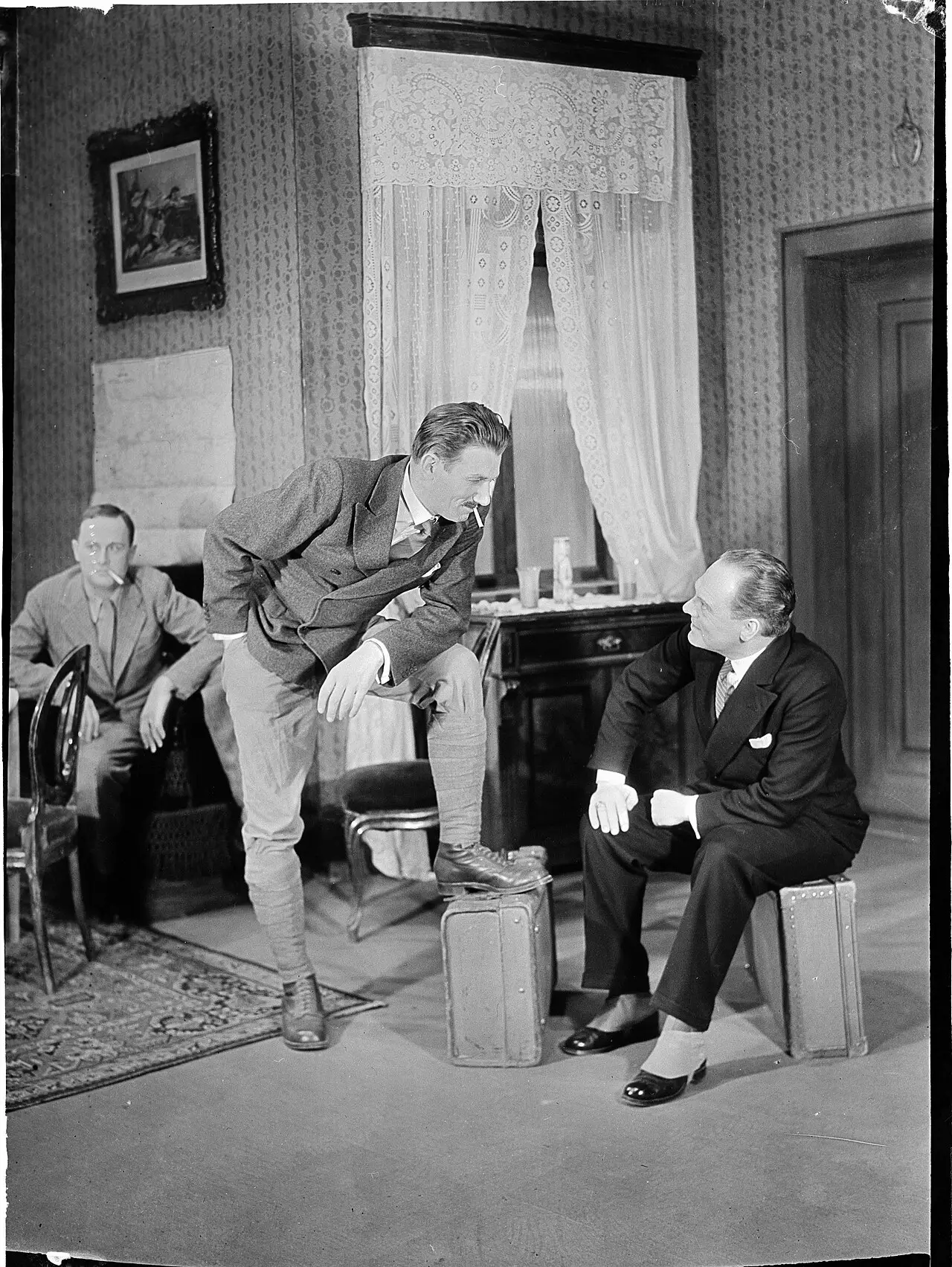
_-_LABW_-_Staatsarchiv_Ludwigsburg_E_18_III_B%C3%BC_346_-1.jpg)
The birthday was the first since Hitler became Chancellor, and the day showed how quickly public life had been reorganised around him. The Völkischer Beobachter had asked for no lavish festivities, but ministries, states, churches and associations competed with telegrams of loyalty, from Hindenburg and the Reichswehr minister to the Centre Party’s leader, Prelate Kaas. The Prussian Ministry of Culture used the day to announce structural changes and dismissals, and the State Theatre chose it to open its ‘new course’ with a play about the nationalist Schlageter and his actions against the French in 1923.
Politics and power
Government, terror and persecution
-
Propaganda 8 am, Berlin, Unter den Linden
Berlin decked out for the Chancellor’s birthday
Berlin put out flags on a scale close to that of the Day of Potsdam, with banners strung across the streets in the north of the city, garlanded portraits of Hitler in shop windows and on balconies, church flags on the churches and flags on all public transport. At 8 am a large crowd on Unter den Linden watched a flag parade in front of the Interior Ministry: a police band, standard-bearers, an armed police detachment, SS, SA and a Stahlhelm company. Hindenburg telegraphed his thanks for Hitler’s ‘great patriotic work’. Hitler himself spent the day in Bavaria.1,2
-
The states Munich
Bavaria makes Hitler and Röhm honorary citizens
The Bavarian government passed and promulgated a law granting honorary citizenship of Bavaria to Reich President Hindenburg, Hitler, the Reich governor Franz Ritter von Epp and the SA chief of staff Ernst Röhm for their services to the ‘national uprising’ (nationale Erhebung, the Nazis’ name for their takeover). The law was to be posted publicly.2
-
Persecution Berlin
Prussia’s birthday decrees for schools and universities
Rust, the Reich commissioner for the Prussian Ministry of Culture, issued decrees for the birthday: the former cadet schools at Plön, Köslin and Potsdam were to become ‘national-political education institutes’ with new teaching staff and the Hitler uniform as dress, and the teacher-training academies were to become ‘colleges for teacher training’ from 1 May. He also withdrew the research assignment of the philosopher Theodor Lessing at the Technical University of Hanover, revoked the teaching assignments of the professors Chajes and Holde at the Technical University in Charlottenburg and suspended two other professors there.2,3
-
Government Munich
NSDAP closes its membership lists
The party treasurer, Schwarz, ordered a freeze on new party members from 1 May ‘until further notice’, because applications since the ‘seizure of power’ (Machtergreifung) of 30 January had become so numerous. Applications received before 1 May could be forwarded until 15 May; members of the Hitler Youth reaching 18 and of the Nazi factory cell organisation were exempt.3
-
Terror night of 19–20 April, Erkner, near Berlin
SA and Stahlhelm clash at Erkner
Late the previous evening, outside the Märkischer Hof restaurant in Erkner, east of Berlin, about 80 Stahlhelm members, some of them armed, confronted Nazi local councillors over the arrest of a Stahlhelm member by the rural police; a Nazi member of the Prussian Landtag was attacked before the local official intervened. Both organisations published conflicting accounts on 20 April.1
-
Churches Rome
Kaas promises ‘unwavering cooperation’
From Rome, the leader of the Centre Party, Prelate Kaas, telegraphed Hitler his blessings and the assurance of ‘unwavering cooperation’ in the work of creating an inwardly united, socially pacified and outwardly free Germany.4,3
Everyday life
What else was happening in Germany
-
Theatre evening, Berlin, Gendarmenmarkt
Premiere of ‘Schlageter’ at the State Theatre
The Staatliches Schauspielhaus on the Gendarmenmarkt gave the first performance of Hanns Johst’s play ‘Schlageter’, about the nationalist Schlageter and his acts of violence against the French in 1923, with Albert Bassermann, Marie Koppenhöfer, Walter Frank and Hans Leibelt among the cast. Goebbels, Frick, Rust and Kerrl watched from the boxes with members of the diplomatic corps; the Kölnische Zeitung called it a huge success and reported that 22 more German theatres would stage it in the coming days.3,5,6
-
Sport morning, Monte Carlo
Caracciola crashes in Monaco practice
Rudolf Caracciola, Germany’s most successful racing driver, now driving for Alfa Romeo, crashed into a tree during practice for the Monaco Grand Prix when his steering failed, and suffered a badly broken thigh that would keep him out of racing for a long time.2
-
Society Berlin
Tickets for the May Day rally go on sale
Tickets were announced for the evening rally on the Tempelhof field on 1 May: grandstand seats at 3, 5 and 7 marks, standing room inside the horseshoe of stands at 2 marks and ‘sacrifice tickets’ beside the government stand at 20 marks, on sale from Saturday at about 150 points in Greater Berlin.2
-
Crime night, Michendorf, near Potsdam
Police shoot a driver near Michendorf
On the road near Michendorf, south-west of Potsdam, a police patrol posted to stop suspicious vehicles opened fire on a car from Kassel that slowed for their signal and then accelerated, killing the driver, Fritz Leye, 44, treasurer of the district savings bank at Fritzlar.1
-
Radio evening
The birthday on the air
In the evening the national ‘Hour of the Nation’ marked the birthday with the Forging Songs from Wagner’s Siegfried and an address by Goebbels, who ended by speaking directly to Hitler at his house on the Obersalzberg; a radio play ‘Horst Wessel’, after the novel by Hanns Heinz Ewers, followed. That morning West German radio had broadcast an SS band concert from Cologne, where listeners gathered despite the early hour and the somewhat cool weather; Berlin’s egg market reported the day as dull.3,2
Elsewhere in the world
-
Soviet Union
British engineers leave Moscow
The three British engineers ordered out of the Soviet Union after the Metropolitan-Vickers trial, Monkhouse, Nordwall and Cushny, left Moscow for England with Gregory, who had been acquitted; Nordwall’s Russian wife went with him.1
In Berlin today


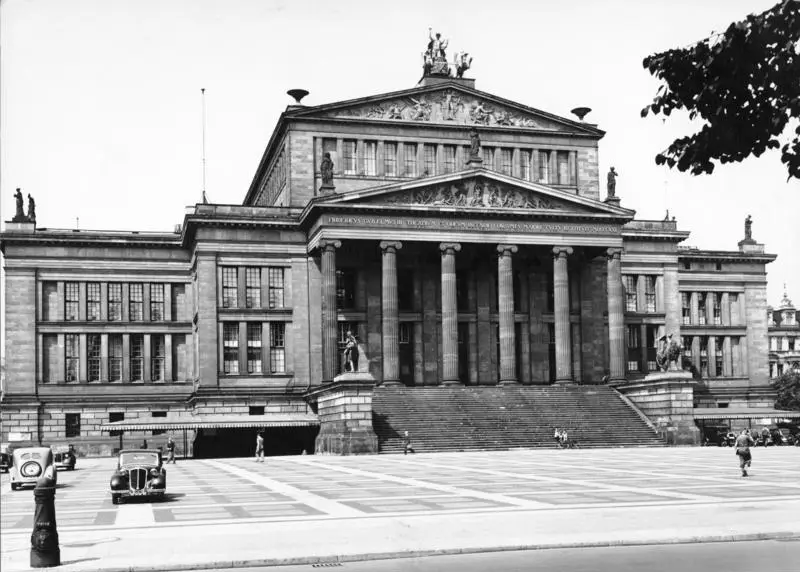
Staatliches Schauspielhaus (now Konzerthaus Berlin)
Gendarmenmarkt, 10117 Berlin
- Then
- The Prussian State Theatre gave the premiere of Hanns Johst’s ‘Schlageter’ here on the evening of Hitler’s birthday, with Goebbels, Frick, Rust and Kerrl in the boxes.3,7
- Today
- Karl Friedrich Schinkel’s theatre of 1818–1821 was destroyed in the Second World War and reopened as a concert hall in 1984; it is now the Konzerthaus Berlin.
More pictures


Sources
- Hamburger Fremdenblatt, 20 April 1933 Deutsche Digitale Bibliothek, Zeitungsportal, p. 1 (Berlin decorations and flag parade; Hindenburg's telegram); p. 2, evening edition (Erkner); p. 3 (Michendorf); Moscow report
- Kölnische Zeitung, 20 April 1933 Deutsche Digitale Bibliothek, Zeitungsportal, Morning edition, p. 2 (Rust's decrees); evening edition, p. 9 (Cologne broadcast), p. 10 (Bavarian law; May Day tickets), p. 11 (Caracciola); Berlin egg market
- Kölnische Zeitung, 21 April 1933 Deutsche Digitale Bibliothek, Zeitungsportal, Morning edition, p. 1 (membership freeze), p. 2 ('Ungeheurer Erfolg des Schauspiels Schlageter'), p. 3 (Lessing and other professors; 'Hitlers Geburtstag im Rundfunk'; Kaas)
- Hamburger Fremdenblatt, 21 April 1933 Deutsche Digitale Bibliothek, Zeitungsportal, Morning edition, p. 1 ('Rom, 20. April': Kaas)
- Hamburger Fremdenblatt, 22 April 1933 Deutsche Digitale Bibliothek, Zeitungsportal, p. 17, picture page: photo caption naming the cast of 'Schlageter'
- Kölnische Zeitung, 24 April 1933 Deutsche Digitale Bibliothek, Zeitungsportal, p. 6, review 'Hanns Johst: Schlageter. Uraufführung im Berliner Staatstheater'
- Konzerthaus Berlin Berliner Bühnen
Spotted a mistake? Send a correction.