Day 53 of 100
The Reichstag passes the Enabling Act; only the Social Democrats vote against
In the Kroll Opera House, ringed by the SS and watched from inside by armed SA men, the Reichstag passed the Enabling Act, giving Hitler’s government the power to make laws without parliament. Otto Wels explained the Social Democrats’ ‘no’; the Centre and the smaller middle parties voted yes. The former Prussian interior minister Karl Severing was arrested on his way into the building, and the Reichsrat gave its consent that evening.
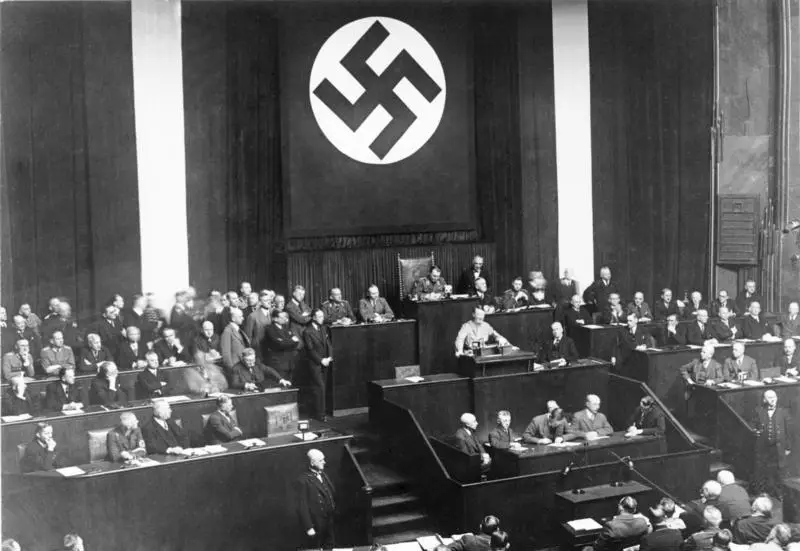

The sitting opened in a building transformed for the purpose: SS men guarded the cordon outside the Kroll Opera House, armed SA men stood inside as ‘hall guards’, and a huge swastika banner hung behind the presidium. Hitler appeared in brown uniform. Before any debate the House adopted the rules change prepared in committee, under which deputies who stayed away without excuse could be counted as present. Twenty-six Social Democratic deputies could not attend because they were in ‘protective custody’ (Schutzhaft, imprisonment without trial) or had fled; one lay in hospital after being beaten by SS and SA men. The 81 Communist deputies were excluded altogether.
In the afternoon Hitler gave a government declaration and asked for the law. He promised to use it only as far as necessary, said that neither the Reichstag nor the Reichsrat would be threatened, that the President’s position, the states and the rights of the churches would remain, and ended by offering the parties a choice between peace and war. The sitting was then adjourned for three hours.
When it resumed, Otto Wels gave the Social Democrats’ reasons for voting no. He said that the elections had given the government parties a majority to govern constitutionally, that never before had parliament’s control been so eliminated, and that no enabling act could destroy ideas that were eternal. Hitler answered at once and sharply. Ludwig Kaas then announced the Centre Party’s support, citing assurances given in preliminary negotiations; the Bavarian People’s Party, the German State Party and the Christian-Social People’s Service followed.
The second and third readings took only minutes. In the roll-call vote the Social Democrats’ 94 votes were the only ones against; all other parties present voted yes, giving far more than the two-thirds majority required. The Reichsrat, whose state governments were already in Nazi hands, met that evening and decided unanimously not to object. The Reichstag had surrendered its power to legislate.
Laws and decrees
Gesetz zur Behebung der Not von Volk und Reich
Law to Remedy the Distress of People and Reich (Enabling Act)
Allowed the Reich government to enact laws, including laws departing from the constitution, budgets and treaties, for four years without the Reichstag or Reichsrat; reserved only the existence of those bodies and the President’s rights.1,2
Politics and power
Government, terror and persecution
-
Parliament afternoon and evening, Berlin, Kroll Opera House
The Enabling Act passes 444 to 94
After the government declaration, a three-hour adjournment and speeches by Wels (SPD), Kaas (Centre), Ritter von Lex (Bavarian People’s Party), Reinhold Maier (German State Party) and Simpfendörfer (Christian-Social People’s Service), the Reichstag passed the ‘Law to Remedy the Distress of People and Reich’ in a roll-call vote. Only the 94 Social Democrats present voted against.1,2,5
Sources disagree. Göring announced 441 votes in favour and 94 against; a later recount found 444 in favour, the figure given by most accounts.
-
Terror Berlin, Kroll Opera House
Intimidation, absences and arrests
The SS guarded the cordon around the building and armed SA men stood in the chamber. Twenty-six Social Democratic deputies were in custody or had fled. The former Prussian interior minister Karl Severing was arrested outside the Kroll Opera as he arrived for the sitting and taken to the Prussian Ministry of the Interior; the Lübeck Social Democratic deputy Leber, already detained once, was also arrested.2,6
-
Opposition
The Communist seats
None of the 81 Communist deputies elected on 5 March took part; many had been arrested or had gone into hiding. Their mandates were treated as void, and counting them would not have changed the outcome: the two-thirds majority would have been reached even if their seats had been included.1,2,5
Sources disagree. LeMO states that the Communist mandates were annulled on 8 March on the basis of the Reichstag Fire Decree; the jurist Hans Schneider argued in 1953 that there was no legal basis for this until the coordination law of 31 March.
-
Parliament evening, Berlin, Reich Ministry of the Interior
Reichsrat consents the same evening
Immediately after the Reichstag sitting, the Reichsrat met in the library of the Reich Ministry of the Interior. Frick, presiding, called it a historic moment; without discussion the members, bound by state governments now under Nazi control, decided unanimously to raise no objection.1
-
Propaganda Berlin-Weissensee
Denial of reports of mutilated bodies at Weissensee
Berlin officials answered reports in the foreign press with a denial: the warden of the Jewish cemetery in Weissensee declared ‘an outrageous lie’ a report in the New York American that mutilated bodies of Jews had been found outside the cemetery on three nights, and the cemetery administration said it knew of no such incidents.7
Everyday life
What else was happening in Germany
-
Crime Berlin
Prosecutor demands twelve years for Hintze
In the Bindernagel manslaughter trial the prosecutor, after a long closing speech, demanded twelve years’ penal servitude and ten years’ loss of civil rights for the banker Wilhelm Hintze.7
-
Transport
Holiday tickets may return to the railways
The Reichsbahn’s administrative council was to meet on 27 and 28 March to discuss reintroducing holiday tickets (Urlaubskarten).7
Voices
Freedom and life can be taken from us, but not our honour. … We German Social Democrats pledge ourselves solemnly in this historic hour to the principles of humanity and justice, of freedom and socialism. No enabling act gives you the power to destroy ideas that are eternal and indestructible.
You think your star could rise again! Gentlemen, Germany’s star will rise and yours will sink.
Elsewhere in the world
-
United States
Jewish war veterans march in New York
About 20,000 Jewish war veterans in New York marched to City Hall to hand the mayor a resolution protesting against the treatment of Jews in Germany.7
In Berlin today


Site of the Kroll Opera House
Platz der Republik, Berlin-Tiergarten
- Then
- The disused opera house a few hundred metres from the burnt-out Reichstag, converted into a provisional chamber, where the Reichstag passed the Enabling Act.3
- Today
- Hit in an air raid in November 1943, the building was largely blown up in March 1951 and its ruins cleared by 1957. Today a memorial stone recalls the building in which parliamentary democracy in Germany ended in 1933.
More pictures

Sources
- Hans Schneider, ‘Das Ermächtigungsgesetz vom 24. März 1933’, Vierteljahrshefte für Zeitgeschichte 1 (1953), Heft 3 Institut für Zeitgeschichte, pp. 204–209: course of the sitting, vote, quorum calculation, Reichsrat session
- 23. März 1933: Reichstag billigt „Ermächtigungsgesetz“ Deutscher Bundestag
- Kroll-Oper Deutscher Bundestag
- Stellungnahme des Abg. Wels (SPD) zum Ermächtigungsgesetz (23.03.1933) documentArchiv.de, Full text; source: Verhandlungen des Reichstags, 8. Wahlperiode 1933, S. 25
- Ermächtigungsgesetz LeMO, Deutsches Historisches Museum
- Sozialdemokrat (Prague), 24 March 1933 Deutsche Digitale Bibliothek, Deutsches Zeitungsportal, p. 1, reports 'Berlin, 23. März': arrests of Severing and Leber; arrest of Gereke
- Der Grafschafter, 24 March 1933 Deutsche Digitale Bibliothek, Deutsches Zeitungsportal, p. 5, reports of 23 March: Weissensee denial; Hintze trial; Reichsbahn holiday tickets; New York veterans' march
Spotted a mistake? Send a correction.