Laws and decrees

Law Reichstag, with the consent of the Reichsrat, as a constitution-amending law

Enabling Act

Gesetz zur Behebung der Not von Volk und Reich

Law to Remedy the Distress of People and Reich

Passed by the Reichstag on 23 March 1933 by 444 votes to 94, with only the Social Democrats voting against and the Communist deputies already excluded, the act let the Reich Government make laws on its own, including budget laws and laws departing from the constitution, and conclude treaties without parliament. The government’s laws were to be engrossed by the Chancellor rather than the President. It was limited to four years and to the ‘present’ government, but was renewed in 1937, 1939 and 1943, and became the legal foundation of the dictatorship.

Dated
Friday 24 March 1933
Published in
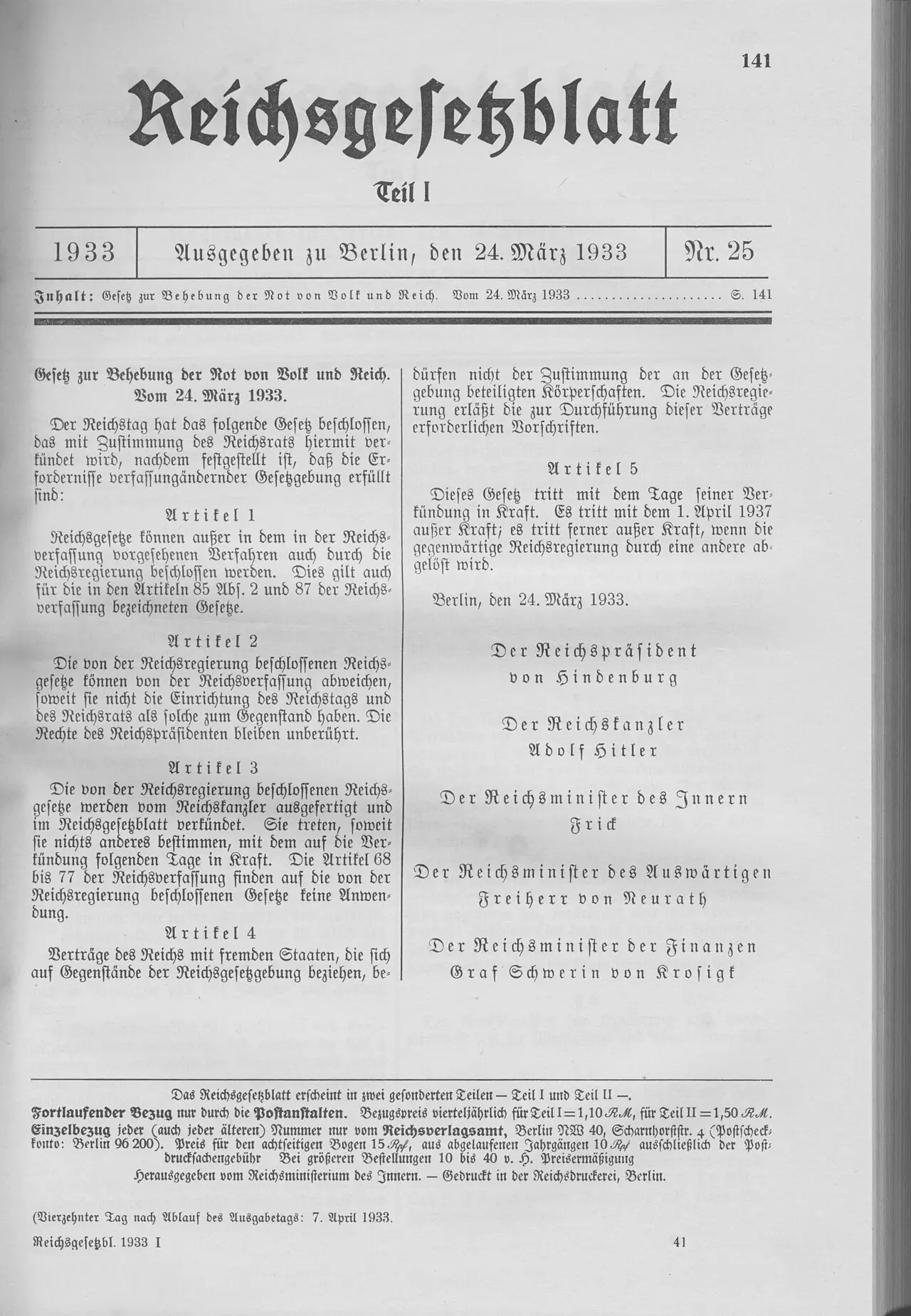
Reichsgesetzblatt Teil I, no. 25, Friday 24 March 1933, p. 141
Citation
RGBl. I S. 141
In force
Friday 24 March 1933
The Reichsgesetzblatt Teil I page on which the measure was published
RGBl. I S. 141. Commons record

The text

Gesetz zur Behebung der Not von Volk und Reich.
Law to Remedy the Distress of People and Reich.
Vom 24. März 1933.
Of 24 March 1933.
Der Reichstag hat das folgende Gesetz beschlossen, das mit Zustimmung des Reichsrats hiermit verkündet wird, nachdem festgestellt ist, daß die Erfordernisse verfassungändernder Gesetzgebung erfüllt sind:
The Reichstag has enacted the following law, which, with the consent of the Reichsrat, is hereby promulgated, it having been established that the requirements of constitution-amending legislation have been met:
Artikel 1 Reichsgesetze können außer in dem in der Reichsverfassung vorgesehenen Verfahren auch durch die Reichsregierung beschlossen werden. Dies gilt auch für die in den Artikeln 85 Abs. 2 und 87 der Reichsverfassung bezeichneten Gesetze.
Artikel 1 Reich laws may be enacted not only by the procedure provided for in the Reich Constitution but also by the Reich Government. This also applies to the laws referred to in Article 85, para. 2, and Article 87 of the Reich Constitution.
Artikel 2 Die von der Reichsregierung beschlossenen Reichsgesetze können von der Reichsverfassung abweichen, soweit sie nicht die Einrichtung des Reichstags und des Reichsrats als solche zum Gegenstand haben. Die Rechte des Reichspräsidenten bleiben unberührt.
Artikel 2 The Reich laws enacted by the Reich Government may depart from the Reich Constitution in so far as they do not have as their object the institution of the Reichstag and the Reichsrat as such. The rights of the Reich President remain unaffected.
Artikel 3 Die von der Reichsregierung beschlossenen Reichsgesetze werden vom Reichskanzler ausgefertigt und im Reichsgesetzblatt verkündet. Sie treten, soweit sie nichts anderes bestimmen, mit dem auf die Verkündung folgenden Tage in Kraft. Die Artikel 68 bis 77 der Reichsverfassung finden auf die von der Reichsregierung beschlossenen Gesetze keine Anwendung.
Artikel 3 The Reich laws enacted by the Reich Government are engrossed by the Reich Chancellor and promulgated in the Reich Law Gazette. Unless they provide otherwise, they come into force on the day following their promulgation. Articles 68 to 77 of the Reich Constitution do not apply to the laws enacted by the Reich Government.
Artikel 4 Verträge des Reichs mit fremden Staaten, die sich auf Gegenstände der Reichsgesetzgebung beziehen, bedürfen nicht der Zustimmung der an der Gesetzgebung beteiligten Körperschaften. Die Reichsregierung erläßt die zur Durchführung dieser Verträge erforderlichen Vorschriften.
Artikel 4 Treaties of the Reich with foreign states that relate to matters of Reich legislation do not require the consent of the bodies taking part in legislation. The Reich Government issues the provisions necessary to implement these treaties.
Artikel 5 Dieses Gesetz tritt mit dem Tage seiner Verkündung in Kraft. Es tritt mit dem 1. April 1937 außer Kraft; es tritt ferner außer Kraft, wenn die gegenwärtige Reichsregierung durch eine andere abgelöst wird.
Artikel 5 This law comes into force on the day of its promulgation. It ceases to be in force on 1 April 1937; it further ceases to be in force if the present Reich Government is replaced by another.
Berlin, den 24. März 1933.
Berlin, 24 March 1933.
Der Reichspräsident von Hindenburg
The Reich President von Hindenburg
Der Reichskanzler Adolf Hitler
The Reich Chancellor Adolf Hitler
Der Reichsminister des Innern Frick
The Reich Minister of the Interior Frick
Der Reichsminister des Auswärtigen Freiherr von Neurath
The Reich Minister for Foreign Affairs Baron von Neurath
Der Reichsminister der Finanzen Graf Schwerin von Krosigk
The Reich Minister of Finance Count Schwerin von Krosigk

About this text

The full text is given. Transcribed from the RGBl. scan (issue 25, p. 141; the whole issue is this one page); compared word by word with German Wikisource, which agrees with the gazette, and with documentArchiv.de, which modernises two words (‘verfassungsändernder’ for the gazette’s ‘verfassungändernder’ in the preamble, ‘Reiches’ for ‘Reichs’ in Article 4); the gazette’s forms are kept.

The English translation was made for this site and is not an official translation. ‘Ausgefertigt’ is rendered as ‘engrossed’: the formal signing of the authentic text that, under Article 70 of the constitution, had been the Reich President’s task. ‘Gegenwärtige Reichsregierung’ is translated literally as ‘the present Reich Government’.

German laws and decrees are official works and not protected by copyright (§ 5 UrhG).

Terms

verfassungändernde Gesetzgebung
Under Article 76 of the Weimar constitution, a law amending the constitution needed two-thirds of the Reichstag’s members to be present and two-thirds of those present to vote for it. The Reichstag had changed its standing orders so that deputies absent without excuse counted as present, so that the arrested and fugitive Communist and Social Democratic deputies could not defeat the quorum.
Artikel 85 Abs. 2 und 87
The constitution’s provisions on the budget law and on borrowing: Article 1 let the government pass the Reich budget and raise loans without the Reichstag.
Artikel 68 bis 77
The constitution’s articles on the ordinary legislative procedure: introduction of bills, the Reichsrat’s right of objection, the President’s engrossment and promulgation, referendums, and the rules for amending the constitution.
Reichsrat
The chamber representing the state governments in Reich legislation.
gegenwärtige Reichsregierung
The cabinet of 30 January 1933: Hitler with a majority of conservative ministers. The clause was meant as a safeguard for them, but it was not invoked when the cabinet’s composition changed; the act was instead extended by the Reichstag in 1937 and 1939 and by decree in 1943.

Sources

  1. Reichsgesetzblatt 1933 Teil I, Nr. 25 (24. März 1933), S. 141 (Reichsministerium des Innern; scan on Wikimedia Commons)
  2. Ermächtigungsgesetz (transcription) (Wikisource (German))
  3. Gesetz zur Behebung der Not von Volk und Reich (transcription) (documentArchiv.de)

Gazette scans: public domain, via Wikimedia Commons.