Day 54 of 100
Hindenburg signs the Enabling Act; it is published and takes effect the same day
Hindenburg signed the ‘Law to Remedy the Distress of People and Reich’, countersigned by Hitler, Frick, Neurath and Schwerin von Krosigk; it was printed in the Reichsgesetzblatt that evening and came into force on promulgation. The Centralverein, the largest Jewish organisation, denied foreign atrocity reports while acknowledging ‘political excesses’ against Jews. Labour exchanges counted about 5.9 million unemployed, and a Berlin jury sentenced the banker Hintze to twelve years for killing the singer Gertrud Bindernagel.
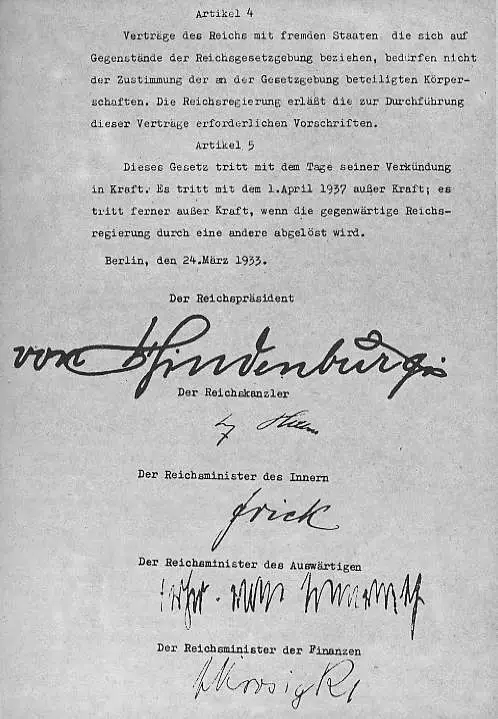

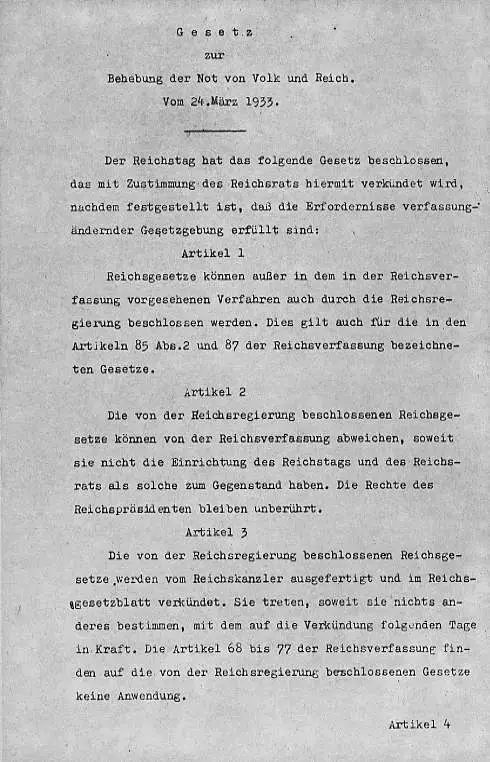
Passed by the Reichstag and approved by the Reichsrat on 23 March, the Enabling Act was signed by the Reich President on the morning of Friday 24 March, after the Chancellor and the ministers Frick, von Neurath and Schwerin von Krosigk had countersigned it. A news agency reported that it was printed late that evening; it was the sole content of number 25 of the Reichsgesetzblatt, and under its own Article 5 it took effect on the day of promulgation. The constitutional lawyer Hans Schneider later observed that no law had ever passed through the Weimar procedure for constitutional amendments so quickly.
The Act was limited to four years and was to lapse on 1 April 1937, or earlier if the present government were replaced by another. It did not lapse: the Reichstag extended it in January 1937 and again in January 1939, and in May 1943 a decree issued by Hitler simply directed the government to go on exercising the powers it conferred.
Laws and decrees
Gesetz zur Behebung der Not von Volk und Reich
Law to Remedy the Distress of People and Reich (Enabling Act)
Allowed the Reich government for four years to enact laws itself, including the budget and laws departing from the constitution, and to conclude treaties without the consent of the legislative bodies.1,2
Gesetz zur Behebung der Not von Volk und Reich
Law to Remedy the Distress of People and Reich (Enabling Act)
Promulgated in the Reichsgesetzblatt on the day of signing and in force from that day; due to expire on 1 April 1937 or on a change of government, but extended in 1937, 1939 and 1943.1,2,3
Zweite Verordnung des Reichspräsidenten zur Förderung der Verwendung inländischer tierischer Fette und inländischer Futtermittel
Second Reich President's decree to promote the use of domestic animal fats and fodder
Published with decrees of 23 March on margarine manufacture and on customs: the duty on margarine rose from 30 to 75 Reichsmarks per 100 kilograms from 29 March, and oil fruits, oilseeds and oil cake were brought into the maize monopoly.3,7
Politics and power
Government, terror and persecution
-
Government Berlin
Enabling Act signed, published and in force
After countersignature by Hitler and the ministers Frick, von Neurath and Graf Schwerin von Krosigk, Hindenburg signed the Enabling Act on Friday morning. It was promulgated the same day in the Reichsgesetzblatt and, under its Article 5, took effect on promulgation.1,2,3,4
-
Parliament 16:45, Berlin, Tempelhof
Hindenburg receives the Reichstag presidium; Hitler flies to Munich
The Reich President received the newly elected Reichstag presidium: President Göring and the vice-presidents Esser, Gräf and Zörner. At 16:45 Hitler took off from Tempelhof airport in a Junkers aircraft for Munich, accompanied by the Nazi Party’s press chief, Dr Dietrich.5
-
Opposition Berlin
Severing released
The former Prussian interior minister Carl Severing, the Social Democrat detained outside the Reichstag on 23 March, was set free but ordered to remain at the authorities’ disposal. Informed quarters insisted that his arrest, like those of the former minister Hermes and of the Reich Commissioner for job creation, Günther Gereke, had criminal rather than political grounds.5,6,7
Sources disagree. A wire report datelined Berlin, 24 March, says he was released that day; another report says he was held for only a few hours on 23 March and was able to take part in the vote.
-
Persecution Berlin
Jewish organisations deny foreign atrocity reports
The Central Association of German Citizens of Jewish Faith (Centralverein), which described itself as the largest organisation of Germany’s 565,000 Jews, declared foreign reports of mutilated bodies at the Weissensee cemetery and of mass mistreatment to be invented, while acknowledging ‘political excesses’ against Jews during the upheaval. The League of National German Jews told its members to oppose any attempt to influence German affairs from abroad.6,7
-
The states Breslau
Mayors of Breslau and Waldenburg suspended
On orders of the Prussian Interior Minister, the district president in Breslau suspended the city’s lord mayor, Dr Wagner of the State Party, and put the lawyer Dr Rebitzki, a Nazi Party member, in charge; the ministry insisted the step was taken purely for reasons of expediency. Mayor Schubert of Waldenburg was also suspended. In Berlin, Flügel stepped down as chairman of the German Civil Servants’ Federation, at his own request.4
Everyday life
What else was happening in Germany
-
Economy
Just under six million registered unemployed
The Reich Institution for Labour Exchanges reported that seasonal relief had continued in the first half of March: on 15 March about 5,935,000 unemployed were registered. Recipients of unemployment insurance fell by about 84,000 to 858,000, but the number on crisis relief rose to about 1,535,000.8
-
Crime Berlin
Twelve years for Hintze
The jury court at Landgericht III sentenced the banker Wilhelm Hintze, who had shot his wife, the opera singer Gertrud Bindernagel, on 23 October 1932, to twelve years’ penal servitude and ten years’ loss of civil rights for manslaughter, as the prosecutor had asked.9
-
Radio Berlin
Dismissed radio engineer and his wife found dead
Walter Schäffer, chief engineer of the Reich Radio Company until his dismissal about two weeks earlier, and his wife took their lives with gas in Berlin. Grief at the loss of his post and nervous strain were reported as the reasons.10
-
Economy
Margarine to cost more
The new fats decrees raised the duty on margarine and gave the government powers over its manufacture, including the use of colouring, butter flavouring and preservatives and compulsory labelling of raw materials, as well as powers to require domestic tallow in soap and candles.7
Voices
All such allegations are pure invention. … For weeks the German people has been undergoing a political upheaval of enormous scale. In the course of it there have also been political excesses against Jews.
More pictures

Sources
- Gesetz zur Behebung der Not von Volk und Reich (24.03.1933) documentArchiv.de, Full text, signatories, note on promulgation and on the extensions (RGBl. 1937 I S. 105, 1939 I S. 95, 1943 I S. 295)
- Hans Schneider, ‘Das Ermächtigungsgesetz vom 24. März 1933’, Vierteljahrshefte für Zeitgeschichte 1 (1953), Heft 3 Institut für Zeitgeschichte, Section II.6 (signature and promulgation) and III.5 (time limit and extensions)
- Deutscher Reichsanzeiger und Preußischer Staatsanzeiger, 27 March 1933 Deutsche Digitale Bibliothek, Deutsches Zeitungsportal, p. 1, Reichsverlagsamt notices: RGBl. I Nr. 25 and Nr. 26, both issued 24 March 1933
- Solinger Tageblatt, 25 March 1933 Deutsche Digitale Bibliothek, Deutsches Zeitungsportal, p. 4: 'Ermächtigungsgesetz in Kraft'; mayors of Breslau and Waldenburg suspended; chairman of the Beamtenbund resigns
- Marbacher Zeitung, 25 March 1933 Deutsche Digitale Bibliothek, Deutsches Zeitungsportal, p. 2, 'Berlin, 24. März': Reichstag presidium received; Hitler flies to Munich
- Bergedorfer Zeitung, 25 March 1933 Deutsche Digitale Bibliothek, Deutsches Zeitungsportal, p. 5, 'Der Zentralverein gegen ausländische Greuelmeldungen' (Berlin, 24 March)
- Erzgebirgischer Volksfreund, 25 March 1933 Deutsche Digitale Bibliothek, Deutsches Zeitungsportal, p. 2: circular of the Verband nationaldeutscher Juden; margarine duty and fats decrees (Berlin, 24 March)
- Verbo Schussen-Bote, 24 March 1933 Deutsche Digitale Bibliothek, Deutsches Zeitungsportal, p. 6, report of the Reichsanstalt für Arbeitsvermittlung for 1-15 March 1933
- NS-Kurier (Stuttgart), 24 March 1933 Deutsche Digitale Bibliothek, Deutsches Zeitungsportal, p. 3, 'Zuchthaus für Bankier Hintze' (Berlin, 24 March)
- Riesaer Tageblatt und Anzeiger, 24 March 1933 Deutsche Digitale Bibliothek, Deutsches Zeitungsportal, p. 7, death of Walter Schäffer, former chief engineer of the Reichs-Rundfunk-Gesellschaft
Spotted a mistake? Send a correction.