Day 92 of 100
The “Day of National Labour”: Hitler addresses a vast crowd on the Tempelhofer Feld
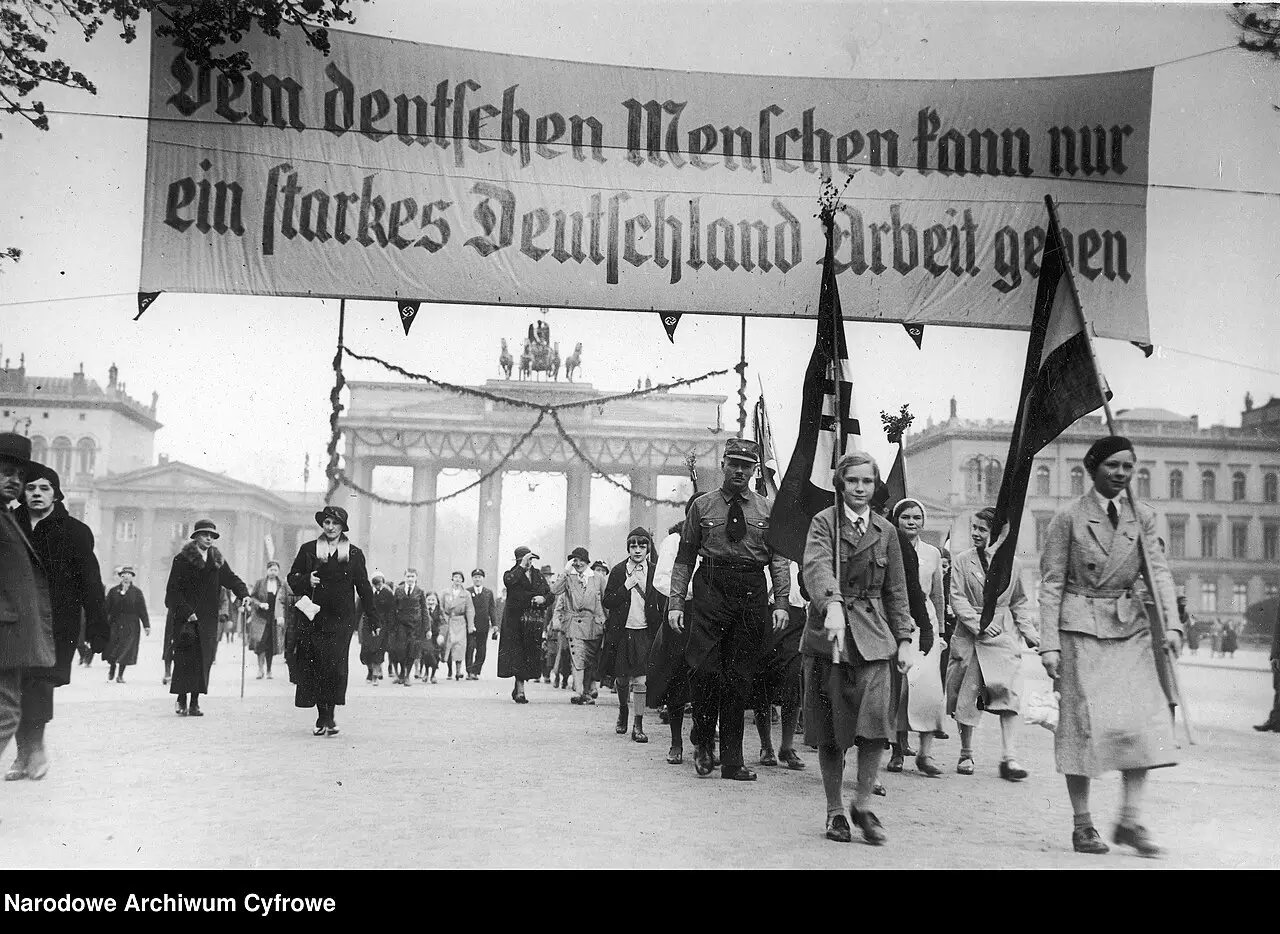
For the first time 1 May was a paid public holiday, renamed by the regime the “Day of National Labour”. Hindenburg spoke to schoolchildren and youth groups in the Lustgarten, workers’ delegations flown in from across Germany and Austria were received at the Reich Chancellery, and in the evening Hitler announced compulsory labour service to a crowd on the Tempelhofer Feld put at one to one and a half million. Fireworks, a torchlight march and Göring’s midnight speech in the Lustgarten closed a day of spring sunshine, while Robert Ley’s committee prepared the next morning’s seizure of the trade unions.
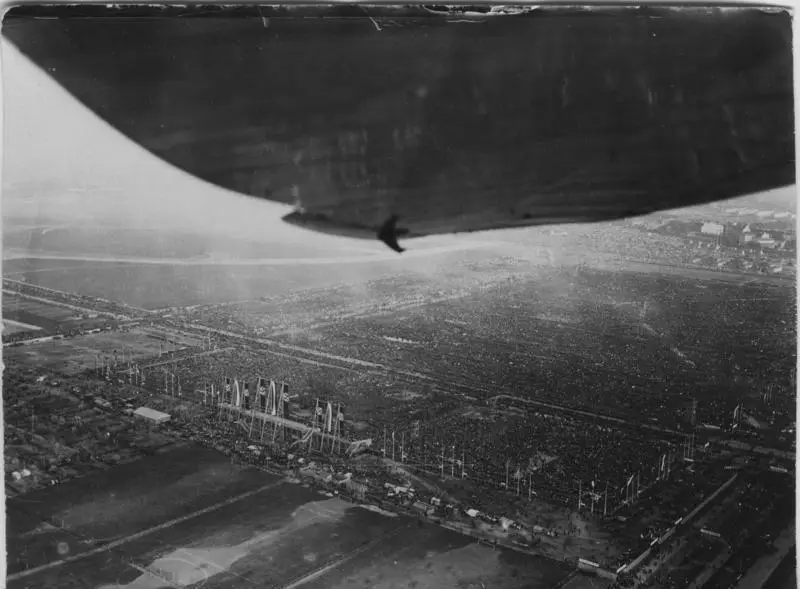

May Day had been the holiday of the international labour movement since 1889, and the unions had long wanted it as a paid public holiday. A law of 10 April made 1 May the “Holiday of National Labour”, to be treated like New Year’s Day, and the regime turned it into a celebration of the Nazi “national community” (Volksgemeinschaft). Hoping to be accepted as a legitimate workers’ representation, the leadership of the General German Trade Union Federation (ADGB) took part in the celebrations, and hundreds of thousands of workers joined the marches across the Reich.
In Berlin the workforces had to assemble at their factories in the morning and march in columns, with SA, SS and army formations, to the Tempelhofer Feld, where Albert Speer had designed a vast tribune for the leadership. The day was organised by Goebbels’s propaganda ministry. It was the prelude to a long-prepared act of force: the next morning the trade union buildings across Germany were occupied and their leaders arrested.
Politics and power
Government, terror and persecution
-
Propaganda morning, Berlin, Lustgarten
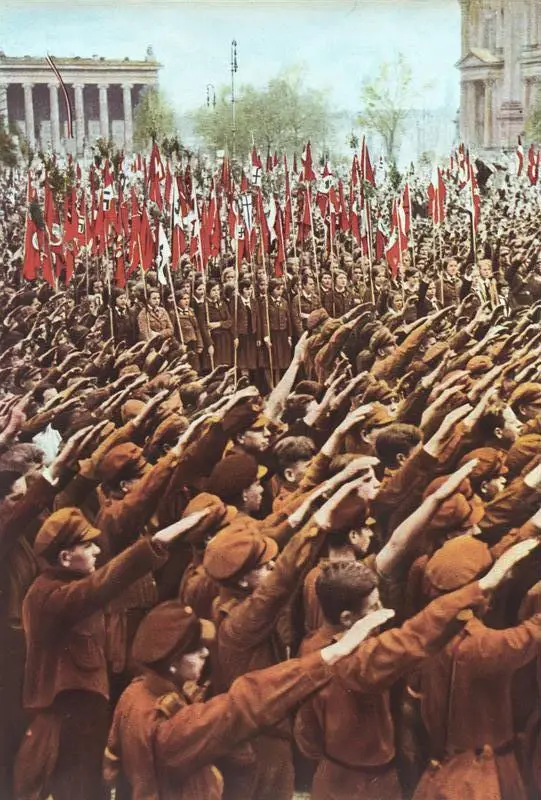
Hindenburg speaks to the youth in the Lustgarten
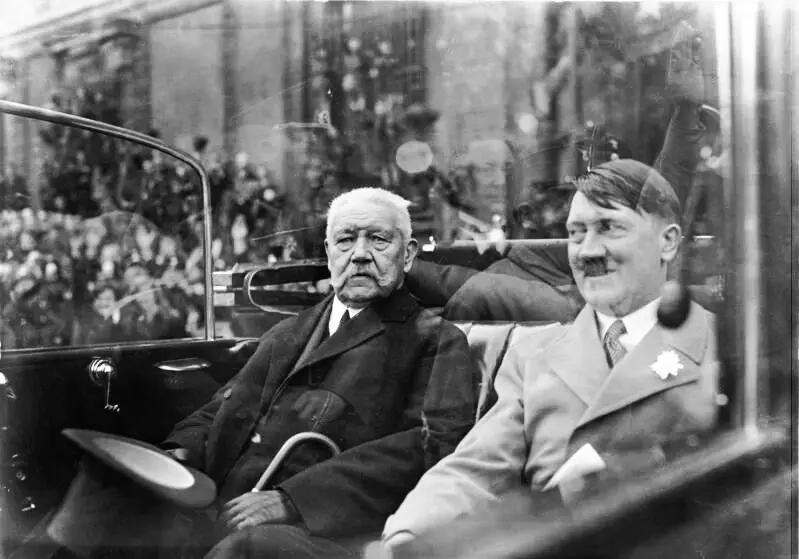
The first event of the day, staged at Hindenburg’s own wish, was a youth rally in the Lustgarten. The President addressed the assembled young people through the microphone, and he and Hitler then drove off to the strains of the presentation march. The press spoke of 100,000 children.2
-
Propaganda 17:30, Berlin, Reich Chancellery
Workers flown in as guests of honour
Seventy German and sixteen Austrian workers, brought to Berlin in ten large aircraft, were the official guests of honour. At 17:30 they assembled in the Reich Chancellery, where Hitler spoke and Hindenburg had each delegate presented to him and shook his hand.2,3
-
Propaganda 20:00, Berlin, Tempelhofer Feld
Hitler’s speech on the Tempelhofer Feld
At 20:00 the floodlights came on over the tribune and the crowd. Hitler announced compulsory labour service, through which every German was to learn that manual work was no disgrace, spoke of road-building and job creation, and closed with words in the form of a prayer. A fireworks display followed, then a torchlight march of uniformed formations to the Lustgarten.2,3,4
Sources disagree. Contemporary papers put the crowd at about one million (Kölnische Zeitung) or one and a half million (Hamburger Fremdenblatt); these were estimates, and no independent count exists.
-
Propaganda midnight, Berlin, Lustgarten
Göring speaks at midnight
At the end of the torchlight march, made up only of uniformed units such as the army, police, SA and Stahlhelm, Göring spoke in the Lustgarten at midnight on behalf of the Prussian government, declaring that “fourteen years of disgrace” were over and calling on everyone to “work, fight and believe”.2
-
Opposition overnight, Bernau bei Berlin
Red flag on Bernau’s church tower
During the night before 1 May someone fixed a red flag with hammer and sickle to the top of the tower of the Marienkirche in Bernau, north-east of Berlin, and stole the swastika flag meant for the town hall. SA men took the red flag down in the early morning. The next night SA and police arrested forty “suspects” and took them to a concentration camp.8
Everyday life
What else was happening in Germany
-
Weather Berlin
A radiant spring day
After Sunday’s showers, 1 May dawned as a bright spring day in Berlin, under a lightly clouded sky; the city was hung with flags and green garlands.6,2
-
Transport 14:00, Berlin
The Graf Zeppelin over Berlin
Around 14:00 the airship Graf Zeppelin, on a flight across Germany under Dr Eckener, circled over the city and the Tempelhofer Feld, watched by hundreds of thousands already gathered there.2
-
Radio
Moscow jams the broadcast
The whole Berlin celebration was broadcast on every German station. Reception of the Deutschlandsender was disturbed by the new Moscow transmitter, at 300 kilowatts said to be the strongest in the world, which broadcast in German over the relay and played Russian military marches and the Internationale during Hitler’s speech.7
-
Society Berlin, Tempelhofer Feld
First aid on the field
First-aid posts on the Tempelhofer Feld treated many people in the crowd; about 200 were taken to hospital, most of whom were soon discharged. No serious accidents were reported.8
Voices
…to educate the German people, through compulsory labour service, to understand that manual work does not disgrace, does not dishonour, but brings honour, like any other work, to whoever does it faithfully and honestly.
In Berlin today
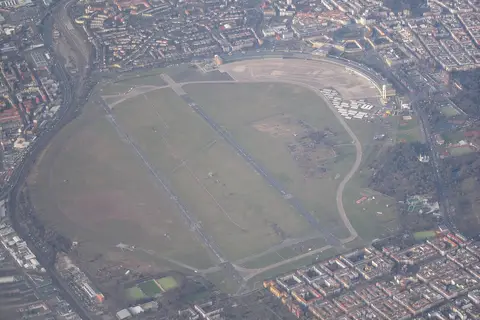

Tempelhofer Feld
Tempelhofer Feld, 12101 Berlin-Tempelhof
- Then
- On the evening of 1 May 1933 the regime staged its mass rally for the “Day of National Labour” here, with Hitler speaking from a tribune designed by Albert Speer near the old parade-ground poplar.4
- Today
- The former airfield is an open park. Panel 18 of the information trail on the history of the Tempelhofer Feld, “Massenkundgebung”, stands close to where the tribune was, and describes the rally as the propaganda prelude to the destruction of the unions the next day.
_%2B_Lustgarten,_2024_(01).jpg)
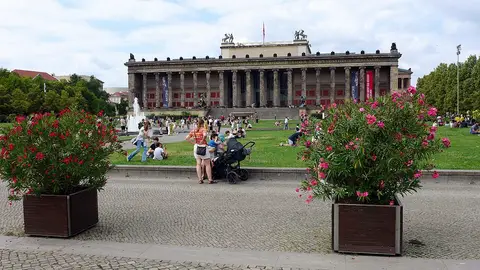
Lustgarten
Am Lustgarten, 10178 Berlin-Mitte
- Then
- In the morning Hindenburg addressed the youth rally here; at midnight Göring spoke at the end of the torchlight march from the Tempelhofer Feld.5
- Today
- Still a garden in 1933, the Lustgarten was paved as a parade ground in 1935 and stayed so until 1998. The present lawns, by the garden architect Hans Loidl, reinterpret Schinkel’s layout in front of the Altes Museum.
More pictures


_NAC_PD.jpg)
Sources
- LeMO: Zerschlagung der Gewerkschaften Deutsches Historisches Museum
- Kölnische Zeitung, 2 May 1933 Deutsche Digitale Bibliothek, Zeitungsportal, pp. 1–5: Hitler's speech, "Hindenburg spricht zur deutschen Jugend", reception of the workers' delegations, the rally, fireworks, "Nächtliche Kundgebung im Berliner Lustgarten"
- Hamburger Fremdenblatt, Reichsausgabe, 2 May 1933 Deutsche Digitale Bibliothek, Zeitungsportal, p. 1, "Anderthalb Millionen auf dem Tempelhofer Feld"; p. 3, reception of the delegations (Wolff)
- Gedenktafeln in Berlin: Massenkundgebung (Informationspfad Tempelhofer Feld 18) Aktives Museum Faschismus und Widerstand in Berlin, Gedenkstätte Deutscher Widerstand, Holger Hübner
- Denkmaldatenbank: Lustgarten Landesdenkmalamt Berlin
- Dresdner Nachrichten, early edition, 2 May 1933 Deutsche Digitale Bibliothek, Zeitungsportal, p. 2, report from Berlin, 1 May
- Erzgebirgischer Volksfreund, 3 May 1933 Deutsche Digitale Bibliothek, Zeitungsportal, p. 2, "Moskauer Sender wollte stören"
- Hamburgischer Correspondent, 3 May 1933 Deutsche Digitale Bibliothek, Zeitungsportal, p. 2, "Die Arbeit der Rettungsstationen"; p. 5, "Kommunistische Provokation" (Bernau)
- Gesetz über die Einführung eines Feiertags der nationalen Arbeit vom 10. April 1933 documentArchiv.de
Spotted a mistake? Send a correction.