Day 41 of 100
Cabinet agrees a propaganda ministry; SA drive Jewish lawyers from Breslau’s courts
At Hitler’s insistence the cabinet agreed to create a Reich Ministry for Popular Enlightenment and Propaganda, expected to go to Goebbels. On the eve of Remembrance Day and the Prussian local elections, SA men and crowds forced department stores and chain stores to close in Hamburg, Breslau, Frankfurt and other cities, and in Breslau SA men ordered Jewish judges and lawyers out of the courts. Magdeburg’s mayor and union leaders in Bochum were taken into ‘protective custody’ (Schutzhaft, imprisonment without trial). Hitler spoke at a rally broadcast from Berlin, and in Cologne a play about front-line soldiers had its first local performance.

Saturday 11 March, the eve of Remembrance Day and of the Prussian municipal elections, brought actions against department stores, chain stores and Jewish businesses in many cities, a day after Hitler had publicly told the SA to stop disrupting business. In Hamburg the police answered not by protecting the shops but by ordering them all shut ‘in the interest of public security and order’, while in Dresden the police had them reopened. In Berlin the cabinet, at Hitler’s urging and over Hugenberg’s wish for more time, agreed to set up a propaganda ministry, the office Goebbels had long expected. In a letter to Papen that the editors of the Reich Chancellery files date to this day, Hitler rejected conservative complaints about SA excesses outright and declared that he would carry on the fight to destroy Marxism.
Politics and power
Government, terror and persecution
-
Government 17:00, Berlin, Reich Chancellery
The cabinet agrees to a propaganda ministry
At a ministers’ meeting at 17:00 Hitler argued for a Reich Ministry for Popular Enlightenment and Propaganda that would unite scattered offices and, above all, prepare the public for important government measures, citing the planned support for farmers in the fats question. Press chief Funk was to become its state secretary; costs would be small, and an advertising monopoly might even bring a surplus. Hugenberg asked for a postponement, but Hitler insisted that the work had to begin before the Reichstag opened, saying the existing Reich Centre for Home Service had failed completely, and the cabinet agreed. The press expected Goebbels to be appointed early in the week and the ministry to move into the Reich Press Office’s rooms in the Prinz-Friedrich-Leopold-Palais on Wilhelmplatz. Hitler also read out Hindenburg’s flag decree, to be announced next day, and Göring proposed a new amnesty that would also benefit Nazis in prison.1,4
-
Persecution 10:30 onwards, Hamburg; Breslau; Frankfurt am Main; Dresden; Gotha
Department stores forced to close
In Hamburg at about 10:30 some 20 SA men blocked the entrances of the Karstadt store in Mönckebergstrasse and raised the swastika on its roof; once the police had been told, SA-Oberführer Böckenhauer withdrew them, and the store reopened before closing again at noon of its own accord. As crowds took up a threatening stance outside other stores, the police ordered every department store and chain store in the city to close for the day. In Breslau a number of department stores and Jewish shops, among them Wertheim, Tietz and the Ehape chain store, were shut at midday while SA men told the public not to buy in department stores; in Frankfurt SA groups cordoned off the department stores, which then closed. In Dresden the police, after consulting higher authority, insisted that chain stores closed that morning be allowed to reopen. In Gotha a group smashed the stock of the Woolworth store; according to the first official findings, they were Communists posing as Nazis.3,5,6,7
-
Persecution Breslau
Jewish judges and lawyers driven from the Breslau courts
SA men entered the regional and district courts in Breslau and demanded that the Jewish judges and lawyers leave the building. They did so; after a while the police occupied the courts and the SA withdrew. An SA detachment also occupied the Breslau produce exchange while its board was fixing the official prices, searched those present for weapons and ordered them out, so that no official quotations were published.5,6
-
Terror Magdeburg; Bochum; Aachen
Magdeburg’s mayor and Ruhr union leaders in custody
At midday an SA detachment came to Magdeburg town hall and told Mayor Reuter to give up his office and follow them; as he left with them, a police squad took him into ‘protective custody’, together with the deputy mayor Goldschmidt. In Bochum SA men had occupied the trade union house and the offices of the metalworkers’ and miners’ unions during the night; the miners’ leader and Social Democratic Reichstag deputy Husemann and several other union officials were taken into ‘protective custody’, and the miners’ union telegraphed protests to the Reich interior minister, Papen and Hindenburg. In Aachen SA men occupied the offices of the Centre party paper Der Volksfreund.3,5
-
The states Karlsruhe; Lübeck; Berlin
Commissioners take over in Baden and Lübeck
In Karlsruhe the Reich commissioner Wagner put commissioners in charge of the Baden ministries, among them the Landtag deputy Walter Köhler for finance, the Reichstag deputy Rupp for justice and the newspaper editor Otto Wacker for education, and State President Schmitt was taken into ‘protective custody’. In Lübeck the Reich took over the powers of the highest state authority, entrusted to the syndic Völtzer, who that evening removed Senator Geister from office. Göring formally summoned the new Reichstag to meet at the Kroll Opera at 17:00 on 21 March, after the morning services in Potsdam, and the Prussian Landtag was called for 22 March.3,4,5,6
-
Propaganda evening, Berlin
Hitler at the Kaiserdamm, and a letter to Papen
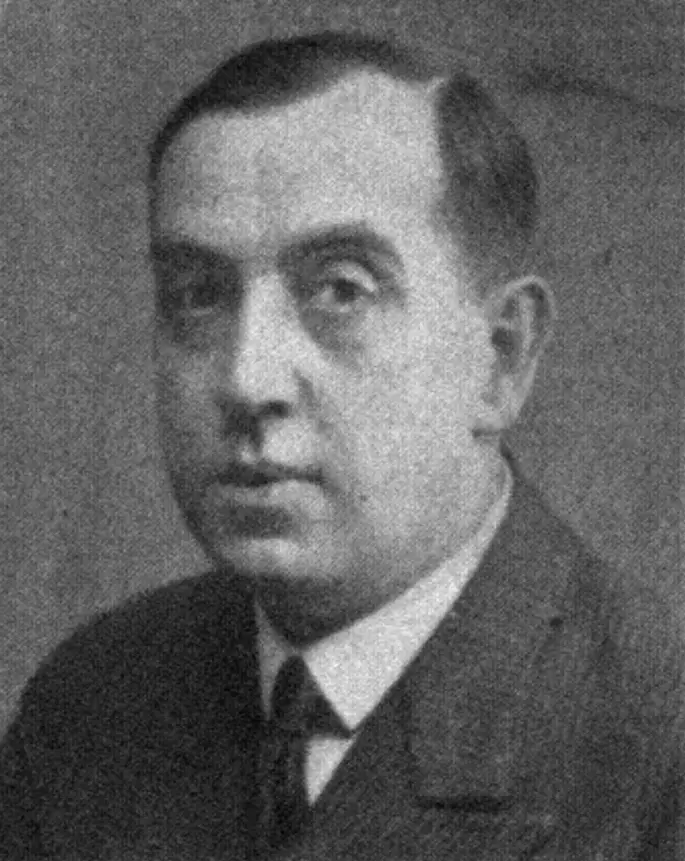
In the evening Hitler addressed a Nazi rally in the exhibition halls at Kaiserdamm in Berlin before Sunday’s local elections, broadcast on most German stations after an introduction by Goebbels, who called it the largest indoor rally the capital had ever seen and claimed that nothing was more lawful than the new state. Hitler claimed that Germany’s fate had now been settled for good. In an undated letter to Papen, answering his complaint that SA men had stopped foreign cars, threatened diplomats’ wives and torn flags from their cars, Hitler insisted that SA men had in fact prevented worse, that a ‘systematic barrage’ of complaints aimed to halt the ‘national uprising’, and that he would not be turned from destroying Marxism.2,4,5,6
Sources disagree. The letter to Papen is undated; the editors of the Reich Chancellery files date it 11 March because it refers to an incident of 10 March as ‘yesterday’. The SA’s own report blamed ‘wild civilians’; a Foreign Office note said a young SA man tore the flag from the Romanian envoy’s car.
Everyday life
What else was happening in Germany
-
Press Berlin
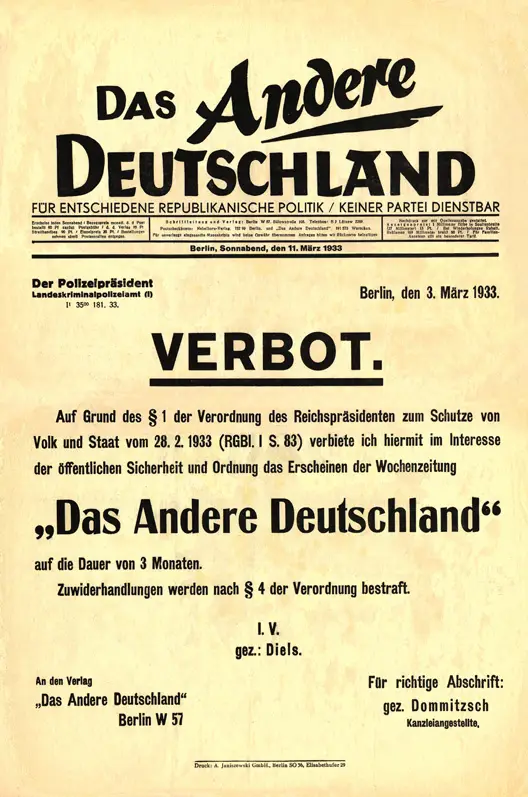
Das Andere Deutschland prints its own ban
The republican weekly Das Andere Deutschland (‘The Other Germany’) appeared with an issue dated Saturday 11 March whose front page carried only the Berlin police president’s order of 3 March, signed for him by Diels, banning the paper for three months under the Reichstag Fire Decree. In Berlin the police president cut short the ban on the Berliner Tageblatt, which was allowed to appear again from the next day.9,3
-
Theatre evening, Cologne, Schauspielhaus
Die endlose Straße in Cologne
On the eve of Remembrance Day the Cologne Schauspielhaus gave the first local performance of Die endlose Straße (The Endless Road), a front-line play in four scenes by Sigmund Graff and Carl Ernst Hintze, two former soldiers who wrote it in 1926. Its preface declared that the company was its hero. The play had come to the German stage by way of a successful London translation, with its German premiere in Aachen and productions in Weimar and, in February 1932, Berlin.8
-
Sport Berlin, Sportpalast
Ice hockey jubilee at the Sportpalast
For its 40th anniversary the Berliner Schlittschuhclub brought to the Sportpalast the new world champions, the Massachusetts Rangers of the United States, the Canadian team Toronto Nationals and Sweden, the 1932 European champions. Before a well-filled house the Canadians beat the Berlin club and the Americans defeated the Swedes.6
-
Economy evening, Hamburg, Uhlenhorster Fährhaus
Hamburg courts East Asia
More than 250 representatives of Hamburg business met in the evening at the Uhlenhorster Fährhaus with guests from the Reich government, the Senate and the consular corps to show the city’s ties with East Asia. Foreign Minister von Neurath, called back to Berlin for the cabinet, had his speech quoted by a Foreign Office official; Hamburg’s new First Mayor Krogmann, in his first speech to such a gathering, assured his audience: ‘I am not a politician, I am a businessman.’3,4
-
Weather
Calm, dry and mild
The Hamburg public weather office reported that a high-pressure area over Europe was giving the whole Reich calm, dry weather, and forecast a bright, dry and very mild Remembrance Sunday with light to moderate easterly winds.4
Voices
I personally of course sincerely regret it when, in the course of such a historic struggle, people not involved, and in yesterday’s case even ladies, suffer unpleasantness. But every war also demands innocent victims.
Elsewhere in the world
-
Switzerland
MacDonald receives Nadolny in Geneva
At the disarmament conference in Geneva the British prime minister MacDonald, after talks with the League of Nations secretary-general Drummond about the Far East, received the German delegate, Ambassador Nadolny, at 18:30 for over an hour, mostly with Foreign Secretary Simon present. No definite plan was put to the German side.4,6
-
United States
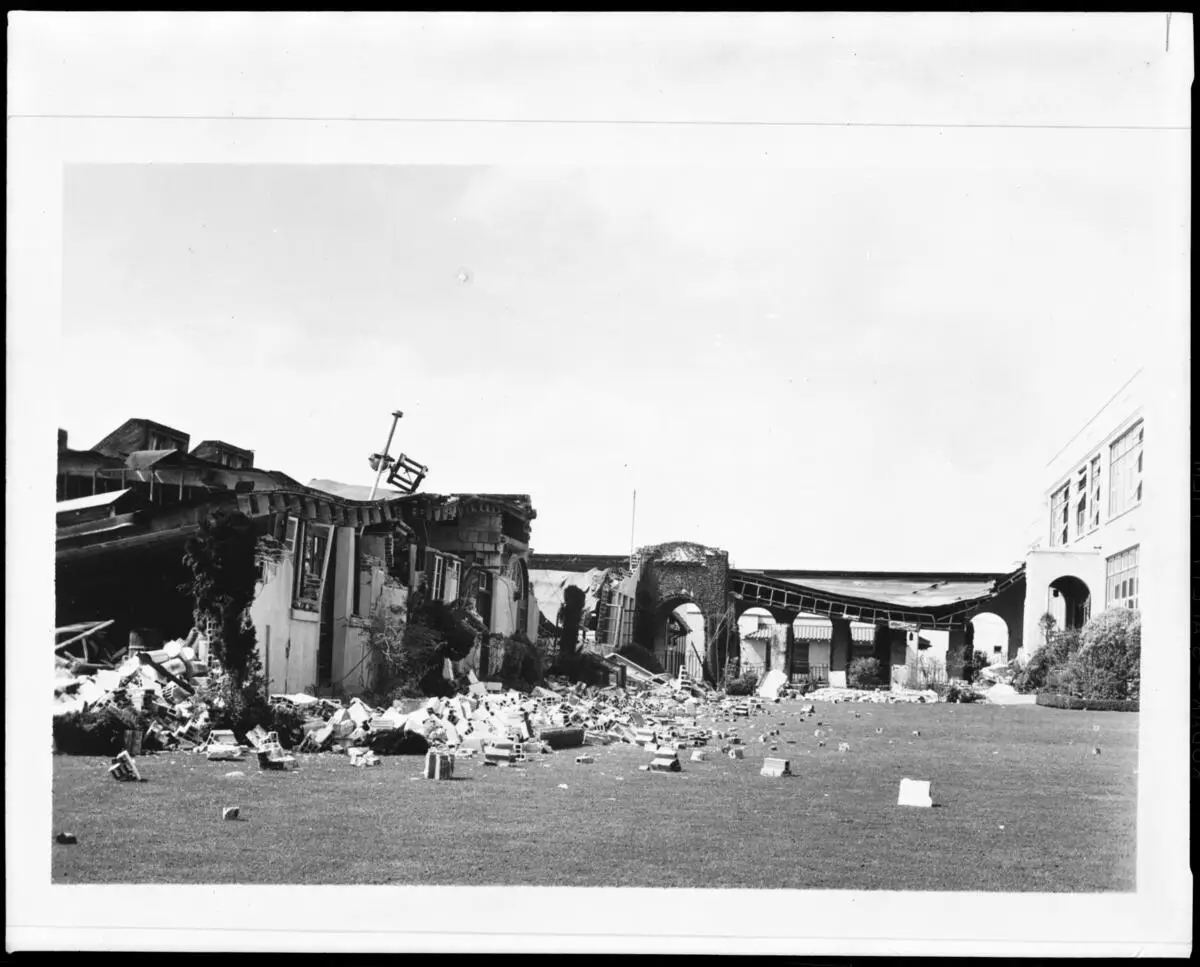
Aftershock at Long Beach
A fresh strong shock brought down many buildings already damaged in the previous evening’s earthquake in Long Beach, California, and almost the whole population was reported to have left the town and to be camping in the surrounding countryside.6
More pictures


Sources
- Akten der Reichskanzlei. Regierung Hitler 1933–1945, Bd. I: Nr. 56, Ministerbesprechung vom 11. März 1933, 17 Uhr Historische Kommission bei der Bayerischen Akademie der Wissenschaften / Bundesarchiv, Band I, pp. 193–197
- Akten der Reichskanzlei. Regierung Hitler 1933–1945, Bd. I: Nr. 58, Der Reichskanzler an den Stellvertreter des Reichskanzlers [11. März 1933] Historische Kommission bei der Bayerischen Akademie der Wissenschaften / Bundesarchiv, Band I, pp. 204–208, with the editors' notes
- Hamburger Fremdenblatt, Reichsausgabe, Nr. 70, 11 March 1933 Deutsche Digitale Bibliothek, Zeitungsportal, p. 1 ('Vorübergehende Geschäftsschließungen'); p. 2 (newspaper occupations and bans; Magdeburg; Neurath; Baden; Reichstag summoned)
- Hamburger Fremdenblatt, Reichsausgabe, Morgen-Ausgabe Nr. 71, 12 March 1933 Deutsche Digitale Bibliothek, Zeitungsportal, pp. 1–2 (propaganda ministry; Lübeck; Hamburg–East Asia; Hitler's speech); p. 3 ('Nadolny bei MacDonald'); p. 6 (weather report of 11 March)
- Hamburgischer Correspondent, Morgenausgabe, 12 March 1933 Deutsche Digitale Bibliothek, Zeitungsportal, p. 2 ('Geschlossene Warenhäuser'; Bochum; Lübeck; Gotha; Hitler's speech)
- Kölnische Zeitung, 12 March 1933 Deutsche Digitale Bibliothek, Zeitungsportal, p. 1 (Geneva; Long Beach); p. 2 (Frankfurt; 'Breslauer Börse von SA. geschlossen'; Prussian Landtag); p. 9 (Kaiserdamm rally); p. 22 (Sportpalast)
- Dresdner neueste Nachrichten, 12 March 1933 Deutsche Digitale Bibliothek, Zeitungsportal, p. 4, 'Gegen eigenmächtige Aktionen'
- Kölnische Zeitung, 13 March 1933 Deutsche Digitale Bibliothek, Zeitungsportal, p. 1, 'Die endlose Straße. Erstaufführung im Kölner Schauspielhaus'
- Das Andere Deutschland, 11 March 1933, front page (scan of the original on Wikimedia Commons) Wikimedia Commons
Spotted a mistake? Send a correction.