Day 100 of 100
Frick tells the states that schools must form “the political human being”
At a meeting of the states’ education ministers in the Reich Interior Ministry, Frick set out the principles of future school policy: schools were to teach race studies, warn against mixing German with “alien”, above all Jewish, blood, and prepare the young for military service. Rust handed sex education back to parents and stopped grants to Jewish trainee teachers. The Berlin guard troops mounted their first guard at the war memorial on Unter den Linden, two convicted murderers were executed at Plötzensee, Joseph Schmidt’s film “Ein Lied geht um die Welt” had its premiere, and from France Klaus Mann wrote to Gottfried Benn.

Frick’s address, which was handed to the press in full, turned Nazi ideology into a school programme. Liberal, individualist education, he said, had spoiled the purpose of schooling at its root; the new school was to start from the idea of community and serve the people as a whole. History lessons were to centre on the World War, the “Versailles dictate” and the “breakthrough” of the Nazi idea, prehistory was to be given more weight, and German script was to take precedence over Latin script. He saw no need to repeal the constitution’s articles on schools formally: where they stood in the way of reform, the necessary steps would be taken case by case.
Politics and power
Government, terror and persecution
-
Government Berlin, Reich Interior Ministry
Frick’s conference of education ministers
Under Frick’s chairmanship the education ministers of the German states met in the Reich Interior Ministry. According to the official communiqué, the discussion that followed his speech showed complete agreement; it dealt above all with applying the law against the overcrowding of schools and universities and with warding off influences “dangerous to the state” on schoolchildren. The Bavarian minister Schemm, as leader of the Nazi Teachers’ League, declared that only the league’s newspaper in Bayreuth spoke for it.1
-
Persecution Berlin
Race studies for the classroom
Frick demanded that biology lessons include race studies. Pupils were to learn to observe racial differences, be shown the “harmful consequences” of racial deterioration and be taught that German blood must be kept from mixing with “alien”, above all Jewish, blood; teaching on “hereditary health” and family research was to follow. Physical training was to include education for military preparedness (Wehrhaftigkeit), and the number of school-leavers and students was to be kept in line with the professions’ needs.1
-
Persecution Berlin
Rust stops grants to Jewish trainee teachers
In a circular the Prussian Minister of Culture, Rust, ordered that further-training grants to Jewish candidates for teaching posts be stopped at once. In a separate decree to the provincial governors as heads of school administration he ruled that sex education could not be given in front of a whole class and was in principle a matter for parents; only where the home failed was a suitable teacher to be called in, with the pupil’s pastor informed.2
-
Military Berlin
Blomberg on conscription and Geneva
Before leaving for Königsberg, Reichswehr Minister von Blomberg told the foreign editor of the WTB news agency that Germany’s stance at the Geneva disarmament conference was widely misunderstood. Universal conscription had served Germany well, he said, both militarily and as a means of educating the people; the “Versailles dictate” had forced a long-service professional army on the British model on Germany, and now the conference wanted to impose a short-service militia based on French proposals.5
-
Propaganda Berlin
Twenty thousand books for the fire
It was announced that the “un-German” books collected by the students, about 20,000 of them, would be burned on the Opernplatz the next day, and that Goebbels would speak.4
-
Propaganda Berlin
Tägliche Rundschau allowed to reappear
The Secret State Police Office lifted its ban on the Berlin daily Tägliche Rundschau with immediate effect, on the strength of a declaration by its editors. Ferdinand Fried took over as editor-in-chief from F. W. von Oertzen.5
-
Terror Warnemünde
Norwegian correspondent arrested
It was reported from Berlin that Olaf Larsen, a Social Democrat and correspondent for Norwegian newspapers in Germany, had been arrested in Warnemünde. According to the report he had published “atrocity stories” in the Norwegian press.4
-
Propaganda Berlin
Rosa Luxemburg’s library “found”
The Nazi factory-cell organisation’s commissioner for the ADGB company “Büropa GmbH” announced that sixteen crates holding Rosa Luxemburg’s books had been found in its cellar, among them her party membership book and books with personal dedications from Kautsky and others. The report used the find to disparage her in antisemitic terms.3
Everyday life
What else was happening in Germany
-
Film Berlin, Ufa-Palast am Zoo
Premiere of “Ein Lied geht um die Welt”
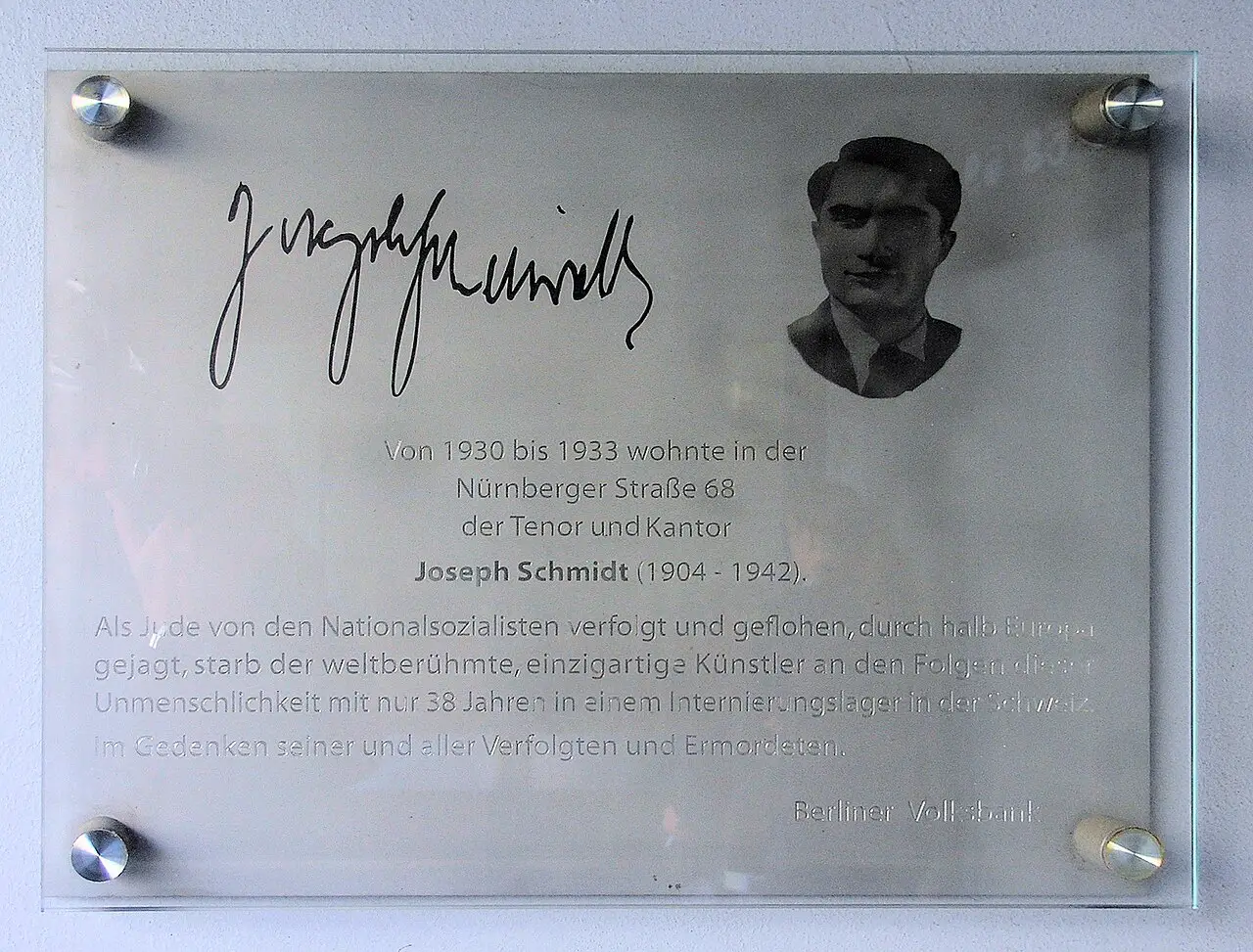
Richard Oswald’s film “Ein Lied geht um die Welt” (A Song Goes Round the World), with music by Hans May, had its premiere at the Ufa-Palast am Zoo. It starred the tenor Joseph Schmidt, born in 1904, as an unknown singer who becomes famous through radio. The film was banned in 1937; Schmidt died on 16 November 1942 in the Girenbad internment camp in Switzerland.6,7
-
Theatre evening, Berlin, Metropol-Theater
Students disrupt an operetta
During the evening performance of the operetta “Die Lindenwirtin” at the Metropol-Theater, students protested against its portrayal of student life: they heckled, threw stink bombs and scattered sneezing powder, and left the theatre after the second act. The rest of the performance went undisturbed; the police took the names of fourteen students.4
-
Books
Klaus Mann writes to Gottfried Benn
From exile in France Klaus Mann wrote a personal letter to the poet Gottfried Benn, who had taken over the poetry section of the Prussian Academy of Arts after Heinrich Mann, Klaus Mann’s uncle, was forced out in February, and who had stayed on in the coordinated academy. Benn replied publicly with an open letter in the Deutsche Allgemeine Zeitung on 25 May.8
-
Crime early morning, Berlin, Plötzensee prison
Two executions at Plötzensee
Early in the morning two men sentenced to death for murder were executed in Plötzensee prison: the bricklayer Ernst Reins, who had killed the postman Gustav Schwan in Schöneberg in 1931, and Johannes Kabelitz, who in January 1931 had shot the driver Ponick from behind and robbed him. Reins’s execution was announced on advertising pillars. Göring, as Prussian Minister-President, commuted the death sentences passed on the farm labourer Lehmann and the harvest worker Anton Potocki to life imprisonment.1,2
-
Society Berlin, Unter den Linden
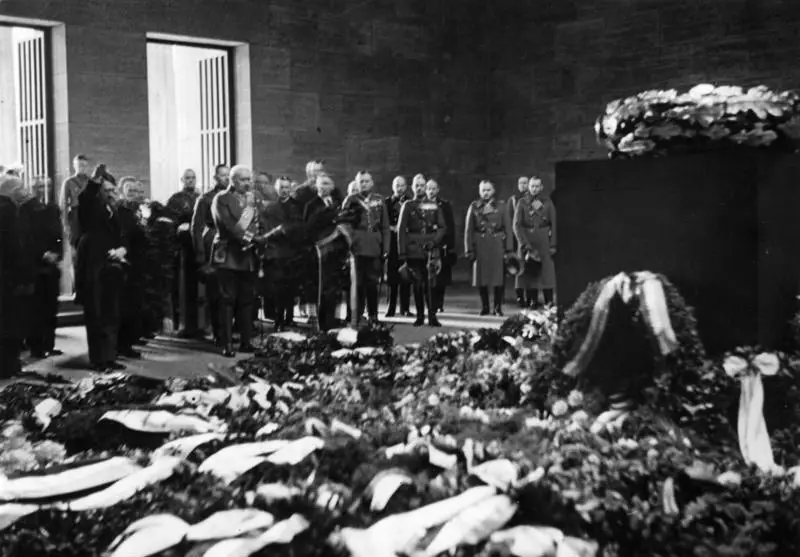
First guard at the war memorial
The Berlin guard troops mounted guard for the first time at the memorial to the fallen (Ehrenmal) on Unter den Linden. Thousands waited at the Brandenburg Gate and along Unter den Linden for the troops to march up, greeting them bare-headed or with raised arms, and the soldiers marched past the memorial in parade step.3
-
Society Berlin
Women’s leagues submit to Hitler
Ley’s negotiations with the leaders of the main women’s organisations were reported to have been concluded. Baroness von Hadeln, leader of the Queen Luise League (Bund Königin Luise), declared that she and her league placed themselves unconditionally under Hitler.5
-
Sport Berlin, Tempelhof airport
The Rome riders fly home
Rittmeister von Salviati and First Lieutenants Brandt, von Nagel and Sahla landed at Tempelhof airport in a plane from Rome. They had just won the Coppa Mussolini at the Rome riding tournament for the third time, so keeping the trophy for Germany for good, and spoke of the warm welcome they had found in Italy.3
Voices
The German school has to form the political human being, who in all his thinking and acting is rooted in his people, serving and sacrificing, and is bound in his innermost being to the history and destiny of his state.
What could have brought you to place your name, which for us was the epitome of the highest standard and of an almost fanatical purity, at the disposal of those whose lack of standards is absolutely without precedent in European history and from whose moral uncleanliness the world turns away in disgust?
Elsewhere in the world
-
Austria
Student brawls at Vienna University
Serious clashes broke out between Nazi and other students at Vienna University, starting in a lecture by Professor Tandler at the Anatomical Institute; a number of students were injured. Fighting followed in the university’s great hall and in the law faculty, and the hall and the Anatomical Institute were closed until further notice.5
In Berlin today


Neue Wache
Unter den Linden 4, 10117 Berlin-Mitte
- Then
- Schinkel’s royal guardhouse of 1816–18, converted by Heinrich Tessenow in 1930–31 into a memorial to the fallen of the World War. On 9 May 1933 the Berlin guard troops mounted guard here for the first time, watched by thousands.9,3
- Today
- Since the national day of mourning in 1993 the Neue Wache has been the Central Memorial of the Federal Republic of Germany, with an enlarged replica of Käthe Kollwitz’s figure of a mourning mother in Tessenow’s restored interior.

Plötzensee Memorial
Hüttigpfad 16, 13627 Berlin-Charlottenburg-Nord
- Then
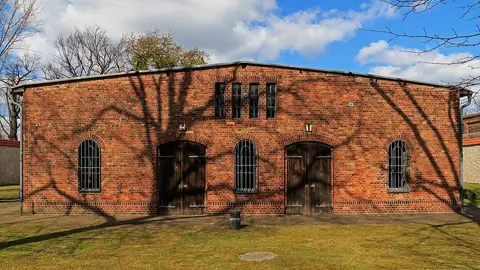
- On the morning of 9 May 1933 Ernst Reins and Johannes Kabelitz, both convicted of murder, were executed in Plötzensee prison. Until 1937 executions here were carried out in the yard by the executioner with a hand axe.10,1
- Today
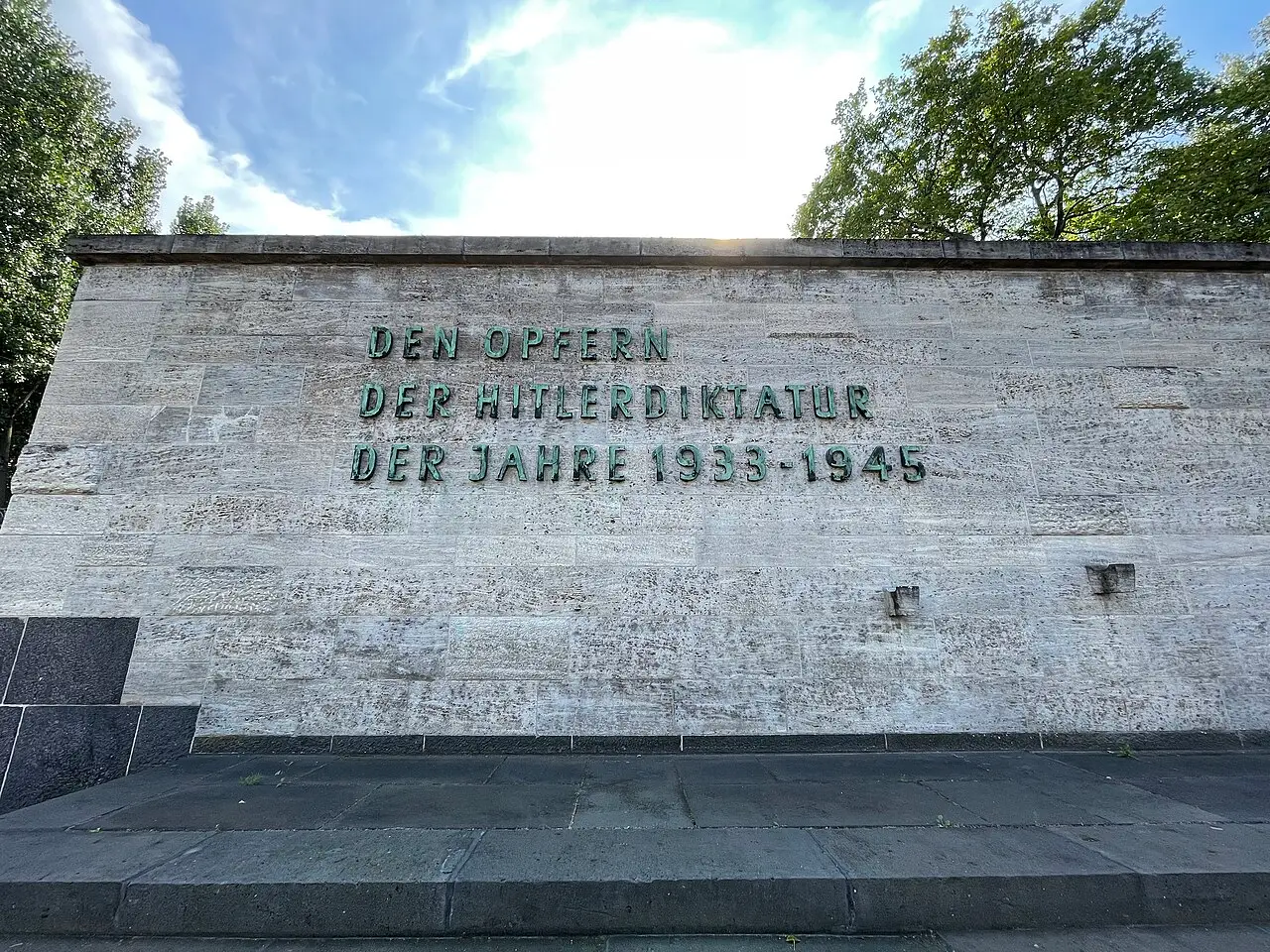
- Since 1951–52 the former execution shed and its yard have been a memorial “to the victims of the Hitler dictatorship of the years 1933–1945”. Between 1933 and 1945, 2,891 people were put to death at Plötzensee, among them many members of the resistance.
More pictures
_Joseph_Schmidt.JPG)

Sources
- Biberacher Zeitung, 10 May 1933 Deutsche Digitale Bibliothek, Zeitungsportal, p. 1, official communiqué and Frick's speech (Berlin, 9 May); p. 12, "Der Briefträgermörder Reins wurde hingerichtet" and "Der Chauffeurmörder Kabelitz enthauptet"
- Sächsische Volkszeitung, 10 May 1933 Deutsche Digitale Bibliothek, Zeitungsportal, p. 2, "Verwandlung von Todesstrafen zu Zuchthausstrafe" and Rust's decree on sex education; p. 4, "Keine Fortbildungszuschüsse für jüdische Schulamtsbewerber" (Berlin, 9 May)
- Hamburgischer Correspondent, morning edition, 10 May 1933 Deutsche Digitale Bibliothek, Zeitungsportal, p. 2, "Der Büchernachlaß Rosa Luxemburgs aufgefunden" and "Die Wache vor dem Ehrenmal"; p. 5, "Rückkehr der siegreichen Reiteroffiziere" (Berlin, 9 May)
- Erzgebirgischer Volksfreund, 10 May 1933 Deutsche Digitale Bibliothek, Zeitungsportal, p. 3, reports on the Metropol-Theater (Berlin, 10 May), the book burning and Olaf Larsen (Berlin, 9 May)
- Bottwartal-Bote, 10 May 1933 Deutsche Digitale Bibliothek, Zeitungsportal, p. 1, Blomberg interview (Berlin, 9 May); p. 2, "Die Frauenbewegungen unterstellen sich Adolf Hitler", "Studentenkundgebungen in Wien" and "Verbot der 'Täglichen Rundschau' aufgehoben"
- Ein Lied geht um die Welt (1933) filmportal.de (Deutsches Filminstitut & Filmmuseum), credits, synopsis, censorship and premiere data
- Joseph Schmidt filmportal.de (Deutsches Filminstitut & Filmmuseum), dates of birth and death
- Klaus Mann: Briefwechsel mit Gottfried Benn (1933) Künste im Exil, Deutsches Exilarchiv 1933–1945 der Deutschen Nationalbibliothek
- Denkmaldatenbank: Neue Wache Landesdenkmalamt Berlin
- Denkmaldatenbank: Strafgefängnis und Gedenkstätte Plötzensee Landesdenkmalamt Berlin
Spotted a mistake? Send a correction.