Day 97 of 100
Students ransack Magnus Hirschfeld’s Institute for Sexual Science
On Saturday morning about a hundred students of the Berlin College of Physical Education, with a brass band and SA students, occupied and wrecked Magnus Hirschfeld’s Institute for Sexual Science and carted off its books and archives for burning. Student squads went on to purge Berlin’s public lending libraries. The Centre Party elected the former Chancellor Brüning as its leader in place of Prelate Kaas, and the censors passed the Joseph Schmidt film “Ein Lied geht um die Welt”.
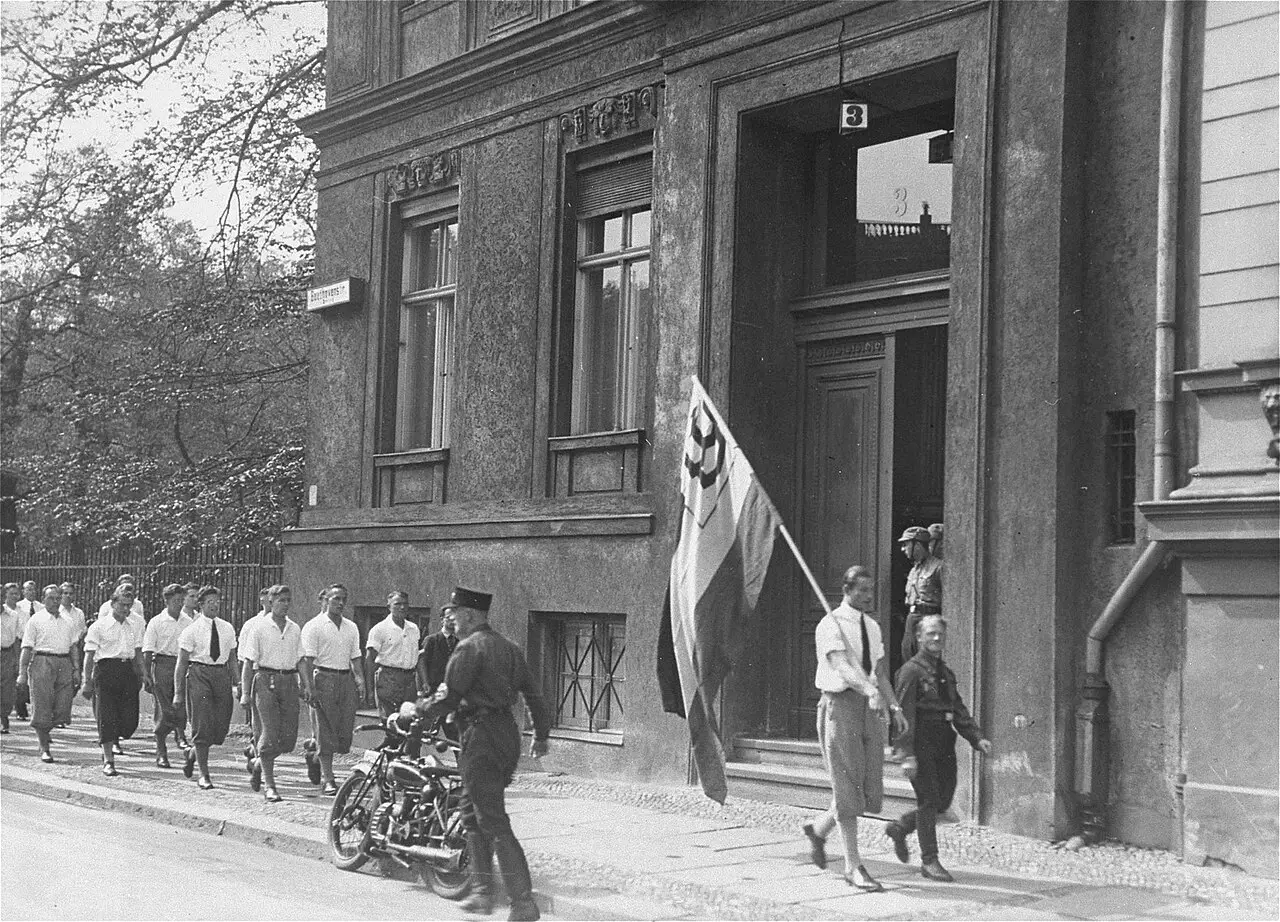

Magnus Hirschfeld had founded his Institute for Sexual Science in 1919 in the former villa of the violinist Joseph Joachim. It served research, practical counselling, public education and politics, above all the campaign to decriminalise sex between men, and held a large library and archive. Hirschfeld had been attacked from the right since his first publications.
The raid opened the Berlin students’ action against “un-German” literature. In the afternoon students of the Veterinary College came back and took a further load of material from the cellar to the Student House in Oranienburger Straße. Part of the library was burned on the Opernplatz four days later. The institute never reopened, and its staff were driven into exile.
Politics and power
Government, terror and persecution
-
Terror morning, Berlin-Tiergarten, Beethovenstraße 3
The Institute for Sexual Science stormed
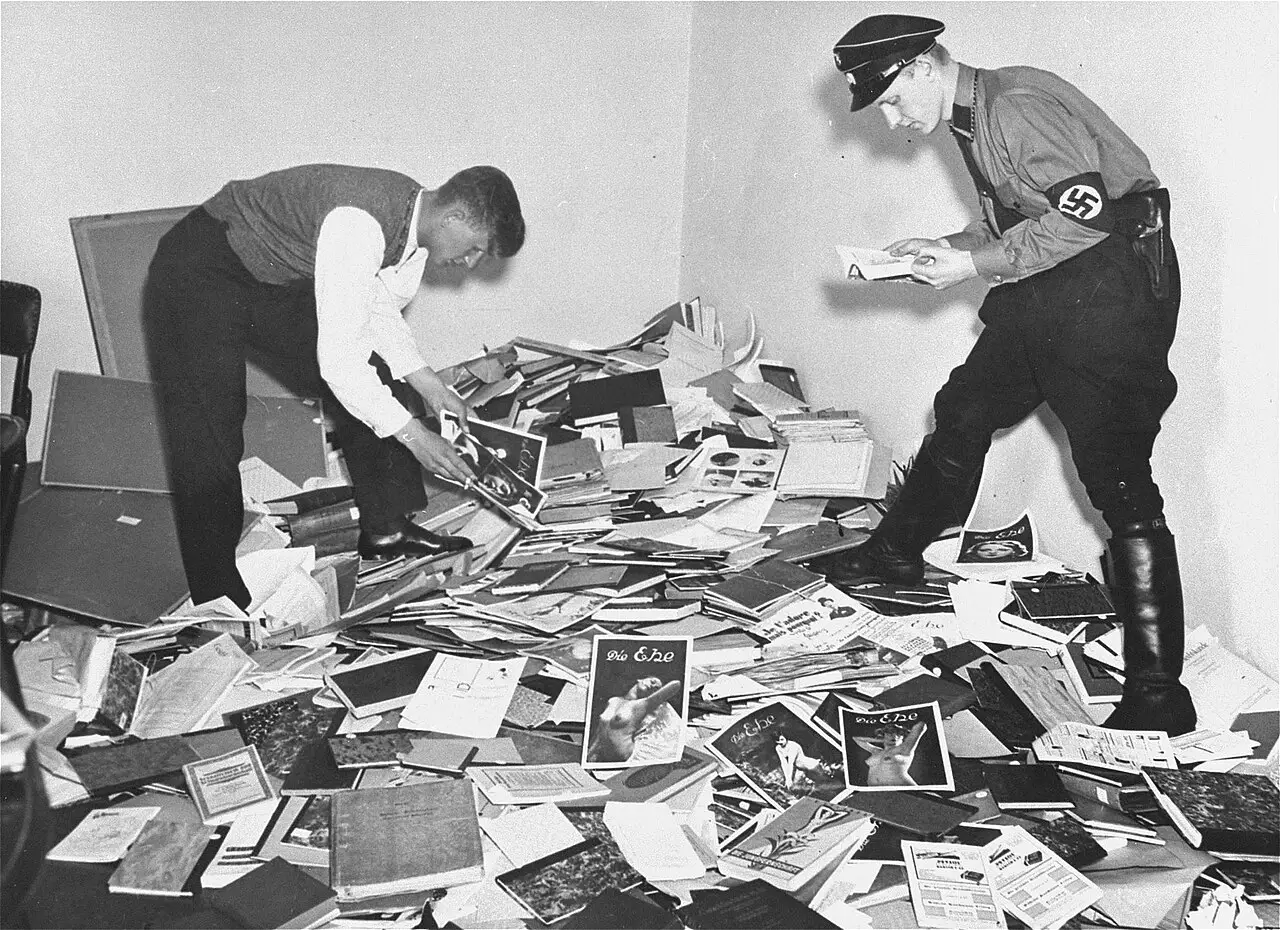
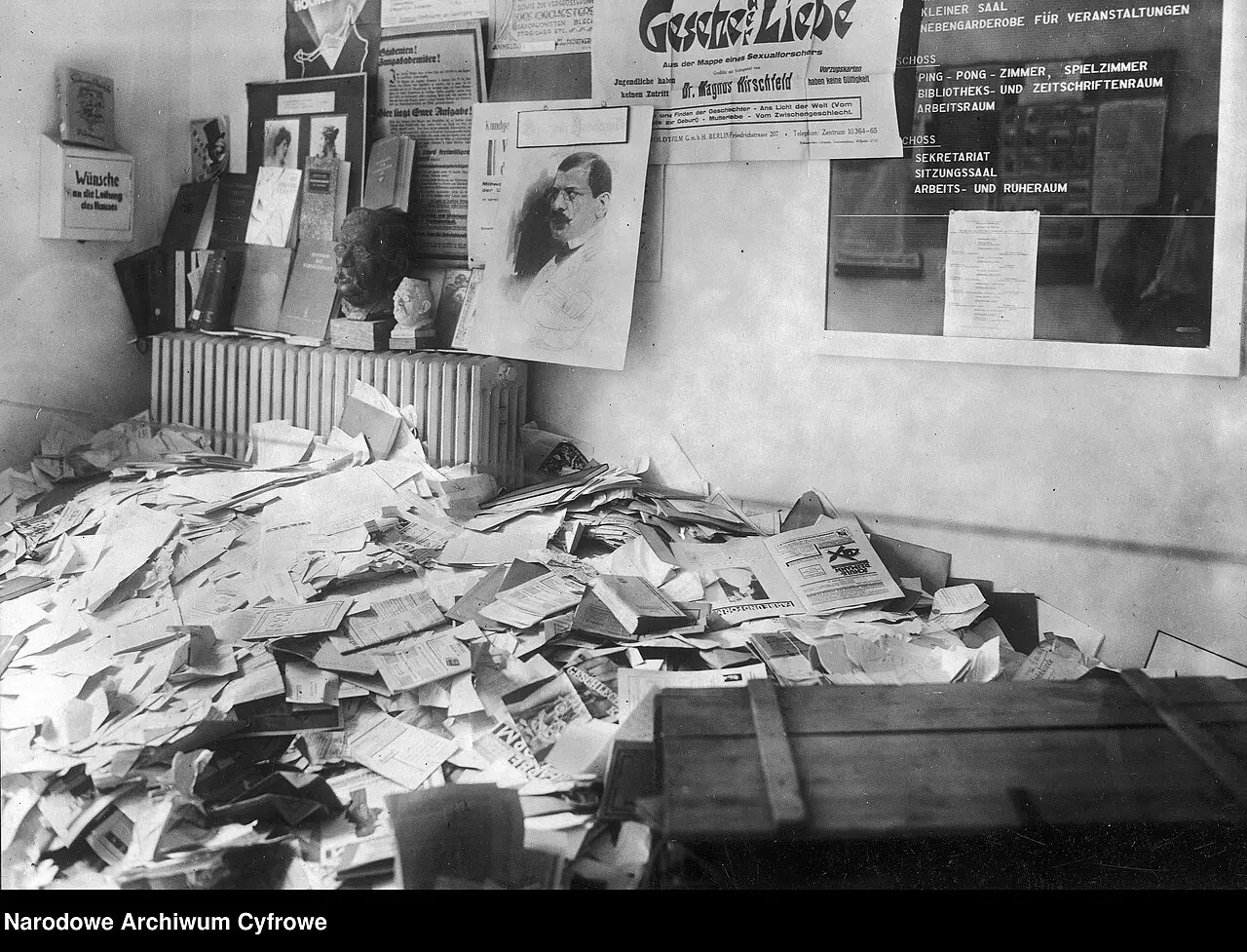
In the morning some hundred gymnastics students of the College of Physical Education (Hochschule für Leibesübungen) marched with a brass band and SA students to the institute at Beethovenstraße 3, broke in and wrecked it. An eyewitness described them pouring ink over carpets and files and kicking pictures and charts about like footballs before throwing them into the street; books, papers and photographs were loaded onto a removal lorry. The student leader Herbert Gutjahr declared the institute closed, and the students sang and marched off. A second group came in the afternoon.1,2
-
Propaganda Berlin
Student squads purge Berlin’s lending libraries
On the orders of the students’ “Committee against the Un-German Spirit” for Berlin and Brandenburg, five student “shock troops” set out in lorries to purge all of Berlin’s public lending libraries; libraries serving scholarship alone were to be spared. The books they removed were to be burned on the Opernplatz on Wednesday, 10 May.3,4
-
Opposition Berlin
Brüning elected leader of the Centre Party
After two days of meetings in Berlin, the Centre Party’s executive and its Reichstag and Prussian Landtag groups elected the former Chancellor Brüning as party leader, succeeding Prelate Kaas. Brüning was given the right to reappoint all party offices; the parliamentarians offered to place their seats at his disposal. A resolution declared the party ready to work for “national reconstruction”.5,6
Everyday life
What else was happening in Germany
-
Film Berlin
Censors pass “Ein Lied geht um die Welt”
The Berlin film censorship office approved “Ein Lied geht um die Welt” (A Song Goes Round the World), starring the tenor Joseph Schmidt and directed by Richard Oswald, with music by Hans May, for screening; its premiere was set for 9 May. In 1937 the film was banned.7
-
Society
Rules for killing fish and lobsters
Under the new Reich slaughter law, the Prussian interior ministry issued a police ordinance on killing fish, crayfish, lobsters and frogs. Fish for human consumption were to be stunned with a heavy blow to the head and then bled before being handed to the buyer; crayfish and lobsters were to be thrown one at a time into fiercely boiling water, and putting them into cold or warm water to be brought to the boil was forbidden; frogs were to be stunned before being cut up.6
Voices
…the German Student Union would no longer allow the German people to be poisoned from here through supposedly scientific lectures and supposedly scientific books.
In Berlin today


Site of the Institute for Sexual Science
Bettina-von-Arnim-Ufer, near the Haus der Kulturen der Welt, 10557 Berlin-Tiergarten
- Then
- On the morning of 6 May 1933 students occupied and plundered Magnus Hirschfeld’s Institute for Sexual Science at Beethovenstraße 3 and declared it closed.8,2
- Today
- Since July 1994 a memorial stele on the Spree bank (Bettina-von-Arnim-Ufer), near the former Congress Hall, recalls the institute; since September 2011 two stelae on the opposite Magnus-Hirschfeld-Ufer commemorate the first homosexual emancipation movement.
More pictures


Sources
- Die Plünderung des Berliner Instituts für Sexualwissenschaft verbrannte-buecher.de
- Das Institut für Sexualwissenschaft Magnus-Hirschfeld-Gesellschaft
- Sächsische Volkszeitung, 7 May 1933 Deutsche Digitale Bibliothek, Zeitungsportal, p. 2, "Das Institut für Sexualwissenschaft geschlossen" (Berlin, 6 May)
- Hohenstein-Ernstthaler Tageblatt und Anzeiger, 8 May 1933 Deutsche Digitale Bibliothek, Zeitungsportal, p. 1, report from Berlin, 7 May, on Saturday's action
- Hamburgischer Correspondent, 7 May 1933 Deutsche Digitale Bibliothek, Zeitungsportal, p. 1, report from Berlin, 6 May, on the Centre Party
- Hamburger Fremdenblatt, Reichsausgabe, 7 May 1933 Deutsche Digitale Bibliothek, Zeitungsportal, p. 2, "Erlaß über die Tötung von Fischen, Krebsen und Fröschen" (Berlin, 6 May)
- Ein Lied geht um die Welt (1933) filmportal.de (Deutsches Filminstitut & Filmmuseum), censorship and premiere data
- Gedenktafeln in Berlin: Magnus Hirschfeld Aktives Museum Faschismus und Widerstand in Berlin, Gedenkstätte Deutscher Widerstand, Holger Hübner
Spotted a mistake? Send a correction.