Day 56 of 100
Berlin’s newly elected city council is installed at the Rathaus with Nazi salutes
On a fine spring Sunday Berlin’s newly elected city council was sworn in at the Rathaus after church services, with the black-white-red flag and the swastika flying; the Nazi group answered with three ‘Heils’ for Hitler and the Horst Wessel song. The Zionist Federation repeated its rejection of foreign ‘atrocity’ reports, Der Angriff threatened ‘traitors’, and the radio refused to carry a German National call for the monarchy. Germany beat France at hockey in Berlin.
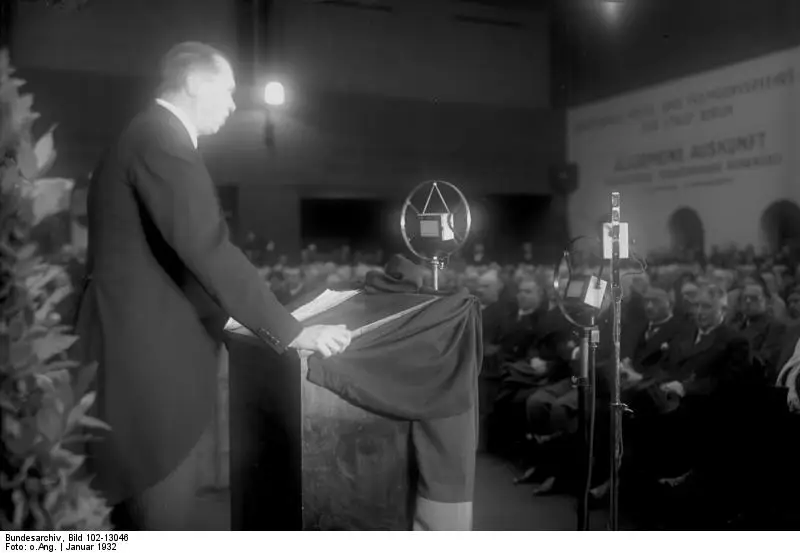

Berlin’s newly elected city council was the first since the war with what the press called a ‘national’ majority. Its installation on Sunday 26 March was staged, as Lord Mayor Sahm himself said, in harmony with the ceremonial opening of the Reichstag and the Prussian Landtag: services in the Nikolaikirche and St Hedwig’s Cathedral, a procession of the city executive (Magistrat) and councillors to the Rathaus, and the flags of the old empire, of Prussia and of the Nazi Party on the building. Sahm, still in office, invoked the ‘spirit of Potsdam’; the Nazi group, led by State Commissioner Lippert, closed the session with salutes to Hitler.
The campaign against foreign reports of violence went on. The Zionist Federation for Germany repeated its protest against ‘atrocity propaganda’ (Greuelpropaganda, the regime’s term for foreign reports of violence in Germany) while insisting on the civil rights and economic position of German Jews, and Der Angriff warned ‘traitors’ at home and abroad that it knew who they were. Even the regime’s German National partners felt the limits: a speech calling for the return of the Hohenzollern monarchy was kept off the air.
Politics and power
Government, terror and persecution
-
The states midday, Berlin, Rathaus
New Berlin city council sworn in at the Rathaus
After services for Protestant councillors in the Nikolaikirche and for Catholics in St Hedwig’s Cathedral, the city executive and councillors walked in procession to the Rathaus, led by Lord Mayor Sahm wearing the gold chain of office granted in 1841, while a crowd of several thousand watched. The black-white-red flag flew from the tower, the Prussian colours and the swastika from the corner turrets. Sahm took the councillors’ pledge by handshake; the leader of the Nazi group, State Commissioner Lippert, then called three ‘Heils’ for Hitler, and his group sang the first verse of the Horst Wessel song standing with raised arms.1,2
-
Government Berlin
Syrup takes over job creation from the arrested Gereke
Officials announced that the arrest of Gereke would not interrupt the work of the Reich Commissioner for job creation. The government entrusted the office provisionally to Dr Syrup, President of the Reich Institution for Labour Exchanges and Unemployment Insurance, who had already taken over; no improper use of the commissioner’s funds had been found so far.1
-
Persecution Berlin
Zionist Federation rejects foreign atrocity reports
The Zionist Federation for Germany declared that it had already protested on 17 March, through the Jewish Telegraphic Agency, against all anti-German propaganda and untrue reports, and repeated the protest publicly. It rejected any attempt to make the Jewish cause serve the interests of other states, adding that the defence of German Jews’ civil rights and economic position must not be linked to political action against Germany.3
-
Propaganda Berlin
Der Angriff issues a ‘last warning’
The Nazi Berlin paper Der Angriff published what it called a last warning against ‘atrocity propaganda’, claiming that groups of ‘traitors’ inside and outside Germany were at work, that it knew the circles they came from, and that it was prepared to use that knowledge if necessary.4
-
Opposition Berlin
Salaries of the former Prussian ministers stopped
Pending inquiries into the whereabouts of a fund of two million marks, the authorities stopped all salary payments to the members of the former Prussian government headed by Braun. The former ministers said they would lodge legal objections.4
-
Propaganda
Radio refuses a monarchist speech
At a Sunday youth rally of the Potsdam branch of the Kampfring junger Deutschnationaler, State Secretary von Bismarck, youth leader of the German National People’s Party, called for the restoration of the Hohenzollern hereditary monarchy. He said the speech had been meant for broadcast, but the radio management had refused because remarks on the monarchy contradicted the government’s line.5
Everyday life
What else was happening in Germany
-
Sport Berlin
Germany beat France at hockey
In the hockey international on the Preussen ground in Berlin, Germany beat France 3–2 (0–0 at half-time) before about 7,000 spectators. The reporter found the win deserved but narrow, praising the fast, technically good French side and noting weak points in the German team.6
-
Sport Berlin
First fine spring Sunday brings two fatal racing accidents
The first fine spring Sunday of the year cost two young sportsmen their lives. In the Berlin amateur road cyclists’ race the former junior rider Höferl fell when a tyre came off and died minutes later of a fractured skull; at the Eilenriede motorcycle race in Hanover the Berlin BMW rider Fritz Weber was killed outright.7
-
Society Berlin
Compulsory labour service promised within days
Introducing a showing of the film ‘Unsere Zukunft liegt in Deutschland’ for the Deutsche Gesellschaft für Ton und Bild (Degeto), the new Reich Commissioner for Labour Service, Mahnken, said compulsory labour service would be decided in the next few days. By summer whole age groups might be called up for land reclamation, drainage, afforestation and flood protection.1
Voices
Today’s installation of the newly elected councillors is no empty formality; here too sounds the same note as at the ceremonial opening of the Reichstag and the Prussian Landtag, in the spirit of German renewal. … Berlin will find the way into a new and better future if it lets itself be guided by the spirit of Potsdam.
Elsewhere in the world
-
France
Paul-Boncour presses for disarmament
At a banquet in Paris in honour of the international press, Foreign Minister Paul-Boncour said the disarmament conference had to succeed, since failure would mean a renewed arms race; closer cooperation among the four western great powers within the League of Nations would ease tension.3
In Berlin today
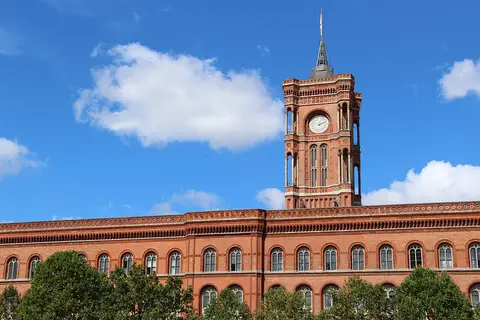

Berliner Rathaus (Rotes Rathaus)
- Then
- Seat of the city government, where the newly elected council was sworn in at midday under the black-white-red flag, with the Prussian colours and the swastika on the corner turrets.1,2,8
- Today
- The red-brick Neo-Renaissance building of 1861–69 by Hermann Friedrich Waesemann houses the Governing Mayor of Berlin and the Senate Chancellery; its ceremonial rooms are open to visitors.
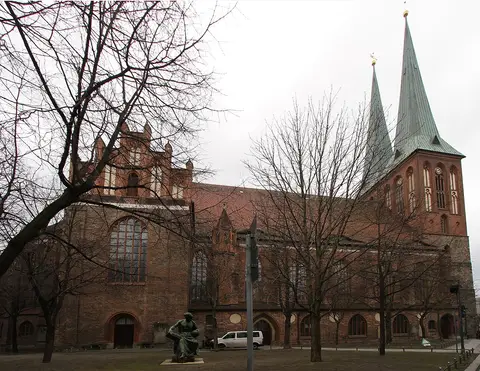

Nikolaikirche
More pictures

Sources
- Dresdner Nachrichten (Frühausgabe), 27 March 1933 Deutsche Digitale Bibliothek, Deutsches Zeitungsportal, p. 1 (Berlin, 26 March): installation of the city council and Sahm's address; Syrup succeeds Gereke; Mahnken on labour service
- Hildener Rundschau, 27 March 1933 Deutsche Digitale Bibliothek, Deutsches Zeitungsportal, p. 2, CNB report (Berlin, 26 March): flags on the Rathaus; services in the Nikolaikirche and St Hedwig's
- Dresdner Nachrichten (Frühausgabe), 27 March 1933 Deutsche Digitale Bibliothek, Deutsches Zeitungsportal, p. 2: statement of the Zionistische Vereinigung für Deutschland (Berlin, 26 March); Paul-Boncour speech (Paris, 26 March)
- Marbacher Zeitung, 27 March 1933 Deutsche Digitale Bibliothek, Deutsches Zeitungsportal, p. 1 (Berlin, 26 March): Der Angriff against 'Greuelhetze'; salaries of the Braun government stopped
- Biberacher Zeitung, 27 March 1933 Deutsche Digitale Bibliothek, Deutsches Zeitungsportal, p. 1, 'Staatssekretär v. Bismarck vor dem Kampfring junger Deutschnationaler' (Berlin, 26 March)
- Hamburger Fremdenblatt (Abendausgabe), 27 March 1933 Deutsche Digitale Bibliothek, Deutsches Zeitungsportal, p. 10, 'Hockey-Länderspiel Deutschland–Frankreich 3:2' (Berlin, 26 March)
- Niederrheinisches Tageblatt, 27 March 1933 Deutsche Digitale Bibliothek, Deutsches Zeitungsportal, p. 1, 'Zwei tödliche Sportunfälle' (Berlin, 26 March)
- The Red Town Hall Berlin.de, The Governing Mayor of Berlin – Senate Chancellery
- Nikolaikirche Stiftung Stadtmuseum Berlin
Spotted a mistake? Send a correction.