Themes

Churches

The Protestant and Catholic churches and the new regime.

19 days

  1. Day 24 Wednesday 22 February 1933

    Göring makes the SA, SS and Stahlhelm an auxiliary police in Prussia

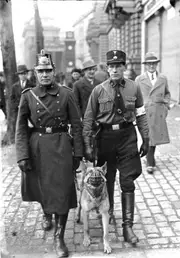
    Göring signed a decree allowing the Prussian police to call up “auxiliary police” from the ranks of “nationally minded” Germans: in practice men of the SA, SS and Stahlhelm, wearing a white armband over their own uniforms and holding full police powers while on duty. The Prussian commissioners pensioned off another wave of senior officials and began closing the secular schools, and Hitler told his followers that the enemy to be beaten on 5 March was “Marxism”. In Berlin the first film directed by Friedrich Hollaender, Ich und die Kaiserin, opened at the Gloria-Palast.
  2. Day 27 Saturday 25 February 1933

    Police claim to find tunnels and treasonable leaflets under the Karl-Liebknecht-Haus

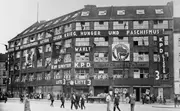
    Diels’s political police announced that the closed Communist headquarters had yielded secret cellars, a tunnel and hundredweights of leaflets calling for armed revolt. The Reichsgericht lifted or shortened a series of newspaper bans, Adenauer settled his protest over Göring’s police decrees in a meeting with Göring, and Rust ordered that the secular schools take no new pupils. Berlin learned from a League of Nations report how much weight its unemployed had lost, and the Sklarek perjury trial ended with a year’s prison for the former transport director Fritz Brolat.

  3. Day 31 Wednesday 1 March 1933

    Göring promises to ‘exterminate’ Communism as the treason decree is published

    On Ash Wednesday the decree against ‘treason against the German people’ appeared in the Reichsgesetzblatt, Frick asked every state to ban the Communist press and meetings, and the Prussian press service claimed that at least ten men had set the Reichstag fire. Göring told radio listeners that the government’s aim was the extermination of Communism, Hitler spoke to some 20,000 people in Breslau, and Cardinal Bertram begged Hindenburg to protect the freedom of the vote. In Berlin, Leopold Jessner bade farewell to the State Theatre with Billinger’s Rosse, while Max Reinhardt reopened the Deutsches Theater with Hofmannsthal’s Great Theatre of the World.

  4. Day 37 Tuesday 7 March 1933

    Hitler tells the cabinet the election was a ‘revolution’ and calls for an Enabling Act

    Two days after the election Hitler told his ministers that 5 March had been a revolution, that Marxism would disappear and that an Enabling Act with a two-thirds majority was needed; he and Frick demanded that van der Lubbe be hanged, retroactively if need be. At Hindenburg’s residence the Reichstag’s opening in Potsdam’s Garrison Church was planned in detail. In Dresden, Nazi supporters whistled the conductor Fritz Busch off the podium of the State Opera. Abroad, Dollfuss began governing Austria without parliament, and the Netherlands reinforced its border against German refugees.

  5. Day 49 Sunday 19 March 1933

    Germany and France draw 3–3 before 45,000 in Berlin’s Grunewald stadium

    On a sunny Sunday some 45,000 spectators, French supporters among them, watched Germany let slip a 3–1 lead against France in the Deutsches Stadion. In Wilmersdorf Fritz Höger’s new brick church on Hohenzollernplatz was consecrated. The same weekend Jewish judges were withdrawn from administrative posts at Berlin’s central district court, and SA auxiliary police raided the Berlin office of the exiled pacifist Professor Foerster.

  6. Day 51 Tuesday 21 March 1933

    The Day of Potsdam: the new Reichstag opens in the Garrison Church

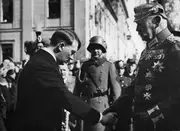
    The new Reichstag was opened with a state ceremony in Potsdam’s Garrison Church, where Hindenburg and Hitler spoke above the tombs of the Prussian kings. In the afternoon the deputies met in Berlin’s Kroll Opera House and re-elected Göring as president, and in the evening a torchlight procession filled the city centre while Wagner’s Meistersinger was performed at the State Opera. The same day Hindenburg signed decrees creating special courts, punishing ‘malicious’ criticism of the government and amnestying crimes committed for the ‘national uprising’.

  7. Day 56 Sunday 26 March 1933

    Berlin’s newly elected city council is installed at the Rathaus with Nazi salutes

    On a fine spring Sunday Berlin’s newly elected city council was sworn in at the Rathaus after church services, with the black-white-red flag and the swastika flying; the Nazi group answered with three ‘Heils’ for Hitler and the Horst Wessel song. The Zionist Federation repeated its rejection of foreign ‘atrocity’ reports, Der Angriff threatened ‘traitors’, and the radio refused to carry a German National call for the monarchy. Germany beat France at hockey in Berlin.

  8. Day 58 Tuesday 28 March 1933

    Nazi party orders a nationwide boycott of Jewish businesses from 1 April

    From Munich the Nazi party leadership published its call for a boycott of Jewish shops, goods, doctors and lawyers, to begin ‘at a stroke’ on Saturday 1 April at 10:00 under a central committee led by Julius Streicher. The Catholic bishops withdrew their warnings against the Nazi movement, and Albert Einstein, landing in Belgium, broke with Prussia. In Berlin Goebbels told the film industry which films he admired.

  9. Day 64 Monday 3 April 1933

    Max Reinhardt ousted from the Deutsches Theater; Germans now need exit visas

    The management of the Deutsches Theater announced, after a meeting with a Prussian ministry commissioner, that Max Reinhardt would have no further part in its artistic direction. The coordination law came into force, and the Interior Minister required every German leaving the country to obtain an exit visa. The pro-Nazi ‘German Christians’ opened their first national conference in Berlin. Hindenburg presented the aviator Elly Beinhorn with the Hindenburg Cup.

  10. Day 66 Wednesday 5 April 1933

    Hitler Youth takes over the youth associations; the Rotter brothers ambushed in exile

    The Hitler Youth occupied the offices of the Reich Committee of German Youth Associations in Berlin, and Baldur von Schirach took over its leadership. Einstein wrote to the Prussian Academy rejecting its charges; Hitler answered Hindenburg on the Jewish veterans and spoke to the farmers’ council; Kerrl told Jewish notaries to stop working. In Liechtenstein the Berlin theatre impresarios Alfred and Fritz Rotter were ambushed; Alfred and his wife fell to their deaths. Prussia ordered a strict Good Friday.

  11. Day 67 Thursday 6 April 1933

    Hitler tells doctors’ leaders he will purge ‘alien influence’ from Germany’s professions

    Receiving the newly ‘coordinated’ leadership of the medical profession, Hitler spoke of removing the ‘excess’ of Jewish intellectuals from German cultural life. In the evening he and Goebbels addressed the foreign press, with the papal nuncio at the head of the diplomatic corps. The civil servants’ federation dissolved itself and the Protestant church protested at Kube’s remarks to the German Christians. Duelling was legalised again in Prussia, and the Propaganda Ministry warned against ‘patriotic kitsch’.

  12. Day 70 Sunday 9 April 1933

    Göring tells 20,000 Nazi factory-cell members it is a ‘National Socialist revolution’

    At the first general meeting of the Nazi factory cell organisation in Greater Berlin, Göring insisted that the upheaval be called a ‘National Socialist’, not merely a ‘national’, revolution; that afternoon he flew to Rome, his appointment as Prussian premier now said to be settled. The Reichstag deputy Sprenger was made Reich commissioner to ‘coordinate’ the civil servants’ associations. Hindenburg attended a Palm Sunday confirmation, and an aircraft crashed into spectators at a Nazi youth flying display in Staaken, killing two.

  13. Day 76 Saturday 15 April 1933

    Germany’s protest over the Commons debate is handed in at an empty Foreign Office

    On Easter Saturday the German chargé d’affaires delivered the Reich’s protest against the Commons debate to the duty official at the Foreign Office, as the Prime Minister sailed for Washington and The Times called the protest ‘absurd’. In Austria the government restored compulsory religious exercises in schools and declared an Easter amnesty, and Hamburg’s Senate placed state commissioners in the Chamber of Commerce. German radio carried the third act of Parsifal from the Berlin State Opera, and Hamburger SV drew 2–2 with the Vienna professionals WAC.

  14. Day 77 Sunday 16 April 1933

    Easter: Erwin Kahn dies of his Dachau wounds; Munich publishes its attack on Thomas Mann

    Early on Easter Sunday Erwin Kahn, the one survivor of the Dachau shootings of 12 April, died under guard in a Munich clinic, killed by force to his larynx. The Easter edition of the Münchner Neueste Nachrichten carried the ‘Protest of the Richard Wagner City of Munich’ against Thomas Mann, signed by more than forty people including Richard Strauss, and the satirical weekly Simplicissimus was brought into line. Protestant pulpits in Prussia read out a message welcoming the ‘new Germany’; in Berlin, burglars cleared out the C&A store on Königstraße, and a gusty wind troubled the Easter air show at Tempelhof.

  15. Day 79 Tuesday 18 April 1933

    Bavaria reports 5,400 people taken into ‘protective custody’ since 9 March

    A semi-official statement from Munich put the number of people taken into ‘protective custody’ (imprisonment without trial) in Bavaria since 9 March at about 5,400, of whom some 1,630 had been released, partly after Cardinal Faulhaber asked for fathers to be freed for Easter. In Rome, Göring spoke at a broadcast celebration of Hitler’s coming birthday held in his and Papen’s honour, and in Lugano Thomas Mann received the Munich ‘protest’ that settled his decision not to return. The deaths were announced of Albrecht von Graefe, a former völkisch member of the Reichstag, and of Count Dietlof von Arnim-Boitzenburg, the last president of the Prussian House of Lords.

  16. Day 82 Friday 21 April 1933

    Kosher slaughter banned across the Reich; Hess named Hitler’s deputy in the party

    A Reich law banning the slaughter of animals without prior stunning, and with it Jewish ritual slaughter, was signed and published, and Hitler named Rudolf Hess his deputy in the NSDAP. In Berlin the Reichskanzlerplatz became Adolf-Hitler-Platz, the university’s rector objected to the students’ anti-Jewish theses, and police officials put the number of Communists in custody at 18,000; in Freiburg, Heidegger was elected rector. On the Rot-Weiss courts the visiting King of Sweden played doubles with Daniel Prenn, Germany’s leading player, whom the press already expected to be replaced in the Davis Cup team.

  17. Day 84 Sunday 23 April 1933

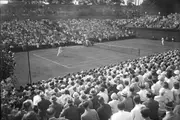
    Tennis federation bars ‘non-Aryans’ from national teams, shutting out Daniel Prenn

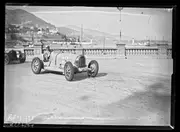
    After the Davis Cup trials in Berlin, the board of the German Tennis Federation resolved that ‘non-Aryans’ (the regime’s term for people of Jewish descent) could no longer be picked for the Davis Cup or other representative teams and that Jews should leave club boards, which shut out the Jewish player Daniel Prenn. In the plenary hall of the Prussian Landtag, the Nazi press chief Otto Dietrich told journalists the press must become a ‘sharply honed weapon’ of German politics, and Protestant leaders announced work on a new constitution for a single German Evangelical Church. Max Planck turned 75, and in Monaco Achille Varzi won the Grand Prix in record time.

  18. Day 85 Monday 24 April 1933

    Decree shutting Jewish doctors out of health-insurance practice is published

    The official gazette published the Reich Labour Minister’s ordinance of 22 April, which told the doctors’ associations to withdraw health-insurance admission from “non-Aryan” doctors and from those accused of communist activity. Hitler handed two of his powers as Reich governor of Prussia to Göring’s cabinet, and the Mecklenburg church dispute reached the Chancellery. The sports pages reported that Germany’s Davis Cup team had been named without Daniel Prenn, after the tennis federation declared that Jewish players could no longer be members.

  19. Day 86 Tuesday 25 April 1933

    Cabinet passes the “overcrowding” law capping Jewish pupils and students

    Hitler’s cabinet sat until after ten at night and passed a law that limited admissions to secondary schools and universities and capped the share of “non-Aryan” pupils and students. Prussia’s culture minister suspended 25 more professors, and Hitler named the army chaplain Ludwig Müller his liaison to the Protestant churches. The labour exchanges reported unemployment down by 69,000 in the first half of April, and Berlin’s university rector explained why he had objected to two of the students’ anti-Jewish posters.