Day 27 of 100
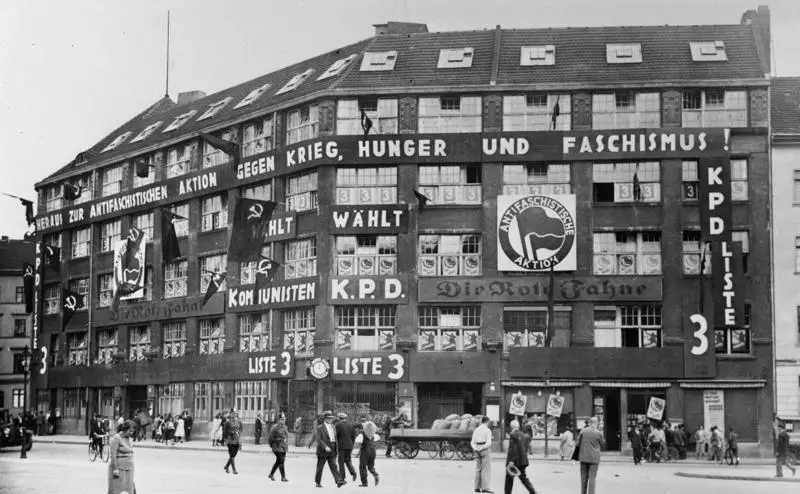
Police claim to find tunnels and treasonable leaflets under the Karl-Liebknecht-Haus
Diels’s political police announced that the closed Communist headquarters had yielded secret cellars, a tunnel and hundredweights of leaflets calling for armed revolt. The Reichsgericht lifted or shortened a series of newspaper bans, Adenauer settled his protest over Göring’s police decrees in a meeting with Göring, and Rust ordered that the secular schools take no new pupils. Berlin learned from a League of Nations report how much weight its unemployed had lost, and the Sklarek perjury trial ended with a year’s prison for the former transport director Fritz Brolat.

Politics and power
Government, terror and persecution
-
Propaganda Berlin, Karl-Liebknecht-Haus
“Sensation in the Karl-Liebknecht-Haus”
The political police, now under Rudolf Diels, announced what it called great successes in the Karl-Liebknecht-Haus, which had been closed for two days. Under the bunks of the Communist guard room, it said, a trapdoor led to cellars with a labyrinth of passages and an underground tunnel to a house in the Bartelstraße, through which wanted men had slipped away during earlier searches; the vaults held “many hundred hundredweight” of treasonable printed matter calling for armed overthrow and bloody revolution. These claims, spread through the press, prepared public opinion for action against the KPD.1,2
Sources disagree. Diels himself later wrote that the search produced “some interesting printed matter, but nothing sensational”.
-
Government Leipzig, Reichsgericht
The Reichsgericht lifts newspaper bans
The 5th criminal senate of the Reichsgericht in Leipzig dealt with about twenty appeals by publishers of banned newspapers. It was learned that a ban on the Münchner Neueste Nachrichten, requested by the Reich government, had been refused; the court lifted the ban on the Ullstein paper Tempo for 17 to 23 February, which had already taken effect, and quashed the five-day ban on the Social Democratic Proletarier in Langenbielau, charging the costs to the governments concerned. A number of other bans were shortened, and further bans on Social Democratic papers reversed. In Munich it became known that the Reich government had asked the Bavarian government to ban eight papers of the Bavarian People’s Party, the Social Democrats and the Peasants’ League, among them the Münchener Post; the view in Munich was that under the press decree the decision lay with the state.3
-
The states Berlin
Adenauer and Göring
The Prussian State Council had asked its president, Konrad Adenauer, to urge Hindenburg to revoke Göring’s police decrees. Papen instead brought Adenauer and Göring together; after a detailed discussion Adenauer declared himself satisfied with Göring’s assurances about how the decrees would be applied, and his visit to the Reich President was dropped. Further details of the auxiliary police were released the same day: its members were to receive three marks a day in expenses, be armed with rubber truncheons and pistols and be sworn in by handshake, and were to be taken on as individuals, not as whole units, without rank or authority over regular police.4
-
Churches Prussia
No new pupils for the secular schools
Rust decreed that from the start of the coming school year the secular “collective schools” (Sammelschulen) and classes for children who took no religious instruction should admit no new pupils and should be run down year by year. New pupils who belonged to no religious community were to be enrolled in the elementary school of their own former confession or, if they had never had one, that of their parents.5
-
Opposition Berlin
Civil servants appeal to Hindenburg
The General German Civil Servants’ Federation (Allgemeiner Deutscher Beamtenbund) protested to Hindenburg that officials far beyond the political posts were being removed for political reasons, and that civil servants were being pushed into treating Germans unequally, in conflict with the constitution they had sworn to uphold. The petition was passed to the Chancellery, which later forwarded it to the Interior Ministry “for information”.5
-
Propaganda evening, Berlin, Sportpalast
Goebbels and Prince August Wilhelm at the Sportpalast
At an election rally of the Berlin NSDAP in the Sportpalast, Prince August Wilhelm of Prussia declared that by Hitler’s will 5 March was to be the last decision the German people would be asked to make. Goebbels told the audience that power should really have been handed to the National Socialists as early as September 1930.6
Everyday life
What else was happening in Germany
-
Society Berlin-Kreuzberg
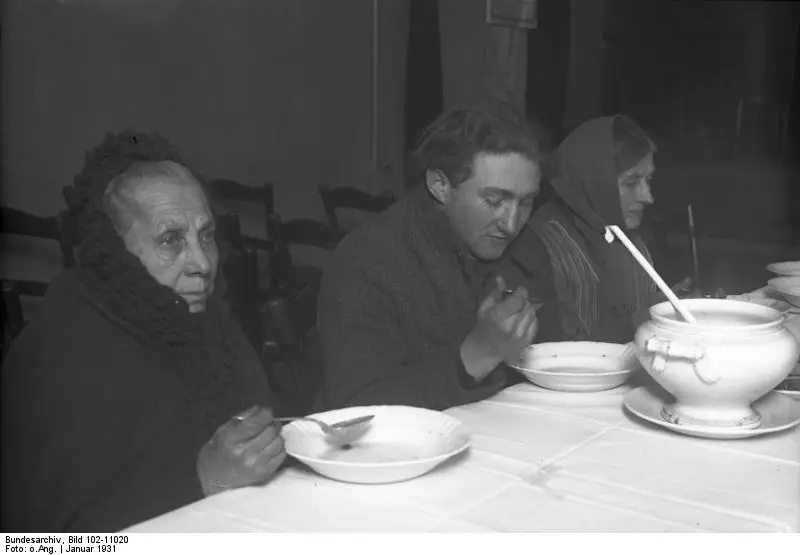
Berlin’s unemployed are going hungry
Vorwärts published findings from a League of Nations Health Section memorandum on unemployed visitors to the Kreuzberg health centre: in recent months they had lost on average three to four kilograms. Of 17 men weighed, twelve were under 60 kilograms; one 49-year-old, unemployed since 1930 and 1.61 metres tall, weighed 43. Of 16 women, twelve weighed less than 50 kilograms. The journal that reviewed the study compared the findings with the worst war years.8
-
Sport Berlin
Hundreds hurt on the toboggan runs
In the eight snowy days of late winter several hundred tobogganing accidents had been recorded around Berlin, few on the official runs but many on the wooded slopes of the Grunewald, the Tegel forest and around the Müggelsee. More than 200 people were slightly hurt, and some 30 to 40 were taken to hospital with broken bones, concussion and sprains.8
-
Crime Berlin
A year in prison for Brolat
After deliberating for three and a half hours, the jury court sentenced Fritz Brolat, former director of the Berlin transport company BVG, to one year in prison for perjury over his evidence about his dealings with the Sklarek brothers, less a month already served on remand, and deprived him of his civic rights for two years. Because of the length of the sentence he remained in custody.1
-
Society Berlin
Women ask the parties where they stand
The Federation of German Women’s Associations (Bund Deutscher Frauenvereine) published the parties’ answers to its question whether they recognised women’s full equality as citizens and would show it by putting up women candidates. The Social Democrats replied that they chose candidates by ability, not sex; the Centre said it had placed four women in safe seats for the Reichstag. The NSDAP’s Reichstag group answered that, as far as it knew, only men were standing on its lists, because its women members had always declined “the somewhat dubious honour” of entering the “firing line” of parliamentary politics. The Communists and the Bavarian People’s Party did not answer.9
Elsewhere in the world
-
Norway
Norway’s government resigns
As expected, the Norwegian cabinet of Prime Minister Hundseid resigned, a day after losing a vote in the Storting. Hundseid advised the King to ask Mowinckel, leader of the Liberal party Venstre, to form a coalition government.4
More pictures

Sources
- Sensation im Karl-Liebknecht-Haus; Ein Jahr Gefängnis für Brolat Kölnische Zeitung, via Deutsche Digitale Bibliothek Zeitungsportal, 26 February 1933, p. 11 (reports dated Berlin, 25 February)
- Nr. 32 Ministerbesprechung vom 28. Februar 1933 (note 8, citing Rudolf Diels, Lucifer ante portas, pp. 188 f.) Bundesarchiv / Historische Kommission bei der Bayerischen Akademie der Wissenschaften, Akten der Reichskanzlei. Regierung Hitler, Band I, Note 8
- Aufgehobene und neue Zeitungsverbote. Urteil des Reichsgerichts; Acht bayrische Blätter Kölnische Zeitung, via Deutsche Digitale Bibliothek Zeitungsportal, 26 February 1933, p. 9 (reports dated Leipzig and Munich, 25 February)
- Adenauer bei Göring. Aussprache über die Polizeierlasse befriedigend; Die preußische Hilfspolizei; Rücktritt des norwegischen Kabinetts Kölnische Zeitung, via Deutsche Digitale Bibliothek Zeitungsportal, 26 February 1933, p. 1 (reports dated Berlin, 25 February)
- Nr. 27 Sitzung der Kommissare des Reichs für Preußen, 22. Februar 1933 (notes 2 and 4, on Rust’s decree of 25 February and the civil servants’ petition of 25 February) Bundesarchiv / Historische Kommission bei der Bayerischen Akademie der Wissenschaften, Akten der Reichskanzlei. Regierung Hitler, Band I, Notes 2 and 4
- Prinz August Wilhelm und Goebbels Kölnische Zeitung, via Deutsche Digitale Bibliothek Zeitungsportal, 25 February 1933, evening edition, p. 7
- Der Verwendungszwang für inländischen Käse Hamburger Fremdenblatt (Reichsausgabe), via Deutsche Digitale Bibliothek Zeitungsportal, 25 February 1933, evening edition, p. 2 (WTB report, Berlin, 25 February)
- Nackter Hunger in Berlin; Tod beim Rodeln Vorwärts, via Deutsche Digitale Bibliothek Zeitungsportal, 25 February 1933, first supplement, p. 3
- Die Parteien und die Frauen. Eine Umfrage und die Antworten Dresdner Nachrichten, via Deutsche Digitale Bibliothek Zeitungsportal, 26 February 1933, p. 2 (report dated Berlin, 25 February)
Spotted a mistake? Send a correction.