Day 69 of 100
Hitler addresses the SA in the Sportpalast; the clairvoyant Hanussen is found shot dead
Before almost 18,000 SA and SS men in the Sportpalast, and by radio to the rest of the country, Hitler called the storm troopers the unshakeable fighting troop of the ‘national revolution’. The Civil Service law came into force, and Berlin’s bar commissioner published the list of only 35 Jewish lawyers still allowed into the city’s courts. The body found near Baruth was identified as that of the clairvoyant Erik Jan Hanussen, and the publisher of the Berliner Tageblatt gave up the running of the Mosse house.
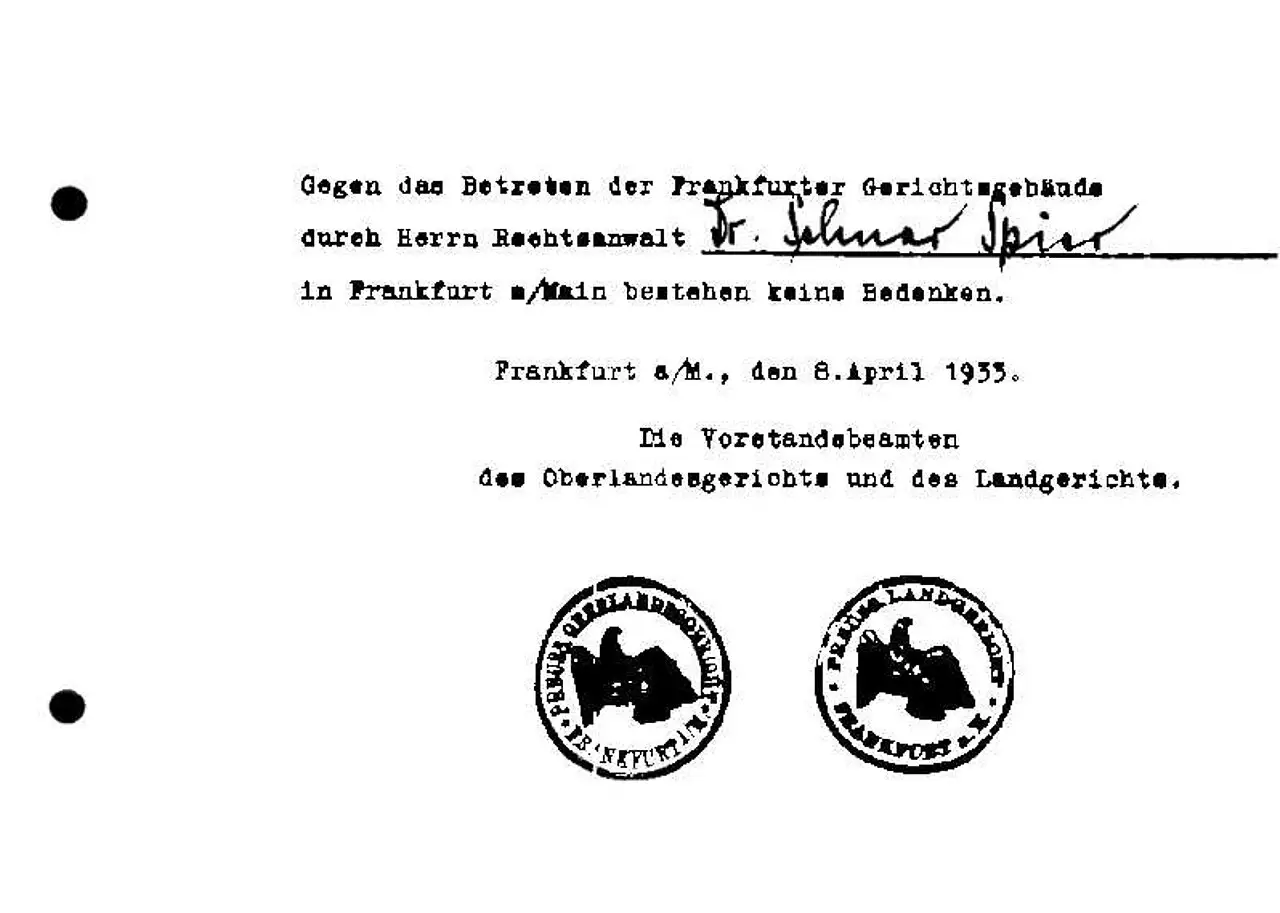

The Saturday before Palm Sunday showed the two faces of the new order side by side. In the evening Hitler thanked the SA and SS for fourteen years of struggle and told them they must now be the unshakeable fighting troop of the ‘national revolution’, while the official commentary on the Civil Service law, in force from that day, spoke of ‘cleansing’ the civil service. In Berlin the courts’ doors were now opened only to the lawyers on the commissioner’s lists: 35 Jewish lawyers were readmitted, and well-known defenders such as Professor Alsberg were missing.
Laws and decrees
Gesetz zur Wiederherstellung des Berufsbeamtentums
Law for the Restoration of the Professional Civil Service
Came into force on the day after its promulgation in the gazette issue of 7 April, opening the purge of ‘non-Aryan’ and politically ‘unreliable’ officials from the Reich, state and municipal services.2
Verordnung über die vorläufige Regelung der Flaggenführung
Ordinance on the Provisional Regulation of the Flying of Flags
Dated 31 March and published in the Reich Law Gazette of 8 April: pending a final decision on the Reich colours, the service flags of civil Reich authorities were changed to black-white-red, Reich vessels were also to fly the swastika flag where possible, and merchant ships could fly black-white-red instead of the republic’s merchant flag.4,8
Politics and power
Government, terror and persecution
-
Propaganda 19:00, Berlin, Sportpalast, Potsdamer Straße
Hitler’s roll-call of the SA and SS
For the ‘great roll-call’ of the SA and SS, broadcast to the whole Reich, almost 18,000 men filled the Sportpalast by 6 p.m., while other units listened in the Wilmersdorf tennis halls; Goebbels gave a live radio commentary from his box. With Röhm, Himmler, Daluege and Prince August Wilhelm present, Hitler told the men that the ‘great time’ they had hoped for during fourteen years had come, that the movement had been built on the principle that strength alone creates right, and that they must now be the unshakeable fighting troop of the ‘national revolution’. The next task was to win over the German people.1
-
Persecution Berlin
The Civil Service law comes into force
The Civil Service law took effect. An official commentary said the government needed the strength of the professional civil service, but that in the last fourteen years it had been infiltrated for party-political reasons by ‘elements’ from which it now had to be freed; only by a ‘cleansing’ (Säuberung) of the civil service could its work be done for ‘people and fatherland’.2
-
Persecution Berlin
Only 35 Jewish lawyers left in Berlin’s courts
The commissioner in charge of the Berlin bar published three lists: two of ‘German-descended’ lawyers who had received passes to appear before the Berlin courts, and one with the names of 35 lawyers of Jewish descent, 6 admitted to the Kammergericht and 29 to the regional courts. The well-known lawyers Professor Alsberg and Dr Frey were not on it; further applications were pending with the ministry. In a decree to the Prussian appeal-court presidents, the Reich commissioner for the Prussian Justice Ministry, Hanns Kerrl, blamed Jewish lawyers and notaries for dismissing their staff after ‘the measures of the last week’, which he claimed had been taken in agreement with the Jewish bar, and ordered lists of the employees to be drawn up; in a second decree he demanded to know why no court president had objected to the 1930 ban on officials belonging to the NSDAP.3
-
Foreign policy Berlin
Roosevelt’s envoy Norman Davis sees Hitler
Hitler received Norman Davis, President Roosevelt’s special envoy, in the afternoon. Afterwards Davis told American journalists that Hitler had struck him as a man of great dynamic force, but declined to discuss the issues, saying he had come to Europe to seek information, not to give it.3
-
The states Berlin
Göring stops a Stahlhelm meeting of policemen
The Greater Berlin Stahlhelm announced that its Sunday meeting of police, criminal-police and fire-brigade officers who had joined the veterans’ league would not take place, at the wish of Reich Minister Göring. In informed circles it was expected that ten Reich governors would be appointed outside Prussia, some of them shared between smaller states.3,5
Everyday life
What else was happening in Germany
-
Crime Baruth, Brandenburg
The clairvoyant Hanussen found shot dead
The body of a well-dressed man found on Friday by road workers in a small fir plantation beside the road from Baruth to Neuhof, south of Berlin, was identified at the mortuary by a former employee as Hermann Steinschneider, who had performed as the clairvoyant Erik Jan Hanussen. Born in Vienna in 1889, he had appeared as a star at the Scala variety theatre until his engagement was suddenly broken off, the management citing a nervous breakdown, and had not been seen since 23 March. He had been shot several times by another hand; as his valuables were still on him, robbery was ruled out. The press spoke of an act of revenge and of ‘underworld’ contacts; the Berlin murder squad under Commissioner Albrecht took up the case.6,10
-
Press Berlin
Lachmann-Mosse gives up the Mosse publishing house
The Berliner Tageblatt announced that its publisher, Hans Lachmann-Mosse, had decided to give up the management of the Rudolf Mosse publishing house and hand it to long-serving staff. He and his wife placed the profits of all their businesses for fifteen years in a charitable fund for victims of the World War, regardless of religion.5
-
Crime Berlin, Landgericht II
‘Prince Sapieha’ sentenced
A Berlin criminal court sentenced Stanislaus Woy, a forest warden who called himself Prince Sapieha, to three and a half years’ penal servitude, a fine of 1,500 marks and five years’ loss of civic rights for repeated fraud and forgery. Posing as the prince, he had pretended to buy Schloss Wintringen and led a woman he had promised to marry into buying furnishings for it.6,7
Voices
Only strength has at all times been entitled to claim the right to live. Weakness has never received the right to live from the world around it.
In view of the judicial independence that the constitution had guaranteed, the judge should have been the one to make himself the spokesman of the nation’s conscience before the State Ministry.
In Berlin today
_Sportpalast.JPG)
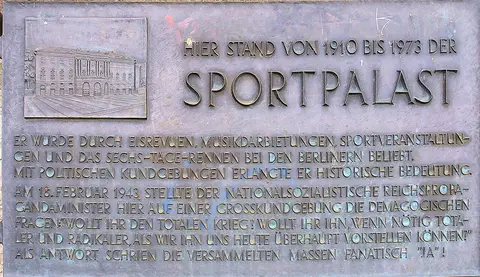
Site of the Sportpalast
Potsdamer Straße 170–172, 10783 Berlin-Schöneberg
- Then
- Almost 18,000 SA and SS men filled the Sportpalast for Hitler’s broadcast roll-call of the storm troopers on the evening of 8 April 1933.1,9
- Today
- The Sportpalast was demolished in 1973. The large housing complex of some 550 flats on the site, once called the ‘Sozialpalast’, is now the Pallasseum; a bronze plaque at Potsdamer Straße 170, unveiled in 1993, recalls the hall and Goebbels’s ‘total war’ speech of 1943.
More pictures

Sources
- Dortmunder Zeitung, 10 April 1933: ‘Der große Appell der SA im Sportpalast – Rede des Reichskanzlers an die SA und SS’ (Berlin, 8 April) Deutsche Digitale Bibliothek, Zeitungsportal, p. 3
- Dresdner Nachrichten, 9 April 1933: ‘Einschneidende Änderung im Beamtenrecht’ (Berlin, 8 April) Deutsche Digitale Bibliothek, Zeitungsportal, p. 2
- Hamburger Fremdenblatt, 9 April 1933: ‘Drei Anwaltslisten in Berlin’; Kerrl’s decrees; ‘Norman Davis bei Hitler’; ‘Zehn Statthalter’ (Berlin, 8 April) Deutsche Digitale Bibliothek, Zeitungsportal, p. 2
- Bergische Zeitung, 10 April 1933: news round-up (flag ordinance in the Reichsgesetzblatt of 8 April) Deutsche Digitale Bibliothek, Zeitungsportal, p. 2
- Bürener Zeitung, 11 April 1933: ‘Eine Berliner Stahlhelmversammlung findet nicht statt’; ‘Änderung in der Leitung des Verlagshauses Mosse’ (Berlin, 8 April) Deutsche Digitale Bibliothek, Zeitungsportal, p. 5
- Hamburger Fremdenblatt, 9 April 1933: ‘Hellseher Hanussen erschossen aufgefunden. Ein Racheakt?’ (Berlin, 8 April) Deutsche Digitale Bibliothek, Zeitungsportal, p. 3
- Westdeutsche Landeszeitung, 10 April 1933: ‘Dreieinhalb Jahre Zuchthaus für Fürst Sapieha’ (Berlin, 9 April) Deutsche Digitale Bibliothek, Zeitungsportal, p. 2
- Verordnung über die vorläufige Regelung der Flaggenführung (31.03.1933) documentArchiv.de, RGBl. 1933 I, S. 179
- Gedenktafeln in Berlin: Sportpalast Gedenktafeln in Berlin
- Langenberger Zeitung, 10 April 1933: ‘Das Ende eines Scharlatans – Die Leiche im Baruther Wald’ Deutsche Digitale Bibliothek, Zeitungsportal, p. 5
Spotted a mistake? Send a correction.