Day 21 of 100
Police break up the “Free Word” congress at the Kroll Opera
More than a thousand writers, scholars and politicians met at the Kroll Opera to defend freedom of speech, the press, assembly and art; police dissolved the meeting when the former Prussian minister Wolfgang Heine mocked the regime. Frick told a Dresden rally that the government would not give up power even without a majority, Hitler spoke against the Centre Party in Cologne and the Reichsbanner marched in the Lustgarten. Berliners took sledges and skis to the snowbound Grunewald.

The congress “Das Freie Wort” (The Free Word) brought writers, scholars and politicians together to defend the civil liberties guaranteed by the Weimar constitution. Its speakers took up, one by one, the freedoms already curtailed by the decree of 4 February: of the press, of assembly, of teaching and of art. The police officer watching the meeting needed only one ironic remark about a swastika found in a Jewish grave to close it. On the same Sunday the Reich Interior Minister told a crowd in Dresden that the government would stay in office whatever the voters decided, and in Berlin a socialist cultural rally was prevented by the police without being banned.
Politics and power
Government, terror and persecution
-
Opposition Berlin, Kroll Opera, Platz der Republik
The “Free Word” congress dissolved
At the Kroll Opera more than a thousand people from all over Germany gathered for the congress “Das Freie Wort”. Rudolf Olden, standing in for Katharina von Kardorff, opened it and read a manifesto declaring that free expression had been severely curtailed by the decree of 4 February and the way it was applied. Professor Erich Everth of the Leipzig Institute for Newspaper Studies spoke on freedom of the press, the former provincial governor Falk on freedom of assembly and the sociologist Ferdinand Tönnies on freedom to teach and speak at the universities; the former Prussian culture minister Adolf Grimme read a declaration by Thomas Mann on the freedom of the mind. When the former Prussian interior and justice minister Wolfgang Heine, speaking on the freedom of art, spoke of “brutality” being officially commended and of “a swastika found centuries ago in a Jewish grave”, the supervising police inspector declared the meeting dissolved for bringing the acting culture minister into contempt. The audience sang the Internationale, and uniformed police cleared the hall without further incident.1,2,3
-
Opposition noon, Berlin, Bülowplatz
A socialist cultural rally blocked by a Nazi band concert
According to the Social Democratic press, the Socialist Cultural League had permission for a large rally in the Volksbühne, for which all tickets had been sold weeks before. But when the audience arrived they found the Bülowplatz sealed off by police, because a Nazi band had been allowed to give an open-air concert at noon on the square between the Volksbühne and the Karl-Liebknecht-Haus. The rally was in effect prevented, and Thomas Mann’s message intended for it was read instead at the Kroll Opera.1
-
Election midday, Dresden, Circus Sarrasani
Frick: the government will stay even without a majority
At a Nazi rally attended by several thousand people in the Circus Sarrasani in Dresden, Reich Interior Minister Wilhelm Frick declared that if the election brought the government no majority, its “work of rescue” would continue regardless. He warned state governments that belittled the Reich government that their own authority would suffer, said that the “Marxist” government of Prussia had been removed for good, and explained that proposals to ban the KPD had been rejected because Marxism could not be defeated by police methods alone but only by a stronger world-view, National Socialism.4
-
Propaganda Cologne, Messe exhibition halls
Hitler speaks against the Centre in Cologne
After an afternoon march of the SA, SS and Hitler Youth from Cologne and the surrounding area through the city centre, Hitler was the only speaker at a rally in the packed exhibition halls of the Cologne trade fair, broadcast by the West German radio. The Kölnische Zeitung headed its report “Against the Centre”.4
-
Opposition Berlin, Lustgarten
The Reichsbanner marches in the Lustgarten
The Berlin Reichsbanner marched to the Lustgarten at the end of its national assembly, which had unanimously confirmed Karl Höltermann as its leader. Höltermann rejected Hitler’s claim that everything had been destroyed in the past fourteen years: it was the destruction of working people’s purchasing power that had brought the misery. On 5 March, he told the crowd, the German people faced a historic decision.4
-
Persecution morning, Berlin
Göring lifts the ban on Centre newspapers
After a morning meeting with the former Chancellor Wilhelm Marx, chairman of the Catholic associations, and the Centre Party’s general secretary, Heinrich Vockel, Göring lifted the three-day ban on Germania and other Centre papers that had printed the Catholic associations’ election appeal. The official Prussian press service said the two men had declared that the appeal was not meant to insult the government, which thereby received “satisfaction”; Göring warned the papers against simply printing appeals containing insults in future.4
Everyday life
What else was happening in Germany
-
Weather Berlin, Grunewald
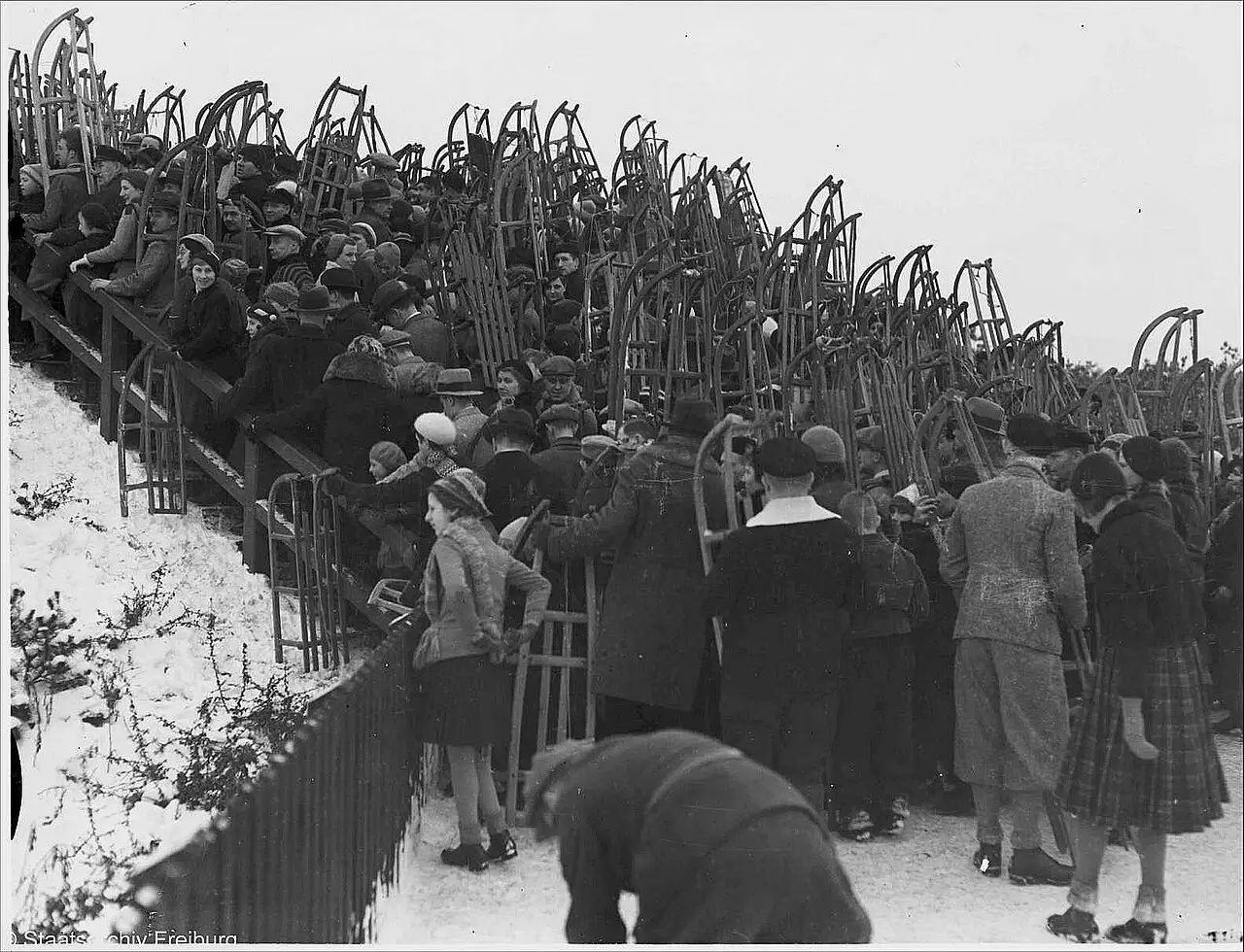
Sledges and skis in the Grunewald
A week of heavy snow and hard frost brought out Berlin’s winter sportsmen. On Sunday the U-Bahn stations at Onkel Toms Hütte and Krumme Lanke and the S-Bahn station Grunewald looked, as Vorwärts put it, like the winter-sports stations of southern Germany, with crowds carrying toboggans and skis into the forest; in the east the Müggel hills, and in the city the Kreuzberg, were packed. The city had taken on unemployed men to help clear the snow. The same weather forced the cancellation of hockey matches in Berlin and across northern Germany.5,4
-
Transport morning, Berlin, former Herrenhaus
The ADAC at thirty
The German motoring club ADAC held its 30th general meeting, also a jubilee assembly, in the plenary hall of the former Prussian House of Lords. The Reich Transport Minister, Freiherr von Eltz-Rübenach, promised the motorists a reduction of the motor vehicle tax from 1 April; the club’s anniversary celebrations were planned for May in Stuttgart.6,4
-
Sport Prague
Germany beat Poland in Prague
On the second day of the ice hockey World Championship in Prague, the German team followed its opening win over Belgium by beating Poland 2–0 in front of about 4,000 spectators.7
-
Births and deaths Garmisch
Death of the writer Karl Strecker
The writer Karl Strecker died on Sunday in Garmisch at the age of 71. He had been sentenced to a year in prison for arson and then amnestied, a case the papers recalled in their notices.2
Voices
We are not willing to quit the field of our own accord.
In Berlin today
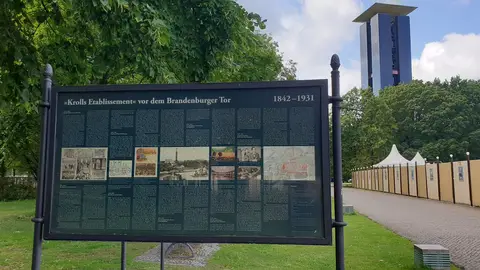

Kroll Opera (site)
Platz der Republik / Große Querallee, 10557 Berlin-Tiergarten
- Then
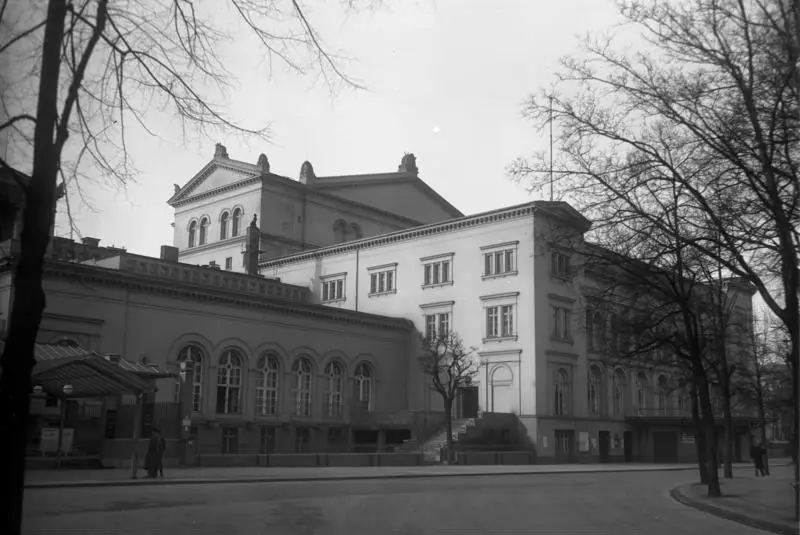
- The Kroll Opera’s festival hall, where the congress “Das Freie Wort” met on 19 February 1933 until the police dissolved it.8
- Today
- Nothing of the building remains: the war-damaged ruin was blown up from 1951 and the last remains cleared in 1957. A blue information panel unveiled in 2007 at the end of the Große Querallee, facing the Carillon, marks the site and tells its history.
More pictures

Sources
- Report on the congress „Das Freie Wort“ and the Volksbühne rally Volksblatt. Organ der Sozialdemokratischen Partei (Solingen), via Deutsche Digitale Bibliothek Zeitungsportal, 21 February 1933, p. 7
- „Freie Wort“ polizeilich aufgelöst; death of Karl Strecker Freiberger Anzeiger und Tageblatt, via Deutsche Digitale Bibliothek Zeitungsportal, 21 February 1933, p. 5 (reports dated Berlin, 19 and 20 February)
- Kongreß „Das freie Wort“ aufgelöst Godesberger Volkszeitung, via Deutsche Digitale Bibliothek Zeitungsportal, 20 February 1933, p. 2
- Zentrumspresse-Verbot aufgehoben; Die KPD wird nicht verboten (Frick in Dresden); Hitlers Wahlrede in Köln; Kundgebung des Reichsbanners; ADAC-Hauptversammlung; hockey Kölnische Zeitung, via Deutsche Digitale Bibliothek Zeitungsportal, 20 February 1933, morning edition, pp. 1–3
- Wiederkehr des Winters Vorwärts, via Deutsche Digitale Bibliothek Zeitungsportal, 23 February 1933, p. 3
- Die 30. Hauptversammlung. Der Reichsverkehrsminister spricht Hamburger Fremdenblatt (Reichsausgabe), via Deutsche Digitale Bibliothek Zeitungsportal, 20 February 1933, p. 3
- Deutschland schlägt Polen 2:0 Badische Presse (Karlsruhe), via Deutsche Digitale Bibliothek Zeitungsportal, 20 February 1933, p. 9
- Geschichtszeugnis Kroll-Oper 1931–1957 Gedenktafeln in Berlin (Aktives Museum Faschismus und Widerstand in Berlin / Gedenkstätte Deutscher Widerstand)
Spotted a mistake? Send a correction.