Day 2 of 100
Talks with the Centre Party fail and the cabinet settles on new elections
Hitler met the leaders of the Catholic Centre Party, failed to win their consent to a year-long adjournment of the Reichstag, and told his cabinet that new elections were unavoidable; he promised that they would be the last. A presidential decree handed Papen the Reich’s powers over Prussia. In Berlin the flu epidemic accelerated, and Ufa’s U-boat film Morgenrot had its premiere in Essen.
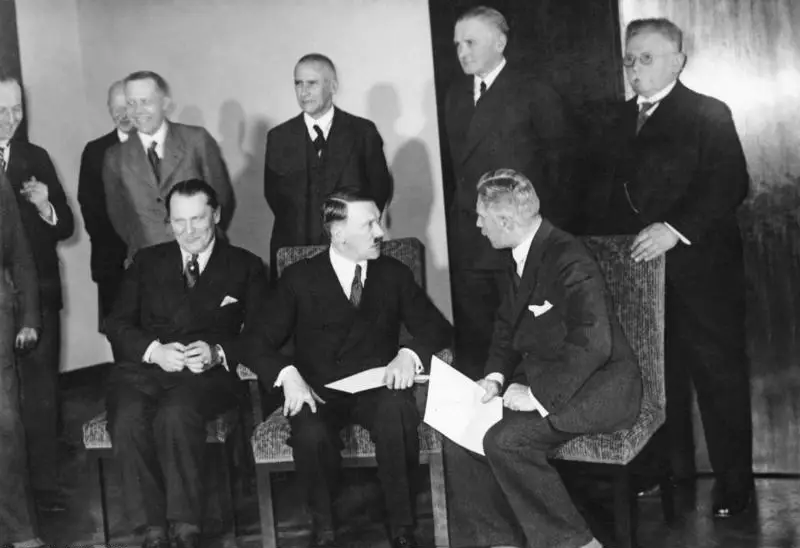

The new government had no majority in the Reichstag, which was due to reconvene. On the morning of 31 January Hitler, with Frick, received Prelate Ludwig Kaas and Heinrich Perlitius of the Centre Party. They would not join the cabinet and would agree to adjournments of at most two months at a time; Kaas then sent a list of written questions about the government’s programme. Hitler told the cabinet that afternoon that further talks were pointless and that he expected to win 51 per cent at new elections.
The minutes record that Vice-Chancellor Papen proposed fixing now that the coming election would be the last and that a return to parliamentary government should be ruled out for good. Hitler then gave two binding undertakings: the result would not change the cabinet’s composition, and this election would be the last. The coalition partners who had expected to contain Hitler were thus agreeing, on the second day, to an election intended to end elections.
Laws and decrees
Verordnung des Reichspräsidenten über den Reichskommissar für das Land Preußen
Decree of the Reich President on the Reich Commissioner for Prussia
Transferred to Vice-Chancellor Franz von Papen the powers over Prussia that the decree of 20 July 1932 (the “Prussian coup” that deposed the elected Prussian government) had given the Chancellor as Reich Commissioner. Signed by Hindenburg, Hitler and Frick, it took effect retroactively from 30 January.4,1
Politics and power
Government, terror and persecution
-
Government morning, Berlin, Reich Chancellery
Hitler meets the Centre Party leaders
In the morning Hitler and Frick met Prelate Ludwig Kaas and Heinrich Perlitius of the Centre Party. The Centre would not enter the government; it might tolerate it, but would only agree to adjourn the Reichstag for up to two months at a time, not for a year as Hitler asked. Kaas promised written questions, which arrived during the afternoon; Hitler judged that a detailed answer would take weeks and gave none.1
-
Government 16:00, Berlin, Reich Chancellery
Cabinet resolves on dissolution and “last” elections
At the 16:00 cabinet meeting Hitler reported that talks with the Centre had failed and that new elections were unavoidable. Papen proposed deciding at once that the coming election would be the last; Hitler pledged that the result would not alter the cabinet and that a return to the parliamentary system must be avoided. Hugenberg urged the removal of the remaining Social Democratic government of Otto Braun in Prussia, and the cabinet agreed in principle.1
-
Opposition
SPD leadership calls for unity but stays within the constitution
A special edition of the Vorwärts carried a statement by the SPD executive and Reichstag group calling on all working people to unite against the Hitler–Papen–Hugenberg government, which it described as a concentration of big business and great landowners. The party declared that it would fight on the basis of the constitution and resist any unconstitutional use of power with every means.2
-
Military early morning, Berlin
Hitler speaks unannounced in Berlin barracks
According to the British historian John Wheeler-Bennett, cited by the editors of the Liebmann notes, Hitler went early on 31 January to several Berlin barracks and spoke to the troops without the officers’ knowledge. The army commander General Kurt von Hammerstein-Equord, troubled by this, then invited Hitler to meet the senior commanders at his home on 3 February.3
Everyday life
What else was happening in Germany
-
Society Berlin
Flu cases in Berlin treble in a day
The city’s general health insurance fund (AOK) registered 572 new influenza cases between Monday and Tuesday midday, against 150 to 200 a day at the end of the previous week. The Vorwärts compared the curve with the epidemic of 1928–29, which had peaked at 1,643 new cases on a single day in mid-January 1929.5
-
Film Essen, Schauburg
Morgenrot opens in Essen
Ufa’s submarine drama Morgenrot, directed by Gustav Ucicky from a script by Gerhard Menzel, with Rudolf Forster as the U-boat commander and Adele Sandrock as his mother, had its premiere at the Schauburg cinema in Essen. The censors had first refused the film on 20 January and passed it on 26 January; its Berlin premiere was set for 2 February.6
Voices
It would be best to establish now that the coming Reichstag election should be the last, and that a return to the parliamentary system is to be avoided for ever.
Elsewhere in the world
More pictures

_%E2%80%93_National_Portrait_Gallery,_London.jpg)
Sources
- Akten der Reichskanzlei. Regierung Hitler 1933–1945, Bd. I, Nr. 2: Ministerbesprechung vom 31. Januar 1933, 16 Uhr Bundesarchiv / Historische Kommission bei der Bayerischen Akademie der Wissenschaften, R 43 I/1459, S. 247–252, items 1–2 with notes 1–11
- Akten der Reichskanzlei. Regierung Hitler 1933–1945, Bd. I, Nr. 1: Ministerbesprechung vom 30. Januar 1933, 17 Uhr Bundesarchiv / Historische Kommission bei der Bayerischen Akademie der Wissenschaften, note 7 (Vorwärts special edition of 31 January)
- Thilo Vogelsang, ‘Neue Dokumente zur Geschichte der Reichswehr 1930–1933’, Vierteljahrshefte für Zeitgeschichte 2 (1954), Heft 4 Institut für Zeitgeschichte München, p. 434, note 127 (citing J. W. Wheeler-Bennett, The Nemesis of Power, p. 291)
- Verordnung des Reichspräsidenten über den Reichskommissar für das Land Preußen. Vom 31. Januar 1933 documentArchiv.de, RGBl. 1933 I S. 33
- Vorwärts, Morgenausgabe Nr. 53, 1 February 1933 Deutsche Digitale Bibliothek, Zeitungsportal, p. 3, 'Grippe wird bedrohlich'
- Morgenrot (1933) filmportal.de (Deutsches Filminstitut & Filmmuseum), Zensur 20.01.1933 Verbot, 26.01.1933 genehmigt; Uraufführung 31.01.1933 Essen, Schauburg
- Jahreschronik 1933 Deutsches Historisches Museum, LeMO, entries for 31 January
Spotted a mistake? Send a correction.