Themes

Taking power

Appointments, the cabinet, Hindenburg, and the government’s own moves.

40 days

  1. Day 1 Monday 30 January 1933

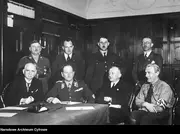
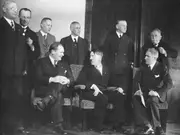
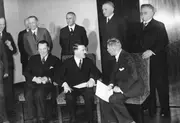
    Hindenburg appoints Hitler Reich Chancellor at the head of a coalition cabinet

    Reich President Paul von Hindenburg appointed Adolf Hitler Reich Chancellor of a cabinet in which only two other National Socialists sat. That evening SA, SS and Stahlhelm columns carried torches through the government quarter, and late that night a police officer and an SA man were shot dead in Charlottenburg. Elsewhere in Berlin a flu epidemic was closing school classes and the police caught two long-sought robbers.
  2. Day 2 Tuesday 31 January 1933

    Talks with the Centre Party fail and the cabinet settles on new elections

    Hitler met the leaders of the Catholic Centre Party, failed to win their consent to a year-long adjournment of the Reichstag, and told his cabinet that new elections were unavoidable; he promised that they would be the last. A presidential decree handed Papen the Reich’s powers over Prussia. In Berlin the flu epidemic accelerated, and Ufa’s U-boat film Morgenrot had its premiere in Essen.

  3. Day 3 Wednesday 1 February 1933

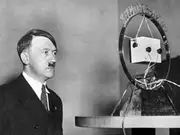
    Reichstag dissolved and Hitler asks the nation for four years in his first radio address

    At Hitler’s request Hindenburg dissolved the Reichstag and set new elections for 5 March. The cabinet agreed to make life harder for new parties, and at 22:00 every German station broadcast the government’s “Appeal to the German People”, read by Hitler. In Berlin a damp spell drove the flu epidemic higher, a new bus route opened to Lankwitz, and a landlord collecting rents in Pankow was shot dead by car-borne robbers.
  4. Day 5 Friday 3 February 1933

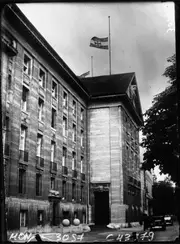
    Hitler tells the army chiefs of “living space in the East” as the Vorwärts is banned

    At a dinner in the army commander’s residence in the Bendlerstraße, Hitler spoke for two and a half hours to the generals and admirals, naming rearmament, conscription and perhaps the conquest of “living space in the East” as his aims. The Berlin police banned the Social Democratic Vorwärts for four days, and the cabinet approved its emergency decree. Two new films opened, one a Frederick the Great epic, the other a Berlin underworld comedy by Richard Oswald.

  5. Day 7 Sunday 5 February 1933

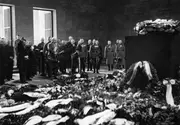
    A state funeral in Berlin Cathedral for an SA leader and a police officer

    Hitler and Göring attended a state funeral in Berlin Cathedral for the SA leader Hans Maikowski and police officer Josef Zauritz, killed on the night of 30 January; the radio carried the ceremony. That night SA men raided a Communist pub in Friedenau and shot its landlady, Anna Röder, dead, and in Staßfurt the mayor Hermann Kasten died of his wounds. Berliners saw the first motor-paced cycle races in the Sportpalast.

  6. Day 10 Wednesday 8 February 1933

    Hitler tells the cabinet rearmament comes first: “everything for the armed forces”

    In cabinet Hitler declared that rearmament must come first in every public works decision for the coming years, and advised ministers to say nothing specific about economic policy before the election. A decree sharply raised the duties on imported livestock, meat and lard. In Staßfurt thousands of workers downed tools to bury their murdered mayor. Berlin’s six-day cycle race was postponed because of the election, and the motoring clubs cancelled their rally to the motor show.

  7. Day 11 Thursday 9 February 1933

    Hitler wants the job-creation programme to serve as cover for rearmament

    In the cabinet’s work-creation committee Hitler declared that Germany’s future depended solely on rebuilding the armed forces and that public works money should help to disguise rearmament; the committee gave the army the largest single share. Württemberg protested at party rallies being broadcast as government programmes. On Berlin’s radio a spokesman for the German cities argued that the unemployed should be left wholly to the municipalities, and new flu cases began to fall.

  8. Day 13 Saturday 11 February 1933

    Hitler opens the Berlin motor show, promising tax relief and a road-building plan

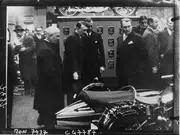
    Walking past ranks of SA men, Hitler opened the International Automobile and Motorcycle Exhibition at the Kaiserdamm, the first Chancellor, the industry noted, ever to do so, and promised motorists lower taxes, a great road-building plan and support for motor sport. That evening the radio carried Hugenberg’s speech to the new German Nationalist and Stahlhelm alliance in the Sportpalast. In a Berlin dairy shop, a milkman told a customer that half the street was living on potatoes.

  9. Day 15 Monday 13 February 1933

    Göring widens the purge of Prussia’s republican police chiefs

    Göring, as Reich Commissioner for the Prussian Ministry of the Interior, sent more officials loyal to the Republic on forced leave, among them the police presidents of Dortmund, Oberhausen, Stettin, Frankfurt and Breslau. The Stahlhelm told its members the coming election was a plebiscite on the “national government”. Away from politics, Bayreuth marked the fiftieth anniversary of Richard Wagner’s death and Berlin radio filled the evening with his operas.

  10. Day 18 Thursday 16 February 1933

    The states protest in the Reichsrat as Göring vows no Social Democrat will stay in office

    In the Reichsrat Bavaria and the southern states protested against Prussia being represented by Göring’s and Papen’s appointees and voted to limit the chamber to urgent business until the constitutional court had ruled. That evening Göring told journalists that no Social Democrat would be tolerated in the Prussian administration. The Reichsgericht lifted an earlier ban on Vorwärts, and the cabinet discussed taking away the court’s power to do so. At the Sportpalast the American ice hockey team beat Germany 7–2.

  11. Day 19 Friday 17 February 1933

    Göring orders the Prussian police to shoot and promises to cover them

    Göring sent all Prussian police authorities a circular telling them to cooperate with the SA, SS and Stahlhelm, to act against “enemies of the state” with the harshest means and to use their firearms without hesitation, promising to cover any officer who did. The Bavarian People’s Party leader Fritz Schäffer warned Hindenburg against Reich commissioners in the states, and uniformed students broke up an examination at the State Art School in Schöneberg. In the evening 4,000 people watched boxing at the Sportpalast.

  12. Day 22 Monday 20 February 1933

    Hitler and Göring ask leading industrialists to pay for the election

    At Göring’s official residence opposite the Reichstag, Hitler told about two dozen leading industrialists and bankers that private enterprise could not survive in a democracy; Göring added that the coming election would surely be the last for ten years, perhaps a hundred, and Hjalmar Schacht proposed a three-million-mark election fund. The same day the Prussian press service released Göring’s “shooting decree”. Göring also banned the sale of spirits on polling days, and the perjury trial of a former Berlin transport director in the Sklarek scandal opened to packed public benches.

  13. Day 24 Wednesday 22 February 1933

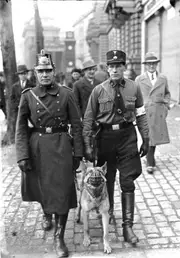
    Göring makes the SA, SS and Stahlhelm an auxiliary police in Prussia

    Göring signed a decree allowing the Prussian police to call up “auxiliary police” from the ranks of “nationally minded” Germans: in practice men of the SA, SS and Stahlhelm, wearing a white armband over their own uniforms and holding full police powers while on duty. The Prussian commissioners pensioned off another wave of senior officials and began closing the secular schools, and Hitler told his followers that the enemy to be beaten on 5 March was “Marxism”. In Berlin the first film directed by Friedrich Hollaender, Ich und die Kaiserin, opened at the Gloria-Palast.

  14. Day 29 Monday 27 February 1933

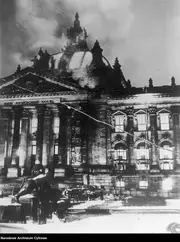
    The Reichstag burns, and the Nazi leadership blames a Communist uprising

    On the evening of Monday 27 February the Reichstag building in Berlin was set alight; a young Dutchman, Marinus van der Lubbe, was arrested inside, and before the night was out Göring had declared the fire the signal for a Communist revolt, banned the left-wing press in Prussia and ordered arrests. Earlier that day the cabinet had approved a harsh new decree against ‘treason’, and SA men had fired into the flat of a Social Democratic deputy in Neukölln. In Cologne the Rosenmontag carnival procession went ahead in the sunshine.

  15. Day 30 Tuesday 28 February 1933

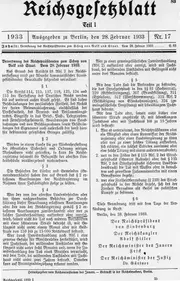
    The Reichstag Fire Decree suspends basic rights ‘until further notice’

    The morning after the fire the cabinet met twice, and by the end of the day Hindenburg had signed and the government had published the decree ‘for the protection of people and state’, which suspended the Weimar constitution’s guarantees of personal liberty, free speech, a free press and assembly. Across Prussia the police and their SA auxiliaries arrested Communists and left-wing intellectuals, among them Carl von Ossietzky and Hans Litten, and the SA hoisted the swastika over the Communist headquarters. It was Shrove Tuesday: Cologne’s carnival corps paraded once more, while in Berlin Göring had the museums closed.
  16. Day 32 Thursday 2 March 1933

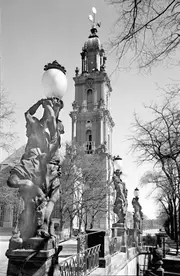
    Cabinet picks Potsdam’s Garrison Church for the opening of the new Reichstag

    With the Reichstag a burnt shell, the cabinet agreed that the new parliament should be opened in the Garrison Church at Potsdam, the germ of the ‘Day of Potsdam’. Göring told ministers of an alleged Communist plan of attack and complained of foreign papers accusing him of the fire; Hitler said the outcry would have died if the arsonist had been hanged at once. To win votes, the cabinet agreed to hand out cheap bread and butter to the unemployed in distressed areas. That evening Hitler spoke in the Sportpalast before members of the diplomatic corps, while in Bremen a Reichsbanner man died after a night of shooting.

  17. Day 35 Sunday 5 March 1933

    Reichstag election under the emergency decree: 43.9 per cent for the NSDAP

    On a grey, rainy Sunday nearly 89 per cent of Germany’s voters went to the polls in an election held under the emergency decree, with Communist leaders in prison or in hiding and the left-wing press silenced. The NSDAP won 43.9 per cent, short of an absolute majority, but with the nationalist ‘Combat Front Black-White-Red’ the government had a majority of seats; the Social Democrats held 18.3 per cent and the Communists 12.3. That night the Reich interior minister ordered Hamburg’s police handed to a Nazi, and SA men raised the swastika on town halls. In Hamburg, Altona 93 won the city football championship in the rain.

  18. Day 37 Tuesday 7 March 1933

    Hitler tells the cabinet the election was a ‘revolution’ and calls for an Enabling Act

    Two days after the election Hitler told his ministers that 5 March had been a revolution, that Marxism would disappear and that an Enabling Act with a two-thirds majority was needed; he and Frick demanded that van der Lubbe be hanged, retroactively if need be. At Hindenburg’s residence the Reichstag’s opening in Potsdam’s Garrison Church was planned in detail. In Dresden, Nazi supporters whistled the conductor Fritz Busch off the podium of the State Opera. Abroad, Dollfuss began governing Austria without parliament, and the Netherlands reinforced its border against German refugees.

  19. Day 39 Thursday 9 March 1933

    Bavaria falls: General von Epp made Reich commissioner over Held’s refusal

    After a day of pressure in Munich from Röhm, Gauleiter Wagner and Himmler, and with the Bavarian government refusing their demands, the Reich used the Reichstag Fire Decree to hand the powers of Bavaria’s government to General Ritter von Epp; Württemberg protested to Hindenburg against the same treatment. In Berlin the Reich Chancellery, on Hitler’s behalf, asked Frick to prepare ‘völkisch’ laws against Eastern European Jews. In Washington Roosevelt signed the Emergency Banking Act. Dresden’s opera, its music director just driven out, staged Graener’s Friedemann Bach.

  20. Day 41 Saturday 11 March 1933

    Cabinet agrees a propaganda ministry; SA drive Jewish lawyers from Breslau’s courts

    At Hitler’s insistence the cabinet agreed to create a Reich Ministry for Popular Enlightenment and Propaganda, expected to go to Goebbels. On the eve of Remembrance Day and the Prussian local elections, SA men and crowds forced department stores and chain stores to close in Hamburg, Breslau, Frankfurt and other cities, and in Breslau SA men ordered Jewish judges and lawyers out of the courts. Magdeburg’s mayor and union leaders in Bochum were taken into ‘protective custody’ (Schutzhaft, imprisonment without trial). Hitler spoke at a rally broadcast from Berlin, and in Cologne a play about front-line soldiers had its first local performance.

  21. Day 42 Sunday 12 March 1933

    Hindenburg puts the swastika beside black-white-red; Hitler orders ‘blindest discipline’

    On Remembrance Day, with black-white-red flags at half-mast, Hindenburg decreed that from the next day the old imperial flag and the swastika flag were to be flown together on public buildings. Hitler announced the decree on the radio and told the SA and SS that the struggle to ‘cleanse’ the Reich would now be directed from above and that all individual actions must stop. Hindenburg and Hitler attended the Volksbund ceremony in the State Opera in Berlin. In Prussia’s municipal and provincial elections the government parties won majorities in most places, including Berlin. In Washington Roosevelt gave his first fireside chat.

  22. Day 43 Monday 13 March 1933

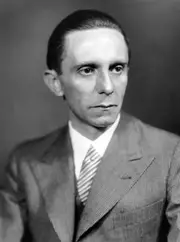
    Goebbels appointed Reich Minister for Popular Enlightenment and Propaganda

    Hindenburg signed the decree creating a Reich Ministry for Popular Enlightenment and Propaganda and appointed Joseph Goebbels, the Nazi Party’s propaganda chief, as its minister. In Prussia, Göring suspended the mayors of Cologne, Frankfurt, Magdeburg, Altona and Kiel and several Berlin city councillors. In Berlin the manslaughter trial of a banker accused of shooting his wife, the soprano Gertrud Bindernagel, opened before packed public benches.
  23. Day 44 Tuesday 14 March 1933
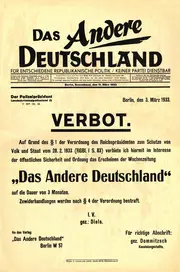
    The Weltbühne banned for six months as Goebbels is sworn in

    Berlin’s police president banned the left-wing weekly Die Weltbühne for half a year, Munich banned Das Tage-Buch, and the ban on the Social Democratic press in Prussia was extended overnight. Hindenburg swore in Goebbels as Propaganda Minister, while the Berlin papers reported that Theodor Wolff and Rudolf Olden had left for Paris. The Reichsbahn announced spring track work for some 90,000 men, and in London the Hamburg-born operetta star Anny Ahlers died after a fall.

  24. Day 46 Thursday 16 March 1933

    Schacht returns to the Reichsbank; Bruno Walter’s Leipzig concert is banned

    Hans Luther resigned as president of the Reichsbank and its General Council unanimously elected Hjalmar Schacht in his place. In Leipzig the police, on the orders of Saxony’s Interior Ministry, forbade the conductor Bruno Walter’s Gewandhaus concert that evening. In Berlin Max Ophüls’s film Liebelei opened at the Atrium and the Titania-Palast, and Hitler promised the organisers of the 1936 Olympic Games his support.

  25. Day 50 Monday 20 March 1933

    Himmler announces the first concentration camp, at Dachau; cabinet adopts the Enabling Act

    At a midday press briefing in Munich, Heinrich Himmler announced that a concentration camp for 5,000 Communist, Reichsbanner and Social Democratic functionaries would open near Dachau on Wednesday. In Berlin Hitler met Centre Party leaders and the cabinet approved the final text of the Enabling Act, which went to the Reichstag as a bill. Berlin renamed Reichskanzlerplatz after Hitler, Jewish prosecutors were barred from courtrooms, Robert Siodmak’s last German film opened, and the publisher Louis Ullstein died.

  26. Day 51 Tuesday 21 March 1933

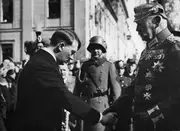
    The Day of Potsdam: the new Reichstag opens in the Garrison Church

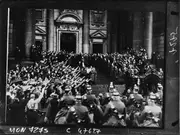
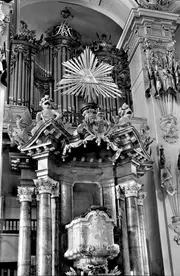
    The new Reichstag was opened with a state ceremony in Potsdam’s Garrison Church, where Hindenburg and Hitler spoke above the tombs of the Prussian kings. In the afternoon the deputies met in Berlin’s Kroll Opera House and re-elected Göring as president, and in the evening a torchlight procession filled the city centre while Wagner’s Meistersinger was performed at the State Opera. The same day Hindenburg signed decrees creating special courts, punishing ‘malicious’ criticism of the government and amnestying crimes committed for the ‘national uprising’.

  27. Day 53 Thursday 23 March 1933

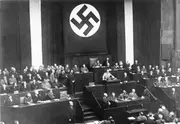
    The Reichstag passes the Enabling Act; only the Social Democrats vote against

    In the Kroll Opera House, ringed by the SS and watched from inside by armed SA men, the Reichstag passed the Enabling Act, giving Hitler’s government the power to make laws without parliament. Otto Wels explained the Social Democrats’ ‘no’; the Centre and the smaller middle parties voted yes. The former Prussian interior minister Karl Severing was arrested on his way into the building, and the Reichsrat gave its consent that evening.

  28. Day 54 Friday 24 March 1933

    Hindenburg signs the Enabling Act; it is published and takes effect the same day

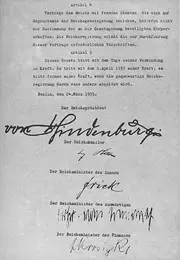
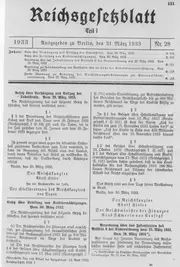
    Hindenburg signed the ‘Law to Remedy the Distress of People and Reich’, countersigned by Hitler, Frick, Neurath and Schwerin von Krosigk; it was printed in the Reichsgesetzblatt that evening and came into force on promulgation. The Centralverein, the largest Jewish organisation, denied foreign atrocity reports while acknowledging ‘political excesses’ against Jews. Labour exchanges counted about 5.9 million unemployed, and a Berlin jury sentenced the banker Hintze to twelve years for killing the singer Gertrud Bindernagel.

  29. Day 59 Wednesday 29 March 1933

    Retroactive death-penalty law signed; Ufa resolves to part with its Jewish staff

    Back from Munich, Hitler told his ministers that the boycott of Jewish businesses had to be organised, and the cabinet discussed the bill to ‘coordinate’ the states. A law dated this day made the death penalty retroactive, clearing the way to hang the alleged Reichstag arsonist. In the film world the censors banned Fritz Lang’s Das Testament des Dr. Mabuse, and Ufa’s board decided in principle to end its contracts with Jewish employees.

  30. Day 60 Thursday 30 March 1933

    Streicher’s committee issues its boycott orders; SPD leader Wels quits the International

    In Munich Julius Streicher’s boycott committee met for the first time and sent out its orders to local branches, while Nazi deputies in Prussia demanded that all Jewish teachers be removed from schools. Hindenburg received Hitler and Papen, the nationalist Ernst Oberfohren gave up his Reichstag seat and Otto Wels left the bureau of the Socialist International. Prussia tightened its rules for dance halls, and the government confirmed a national census for June.

  31. Day 71 Monday 10 April 1933

    Hitler signs the law turning 1 May into a state ‘Holiday of National Labour’

    Hitler, Frick and Goebbels signed a law making 1 May, the labour movement’s own day, a public holiday under state control, while the official gazette published the law allowing Jewish lawyers to be struck off. Franz Ritter von Epp was appointed Reich governor of Bavaria, and in Rome Papen met Cardinal Pacelli and Mussolini as Göring flew in. On a rainy Monday in Berlin, radio listeners could hear Furtwängler conduct the Eroica, and the theatre director Viktor Barnowsky left the Komödienhaus.

  32. Day 72 Tuesday 11 April 1933

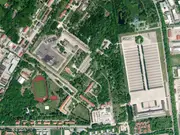
    Police and SA search and seal the Bauhaus in Berlin-Steglitz

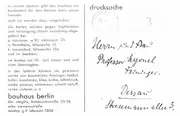
    Police and SA searched the Bauhaus school in its converted telephone factory in Berlin-Steglitz, sealed the building and arrested 32 students; the school never taught there again. The first implementing ordinance of the Civil Service law defined anyone with a single Jewish grandparent as ‘non-Aryan’, Göring was named Prussian Minister President, and the SS took over the Dachau camp. Newspapers printed Goebbels’s reply to the conductor Wilhelm Furtwängler, who had objected to artists such as Bruno Walter being driven from the platform, and most Jewish members of the Berlin club Tennis Borussia left it.

  33. Day 81 Thursday 20 April 1933

    Hitler’s 44th birthday: flags across Berlin and the premiere of Johst’s ‘Schlageter’

    For Hitler’s 44th birthday Berlin put out flags almost as for the Day of Potsdam, a flag parade marched past the Interior Ministry on Unter den Linden, and Bavaria made Hindenburg, Hitler, Epp and Röhm honorary citizens; Hitler himself stayed in Bavaria. Prussia marked the day by turning three cadet schools into ‘national-political education institutes’ and by withdrawing Theodor Lessing’s research post, while the party announced a ban on new members from 1 May. That evening the State Theatre gave the premiere of Hanns Johst’s Nazi drama ‘Schlageter’ before Goebbels, Frick and Rust.

  34. Day 82 Friday 21 April 1933

    Kosher slaughter banned across the Reich; Hess named Hitler’s deputy in the party

    A Reich law banning the slaughter of animals without prior stunning, and with it Jewish ritual slaughter, was signed and published, and Hitler named Rudolf Hess his deputy in the NSDAP. In Berlin the Reichskanzlerplatz became Adolf-Hitler-Platz, the university’s rector objected to the students’ anti-Jewish theses, and police officials put the number of Communists in custody at 18,000; in Freiburg, Heidegger was elected rector. On the Rot-Weiss courts the visiting King of Sweden played doubles with Daniel Prenn, Germany’s leading player, whom the press already expected to be replaced in the Davis Cup team.

  35. Day 87 Wednesday 26 April 1933

    Göring’s Prussia creates the Secret State Police Office, the Gestapo

    A Prussian law dated 26 April set up the Secret State Police Office (Geheimes Staatspolizeiamt, Gestapa) under Göring as interior minister, separating political policing from the ordinary administration; Rudolf Diels led it. The same day the Social Democrats held a Reich conference in their group’s rooms in the Reichstag building and elected Otto Wels and Hans Vogel as chairmen. Goebbels toured the Ufa film studios at Neubabelsberg, and in Munich Arno Penzias, a future Nobel laureate, was born into a Jewish family.

  36. Day 88 Thursday 27 April 1933

    Seldte joins the Nazi Party; ex-deputy Albert Funk dies in police custody

    In an evening radio address the Stahlhelm leader and Reich Labour Minister Franz Seldte announced that he was joining the Nazi Party and placing himself under Hitler. In Recklinghausen the Communist former Reichstag deputy Albert Funk died after interrogation and abuse at police headquarters. Hitler asked towns to stop renaming historic streets after him, and at Berlin Zoo a small boy lost his forearm to a bear.

  37. Day 91 Sunday 30 April 1933

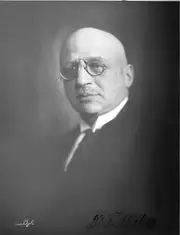
    Fritz Haber resigns rather than dismiss his Jewish staff

    The Nobel chemist Fritz Haber, told to dismiss the “non-Aryan” members of his Kaiser Wilhelm Institute in Dahlem, asked instead to be retired; though exempt himself as a war veteran, he refused to choose staff by race. In the Reich Labour Ministry, Seldte proclaimed his “dictatorial” leadership of the Stahlhelm and its leaders pledged allegiance to Hitler. It was a showery Sunday in Berlin; 12,000 people watched Hertha BSC win a nine-goal match, and seven miners died in an explosion near Essen.

  38. Day 92 Monday 1 May 1933

    The “Day of National Labour”: Hitler addresses a vast crowd on the Tempelhofer Feld

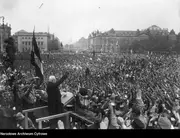
    For the first time 1 May was a paid public holiday, renamed by the regime the “Day of National Labour”. Hindenburg spoke to schoolchildren and youth groups in the Lustgarten, workers’ delegations flown in from across Germany and Austria were received at the Reich Chancellery, and in the evening Hitler announced compulsory labour service to a crowd on the Tempelhofer Feld put at one to one and a half million. Fireworks, a torchlight march and Göring’s midnight speech in the Lustgarten closed a day of spring sunshine, while Robert Ley’s committee prepared the next morning’s seizure of the trade unions.

  39. Day 93 Tuesday 2 May 1933

    SA and SS occupy the trade union offices across Germany; union leaders arrested

    At ten in the morning, the day after the “Day of National Labour”, SA and SS men occupied every building of the free trade unions in Germany, together with their newspapers and their bank. Theodor Leipart, Peter Graßmann and other leaders were taken into “protective custody”, the unions’ property was seized and Nazi commissioners took over. In Duisburg four union officials were murdered. The Hoppegarten racecourse opened its season the same afternoon.

  40. Day 96 Friday 5 May 1933

    Seven Nazi Reich governors appointed to rule the states for Berlin

    On Hitler’s proposal Hindenburg appointed seven Reich governors (Reichsstatthalter), all of them Nazi leaders, for Württemberg, Baden, Saxony, Hesse, Bremen and Oldenburg, Anhalt and Brunswick, and Thuringia. The cabinet passed laws on tax advisers, sales premiums and a six-month freeze on new shops, and in Moscow Germany and the Soviet Union brought the extension of the Berlin Treaty into force. On the Avus the French racing driver Count Czaykowski set a world one-hour record of 213.8 km/h; Berlin’s Jewish community bulletin reported hundreds seeking help every day.