Day 35 of 100
Reichstag election under the emergency decree: 43.9 per cent for the NSDAP
On a grey, rainy Sunday nearly 89 per cent of Germany’s voters went to the polls in an election held under the emergency decree, with Communist leaders in prison or in hiding and the left-wing press silenced. The NSDAP won 43.9 per cent, short of an absolute majority, but with the nationalist ‘Combat Front Black-White-Red’ the government had a majority of seats; the Social Democrats held 18.3 per cent and the Communists 12.3. That night the Reich interior minister ordered Hamburg’s police handed to a Nazi, and SA men raised the swastika on town halls. In Hamburg, Altona 93 won the city football championship in the rain.
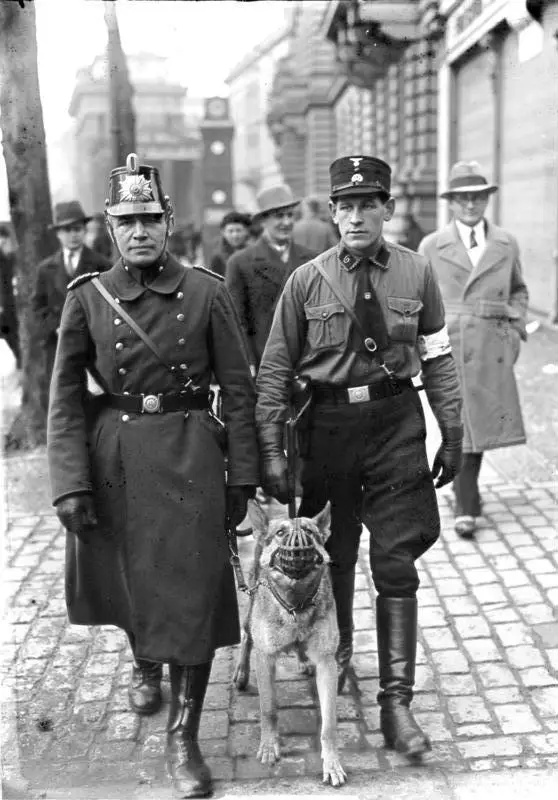

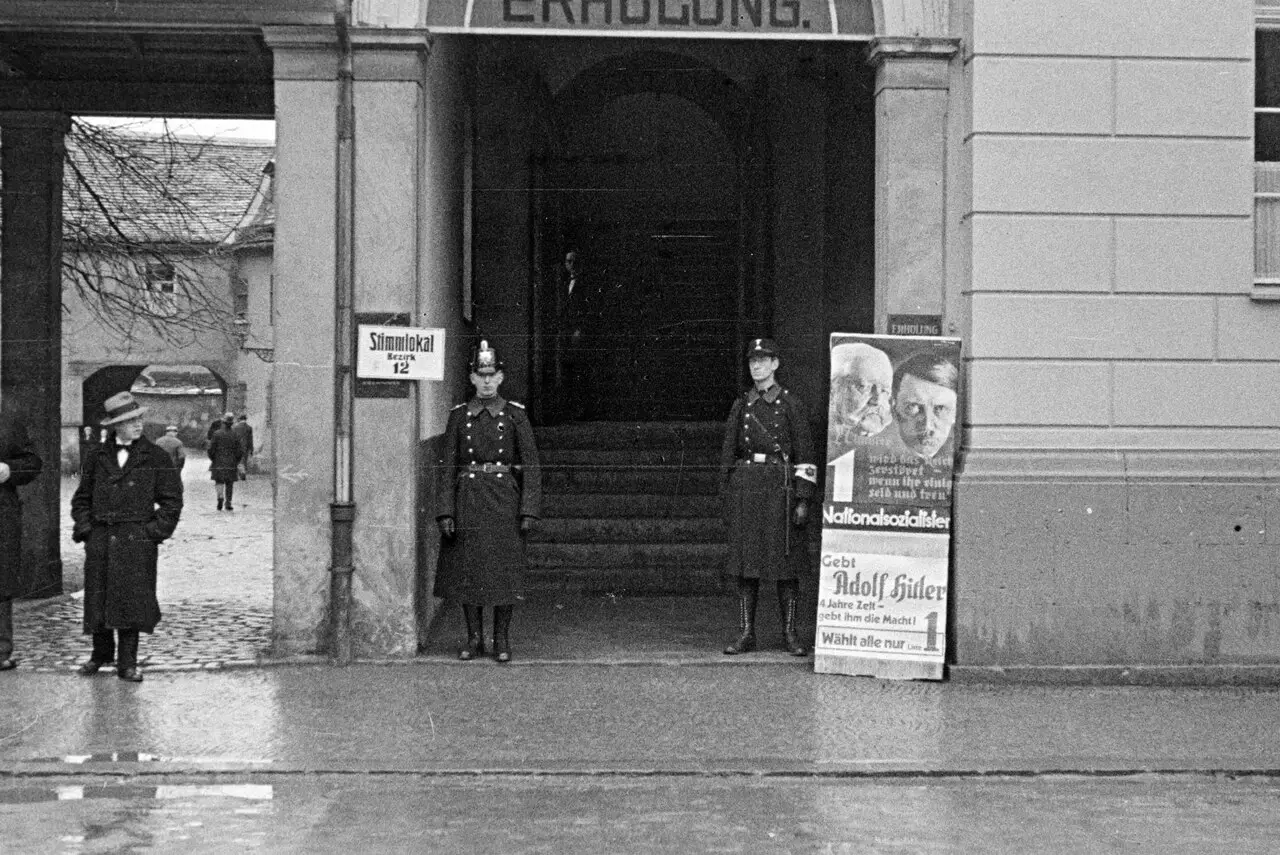
The election of 5 March 1933 was the last Reichstag election in which more than one party stood. It was not a free one. Since the Reichstag fire the Communist party’s leaders had been arrested or driven underground, its press and meetings banned, and the Social Democratic press in Prussia silenced; in Prussia some 50,000 members of the SA, SS and Stahlhelm served as ‘auxiliary police’. In Berlin the uniformed police carried carbines on polling day, and auxiliary policemen in brown uniforms with police greatcoats or white armbands patrolled the streets. House fronts showed black-white-red and swastika flags; only here and there in working-class districts did a red or black-red-gold flag appear.
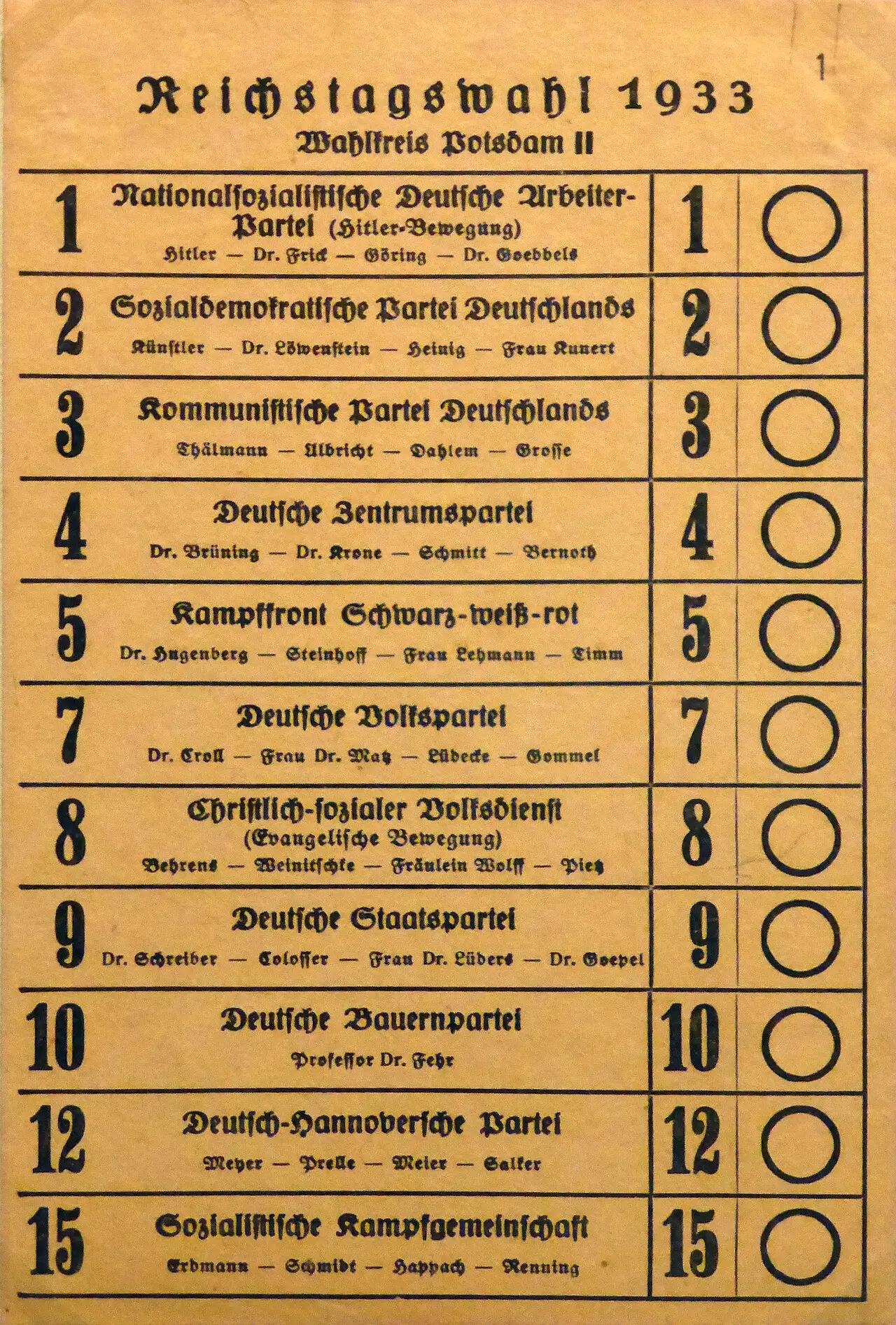
Turnout was 88.7 per cent. The NSDAP took 17.3 million votes, 43.9 per cent and 288 of 647 seats; with the 52 seats of the ‘Combat Front Black-White-Red’ (the German Nationalists and the Stahlhelm) the coalition had a narrow majority. The Social Democrats won 18.3 per cent and 120 seats, the Communists, campaigning from underground, 12.3 per cent and 81 seats, and the Catholic Centre 11.2 per cent. The simultaneous election to the Prussian Landtag gave a similar picture. For all the propaganda and terror, a majority of voters had not voted for Hitler’s party.
The leadership treated the result as a mandate for a ‘national revolution’. Hitler, who had flown back from Königsberg that afternoon and spent the evening at the theatre, waited for the results in the Reich Chancellery with Frick, Goebbels and Prince August Wilhelm of Prussia; he let it be known that the election would not change the composition of the government. In Hamburg, where the Social Democratic senators had resigned two days earlier, Frick used the Reichstag Fire Decree for the first time to intervene in a state: he ordered the city’s police handed over to the Nazi deputy Richter, and Mayor Petersen resigned. It was the start of the takeover of the states in the days that followed.
The Communist seats were never taken up: the mandates won on the Communist list were declared void by the law of 31 March on the ‘coordination’ of the states, and the new Reichstag, opened in Potsdam on 21 March, passed the Enabling Act two days later.
Politics and power
Government, terror and persecution
-
Election
Reichstag election: 43.9 per cent for the NSDAP
Of 44.7 million voters, 39.7 million voted. The NSDAP won 17,277,180 votes (43.9 per cent, 288 seats); the Social Democrats 7,181,629 (18.3 per cent, 120); the Communists 4,848,058 (12.3 per cent, 81); the Centre 4,424,905 (11.2 per cent, 73); the Combat Front Black-White-Red 3,136,760 (8.0 per cent, 52); and the Bavarian People’s Party 2.7 per cent (19 seats). The liberal and smaller parties shared the rest. Together the NSDAP and the Combat Front held 340 of 647 seats.1,2
-
Election 09:00 onwards, Berlin
Polling day in Berlin
Turnout in Berlin was heavy; by midday more than a third had voted and in the afternoon queues stretched into the streets. Hindenburg voted shortly after 9:00 at the ministers’ polling station in the Kanonierstraße, accompanied by State Secretary Meissner, and was cheered by the crowd; Neurath and Papen voted there too. In the afternoon 23 battalions of the Stahlhelm, 25,000 to 30,000 men, paraded through the city.4
-
The states evening and overnight, Hamburg; Altona
Hamburg’s police handed to the Nazis
After a day of negotiations with the Nazi party and the Reich, an official statement on Sunday evening announced that the Reich interior minister had ordered Hamburg’s police handed over at once to the Nazi Bürgerschaft deputy Richter; the Senate complied under formal protest and Mayor Petersen resigned. It was the first use of the second paragraph of the Reichstag Fire Decree against a state. Swastika and black-white-red flags went up on the police barracks in the Bundesstraße and the city hall, and the SA leader Böckenhauer spoke from the city hall balcony. After midnight SA men entered Altona’s town hall and raised the swastika on its roof.4,5,6
-
Terror Breslau; Hamburg; Kellinghusen
Shootings on election day
In Breslau an auxiliary policeman was killed and several people wounded at about 16:00 when a police patrol came under fire from houses and returned it. In Hamburg-Billstedt police shot and seriously wounded a Communist named Florczak who, they said, was carrying weapons and did not stop when challenged. In Kellinghusen in Holstein a Communist supporter was shot dead at about 21:00 by an unknown attacker.5,7
Everyday life
What else was happening in Germany
-
Weather
A dull, wet Sunday
The day dawned grey, rainy and quiet across much of Germany. In Hamburg the football authorities called off most of the weekend’s matches after heavy rain.5,7
-
Sport Hamburg
Altona 93 win the Hamburg championship
Before 12,000 spectators on the Rothenbaum ground, Altona 93 beat the Hamburger SV 2–1 after extra time on a heavy, sodden pitch to become Greater Hamburg’s football champions. HSV led at half-time; Altona equalised in the second half and scored the winner four minutes into extra time.5
-
Society Dresden
A lift to the polls
Parties offered cars to take voters who could not walk to the polling station and home again; in Dresden the German People’s Party and the Christian Social People’s Service published telephone numbers for the service.8
-
Economy Leipzig
The Leipzig spring fair opens on polling day
The Leipzig spring fair opened on the Sunday of the election. Reporters found the trade streets quieter than usual: the vote took precedence over buying and selling, and fear of unrest had kept many visitors away. Fewer firms were exhibiting than in 1929, the number of foreign exhibitors had fallen sharply, and the textile industry had almost halved its presence since the previous spring.4,9
Elsewhere in the world
-
Greece
Venizelos defeated at the polls
In parliamentary elections in Greece the government bloc led by Eleftherios Venizelos suffered a heavy defeat.5
More pictures

Sources
- Deutschland: Wahl zum 8. Reichstag 1933 (Wahlen in der Weimarer Republik) Andreas Gonschior, gonschior.de, after Statistisches Jahrbuch für das Deutsche Reich 1933, pp. 540ff.
- Reichstagswahl 1933 LeMO, Deutsches Historisches Museum
- Jahreschronik 1933 LeMO, Deutsches Historisches Museum, entries for 5 and 8 March
- Hamburgischer Correspondent, Abendausgabe, 6 March 1933 Deutsche Digitale Bibliothek, Zeitungsportal, p. 4, 'Der Wahltag in Berlin'; p. 5, Hamburg police and Altona town hall; p. 11, 'Eröffnung der Leipziger Messe'
- Hamburger Fremdenblatt, Reichsausgabe, Abend-Ausgabe Nr. 65, 6 March 1933 Deutsche Digitale Bibliothek, Zeitungsportal, p. 1 ('Tagesschau', Hamburg police); p. 3 (Hitler on election night); p. 5 (Billstedt, Kellinghusen); p. 10 (football)
- Gleichschaltung der Länder LeMO, Deutsches Historisches Museum
- Dresdner neueste Nachrichten, 6 March 1933 Deutsche Digitale Bibliothek, Zeitungsportal, p. 4, 'Am Morgen nach der Schlacht', 'Zusammenstöße in Breslau'
- Dresdner neueste Nachrichten, 5 March 1933 Deutsche Digitale Bibliothek, Zeitungsportal, p. 5, 'Wahlschleppdienst'
- Kölnische Zeitung, 6 March 1933 Deutsche Digitale Bibliothek, Zeitungsportal, p. 4, report from Leipzig, 5 March
Spotted a mistake? Send a correction.