Day 34 of 100
Election eve: Hitler speaks from Königsberg and Otto Braun leaves for Switzerland
On the eve of the election the Nazi party staged its ‘Day of the Awakening Nation’: Hitler flew to Königsberg and spoke there in a broadcast relayed to marching columns and loudspeakers across Germany. Otto Braun, the Social Democrat who had governed Prussia for most of the Weimar years, crossed the Swiss border that afternoon and did not come back. In Hamburg the Nazis demanded control of the police, in Vienna all three presidents of the Austrian parliament resigned, and in Washington Franklin D. Roosevelt took office. Hamburg’s port saw the season’s first Mediterranean cruise sail.

Saturday 4 March closed a campaign fought under the emergency decree, with Communist newspapers and meetings banned, the Social Democratic press in Prussia silenced and thousands in ‘protective custody’ (Schutzhaft, imprisonment without trial). The Nazi party turned the last evening into a national rally broadcast from Königsberg, the capital of East Prussia. On the same day the man who had embodied republican Prussia, Otto Braun, drove to Friedrichshafen and took the car ferry across Lake Constance into exile, and in Hamburg the Nazis pressed the remaining city government to hand them the police, a foretaste of what would follow the vote.
Politics and power
Government, terror and persecution
-
Propaganda 20:00, Königsberg; Berlin; Cologne
Hitler speaks in Königsberg to the whole country
Hitler flew from Hamburg to Königsberg, sending a greeting from the aircraft that the ‘fires of German freedom’ had always been lit in the east. The Haus der Technik, the city’s largest hall, was full by 18:00; his speech from 20:00 was carried by the radio and relayed by loudspeaker to rallies across the country, and ended with the Netherlands Thanksgiving hymn. In Berlin the SA and SS marched through the city and listened at 24 loudspeaker sites; in Cologne a torchlight procession wound through the old town after the broadcast.1,2,3
-
Opposition afternoon, Friedrichshafen
Otto Braun leaves Germany
Otto Braun, Prussian minister-president for most of the years from 1920 to 1932 until the Papen government removed him, drove to Friedrichshafen and in the afternoon took the car ferry to Romanshorn in Switzerland; his passport and papers were in order. People close to him said he was going, as every March, to Ascona for a cure with his wife, who had been severely paralysed for five years, and would come back to a border town to vote. He did not return, and spent the Nazi years in exile in Switzerland.5,6,7
Sources disagree. Police statements reported in the press put his crossing at 15:15 and at 15:45.
-
The states Hamburg
Nazis demand Hamburg’s police before the vote
After the Social Democratic police senator Schönfelder left the Senate, the Nazis demanded that their Bürgerschaft deputy Alfred Richter be put in charge of Hamburg’s police at once, before the election, and were reported to have threatened intervention by Reich Interior Minister Frick. The Senate refused, citing the city’s constitution, and declared that the police would keep order on election day. The commander of the uniformed police, Colonel Danner, went on leave at his own request; that evening a column of SA and Stahlhelm men marched to the police station below his flat in the Sierichstraße and hoisted the swastika and the black-white-red flag.1,4
-
Terror Berlin
More arrests; warrant against van der Lubbe
Berlin police arrested 110 people between Friday evening and Saturday morning, most of them Communists. An arrest warrant was issued against Marinus van der Lubbe for arson in four cases and preparation for high treason.1,2
Everyday life
What else was happening in Germany
-
Radio 17:00 to evening
An evening of Hitler on every station
Radio listeners were offered a live report of Hitler’s arrival at Königsberg airport at 17:00, his speech at 20:00 and a report on the SA and SS torchlight procession afterwards; in Berlin people gathered round loudspeakers in the streets.3
-
Transport Hamburg
First Mediterranean cruise of the season
The Hamburg-Amerika Line’s cruise ship Oceana left Hamburg on Saturday on the first of the year’s Mediterranean pleasure cruises, and the motor ship Orinoco reopened the line’s suspended passenger service to Cuba and Mexico. The weekend brought 130 ships into the port and saw 110 leave, a little busier than in recent weeks.4
-
Art midday, Hamburg
Chinese folk art at the Hamburg Museum of Ethnology
Professor Thilenius, the museum’s director, opened a special exhibition of Chinese folk culture at the Museum für Völkerkunde at midday, in the presence of city officials: puppets, theatre costumes, lanterns, door pictures and children’s toys collected in Nanking, Peking and Shanxi in 1932 by the museum’s curator and an assistant, together with portraits from the former imperial court.6
Voices
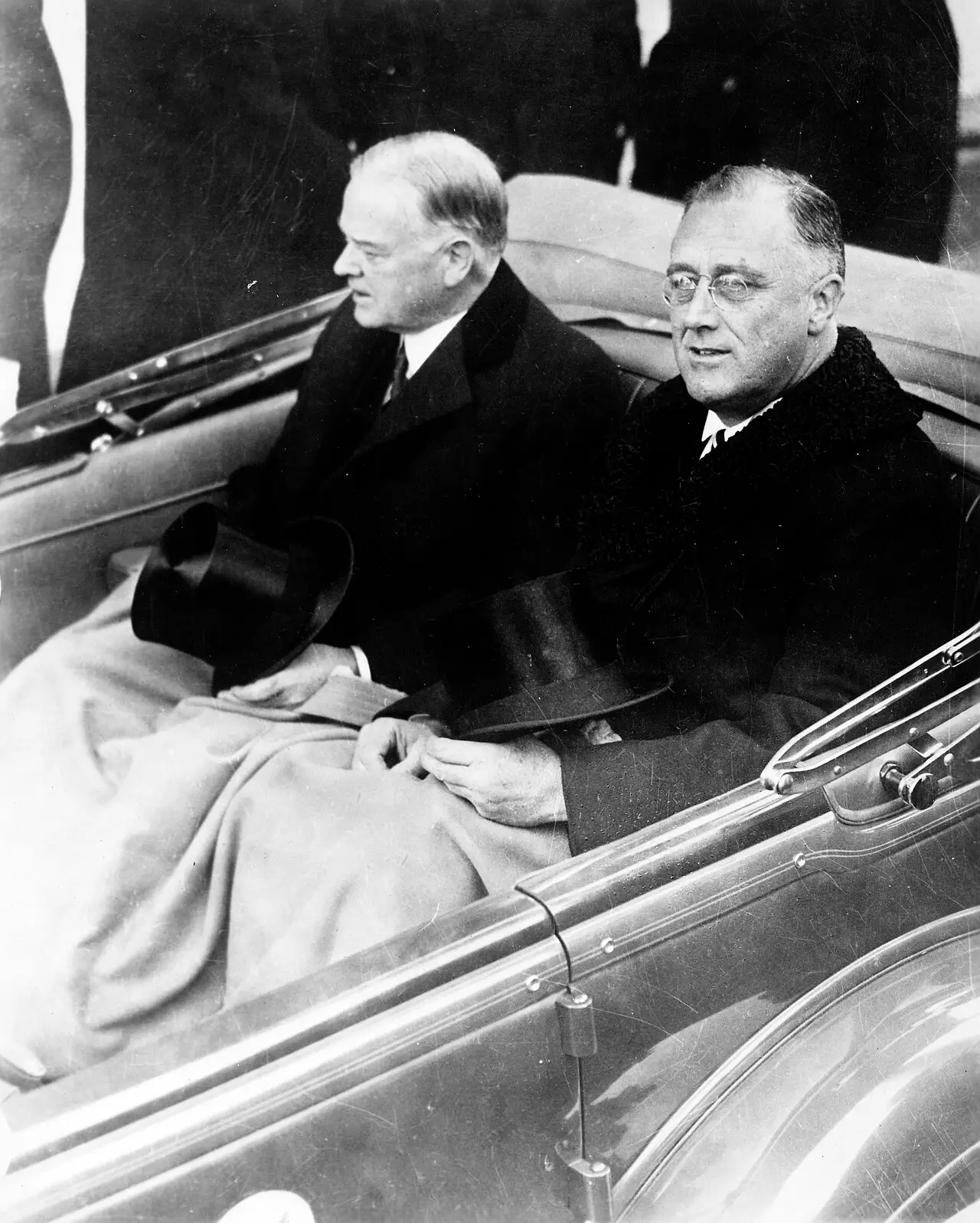
So, first of all, let me assert my firm belief that the only thing we have to fear is fear itself—nameless, unreasoning, unjustified terror which paralyzes needed efforts to convert retreat into advance.
Elsewhere in the world
-
Austria
The Austrian parliament leaderless
During a turbulent session of the National Council over a railway workers’ strike and a disputed vote, its president, the Social Democrat Karl Renner, resigned, followed by the second and third presidents, Rudolf Ramek and Sepp Straffner. The standing orders made no provision for this, and no one was entitled to call the next session. Chancellor Engelbert Dollfuss spoke of the parliament having ‘dissolved itself’ and used the crisis to shut it out and govern in authoritarian fashion.8,9
-
United States
Roosevelt takes office in the banking crisis
Franklin D. Roosevelt was sworn in as President in Washington, with banks closed or restricted across most of the country; German papers reported that only four states still had normal payments. In his inaugural address he promised ‘action, and action now’ and called for strict supervision of banking, credit and investment.1,10
More pictures


Sources
- Hamburger Fremdenblatt, Reichsausgabe, Nr. 64, 5 March 1933 Deutsche Digitale Bibliothek, Zeitungsportal, p. 1: 'Tagesschau' (Danner, van der Lubbe warrant, Austrian presidents, US banks), Hamburg Senate statement, 'Der Reichskanzler im deutschen Osten'
- Kölnische Zeitung, 5 March 1933 Deutsche Digitale Bibliothek, Zeitungsportal, p. 2, 'Wieder 110 Personen in Berlin festgenommen'; p. 9, Hitler in Königsberg and the Cologne rally
- Dresdner neueste Nachrichten, 5 March 1933 Deutsche Digitale Bibliothek, Zeitungsportal, p. 1 (Berlin marches and loudspeakers); p. 5, 'Königsberg im Rundfunk'
- Hamburger Fremdenblatt, Reichsausgabe, Abend-Ausgabe Nr. 65, 6 March 1933 Deutsche Digitale Bibliothek, Zeitungsportal, p. 6, 'Demonstration vor Oberst Danner'; p. 11, 'Beginn der Mittelmeerfahrten'
- Dresdner neueste Nachrichten, 6 March 1933 Deutsche Digitale Bibliothek, Zeitungsportal, p. 4, Otto Braun's departure (Friedrichshafen police statement)
- Hamburgischer Correspondent, Morgenausgabe, 5 March 1933 Deutsche Digitale Bibliothek, Zeitungsportal, p. 1, 'Braun in die Schweiz gefahren'; report on the Chinese folk-culture exhibition at the Museum für Völkerkunde
- Otto Braun (biography) LeMO, Deutsches Historisches Museum
- 1933: Zerstörung des Parlamentarismus Haus der Geschichte Österreich (hdgö)
- 4. März 1933: PräsidentInnen des Nationalrats und Bundesrats mahnen Wachsamkeit ein (Parlamentskorrespondenz Nr. 219, 3 March 2021) Parlament Österreich
- Franklin D. Roosevelt, Inaugural Address, March 4, 1933 The American Presidency Project (Gerhard Peters and John T. Woolley)
Spotted a mistake? Send a correction.