Day 7 of 100
A state funeral in Berlin Cathedral for an SA leader and a police officer
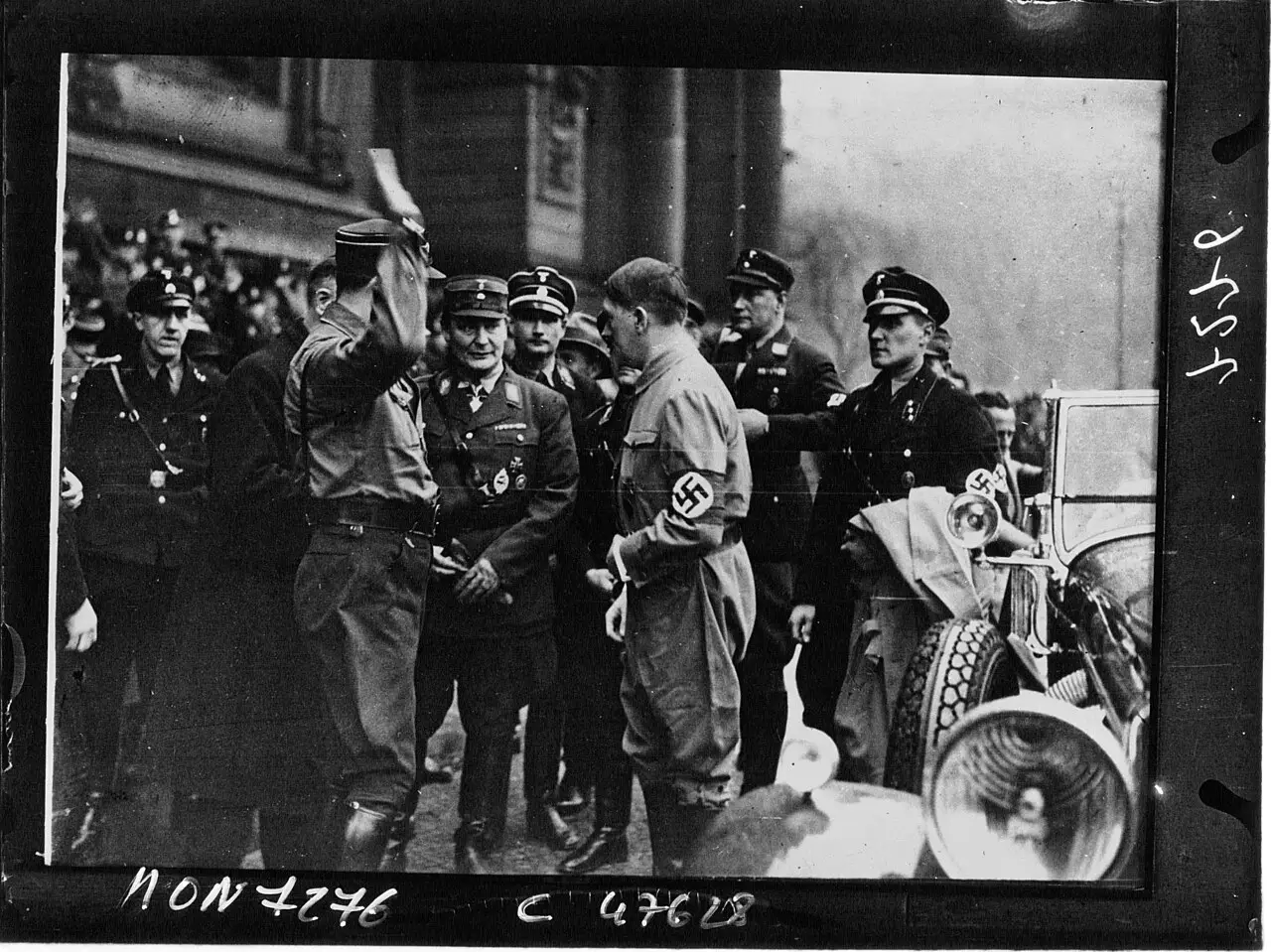
Hitler and Göring attended a state funeral in Berlin Cathedral for the SA leader Hans Maikowski and police officer Josef Zauritz, killed on the night of 30 January; the radio carried the ceremony. That night SA men raided a Communist pub in Friedenau and shot its landlady, Anna Röder, dead, and in Staßfurt the mayor Hermann Kasten died of his wounds. Berliners saw the first motor-paced cycle races in the Sportpalast.
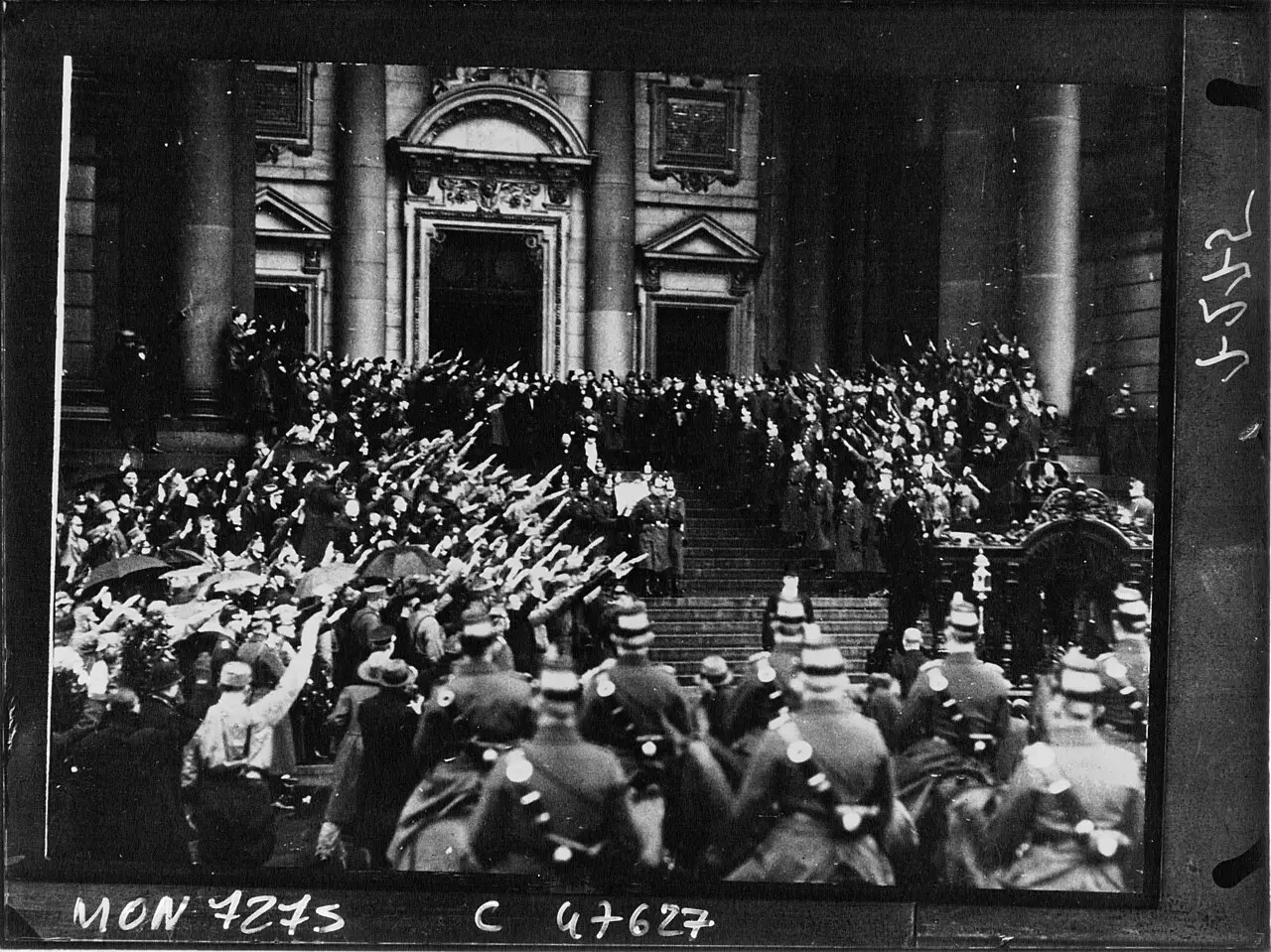

The Nazi press and the new government turned the deaths in the Wallstraße into a demonstration of their alliance with the state. According to the Vorwärts, Maikowski’s Sturm 33 had attacked a Communist meeting in December 1931, when a worker named Lange was shot dead; Maikowski fled, admitted the shooting in a letter while claiming self-defence, and after his arrest was held on remand until shortly before Christmas 1932. Now his coffin lay in Berlin Cathedral beside that of the police officer killed with him, Hitler and Göring were among the mourners, and the ceremony was broadcast. The same day a Social Democratic mayor died of gunshot wounds in Staßfurt, and that night SA men killed a Berlin publican; the Vorwärts asked whether either of them would be honoured as Maikowski had been.
Politics and power
Government, terror and persecution
-
Propaganda Berlin, Cathedral and Lustgarten
State funeral for Maikowski and Zauritz
The SA leader Hans Maikowski and police Oberwachtmeister Josef Zauritz were buried at state expense after a service in Berlin Cathedral, attended according to the Berliner Lokal-Anzeiger by Hitler, Göring and the former Crown Prince. The ceremony was broadcast; the Vorwärts reported that the radio announcer greeted the passing Sturm 33 as the “so-called murder storm” and that the announcer in the Lustgarten exulted that the SA and the police were one.1,2
-
Terror about 23:30, Berlin-Friedenau, Rubensstraße
SA raid on a Friedenau pub: Anna Röder killed
At about 23:30 a large group of SA men armed with pistols, daggers, knives and clubs smashed the windows of the “Pappschachtel”, a garden restaurant in the Rubensstraße used mainly by Communist workers, and forced the guests to raise their hands. When the landlady, the widow Anna Röder, tried to go into the kitchen she was shot in the abdomen and died on the way to hospital. Police arrested sixteen National Socialists and found ten pistols and other weapons on them; the Nazi Angriff called it a brawl.2,3
Sources disagree. The Vorwärts gives the number of attackers as fifteen in one report and as over twenty in another.
-
Terror about 06:00, Staßfurt
Hermann Kasten dies in Staßfurt
The Social Democratic mayor of Staßfurt, Hermann Kasten, shot the previous evening, died at about 06:00 despite an emergency operation in the miners’ hospital at Leopoldshall. The town council informed the district governor in Magdeburg the same day of the “assassination” (Meuchelmord) of its mayor.4
-
Government 10:00, Berlin, Reich Chancellery
Hitler and Papen receive the Reich Court president
At 10:00 Hitler and Papen received the president of the Reich Court, Bumke, whom Hitler had wanted to brief on the situation in Prussia, where two rival governments claimed authority over the civil service. No record of the conversation survives in the Chancellery files; an official statement later insisted that the visit was a courtesy call and that Bumke had not been told of the decree issued the next day.5,6
Sources disagree. Newspapers close to the government had reported that Bumke was consulted; the official statement of 11 February denied it, and no record exists.
-
Propaganda
Press association protests to Hindenburg
The Reich Association of the German Press (Reichsverband der Deutschen Presse) telegraphed Hindenburg to warn that the new decree would make it impossible for the press to play its part in forming public opinion. The Chancellery filed the telegram without reply.7
Everyday life
What else was happening in Germany
-
Sport evening, Berlin, Sportpalast, Potsdamer Straße
Motor-paced racing comes indoors at the Sportpalast
Berlin’s cycling fans saw the first races behind motor pacers ever held indoors in the Sportpalast, a premiere the police had approved only after extra safety barriers were fitted. Six riders, among them Walter Sawall, took part behind small pacing motorcycles reaching about 60 kilometres an hour. The crowd was thin, but the Vorwärts found the noise and fumes less than feared; Metze of Dortmund won the 25-kilometre final of the opening prize in 20:40.3,8
-
Weather Berlin
Pitches like swamps
Wet weather left Berlin’s football pitches, as the Vorwärts put it, like swamps on Sunday, and the workers’ clubs played their friendly matches on heavy ground; Rot-Weiß Neukölln, short of players because of flu, still beat Mahlsdorf.3
Voices
We ask: will the widow Röder also be buried at state expense and laid out in the Cathedral?
In Berlin today
.jpg)
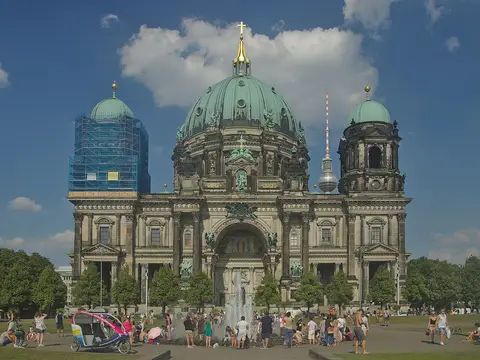
Berlin Cathedral (Berliner Dom)
Am Lustgarten, 10178 Berlin
- Then
- On 5 February the coffins of SA leader Hans Maikowski and police officer Josef Zauritz lay in the Cathedral for a state funeral attended by Hitler and Göring; the procession formed up in the Lustgarten outside.1,9,10
- Today
- The Cathedral was re-consecrated in 1993 after its post-war reconstruction and is again a Protestant church. Its own history acknowledges that the Nazi regime was able to use it as a stage for its self-display.
More pictures

Sources
- Vorwärts, Morgenausgabe Nr. 57, 3 February 1933 Deutsche Digitale Bibliothek, Zeitungsportal, p. 2, on Maikowski, Sturm 33 and the planned state funeral
- Vorwärts, Morgenausgabe Nr. 59–63, 7 February 1933 Deutsche Digitale Bibliothek, Zeitungsportal, p. 2, 'Die Nacht danach'; p. 4, 'Politische Morde' and 'Das Staatsbegräbnis'
- Vorwärts, Abendausgabe Nr. 64, 7 February 1933 Deutsche Digitale Bibliothek, Zeitungsportal, p. 2 (arrested men brought before the examining magistrate); p. 6, 'Blauer Dunst. Die ersten Motorschrittmacher im Sportpalast' and workers' football results
- »… gefallen durch feigen Meuchelmord«. Hermann Kasten Stadt Staßfurt (J. Kleemann, T.-A. Matzke, T. Hoffmann, 2013), pp. 1–2
- Akten der Reichskanzlei. Regierung Hitler 1933–1945, Bd. I, Nr. 13: Chefbesprechung vom 4. Februar 1933, 13 Uhr Bundesarchiv / Historische Kommission bei der Bayerischen Akademie der Wissenschaften, notes 3–4 (Bumke; official statement in the Berliner Lokal-Anzeiger, 11 February 1933)
- Münsterländische Volkszeitung, 12 February 1933 Deutsche Digitale Bibliothek, Zeitungsportal, p. 2, statement on the Reich Court president's visit, with the editors' comment
- Akten der Reichskanzlei. Regierung Hitler 1933–1945, Bd. I, Nr. 11: Ministerbesprechung vom 3. Februar 1933, 18.30 Uhr Bundesarchiv / Historische Kommission bei der Bayerischen Akademie der Wissenschaften, note 7 (telegram of the Reichsverband der Deutschen Presse, 5 February 1933)
- Vorwärts, Abendausgabe Nr. 54, 1 February 1933 Deutsche Digitale Bibliothek, Zeitungsportal, p. 6, 'Motore im Sportpalast'
- Der Dom seit 1993 Oberpfarr- und Domkirche zu Berlin
- Drittes Reich Oberpfarr- und Domkirche zu Berlin
Spotted a mistake? Send a correction.