Day 43 of 100
Goebbels appointed Reich Minister for Popular Enlightenment and Propaganda
Hindenburg signed the decree creating a Reich Ministry for Popular Enlightenment and Propaganda and appointed Joseph Goebbels, the Nazi Party’s propaganda chief, as its minister. In Prussia, Göring suspended the mayors of Cologne, Frankfurt, Magdeburg, Altona and Kiel and several Berlin city councillors. In Berlin the manslaughter trial of a banker accused of shooting his wife, the soprano Gertrud Bindernagel, opened before packed public benches.
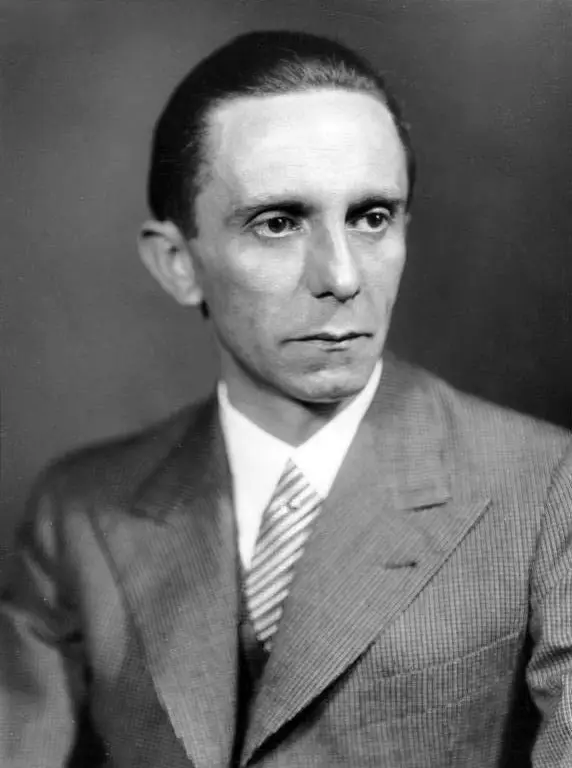

The decree signed on 13 March was four sentences long. It created a Reich Ministry for Popular Enlightenment and Propaganda (Reichsministerium für Volksaufklärung und Propaganda) to inform the population about the government’s policy and the ‘national reconstruction’, and left it to Hitler alone to decide what the new ministry would do and which tasks other ministries would have to hand over to it, even where this cut into their core business.
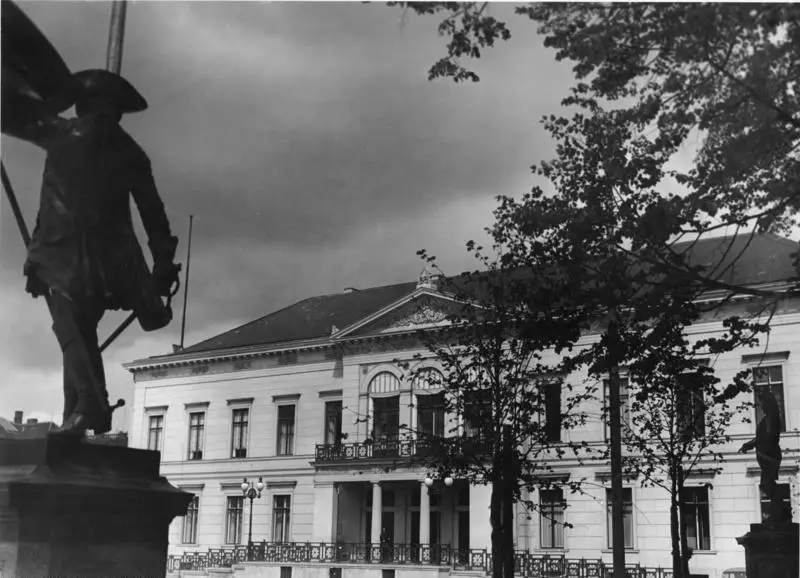
Hindenburg appointed Joseph Goebbels, the Reichstag deputy who ran the Nazi Party’s propaganda and its Berlin organisation, as minister, and the ministerial director Walther Funk as his state secretary. Goebbels kept both party posts. The ministry was to be housed in the Palais Leopold on Wilhelmplatz, seat of the Reich government’s press office since 1918, where Goebbels arrived on the afternoon of his appointment.
The ministry was the first new department created by the Hitler government, and it was placed in the hands of a Nazi rather than one of the conservative coalition partners. Because its remit was left open, to be fixed by Hitler at the expense of other ministries, it could grow into any field of public communication. Goebbels told party officials that he would use both the state and the party machine to win over the whole population.
The same day the double-flag decree announced by Hindenburg on the 12th took effect: from 13 March the black-white-red flag of the Empire and the swastika flag were to be flown together on public buildings, replacing the black-red-gold of the Republic.
Laws and decrees
Erlaß über die Errichtung des Reichsministeriums für Volksaufklärung und Propaganda
Decree establishing the Reich Ministry for Popular Enlightenment and Propaganda
Created a new Reich ministry for ‘enlightenment and propaganda’ and gave the Chancellor sole power to define its tasks and to transfer responsibilities to it from other ministries.1,3
Erlaß des Reichspräsidenten über die vorläufige Regelung der Flaggenhissung
Reich President's decree on the provisional regulation of flag-flying
From 13 March the black-white-red flag and the swastika flag were to be flown together on public buildings until the national colours were settled; military buildings flew only the war ensign.2,3
Politics and power
Government, terror and persecution
-
Government Berlin
Propaganda Ministry created; Goebbels appointed minister
Hindenburg and Hitler signed the decree establishing the Reich Ministry for Popular Enlightenment and Propaganda. The Reich President appointed Joseph Goebbels, born in Rheydt in 1897 and a member of the Reichstag since 1928, as minister and the ministerial director Walther Funk as state secretary.1,4,5
-
Propaganda afternoon, Berlin, Wilhelmplatz
Goebbels takes office at the Palais Leopold
Goebbels arrived in the afternoon at the Palais Leopold on Wilhelmplatz, seat of the Reich government’s press office, which was to become his ministry. In a message to the party’s propaganda officials he said that, at Hitler’s wish, he would remain head of party propaganda; he also kept the leadership of the Nazi Party in Greater Berlin.5,6
-
The states Berlin, Prussian Ministry of the Interior
Göring suspends mayors and Berlin city councillors
As Reich Commissioner for the Prussian Ministry of the Interior, Göring suspended with immediate effect the lord mayors Konrad Adenauer (Cologne), Ludwig Landmann (Frankfurt am Main), Ernst Reuter (Magdeburg), Max Brauer (Altona) and Lueken (Kiel). In Berlin the city treasurer Asch, the city building councillor (Stadtbaurat) Wagner, the city schools councillor Nydahl and the councillor Heuer were sent on leave. Göring also announced that direct interventions by the ‘national associations’ in town halls, courts and theatres were now unnecessary, because he would carry out the ‘cleansing’ of his department himself.5
-
Persecution Berlin
Peace Society leaders taken into ‘protective custody’
The Berlin police placed two leaders of the German Peace Society (Deutsche Friedensgesellschaft) in ‘protective custody’ (Schutzhaft, imprisonment without trial): its business manager Küster and its chairman, the retired police colonel Lange. The police said pacifist circles were behind ‘untrue’ reports about Germany in the foreign press.7
Everyday life
What else was happening in Germany
-
Crime Berlin
Bindernagel manslaughter trial opens
Before a Berlin jury court (Schwurgericht) the trial of the banker Wilhelm Hintze began. He was accused of shooting his wife, the soprano Gertrud Bindernagel, as she left the Städtische Oper in Bismarckstraße after singing in Siegfried on 23 October 1932; she died on 3 November. The prosecution charged manslaughter (Totschlag), not murder, and the case drew large crowds.8
-
Art Berlin, Köthener Straße
Schinkel festival on the architect’s birthday
The Architects’ and Engineers’ Association of Berlin held its annual Schinkel festival in the Meistersaal in Köthener Straße on Karl Friedrich Schinkel’s birthday and presented its Schinkel prizes. Guests included the Reich Transport Minister and the head of the Reichsbahn; the chairman, Professor Ehlgötz, said this year’s festival was held under the impression of the ‘national renewal’.9
-
Education Dresden
Saxony relaxes the ban on caning in schools
In Dresden the official running Saxony’s education ministry for the Reich Commissioner ordered that ‘moderate’ corporal punishment would no longer count as a breach of a teacher’s duty when used against deliberate disruption. Teachers had to record each case in writing by the end of the lesson.5
-
Economy Berlin
50,000 tonnes of potatoes to be turned into flakes
Because of large potato stocks, the Reich Ministry of Food ordered a new ‘potato flakes’ scheme of 50,000 tonnes, intended to relieve a slack potato market during the spring.5
Voices
From today I take over the Reich Ministry for Popular Enlightenment and Propaganda. … I hope that within the foreseeable future, through exemplary work of enlightenment by both the state and the movement, we shall succeed in winning the whole German people for the idea of the national revolution.
Elsewhere in the world
-
Austria
Dollfuss cabinet issues decrees without parliament
In Vienna the Austrian government passed twelve decrees under the wartime economic enabling law, among them a ban on ‘uniform-price’ shops, citing bad experiences with such stores in Germany.5
-
United States
Condolences after the Los Angeles earthquake
Hindenburg sent a telegram of condolence to the President of the United States after the earthquake that had struck the Los Angeles area.5
In Berlin today
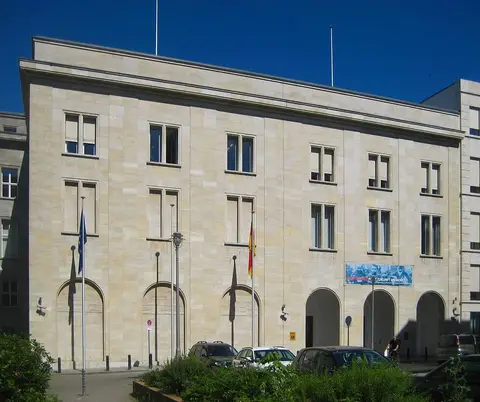

Ordenspalais (Palais Leopold), Wilhelmplatz
Wilhelmstraße 49, 10117 Berlin (former Wilhelmplatz 8–9)
- Then
- Seat of the Reich government’s press office since 1918. Goebbels arrived here on the afternoon of 13 March; it became the home of his new Propaganda Ministry.6,10
- Today
- The complex was badly damaged in 1945. Parts of the ministry buildings, extended in the Nazi years, survive at Wilhelmstraße 49, which since the late 1990s has been the Berlin seat of the Federal Ministry of Labour and Social Affairs.
More pictures

Sources
- Erlaß über die Errichtung des Reichsministeriums für Volksaufklärung und Propaganda (13.03.1933) documentArchiv.de, Full text; source given as RGBl. 1933 I S. 104
- Erlaß des Reichspräsidenten über die vorläufige Regelung der Flaggenhissung (12.03.1933) documentArchiv.de, Full text and note on promulgation (17 March 1933); RGBl. 1933 I S. 103
- Deutscher Reichsanzeiger und Preußischer Staatsanzeiger, 18 March 1933 Deutsche Digitale Bibliothek, Deutsches Zeitungsportal, p. 6, Reichsverlagsamt notice: contents of RGBl. I Nr. 21, issued 17 March 1933
- Gütersloher Volks-Zeitung, 14 March 1933 Deutsche Digitale Bibliothek, Deutsches Zeitungsportal, p. 2, TU report 'Berlin, 13. März': appointment of Goebbels and Funk, text of the decree, biography
- Erzgebirgischer Volksfreund, 14 March 1933 Deutsche Digitale Bibliothek, Deutsches Zeitungsportal, p. 2: Goebbels's message; Göring's suspensions and statement; Dresden school order; potato flakes; Vienna and Los Angeles reports (all datelined 13 March)
- Dresdner Nachrichten (Frühausgabe), 14 March 1933 Deutsche Digitale Bibliothek, Deutsches Zeitungsportal, p. 2, 'Berlin, 13. März': Goebbels takes up office in the Palais Leopold
- Schwelmer Zeitung, 14 March 1933 Deutsche Digitale Bibliothek, Deutsches Zeitungsportal, p. 2, report on 'protective custody' for the leaders of the German Peace Society
- Kölnische Zeitung, 13 March 1933 Deutsche Digitale Bibliothek, Deutsches Zeitungsportal, p. 7, opening of the Hintze trial; see also Wittener Volks-Zeitung 13 March 1933, p. 5
- Dresdner Nachrichten (Abendausgabe), 14 March 1933 Deutsche Digitale Bibliothek, Deutsches Zeitungsportal, p. 2, 'Kunst und Wissenschaft': Schinkel festival of the Architekten- und Ingenieurverein
- Die Geschichte des Dienstsitzes des BMAS in Berlin Bundesministerium für Arbeit und Soziales
Spotted a mistake? Send a correction.