Day 17 of 100
Käthe Kollwitz and Heinrich Mann forced out of the Prussian Academy of Arts
Under threat that the Academy would be dissolved, Käthe Kollwitz and Heinrich Mann left the Prussian Academy of Arts, and the Prussian commissioners confirmed a sweeping purge of police chiefs, naming a retired rear admiral as police president of Berlin. Vorwärts and the 8-Uhr-Abendblatt were banned for a week, and in Stuttgart someone cut the cable carrying Hitler’s speech to the radio. Abroad, Thomas Mann lectured on Wagner in Brussels and an assassin fired on Franklin D. Roosevelt in Miami.
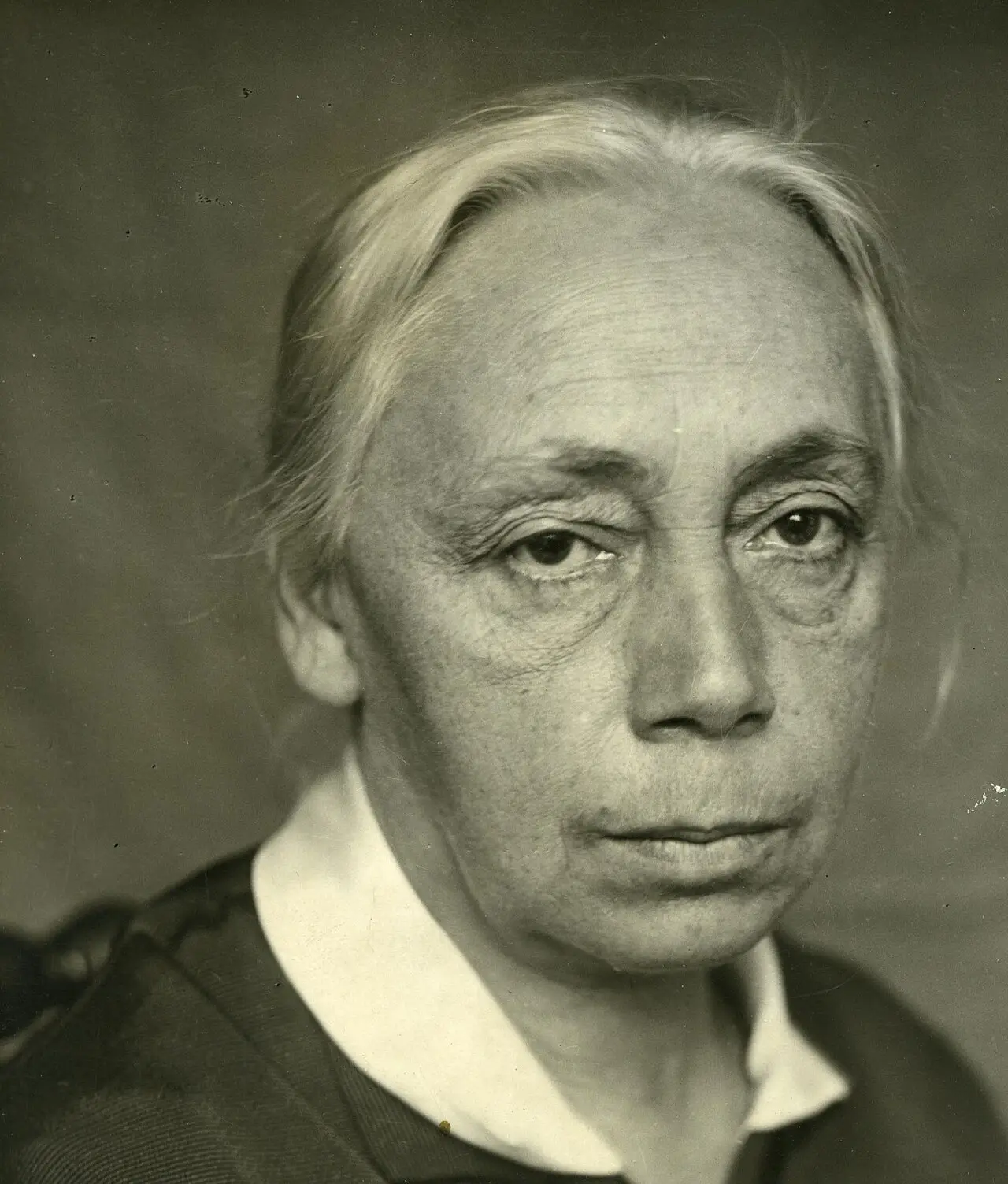

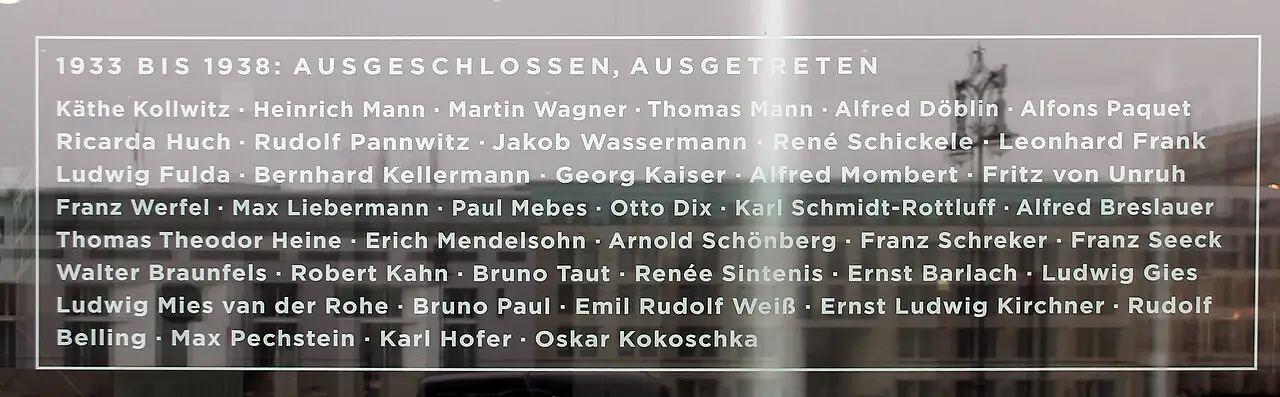
Käthe Kollwitz and the novelist Heinrich Mann had signed an appeal for a united front of the left against National Socialism before the 5 March election. That was reason enough for Bernhard Rust, the acting Prussian Minister of Culture, to tell the Academy’s president, Max von Schillings, that he would dissolve the institution unless both left. They went, saying they could not take responsibility for the hardship a dissolution would cause their colleagues. On the same day the Prussian commissioners confirmed Göring’s purge of the police and Berlin’s police president banned two opposition dailies for their reporting: a fortnight after Hitler’s appointment, the arts, the police and the press were all being brought into line.
Politics and power
Government, terror and persecution
-
Persecution evening, Berlin, Pariser Platz
Kollwitz and Heinrich Mann leave the Academy under threat
After Rust had told the Academy’s president, Max von Schillings, that he would dissolve the Prussian Academy of Arts if Heinrich Mann and Käthe Kollwitz did not go, both left after a heated session. Their offence was to have signed an “Urgent Call for Unity” (Dringender Appell) for a united front of the left against National Socialism. Mann gave up the chair of the Academy’s literature section; Kollwitz lost her post as head of a master class in graphic art. The Berlin city architect Martin Wagner left the Academy with them.1,2,3
-
The states Berlin
A retired admiral becomes Berlin’s police president
Acting on Göring’s proposals, the Reich Commissioners for Prussia turned most of the recent forced leave into retirement. The district presidents of Kassel, Wiesbaden and Arnsberg and the police presidents of Stettin, Breslau, Waldenburg, Halle, Weißenfels, Hanover, Harburg-Wilhelmsburg, Dortmund, Frankfurt, Koblenz, Oberhausen and Bochum were pensioned off. Berlin’s police president, Melcher, was moved to head the province of Saxony and replaced by Magnus von Levetzow, a retired rear admiral who had been caught up in the proceedings after the Kapp Putsch of 1920; Viktor Lutze, until now a member of the Reichstag, became police president of Hanover.4
-
Persecution Berlin
Vorwärts and the 8-Uhr-Abendblatt banned for a week
Berlin’s police president banned the Social Democratic Vorwärts and the 8-Uhr-Abendblatt of the Mosse publishing house until 22 February inclusive, under the decree “for the protection of the German people” of 4 February. Both papers were punished for their reporting of the clashes at Eisleben on 12 February: Vorwärts for an article headed “For the truth: Bloody Sunday in Eisleben”. It was the second ban on Vorwärts in a fortnight.5,6
-
Propaganda Berlin
Hans Bredow leaves German radio
The Reich Post Minister released the Reich Post’s radio commissioner, Hans Bredow, “at his own request”, with thanks for his services; the ministry’s state secretary took over his duties for the time being. The same day the Interior Ministry’s own radio commissioner, Conrad, returned to the ministry and handed his duties to his assistant, Krukenberg.7,8
-
Opposition 20:30–21:45, Stuttgart, Stadthalle
Hitler’s Stuttgart speech cut off the air
Hitler spoke in the Stuttgart Stadthalle to about 7,000 people, with loudspeakers carrying the speech to a crowd on the market square. At about 21:15, during a passage against parliamentary government, the radio relay went dead: the Post Office cable from the hall to the telegraph exchange had been cut with an axe, and the broadcast could not be restored before the speech ended at 21:45. The Akten der Reichskanzlei record that the cable was cut by an anti-fascist group that included Communists. At the next day’s ministers’ meeting Frick proposed bringing radio technicians under the Reich government’s direct control, and Hitler said he would take drastic measures if anything similar happened again.9,6
Everyday life
What else was happening in Germany
-
Books evening, Brussels
Thomas Mann speaks on Wagner in Brussels
In the Palais des Beaux-Arts in Brussels Thomas Mann spoke on Richard Wagner at an evening of the PEN Club, weighing Wagner’s worth from the intellectual, political and musical points of view and ending in the hope that German vitality would go on enriching the world, as it had through Wagner. Mann had left Germany for Holland on 11 February; the Thomas Mann Society dates the beginning of his exile from that departure.10,11
-
Transport Berlin
Railways against lorries at the motor congress
Opening the International Congress of the Motor Transport Industry in Berlin, the Reich Transport Minister, Freiherr von Eltz-Rübenach, said the competition between the railways and motor vehicles was one of his greatest concerns: the number of motor vehicles in Germany had grown eighteenfold since 1914, and faster still elsewhere in Europe. The Deutschlandsender scheduled extracts from the opening session for its evening programme.12,13
-
Radio evening, Berlin
A Mozart and Bruckner evening
Berlin’s Funkstunde relayed a concert from the Philharmonie, Mozart from 20:20 and, after the news, Bruckner from 21:03. Earlier, at 18:30, the writer Günter Eich read his own prose.13
Elsewhere in the world
-
United States
Shots fired at Roosevelt in Miami
As the President-elect, Franklin D. Roosevelt, spoke from his car in Bayfront Park, Miami, an Italian fired several shots at him. Roosevelt was unhurt, but the Mayor of Chicago, Cermak, standing close by, was badly wounded, as were five other people. German papers carried the news on their front pages the next morning.1,14
In Berlin today
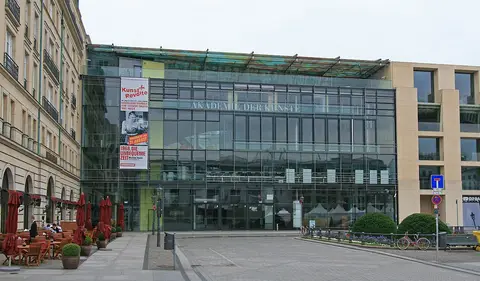

Prussian Academy of Arts (Akademie der Künste)
Pariser Platz 4, 10117 Berlin-Mitte
- Then
- Seat of the Prussian Academy of Arts, where on the evening of 15 February 1933 Käthe Kollwitz and Heinrich Mann left the Academy under the threat of its dissolution.1,2,15
- Today
- The Akademie der Künste’s building by Günter Behnisch, opened in 2005 within the proportions of the 1907 building, keeps the old top-lit exhibition rooms and houses the Academy’s library, reading room and architecture archive.
More pictures
_Akademie_der_K%C3%BCnste.jpg)

Sources
- Chronik 1933 (entries for 15 February) Deutsches Historisches Museum, LeMO
- Krise in der preußischen Akademie Hamburger Fremdenblatt (Reichsausgabe), via Deutsche Digitale Bibliothek Zeitungsportal, 16 February 1933, p. 2
- About Käthe Kollwitz Akademie der Künste
- Die neuen Polizeipräsidenten; Der neue Berliner Polizeipräsident Hildener Rundschau, via Deutsche Digitale Bibliothek Zeitungsportal, 16 February 1933, p. 1 (Amtlicher Preußischer Pressedienst)
- „8 Uhr-Abendblatt“ und „Vorwärts“ bis 22. Februar verboten Der Führer (Karlsruhe, NSDAP Gau Baden), via Deutsche Digitale Bibliothek Zeitungsportal, 17 February 1933, p. 2
- Nr. 22 Ministerbesprechung vom 16. Februar 1933, 16.15 Uhr Bundesarchiv / Historische Kommission bei der Bayerischen Akademie der Wissenschaften, Akten der Reichskanzlei. Regierung Hitler, Band I, P. 15 note 49 (second Vorwärts ban, 15 February); P. 16 and note 51 (Stuttgart)
- Rundfunkkommissar Dr. Bredow abberufen; „Acht-Uhr-Abendblatt“ und „Vorwärts“ verboten Dresdner Nachrichten, via Deutsche Digitale Bibliothek Zeitungsportal, 16 February 1933, p. 2 (reports dated Berlin, 15 February)
- Wechsel im Rundfunk. Ein neuer Rundfunkkommissar Kölnische Zeitung, via Deutsche Digitale Bibliothek Zeitungsportal, 15 February 1933, p. 7
- Sabotage bei der Stuttgarter Kanzlerrede Neue Mannheimer Zeitung, via Deutsche Digitale Bibliothek Zeitungsportal, 16 February 1933, p. 1
- Wagner-Vortrag Thomas Manns im Brüsseler Pen-Klub Westfälische Neueste Nachrichten (Bielefeld), via Deutsche Digitale Bibliothek Zeitungsportal, 17 February 1933, p. 3
- Thomas Mann 1933–1945 (chronology) Deutsche Thomas Mann-Gesellschaft, 1933: "11. Februar: Abreise nach Holland. Beginn des Exils."
- Zwischen Eisenbahn und Kraftwagen Hamburgischer Correspondent, via Deutsche Digitale Bibliothek Zeitungsportal, 16 February 1933, p. 2 (report dated Berlin, 15 February)
- Rundfunk am Abend: Mittwoch, 15. Februar Vorwärts, via Deutsche Digitale Bibliothek Zeitungsportal, 15 February 1933, p. 4
- Italienisches Attentat auf Roosevelt Hamburger Fremdenblatt (Reichsausgabe), via Deutsche Digitale Bibliothek Zeitungsportal, 16 February 1933, p. 1
- Akademie der Künste am Pariser Platz visitBerlin (Berlin Tourismus & Kongress GmbH)
Spotted a mistake? Send a correction.