Day 75 of 100
Good Friday: Berlin protests to London over the Commons debate on Germany
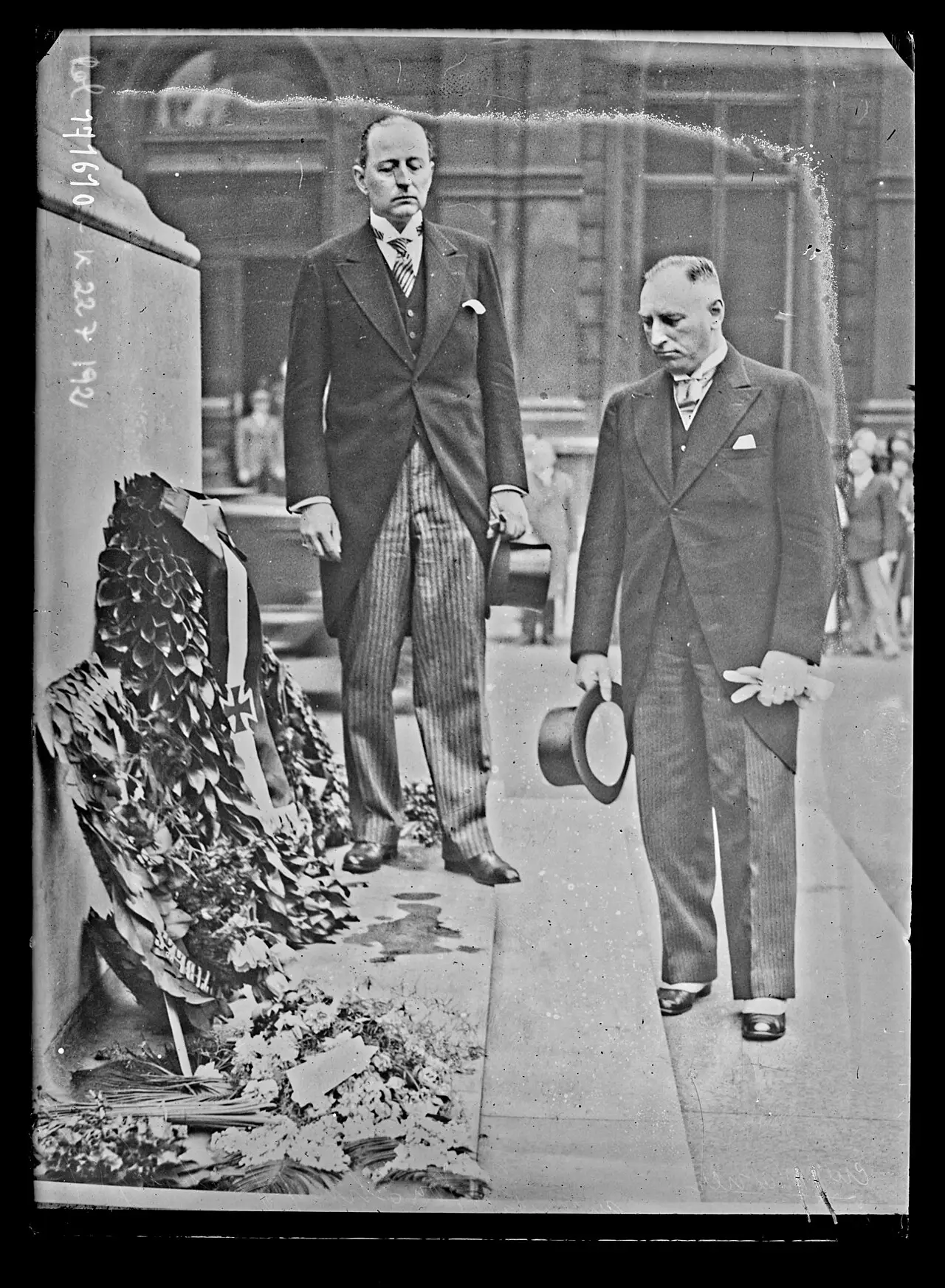
On Good Friday the government instructed its ambassador in London to protest ‘most emphatically’ against the previous day’s Commons debate, while at noon Germany’s attachés laid a wreath at the Cenotaph. The Nazi ‘Fighting League for German Culture’ founded a national theatre-goers’ association with ministers as its founders, and Prussia ruled that only Nazi organisations and the Stahlhelm counted as ‘national associations’ for shortened law exams. With matches banned almost everywhere for the holy day, 6,000 people in Cologne watched Grasshoppers Zürich, and a balloon set off from Gelsenkirchen for Africa.
_-_btv1b532700824.jpg)
Politics and power
Government, terror and persecution
-
Foreign policy
Protest ordered over the Commons debate
Taking the House of Commons debate of 13 April on conditions in Germany as its cue, the Reich government instructed the German ambassador in London to lodge an immediate and emphatic protest with the British government. The Paris Temps wrote that the debate would be heard across Europe as a stern warning.1
-
Propaganda Berlin
A national theatre-goers’ league under Nazi patrons
Within its theatre section, the Fighting League for German Culture (Kampfbund für deutsche Kultur) founded the Reich Association of German Theatre-Goers’ Organisations, ‘Deutsche Bühne’, with its office in the Berlin Palace. Its first task was to bring existing audience societies together under uniform guidelines. Dr Walter Stang was named its head; the founders listed included Frick, Goebbels, Göring, Rust, Rosenberg, Röhm, Baldur von Schirach, Rudolf Hess, Hans Hinkel and Hanns Johst.1
-
Government Berlin
Exam privileges only for Nazi organisations and the Stahlhelm
The Reich commissioner for the Prussian Ministry of Justice, Kerrl, issued implementing rules for his decree of 5 April allowing shortened law examinations for members of ‘national associations’: only the organisations of the NSDAP and the Stahlhelm qualified, and membership had to date from before 1 April.1,2
-
The states Königsberg
Commissioner for the East Prussian Landschaft
Because accusations against the director-general of the East Prussian Landschaft, the province’s agricultural credit institution, von Hippel, had been followed by ‘continuing local interventions’ that prevented its lawful management, Hugenberg, as Prussian commissioner, installed a former Danzig finance senator, Dr Ernst Volkmann, as commissioner for it.1,2
-
Foreign policy morning, Ostia
Göring flies to Sicily
Göring took off from Ostia in the morning for Naples and Sicily, accompanied by Prince Philipp of Hesse and the state secretaries Milch and Körner.1
Everyday life
What else was happening in Germany
-
Sport Cologne
Grasshoppers in Cologne on Good Friday
While almost everywhere in the Reich sport was banned on Good Friday, the authorities in Cologne allowed the Kölner Sportclub 1899 to keep its pre-war tradition of a Good Friday match against a leading foreign side. About 6,000 people watched the club, reinforced by guest players including Kobierski of Fortuna Düsseldorf, play Grasshoppers Zürich.1
-
Transport morning, Gelsenkirchen
Balloon ‘Deutschland’ sets off for Africa
On Good Friday morning the balloon ‘Deutschland’, piloted by Dr Zinner with Schicht of Dresden as co-pilot, rose from Gelsenkirchen hoping to reach the African coast and break the distance record. After 56 hours it came down unharmed in south-eastern Bulgaria, where villagers helped recover the envelope and instruments.3
-
Press
A German-American publisher arrives to see for himself
A delegation of German-Americans, invited by the German shipping lines to study conditions in Germany, landed from the liner Bremen. Victor Ridder, publisher of the New Yorker Staats-Zeitung, went on to Berlin, saying that Americans could as yet form no picture of German conditions because events had moved too fast for the correspondents.2
-
Press
No papers on Saturday morning
Because of the holiday, the Hamburger Fremdenblatt told readers that no morning edition would appear on Saturday; its next issue would come out on Saturday evening at the usual hour.4
Elsewhere in the world
-
United Kingdom
German wreath at the Cenotaph
At noon, on behalf of the Reich government, the German military and naval attachés, Colonel Freiherr Geyr von Schweppenburg and Captain E. Wassner, laid a wreath at the Cenotaph in Whitehall, the memorial to Britain’s war dead, without any official ceremony.1
-
France
Chamber passes a provisional budget
In the early hours the French Chamber of Deputies adopted the provisional budget for 1933, still showing a deficit of more than 4 billion francs, by 509 votes to 94, and adjourned until 16 May. The vote on military credits had split the Socialist group three ways.1
More pictures
.png)
Sources
- Kölnische Zeitung, 15 April 1933 Deutsche Digitale Bibliothek, Zeitungsportal, Morning edition, p. 1 (protest to London; Paris press; Göring's flight; French budget); p. 2 ('Deutsche Bühne'; exam rules; East Prussian Landschaft; Cenotaph); p. 5 (Good Friday football)
- Hamburger Fremdenblatt, 15 April 1933 Deutsche Digitale Bibliothek, Zeitungsportal, p. 2 (East Prussian Landschaft; exam rules; German-American delegation)
- Hamburger Fremdenblatt, 18 April 1933 Deutsche Digitale Bibliothek, Zeitungsportal, Evening edition, p. 3 ('Ballon „Deutschland“ in Bulgarien glücklich gelandet')
- Hamburger Fremdenblatt, 14 April 1933 Deutsche Digitale Bibliothek, Zeitungsportal, Morning edition, p. 1 (notice on publication over Easter)
Spotted a mistake? Send a correction.