Day 86 of 100
Cabinet passes the “overcrowding” law capping Jewish pupils and students
Hitler’s cabinet sat until after ten at night and passed a law that limited admissions to secondary schools and universities and capped the share of “non-Aryan” pupils and students. Prussia’s culture minister suspended 25 more professors, and Hitler named the army chaplain Ludwig Müller his liaison to the Protestant churches. The labour exchanges reported unemployment down by 69,000 in the first half of April, and Berlin’s university rector explained why he had objected to two of the students’ anti-Jewish posters.

The “Law against the Overcrowding of German Schools and Universities” was presented as a measure against an academic surplus, but its working part was racial. New admissions of “non-Aryans” (the regime’s term, borrowed from the civil service law, for anyone with a Jewish parent or grandparent) were held to 1.5 per cent at every school and faculty, and their total share could be pushed down towards 5 per cent by removing pupils and students already enrolled. Children of front-line veterans and children of mixed marriages contracted before the law were not counted. The historian Albrecht Götz von Olenhusen dates the start of direct anti-Jewish measures in German higher education to this law. Several newspapers reported it as a law against the “over-foreignisation” (Überfremdung) of schools.
Laws and decrees
Gesetz gegen die Überfüllung deutscher Schulen und Hochschulen
Law against the Overcrowding of German Schools and Universities
Allowed admissions to secondary schools and universities to be capped by Reich guideline figures and limited “non-Aryan” pupils and students to their share of the population, with new admissions held to 1.5 per cent. Already enrolled students could be removed where the share was higher.1,2
Gesetz zur Änderung des Reichsstatthaltergesetzes
Law amending the Reich Governors Law
Stated that the Reich Chancellor exercised the Reich governor’s powers in Prussia and could delegate the powers to appoint officials and judges, to pardon and related rights to the Prussian prime minister, Göring.3
Politics and power
Government, terror and persecution
-
Persecution Berlin, Reich Chancellery
Quota for Jewish pupils and students
The Reich cabinet passed the law limiting numbers at schools above the compulsory level and at universities, together with its first implementing ordinance. Within those limits, the share of “non-Aryan” German nationals at each school and faculty was not to exceed their share of the population; new admissions were held to 1.5 per cent. The children of men who had fought at the front were to be admitted or kept first.1,2,10
-
The states Berlin
Hitler may delegate Prussian powers to Göring
A short amendment to the Reich governors law of 7 April confirmed that in Prussia the Reich Chancellor himself exercised the governor’s rights, and allowed him to hand three of them, including appointments of officials and judges and the right of pardon, to the Prussian prime minister, who could pass them on in turn. It gave legal form to the transfer to Göring’s cabinet announced the day before.3,10
-
Government Berlin, Reich Interior Ministry
Interior ministers of all the states meet in Berlin
Frick convened the interior ministers of every German state at the Reich Interior Ministry. After his introduction, Göring explained how Prussia was applying the civil service law of 7 April; officials then discussed its uniform enforcement and the training of the police.4
-
Persecution
25 more professors suspended
The Prussian culture minister Rust placed 17 professors at Frankfurt University, two at Marburg and six at Göttingen on leave (beurlaubt). He announced more suspensions, and transfers meant to restore the “native character” of the border universities of Breslau, Kiel and Königsberg.5
-
Churches Berlin
Ludwig Müller named Hitler’s man for the Protestant church
The “German Christians”, the Nazi movement inside German Protestantism, announced that Hitler had appointed Ludwig Müller, the military district chaplain (Wehrkreispfarrer) in Königsberg and a member of their leadership, as his liaison to the official bodies of the Protestant church. The same afternoon the church federation’s committee, meeting in Berlin, declared itself for a new constitution creating a single German Protestant church and backed the steps taken by its president, Kapler.6
Everyday life
What else was happening in Germany
-
Economy
Unemployment down by 69,000
The Reich Institute for Labour Exchanges reported that registered unemployment fell by about 69,000 in the first half of April, to about 5,530,000. Since the winter peak it had dropped by some 518,000, or 8.6 per cent, against 195,000 in the same period of 1932. Most of the gain was in outdoor trades helped by public works schemes.7
-
Education Berlin, Unter den Linden
Berlin’s rector and the students’ posters
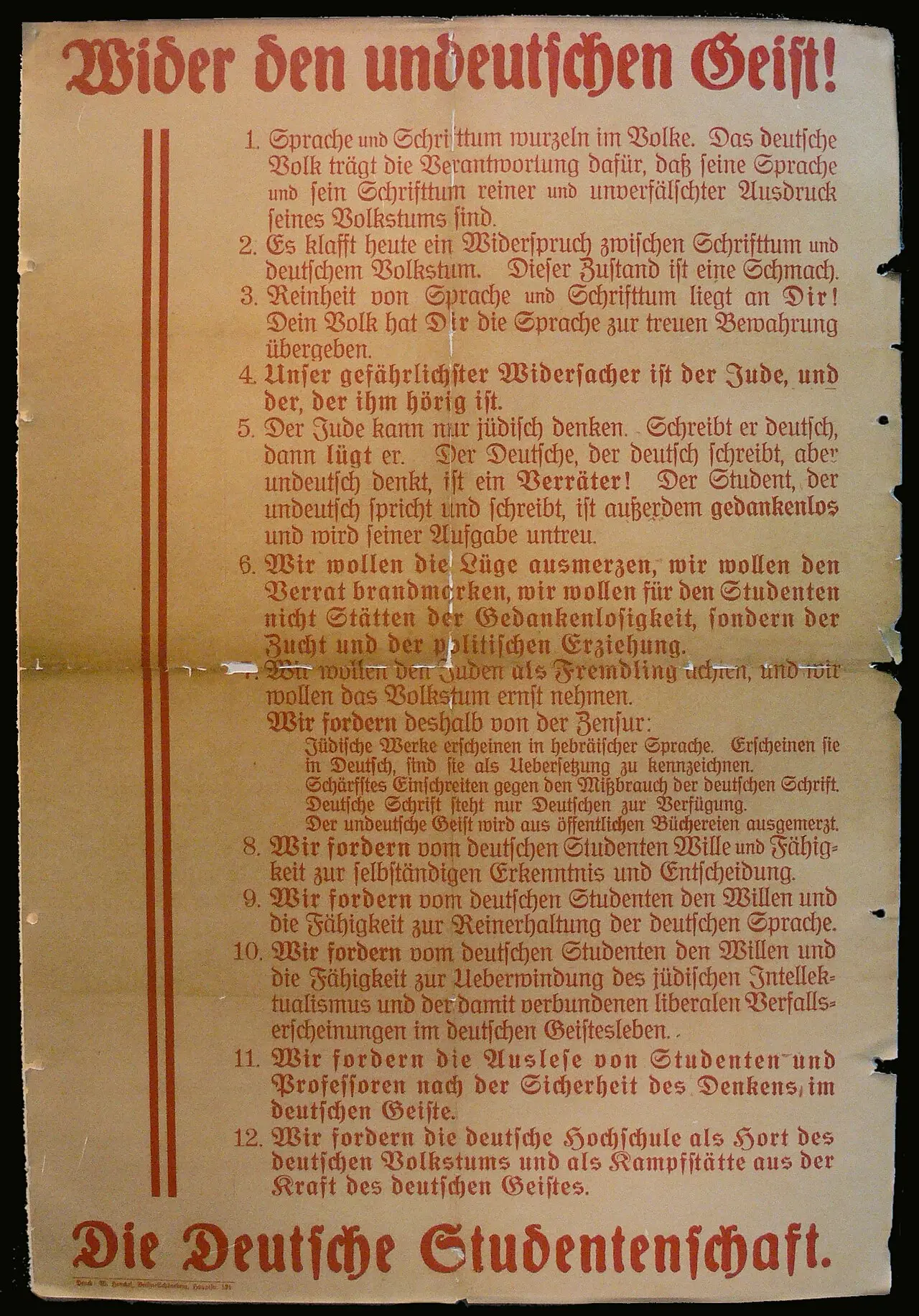
The rector of Berlin University, Professor Kohlrausch, answered rumours of a conflict over the German Student Union’s twelve theses “Against the Un-German Spirit”, issued on 12 April. He said he had objected to two of them: that a Jew who writes German lies, and that Jewish works should appear in Hebrew or be marked as translations. The students had hung the poster in the university’s entrance hall anyway; he would ask the minister whether it should come down. He denied that he had resigned.8,9
-
Society Hamburg
Hamburg’s old alleys to be cleared
Hamburg’s Senate named the police senator, Richter, state commissioner for the redevelopment of the Gängeviertel, the crowded old alley quarter of the northern Neustadt.8
Voices
I called these sentences exaggerations that could only discredit the fight against the un-German spirit, not advance it.
More pictures

Sources
- Die “nichtarischen” Studenten an den deutschen Hochschulen. Zur nationalsozialistischen Rassenpolitik 1933–1945 Albrecht Götz von Olenhusen, Vierteljahrshefte für Zeitgeschichte 14 (1966), Heft 2, Institut für Zeitgeschichte, pp. 177–179 and notes 18–26
- Biberacher Zeitung, 26 April 1933 Deutsche Digitale Bibliothek, Zeitungsportal, p. 9, report from Berlin, 25 April, on the cabinet's law
- Gesetz zur Änderung des Reichsstatthaltergesetzes vom 25. April 1933 documentArchiv.de, text after RGBl. 1933 I S. 225
- Der sächsische Erzähler (Bischofswerdaer Tageblatt), 26 April 1933 Deutsche Digitale Bibliothek, Zeitungsportal, p. 1, "Die Konferenz der Länderminister" (Berlin, 25 April)
- Erzgebirgischer Volksfreund, 26 April 1933 Deutsche Digitale Bibliothek, Zeitungsportal, p. 2, item datelined Berlin, 25 April, on professors placed on leave
- Weißeritz-Zeitung, 26 April 1933 Deutsche Digitale Bibliothek, Zeitungsportal, p. 4, "Verbindungsmann zwischen Adolf Hitler und den amtlichen Stellen der evangelischen Kirche" (Berlin, 25 April)
- Bottwartal-Bote, 26 April 1933 Deutsche Digitale Bibliothek, Zeitungsportal, p. 2, "Die Arbeitsmarktlage im Reich" (Berlin, 25 April)
- Sächsische Volkszeitung, 26 April 1933 Deutsche Digitale Bibliothek, Zeitungsportal, p. 2, "Eine Erklärung des Rektors der Berliner Universität" (Berlin, 25 April) and "Hamburger Gängeviertel soll verschwinden"
- 10. Mai 1933: Verbrennung von Büchern in Deutschland Bundesarchiv
- Marbacher Zeitung (Bottwartal-Bote), 26 April 1933 Deutsche Digitale Bibliothek, Zeitungsportal, p. 1, report from Berlin, 25 April, on the cabinet sitting
Spotted a mistake? Send a correction.