Laws and decrees

Law Reich Government, under the Enabling Act

Law against the Overcrowding of German Schools

Gesetz gegen die Überfüllung deutscher Schulen und Hochschulen

Law against the Overcrowding of German Schools and Institutions of Higher Education

Presented as a measure against overcrowded secondary schools and universities, the law let the states cap admissions and, in its § 4, set a quota for ‘non-Aryan’ pupils and students: new admissions were not to exceed their share of the German population, and numbers already enrolled could be cut. The first implementing ordinance, issued the same day, fixed the admissions quota at 1.5 per cent and the ceiling for existing pupils and students at 5 per cent. Children of front-line veterans, and children of mixed marriages contracted before the law with one ‘Aryan’ parent or two ‘Aryan’ grandparents, were exempt.

Dated
Tuesday 25 April 1933
Published in
Reichsgesetzblatt Teil I, no. 43, Wednesday 26 April 1933, p. 225
Citation
RGBl. I S. 225
In force
on promulgation, 26 April 1933 (§ 7)

On the day pages
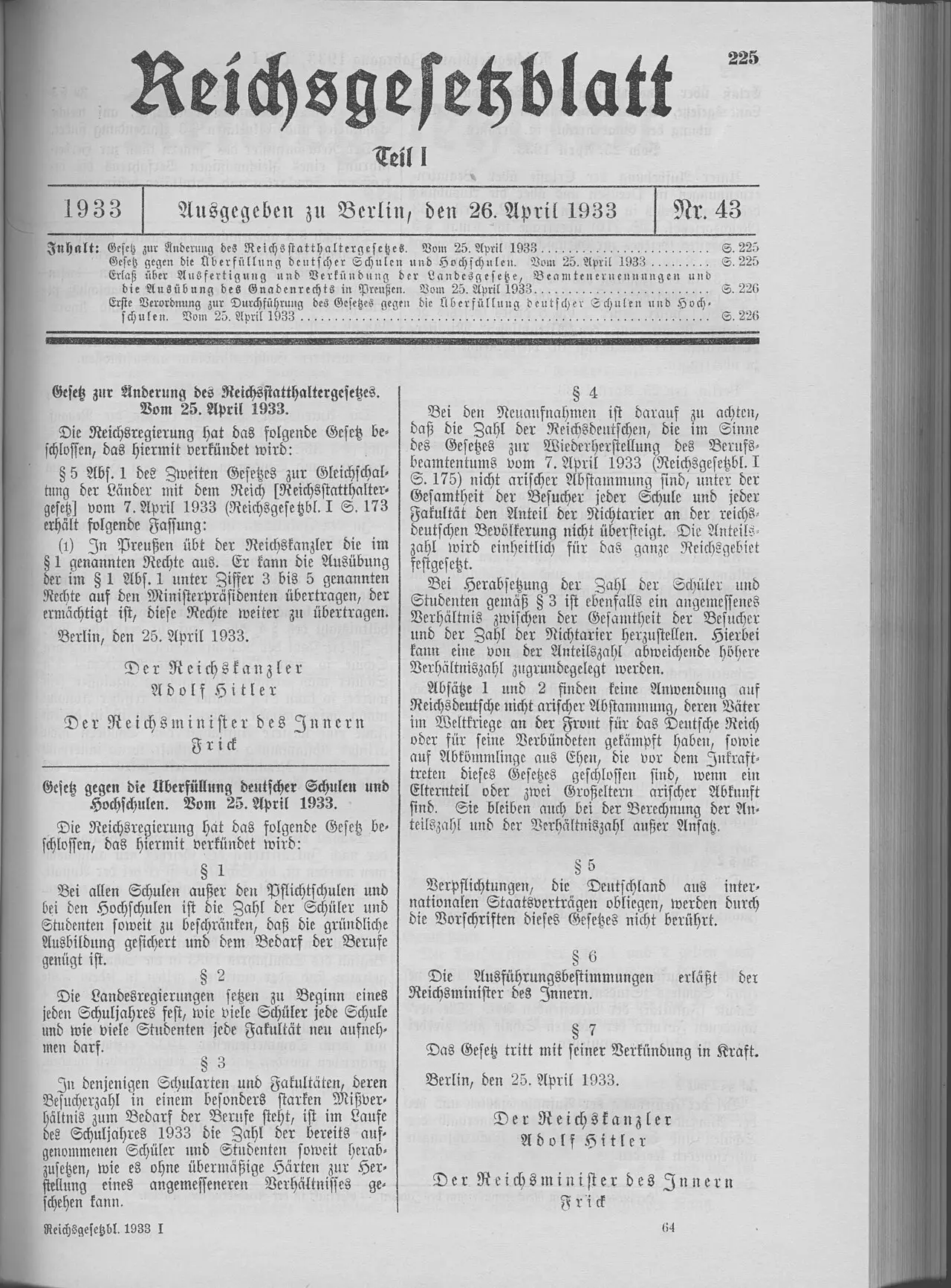
  1. Passed Day 86, Tuesday 25 April 1933
The Reichsgesetzblatt Teil I page on which the measure was published
RGBl. I S. 225. Commons record

The text

Gesetz gegen die Überfüllung deutscher Schulen und Hochschulen.
Law against the Overcrowding of German Schools and Institutions of Higher Education.
Vom 25. April 1933.
Of 25 April 1933.
Die Reichsregierung hat das folgende Gesetz beschlossen, das hiermit verkündet wird:
The Reich Government has enacted the following law, which is hereby promulgated:
§ 1 Bei allen Schulen außer den Pflichtschulen und bei den Hochschulen ist die Zahl der Schüler und Studenten soweit zu beschränken, daß die gründliche Ausbildung gesichert und dem Bedarf der Berufe genügt ist.
§ 1 At all schools other than the compulsory schools, and at the institutions of higher education, the number of pupils and students is to be limited to the extent that thorough training is ensured and the needs of the professions are met.
§ 2 Die Landesregierungen setzen zu Beginn eines jeden Schuljahres fest, wie viele Schüler jede Schule und wie viele Studenten jede Fakultät neu aufnehmen darf.
§ 2 At the beginning of each school year the state governments shall fix how many pupils each school and how many students each faculty may newly admit.
§ 3 In denjenigen Schularten und Fakultäten, deren Besucherzahl in einem besonders starken Mißverhältnis zum Bedarf der Berufe steht, ist im Laufe des Schuljahres 1933 die Zahl der bereits aufgenommenen Schüler und Studenten soweit herabzusetzen, wie es ohne übermäßige Härten zur Herstellung eines angemesseneren Verhältnisses geschehen kann.
§ 3 In those types of school and those faculties whose attendance is especially out of proportion to the needs of the professions, the number of pupils and students already admitted is to be reduced in the course of the 1933 school year as far as can be done without excessive hardship, in order to establish a more appropriate proportion.
§ 4 Bei den Neuaufnahmen ist darauf zu achten, daß die Zahl der Reichsdeutschen, die im Sinne des Gesetzes zur Wiederherstellung des Berufsbeamtentums vom 7. April 1933 (Reichsgesetzbl. I S. 175) nicht arischer Abstammung sind, unter der Gesamtheit der Besucher jeder Schule und jeder Fakultät den Anteil der Nichtarier an der reichsdeutschen Bevölkerung nicht übersteigt. Die Anteilszahl wird einheitlich für das ganze Reichsgebiet festgesetzt.
§ 4 In new admissions, care is to be taken that the number of Reich Germans who are of non-Aryan descent within the meaning of the Law for the Restoration of the Professional Civil Service of 7 April 1933 (Reichsgesetzbl. I p. 175) does not, among the total attendance of each school and each faculty, exceed the proportion of non-Aryans in the Reich German population. The proportional figure shall be fixed uniformly for the whole territory of the Reich.
Bei Herabsetzung der Zahl der Schüler und Studenten gemäß § 3 ist ebenfalls ein angemessenes Verhältnis zwischen der Gesamtheit der Besucher und der Zahl der Nichtarier herzustellen. Hierbei kann eine von der Anteilszahl abweichende höhere Verhältniszahl zugrundegelegt werden.
In reducing the number of pupils and students under § 3, an appropriate ratio between the total attendance and the number of non-Aryans is likewise to be established. For this purpose a higher ratio, departing from the proportional figure, may be taken as the basis.
Absätze 1 und 2 finden keine Anwendung auf Reichsdeutsche nicht arischer Abstammung, deren Väter im Weltkriege an der Front für das Deutsche Reich oder für seine Verbündeten gekämpft haben, sowie auf Abkömmlinge aus Ehen, die vor dem Inkrafttreten dieses Gesetzes geschlossen sind, wenn ein Elternteil oder zwei Großeltern arischer Abkunft sind. Sie bleiben auch bei der Berechnung der Anteilszahl und der Verhältniszahl außer Ansatz.
Paragraphs 1 and 2 do not apply to Reich Germans of non-Aryan descent whose fathers fought at the front in the World War for the German Reich or for its allies, nor to descendants of marriages concluded before this law came into force if one parent or two grandparents are of Aryan extraction. These persons are also left out of account in calculating the proportional figure and the ratio.
§ 5 Verpflichtungen, die Deutschland aus internationalen Staatsverträgen obliegen, werden durch die Vorschriften dieses Gesetzes nicht berührt.
§ 5 Obligations incumbent on Germany under international treaties are not affected by the provisions of this law.
§ 6 Die Ausführungsbestimmungen erläßt der Reichsminister des Innern.
§ 6 The implementing provisions shall be issued by the Reich Minister of the Interior.
§ 7 Das Gesetz tritt mit seiner Verkündung in Kraft.
§ 7 The law comes into force on its promulgation.
Berlin, den 25. April 1933.
Berlin, 25 April 1933.
Der Reichskanzler Adolf Hitler
The Reich Chancellor Adolf Hitler
Der Reichsminister des Innern Frick
The Reich Minister of the Interior Frick

About this text

The full text is given. Transcribed from the RGBl. scan (issue 43, p. 225); no independent transcription was found to compare against.

The English translation was made for this site and is not an official translation. ‘Hochschulen’ covers universities, technical universities and other institutions of university rank. ‘Anteilszahl’ (the quota for new admissions) is translated ‘proportional figure’ and ‘Verhältniszahl’ (the ceiling applied when reducing existing numbers) ‘ratio’; the figures themselves were set in the First Implementing Ordinance of the same day (RGBl. I S. 226): 1.5 and 5 per cent.

German laws and decrees are official works and not protected by copyright (§ 5 UrhG).

Terms

nicht arischer Abstammung, Nichtarier
‘Of non-Aryan descent’, ‘non-Aryans’: defined in the First Implementing Ordinance of 11 April 1933 to the Civil Service Law (one Jewish parent or grandparent was enough). Because children of existing marriages with one ‘Aryan’ parent or two ‘Aryan’ grandparents were exempt, the quota in practice fell on pupils and students with three or four Jewish grandparents.
Reichsdeutsche
German citizens of the Reich, as distinct from ethnic Germans abroad and from foreigners. Foreign Jewish students were not counted against the quota, and § 5 kept treaty obligations, such as those protecting minorities in Upper Silesia, intact.
Pflichtschulen
Compulsory schools: the elementary and vocational schools that all children had to attend, which the law left untouched. The quota hit the secondary schools leading to university and the universities themselves.

Sources

  1. Reichsgesetzblatt 1933 Teil I, Nr. 43 (26. April 1933), S. 225 (Reichsministerium des Innern; scan on Wikimedia Commons)
  2. Reichsgesetzblatt 1933 Teil I, Nr. 43 (26. April 1933), S. 226: Erste Verordnung zur Durchführung des Gesetzes gegen die Überfüllung deutscher Schulen und Hochschulen (Reichsministerium des Innern; scan on Wikimedia Commons)

Gazette scans: public domain, via Wikimedia Commons.