Day 94 of 100
The remaining union federations submit to Hitler; Göring defines the Gestapo’s powers
Ley announced that the Christian trade unions, the Hirsch-Duncker union ring and other employees’ federations had placed themselves unconditionally under Hitler and his action committee. A circular from Göring set out the new Secret State Police Office’s tasks and its headquarters at Prinz-Albrecht-Straße 8, and the Berlin daily Tägliche Rundschau was banned until the end of May. The German National People’s Party renamed itself the “German National Front”. In Berlin a football play-off ended 3–3 after extra time.

Göring’s circular to all police authorities turned the law of 26 April into an organisation. The Secret State Police Office in Berlin was to take over the political police tasks of the old state criminal police office; a state police post (Staatspolizeistelle) was to be set up in every administrative district, while in Berlin the office itself did the work. It was given the power to seize and ban publications and to order restrictions of property, personal liberty and the rights of association and assembly, and interference with the secrecy of letters, post and telephone.
Politics and power
Government, terror and persecution
-
Economy Berlin
Christian and Hirsch-Duncker unions submit unconditionally
Ley announced through the Nazi press service that the federation of Christian trade unions, the Hirsch-Duncker ring of employees’, workers’ and civil servants’ associations, the GDA and other federations had placed themselves unconditionally under Hitler’s leadership and the orders of his “Action Committee for the Protection of German Labour”. Negotiations with the DHV, the last federation still outside, were to follow the next day.1
-
Terror Berlin
Göring sets out the Gestapo’s tasks
The Prussian interior minister issued a circular implementing the law of 26 April. The Secret State Police Office, at Prinz-Albrecht-Straße 8 in Berlin and directly under the minister, was to investigate all “political activities dangerous to the state” throughout Prussia with its own officers and regional posts, and could give instructions to other police authorities.2,3
-
Propaganda Berlin
Tägliche Rundschau banned
The Berlin daily Tägliche Rundschau was banned with immediate effect until 31 May, after an article headed “Students, where to?” (Studentenschaft wohin?).3,4
Sources disagree. One report attributed the ban to the Berlin police headquarters, another, a day later, to the Secret State Police Office, which had taken over the power to ban Berlin periodicals on 29 April.
-
Opposition late evening, Berlin
The DNVP becomes the “German National Front”
Meeting in Berlin, the executive of the German National People’s Party (DNVP) unanimously demanded equal treatment for its members in political and economic life and, declaring that the Weimar party state belonged to the past, renamed the party the “German National Front” (Deutschnationale Front).2,4
-
Foreign policy Berlin, Reich Chancellery
Hitler receives the Polish envoy
Hitler received the Polish envoy in Berlin, Wysocki, with Foreign Minister von Neurath present. According to the official statement Hitler stressed the German government’s firm intention to keep its attitude and actions strictly within the existing treaties.2
Everyday life
What else was happening in Germany
-
Sport evening, Berlin
Berlin play-off ends 3–3
On Wednesday evening Viktoria 89 and Berliner SV 92 drew 3–3 after extra time in the play-off for Berlin’s second place in the national football championship. The match was to be replayed on Sunday, and their first-round tie against Schalke 04 had to be moved.5,6
-
Economy
Reichsbank’s thin cover
The Reichsbank’s return for the last week of April showed its holdings of bills, cheques, loans and securities up by 379.6 million to 3,643.3 million Reichsmarks, while its gold and foreign exchange fell by 1.9 million to 510.0 million; banknote cover dropped to 14.4 per cent from 15.6 per cent.4
-
Education Stuttgart
An honorary doctorate for Hitler
The Technical University of Stuttgart made Hitler an honorary doctor.4
In Berlin today
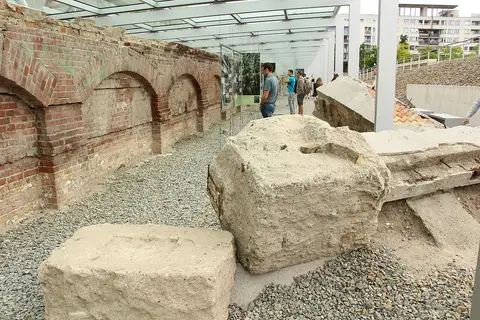

Topography of Terror (former Prinz-Albrecht-Straße 8)
Niederkirchnerstraße 8, 10963 Berlin-Kreuzberg
- Then
- Göring’s circular, published on 3 May 1933, gave Berlin SW 11, Prinz-Albrecht-Straße 8, the former School of Applied Arts, as the seat of the Secret State Police Office.3,7
- Today
- The site of the former Gestapo headquarters is the Topography of Terror documentation centre, whose permanent exhibition documents the Gestapo, the SS and the Reich Security Main Office.
More pictures

Sources
- Laupheimer Verkündiger, 4 May 1933 Deutsche Digitale Bibliothek, Zeitungsportal, p. 1, "Unterstellung der Gewerkschaften unter Adolf Hitler" (Berlin, 3 May)
- Hamburgischer Correspondent, 4 May 1933 Deutsche Digitale Bibliothek, Zeitungsportal, p. 1, "Deutsch-polnische Aussprache" and "Geheimes Staatspolizei-Amt" (Berlin, 3 May); p. 2, the DNVP's change of name
- Buersche Volkszeitung, 4 May 1933 Deutsche Digitale Bibliothek, Zeitungsportal, p. 2, text of the circular on the Secret State Police Office and "Die Tägliche Rundschau bis zum 31. Mai verboten"
- Erzgebirgischer Volksfreund, 4 May 1933 Deutsche Digitale Bibliothek, Zeitungsportal, p. 2, items datelined Berlin and Stuttgart, 3 May
- Karlsruher Tagblatt, 5 May 1933 Deutsche Digitale Bibliothek, Zeitungsportal, p. 8, sports notes
- General-Anzeiger (Bonn), 4 May 1933 Deutsche Digitale Bibliothek, Zeitungsportal, p. 6, football notes
- Geschichte des Ortes vor 1945 Stiftung Topographie des Terrors
Spotted a mistake? Send a correction.