Day 11 of 100
Hitler wants the job-creation programme to serve as cover for rearmament
In the cabinet’s work-creation committee Hitler declared that Germany’s future depended solely on rebuilding the armed forces and that public works money should help to disguise rearmament; the committee gave the army the largest single share. Württemberg protested at party rallies being broadcast as government programmes. On Berlin’s radio a spokesman for the German cities argued that the unemployed should be left wholly to the municipalities, and new flu cases began to fall.
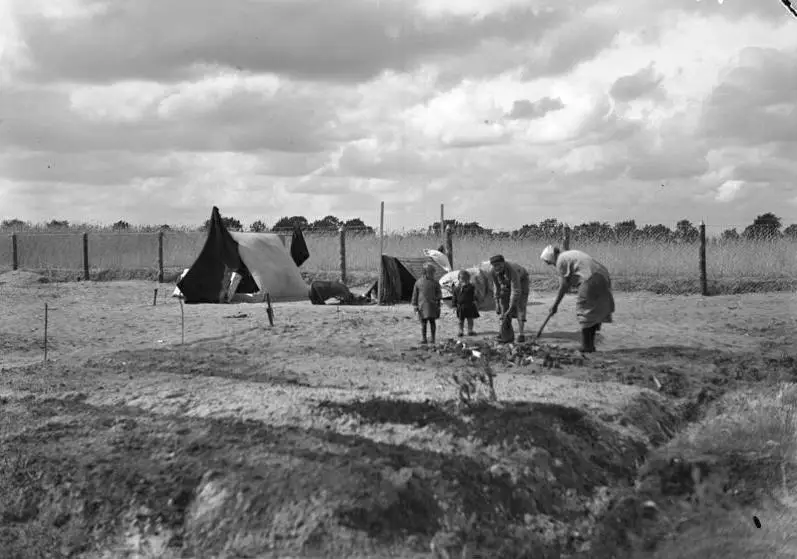

The minutes of the work-creation committee are among the clearest early records of how the regime linked unemployment policy to rearmament. Reich ministries had claimed four times the 100 million marks reserved for them in the “immediate programme”. Hitler told the committee that billions would be needed for rearmament, that every claim from the states and municipalities that was not strictly necessary should be struck out, and that the programme was well suited to camouflage work for national defence. The most dangerous period, he said, would be the years between the theoretical recognition of Germany’s military equality and the achievement of real strength; only when Germany was strong enough to be worth an alliance, if need be against France, would the main difficulties be over.
Politics and power
Government, terror and persecution
-
Military 17:00, Berlin, Reich Chancellery
Work creation to camouflage rearmament
Gereke reported claims of some 400 million marks on the Reich’s 100-million share of the job-creation programme, including 100 million for armaments and 30 million for strategic railways. Hitler said the future of Germany depended exclusively on rebuilding the armed forces and that the programme offered the best chance of disguising defence work. The committee approved 140 million marks for Reich purposes: 50 million for the army, 40 million for suburban smallholdings for the unemployed, and 10 million each for aviation and canals, cutting the share for states and municipalities by 40 million.1
-
Military Berlin, Reich Chancellery
Aviation asks for a three-year programme
Director Milch, speaking for Göring’s new aviation commissariat, said it had already agreed with the defence ministry on a minimum three-year programme costing 127 million marks, with 42.3 million needed in 1933. Hitler called this the smallest sum worth considering.1
-
The states Stuttgart
Württemberg objects to party rallies on government radio
Württemberg’s state president, Bolz, wrote to the Reich Interior Ministry that the planned broadcast of the NSDAP rally on 10 February and of the German Nationalist rally on 11 February as compulsory government programmes on all stations broke the rule that radio served no party. Württemberg would not object this time, but would in future; Bavaria lodged a similar protest two days later.2
-
Terror about 23:30, Berlin
Shots at Social Democrats in Berlin
Late at night, as Social Democrats walked home from a members’ meeting, shots were fired behind them in the Graudenzer Straße and the Röntgenstraße; no one was hurt. The Vorwärts complained that hardly a night now passed without armed Nazi groups threatening passers-by.3
Everyday life
What else was happening in Germany
-
Radio Berlin, Funkstunde
Should the cities take over the unemployed?
In a series on the Berlin Funkstunde about the unemployed, Dr Mulert of the German Association of Cities argued that all care of the jobless should be handed to the municipalities. The Vorwärts found the talk one-sided and complained that listeners hoping for practical information about help for the unemployed were disappointed.3
-
Society Berlin
Flu numbers start to fall
The Berlin AOK registered 967 new influenza cases between Wednesday and Thursday midday, below the peak of earlier in the week; the following day the figure fell again, to 802.4
-
Economy
Syrup proposed again for the labour exchanges
The board of the Reich Institution for Unemployment Insurance met on Thursday and unanimously endorsed the cabinet’s proposal to reappoint its former president Dr Syrup, who had been labour minister under Schleicher, to run the agency that paid unemployment benefit.3,5
Voices
The future of Germany depends exclusively and solely on the rebuilding of the armed forces. All other tasks must take second place to rearmament.
Elsewhere in the world
-
United States
Cold wave reaches New York
A cold wave from the north-west reached New York, where the temperature fell from 17 degrees above zero on Wednesday to 11 below on Thursday. More than 30 people were reported frozen to death across the country, and snow six metres deep cut communications in the north-western mountains.3
More pictures

Sources
- Akten der Reichskanzlei. Regierung Hitler 1933–1945, Bd. I, Nr. 19: Sitzung des Ausschusses der Reichsregierung für Arbeitsbeschaffung, 9. Februar 1933, 17 Uhr Bundesarchiv / Historische Kommission bei der Bayerischen Akademie der Wissenschaften, R 43 II/540, Bl. 35–40
- Akten der Reichskanzlei. Regierung Hitler 1933–1945, Bd. I, Nr. 20: Das Württembergische Staatsministerium an das Reichsministerium des Innern, Stuttgart, 9. Februar 1933 Bundesarchiv / Historische Kommission bei der Bayerischen Akademie der Wissenschaften, R 43 II/387, Bl. 2, with notes 1–8
- Vorwärts, Morgenausgabe Nr. 69, 10 February 1933 Deutsche Digitale Bibliothek, Zeitungsportal, p. 3, report of shots in the Graudenzer Straße and Röntgenstraße; p. 4 (cold wave in the United States); p. 5 ('Syrup wieder Präsident'; radio criticism of Dr Mulert's talk)
- Vorwärts, Morgenausgabe Nr. 71, 11 February 1933 Deutsche Digitale Bibliothek, Zeitungsportal, p. 3, 'Grippewelle sinkt weiter'
- Akten der Reichskanzlei. Regierung Hitler 1933–1945, Bd. I, Nr. 9: Ministerbesprechung vom 2. Februar 1933, 18 Uhr Bundesarchiv / Historische Kommission bei der Bayerischen Akademie der Wissenschaften, item 8 (cabinet proposes Syrup's reappointment as president of the Reichsanstalt)
Spotted a mistake? Send a correction.