Day 25 of 100
Police search the Communist headquarters and break up the KPD’s Sportpalast rally
In the afternoon the political police occupied and searched the Karl-Liebknecht-Haus, the Communist Party’s headquarters; in the evening a police officer dissolved the KPD’s rally in the Sportpalast while Wilhelm Pieck was speaking. Overnight men in Nazi uniform had shot a Reichsbanner leader in Großbeeren and burned down the poorhouse where he lived. Göring ordered tougher action against the opposition press. In Berlin the motor show closed after more than 400,000 visits, and Prussia relaxed its rules on men’s bathing trunks.

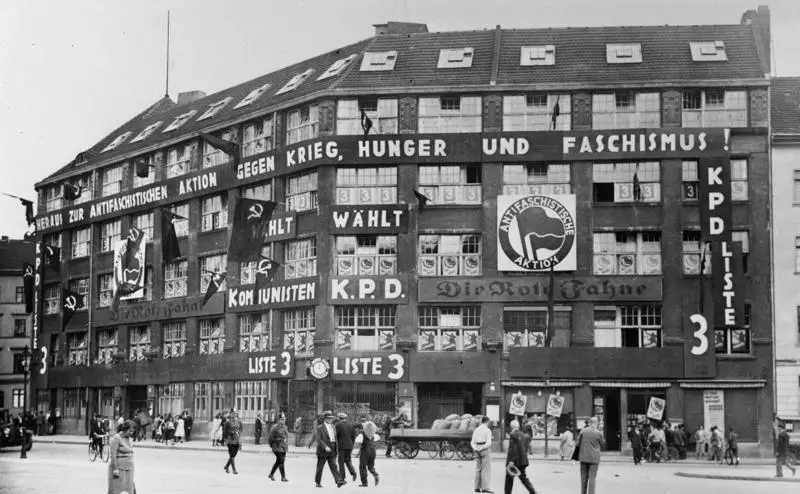
Within a few hours on 23 February the KPD lost the use of its two most visible Berlin platforms. In the afternoon political and uniformed police occupied the whole of the Karl-Liebknecht-Haus on the Bülowplatz and spent hours searching it for treasonable writings. In the evening the police officer supervising the party’s rally in the Sportpalast closed it down on account of a remark by Wilhelm Pieck about religion. The same day Göring rebuked officials for applying the press decree of 4 February too leniently, and the night before, in Großbeeren near Berlin, a local Reichsbanner leader had been shot and the house he lived in set on fire.
Laws and decrees
Verordnung des Reichspräsidenten zur Förderung der Landwirtschaft
Emergency decree to promote agriculture
Provided the legal basis for the government’s programme of grain-market support, regulated the area under hops, and empowered the Minister of Food and Agriculture to require processed-cheese makers to use German cheese, since the industry had increasingly turned to cheap imported cheese.5
Politics and power
Government, terror and persecution
-
Persecution 15:45, Berlin, Karl-Liebknecht-Haus, Bülowplatz
The Karl-Liebknecht-Haus searched
At about 15:45 a large detachment of political police, supported by uniformed police, appeared at the Karl-Liebknecht-Haus on the Bülowplatz, the headquarters of the Communist Party. They occupied the whole building and searched it for treasonable writings for several hours; the material seized was still being sifted that evening. According to the press, large quantities of illegal leaflets were taken.1,2
Sources disagree. The Akten der Reichskanzlei date both the search and the closure to 23 February; the official notices of the closure were issued on 24 February.
-
Opposition evening, Berlin, Sportpalast, Potsdamer Straße
The KPD’s Sportpalast rally dissolved
At what proved to be the KPD’s last big rally in Berlin, Wilhelm Pieck spoke in the Sportpalast in favour of a united front of the working class against the Hitler government. When, towards the end, he said of the plan to bring religious instruction into the vocational schools that working-class children would rather have something to eat and could do without consolation in the hereafter, the supervising police officer dissolved the meeting for bringing religion into contempt.3,4
-
Terror overnight, about 2:00, Großbeeren, near Berlin
A Reichsbanner leader shot and a poorhouse burned in Großbeeren
At about 2 a.m., after a peaceful Nazi rally and torchlight procession in Großbeeren, near Berlin, a band of men who, according to the local district official (Amtsvorsteher), wore Nazi uniform broke into the village poorhouse, home to nine families. They fired several shots through the door of Karl Schlombach, a mason and the local Reichsbanner leader, wounding him; he and his wife escaped by jumping from the window in their nightclothes. The attackers then set fire to his flat, and although volunteer fire brigades came from the surrounding villages, the house burned out and the nine families lost their homes. The attackers had fled before the police arrived. The district government in Potsdam said it knew only that fire had broken out “for reasons not yet known”.5
-
Propaganda Berlin
Göring demands a harder line against the press
Göring complained to the provincial governors and district presidents that the press provisions of the decree of 4 February were not being applied with the severity required by the “daily increasing agitation” in newspapers, leaflets and posters, and threatened disciplinary proceedings against officials who lacked zeal. In an appeal to the SA, SS and Stahlhelm he assured them of his “unlimited trust” as “bearers of the national will”, while warning that members who disobeyed their leaders would be held to account.6,5
-
The states Berlin, Prussian State Council
The Prussian State Council protests
The Prussian State Council debated the constitutional situation on the basis of motions from its constitutional committee, which declared the dissolution of all local councils contrary to law and proposed challenging before the Staatsgerichtshof the dissolution of the bodies that elected the Council’s members. The press summarised the debate as a protest against Göring’s decrees.6
Everyday life
What else was happening in Germany
-
Fashion Prussia
Men’s bathing trunks allowed again
The Prussian Interior Ministry let it be known through a textile trade paper that the bathing regulations of August and September 1932, the so-called Zwickelerlass (gusset decree) issued under Franz Bracht, were soon to be changed. Short trunks for men, banned in mixed bathing establishments, would again be permitted provided they had a gusset, so men need no longer wear a full bathing costume; the rules for women’s swimwear stayed as they were.7
-
Technology Berlin, Exhibition halls, Kaiserdamm
The motor show closes after 400,000 visitors
The International Automobile and Motorcycle Exhibition, organised by the Reich Association of the Automobile Industry, closed its halls on the Kaiserdamm after an exceptional attendance of more than 400,000 visitors from Germany and abroad at over 400 stands. Lorry sales had been disappointing, but the makers of cars and motorcycles reported that their hopes had been far exceeded. The halls were to be prepared for the next show, “Die Frau” (Woman), with some 130 meetings and lectures on women’s lives.8
-
Books Berlin
Rosenberg and Johst at a rally for “German writing”
The Kampfbund für deutsche Kultur held a rally for German literature. Alfred Rosenberg told the audience that most Germans were no longer interested in what “democratic” writers thought or in “contrite souls dissected by psychoanalysts”; the Kampfbund’s office had read 1,500 plays in the past year and found perhaps ten or fifteen usable. The dramatist Hanns Johst read the fourth act of his play Albert Leo Schlageter.3
In Berlin today
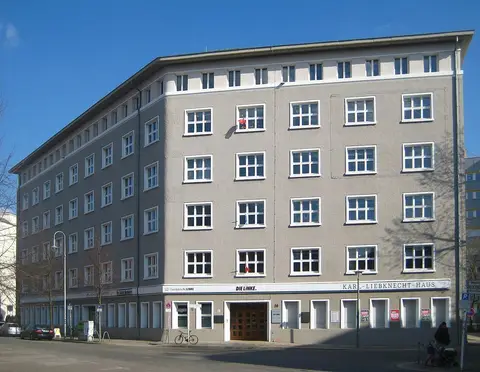

Karl-Liebknecht-Haus
Kleine Alexanderstraße 28, 10178 Berlin-Mitte
- Then
- Headquarters of the KPD, which the political police occupied and searched on the afternoon of 23 February 1933.9,10
- Today
- The building is the national headquarters of the party Die Linke. A plaque beside the entrance on the Kleine Alexanderstraße records that the Central Committee of the KPD worked here from 1926 to 1933.
_Sportpalast.JPG)
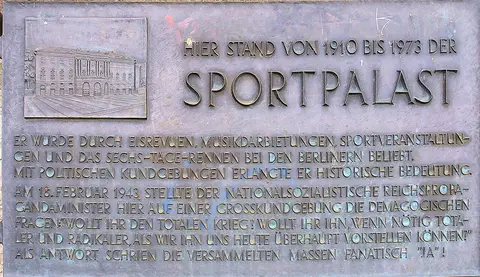
Sportpalast (site)
Potsdamer Straße 170, 10783 Berlin-Schöneberg
- Then
- The arena where the KPD’s rally with Wilhelm Pieck was dissolved by the police on the evening of 23 February 1933.11
- Today
- The Sportpalast was demolished from 1973. A bronze plaque unveiled in 1993 marks the site and recalls its sporting events and Goebbels’s “total war” speech of 18 February 1943.
More pictures

Sources
- Karl-Liebknecht-Haus durchsucht Hamburgischer Correspondent, via Deutsche Digitale Bibliothek Zeitungsportal, 24 February 1933, p. 2 (report dated Berlin, 23 February)
- Nr. 32 Ministerbesprechung vom 28. Februar 1933 (note 8 on the search of the Karl-Liebknecht-Haus) Bundesarchiv / Historische Kommission bei der Bayerischen Akademie der Wissenschaften, Akten der Reichskanzlei. Regierung Hitler, Band I, Note 8
- Kommunistische Versammlung aufgelöst; Für das deutsche Schrifttum Hamburger Fremdenblatt (Reichsausgabe), via Deutsche Digitale Bibliothek Zeitungsportal, 24 February 1933, p. 2
- Chronik 1933 (entry for 23 February) Deutsches Historisches Museum, LeMO
- Armenhaus in Brand gesteckt; Göring an SS, SA und Stahlhelm; Käserei und Hopfenanbau Kölnische Zeitung, via Deutsche Digitale Bibliothek Zeitungsportal, 23 February 1933, evening edition, p. 9
- Polizei und Presse. Göring ordnet schärferes Vorgehen an; Staatsrat gegen Görings Erlasse Kölnische Zeitung, via Deutsche Digitale Bibliothek Zeitungsportal, 24 February 1933, p. 1 (reports dated Berlin, 23 February)
- Die Badehose wieder zugelassen Kölnische Zeitung, via Deutsche Digitale Bibliothek Zeitungsportal, 24 February 1933, p. 2 (report dated Berlin, 23 February)
- Ausstellungen gehen und kommen. Jetzt: Die Frau Kölnische Zeitung, via Deutsche Digitale Bibliothek Zeitungsportal, 25 February 1933, p. 3 (report dated Berlin, 24 February)
- Karl-Liebknecht-Haus (memorial plaque, Kleine Alexanderstraße 28) Gedenktafeln in Berlin (Aktives Museum Faschismus und Widerstand in Berlin / Gedenkstätte Deutscher Widerstand)
- Bundesgeschäftsstelle Die Linke, Address: Karl-Liebknecht-Haus, Kleine Alexanderstraße 28, 10178 Berlin
- Sportpalast (memorial plaque, Potsdamer Straße 170) Gedenktafeln in Berlin (Aktives Museum Faschismus und Widerstand in Berlin / Gedenkstätte Deutscher Widerstand)
Spotted a mistake? Send a correction.