Day 48 of 100
Emergency decrees speed up treason trials and withdraw the four-pfennig coin
Hindenburg signed two emergency decrees: one shortened procedure in treason cases, the other bundled financial, economic and legal measures, including a reform of the coinage that withdrew the four-pfennig piece. Goebbels opened the exhibition ‘Die Frau’ at the Kaiserdamm halls, Schacht spoke on the radio as the new Reichsbank president, and Frick banned the Soviet papers Izvestia and Pravda. Berlin and Potsdam were declared closed airspace for the day of the Reichstag’s opening.

The treason decree was a technical text with a political purpose. It removed procedural safeguards in the political prosecutions the regime was bringing against its opponents: the Reich prosecutor could pass lesser treason cases to the states, preliminary judicial investigations were curtailed, and the formal court decision to open a trial was abolished in cases before the Reichsgericht and the higher regional courts.
Laws and decrees
Verordnung des Reichspräsidenten zur Beschleunigung des Verfahrens in Hochverrats- und Landesverratssachen
Reich President's decree to accelerate proceedings in cases of high treason and treason
Let the Reich prosecutor hand lesser treason cases to state prosecutors, curtailed preliminary judicial investigation and abolished the formal decision to open the main trial in cases before the Reichsgericht and higher regional courts; in force on the second day after promulgation.2,3
Verordnung des Reichspräsidenten über Maßnahmen auf dem Gebiete der Finanzen, der Wirtschaft und der Rechtspflege
Reich President's decree on measures in the fields of finance, the economy and the administration of justice
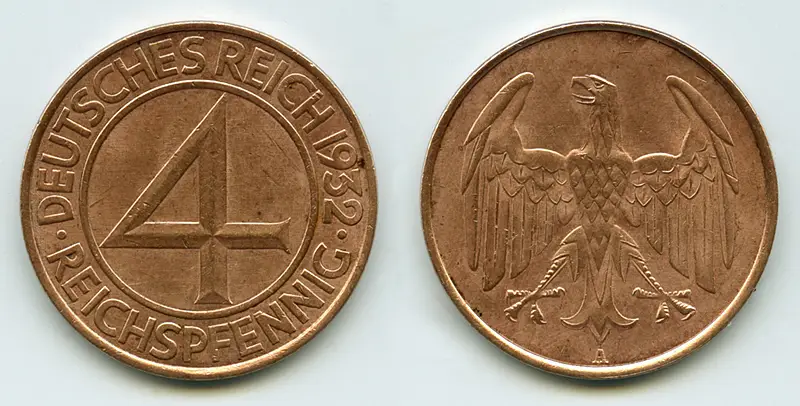
An omnibus emergency decree: among much else it kept the cut in civil-service posts until 1936, extended auxiliary judges at the Reichsgericht and reformed the coinage, withdrawing the three-mark and four-pfennig pieces.1,3,4
Politics and power
Government, terror and persecution
-
Government Berlin
Two emergency decrees signed
Under Article 48 of the constitution, Hindenburg signed a decree to accelerate proceedings in cases of high treason and treason, countersigned by Frick, and a long decree on ‘measures in the fields of finance, the economy and the administration of justice’, countersigned by Papen and other ministers. The latter extended until March 1936 the rule that one in three vacated civil-service posts must be abolished.1,2,4
-
Propaganda morning, Berlin, Kaiserdamm exhibition halls
Goebbels opens the exhibition ‘Die Frau’
In the exhibition halls on Kaiserdamm, Goebbels opened the exhibition ‘Die Frau’ (Woman) in the morning; the speech was broadcast. He said that women had been kept out of the ‘parliamentary-democratic intrigue’ not out of disrespect, but because their strengths lay in other fields than men’s, while insisting that no one intended to push women out of public life and paid work.5
-
Economy evening
Schacht’s first broadcast as Reichsbank president
Hjalmar Schacht spoke on all German stations about the Reichsbank’s future policy. ‘This is not the time for long speeches,’ he began; money, banking and credit were not a world apart governed by mathematical rules but bound up with the interests of the national economy.4
-
Propaganda Berlin
Izvestia and Pravda banned; airspace closed for 21 March
Frick banned the Soviet newspapers Izvestia and Pravda from circulation in Germany until 30 April for publications ‘damaging the reputation of the German government’. The Reich Commissioner for Aviation declared Berlin and Potsdam prohibited airspace for the opening of the Reichstag on 21 March, to be enforced ‘if necessary by force of arms’.6,7
Everyday life
What else was happening in Germany
-
Economy
Farewell to the four-pfennig piece
The coin reform in the new decree announced that the four-pfennig piece would be withdrawn by 15 October 1933. Three-mark coins were also to be called in; one-mark coins were in future to be struck in nickel, and smaller five-mark and two-mark pieces with a higher silver content were planned.1,4
-
Transport
Graf Zeppelin to fly to South America again
The airship Graf Zeppelin was to resume its South America flights carrying mail, leaving Friedrichshafen from May on the first Saturday of each month and from 2 September every other Saturday, via Recife to Rio de Janeiro.8
-
Crime early morning, Berlin
Raid on ‘food looters’ in southern Berlin
In an early-morning operation in the south of Berlin the police arrested 34 people suspected of looting food shops; several were said to have confessed.9
Voices
It was not because we did not respect women that we kept them out of the parliamentary-democratic intrigue. We are convinced that a woman must exercise her powers and use her abilities in other fields than a man.
More pictures

Sources
- Verordnung des Reichspräsidenten über Maßnahmen auf dem Gebiete der Finanzen, der Wirtschaft und der Rechtspflege (18.03.1933), excerpt documentArchiv.de, Chapter X, amendment of the Coinage Act; signatories; RGBl. 1933 I S. 109–122
- Verordnung des Reichspräsidenten zur Beschleunigung des Verfahrens in Hochverrats- und Landesverratssachen (18.03.1933) documentArchiv.de, Full text; RGBl. 1933 I S. 131
- Deutscher Reichsanzeiger und Preußischer Staatsanzeiger, 22 March 1933 Deutsche Digitale Bibliothek, Deutsches Zeitungsportal, p. 1, Reichsverlagsamt notice: contents of RGBl. I Nr. 23, issued 22 March 1933
- Hamburger Fremdenblatt (Reichsausgabe), 19 March 1933 Deutsche Digitale Bibliothek, Deutsches Zeitungsportal, p. 1, contents of the emergency decree; Schacht's radio address
- Verbo Schussen-Bote, 20 March 1933 Deutsche Digitale Bibliothek, Deutsches Zeitungsportal, p. 2, Wolff report on the opening of the exhibition 'Die Frau'
- Hamburger Fremdenblatt (Reichsausgabe), 19 March 1933 Deutsche Digitale Bibliothek, Deutsches Zeitungsportal, p. 2, ban on 'Izvestia' and 'Pravda'
- Neue Mannheimer Zeitung, 19 March 1933 Deutsche Digitale Bibliothek, Deutsches Zeitungsportal, p. 2, Berlin and Potsdam declared prohibited airspace for 21 March
- Hamburger Fremdenblatt (Reichsausgabe), 19 March 1933 Deutsche Digitale Bibliothek, Deutsches Zeitungsportal, p. 8, 'Graf Zeppelin' South America flights
- Bergedorfer Zeitung, 18 March 1933 Deutsche Digitale Bibliothek, Deutsches Zeitungsportal, p. 2, police operation against food looters in southern Berlin
Spotted a mistake? Send a correction.