Day 32 of 100
Cabinet picks Potsdam’s Garrison Church for the opening of the new Reichstag
With the Reichstag a burnt shell, the cabinet agreed that the new parliament should be opened in the Garrison Church at Potsdam, the germ of the ‘Day of Potsdam’. Göring told ministers of an alleged Communist plan of attack and complained of foreign papers accusing him of the fire; Hitler said the outcry would have died if the arsonist had been hanged at once. To win votes, the cabinet agreed to hand out cheap bread and butter to the unemployed in distressed areas. That evening Hitler spoke in the Sportpalast before members of the diplomatic corps, while in Bremen a Reichsbanner man died after a night of shooting.
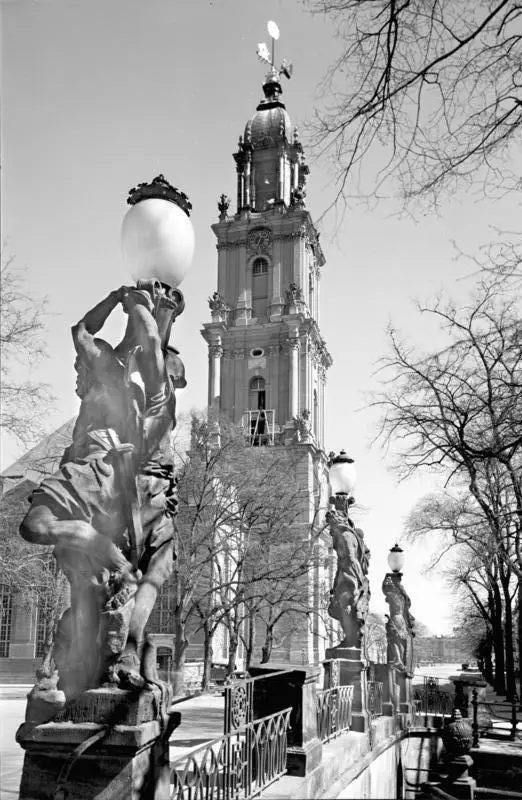

The cabinet meeting of 2 March shows the government preparing both the election and its aftermath. Göring presented supposed Communist plans for an uprising, said publishing them was too dangerous, and wanted the investigation of the Reichstag fire taken from a judge he distrusted because he might confine it to van der Lubbe or release Torgler. Neurath, worried by foreign reactions, asked whether the measures against the Social Democrats might be eased; Göring refused to release their newspapers before the vote. Ministers then turned to the opening of the new Reichstag: since the rooms in the Potsdam palaces were too small, they chose the Garrison Church, which held 2,000.
Politics and power
Government, terror and persecution
-
Parliament 12:00, Berlin, Reich Chancellery
The Garrison Church is chosen for the Reichstag’s opening
Frick reported that the Oranienburg Hall in the Potsdam City Palace held only 200 people and that the New Palace was also too small; only the Garrison Church, with room for 2,000, would do. Hitler and the cabinet readily agreed. Popitz pointed out that the drill hall (Exerzierhaus) might also serve.1
-
Government 12:00, Berlin, Reich Chancellery
Göring’s ‘Communist plans’ and a judge he wants replaced
Göring told the cabinet that documents found overnight showed the Communists had first planned to strike on election night and then postponed the date to mid-March, and that a map marking Berlin’s power stations and underground railway installations had been found; he would not publish it. He asked for the investigation of the fire to be taken from the examining judge, Landgerichtsdirektor Braune, who might confine it to van der Lubbe or release Torgler early, and complained that foreign papers were accusing him of setting the fire. Foreign Minister von Neurath asked whether the measures against the Social Democrats, a main cause of hostile foreign comment, could be relaxed; Göring answered that their papers would stay banned until after the election.1
-
Propaganda 20:00, Berlin, Sportpalast
Hitler in the Sportpalast, Göring in the exhibition halls
The Nazi party filled the Sportpalast and one of the large exhibition halls in Berlin. Many members of the diplomatic corps accepted invitations to the Sportpalast, where SA men wearing auxiliary police armbands were on duty. Hitler, greeted by some ten minutes of applause when he arrived, presented himself as the accuser of the parties that had governed for fourteen years; Göring spoke in the exhibition halls, and part of his speech was relayed to the Sportpalast. The speeches were broadcast.3,4,5
-
Terror overnight and evening, Bremen
A Reichsbanner man dies after a night of shooting in Bremen
During the night to Thursday Nazis and members of the Reichsbanner, the Social Democrats’ defence league, clashed in the Waller Heerstraße in Bremen. Three Reichsbanner men were seriously wounded by shots to the stomach and thighs, and one of them died that evening. The newspapers did not give his name.6
-
Churches Berlin
Hindenburg answers the bishops
Hindenburg replied to Cardinal Bertram’s appeal of the previous day that he would do everything in his power to secure the citizens’ freedom to vote and to prevent excesses in the campaign, and that he was convinced the Reich government shared that intention. His office sent the cardinal’s letter on to Hitler.2
Everyday life
What else was happening in Germany
-
Economy Berlin
Cheap bread and butter before the vote
Frick wanted every household of the poor and unemployed to receive about five hundredweight of coal free before the election, but at 20 to 30 million marks it was too dear. The cabinet agreed instead to distribute butter from state support stocks and cheap rye bread in distressed areas such as Berlin, Upper Silesia, Thuringia, the Ruhr and Saxony. The Nazi Völkischer Beobachter announced 40,000 hundredweight of butter and 700,000 of rye; in the event 34,000 and 465,000 were provided, giving the unemployed about a kilo of cheap bread a week for four weeks.1
-
Radio evening
An evening on the wireless
Listeners in Hamburg heard Hitler’s Sportpalast speech from 20:00, followed shortly after 21:00 by a programme pleading for the theatre as a German cultural asset, and late dance music. Breslau broadcast a radio play, Flucht aus Venedig, and Frankfurt Beethoven’s Eroica.5
-
Society Hamburg
The influenza wave ebbs
Hamburg’s health office reported 12 deaths from influenza in the week of 19 to 25 February, the lowest figure for six weeks, after 15 deaths in the week of 15 to 21 January and a sharp rise in the weeks that followed.5
Voices
The outcry would have lost its ground if the culprit had been hanged at once.
More pictures

Sources
- Akten der Reichskanzlei. Regierung Hitler 1933–1945, Bd. I: Nr. 41, Ministerbesprechung vom 2. März 1933, 12 Uhr Historische Kommission bei der Bayerischen Akademie der Wissenschaften / Bundesarchiv, Band I, pp. 146–152, items 1–4, with editorial notes on the butter and bread scheme
- Akten der Reichskanzlei. Regierung Hitler 1933–1945, Bd. I: Nr. 40, Kardinal Bertram an den Reichspräsidenten (with Hindenburg’s reply of 2 March 1933) Historische Kommission bei der Bayerischen Akademie der Wissenschaften / Bundesarchiv, Band I, p. 145, note 1
- Kölnische Zeitung, 3 March 1933 Deutsche Digitale Bibliothek, Zeitungsportal, p. 3, 'Hitler über den ...' (report of the Sportpalast meeting)
- Hamburgischer Correspondent, Morgenausgabe, 3 March 1933 Deutsche Digitale Bibliothek, Zeitungsportal, p. 5, report of Hitler's Sportpalast speech
- Hamburger Fremdenblatt, Reichsausgabe, 2 March 1933 Deutsche Digitale Bibliothek, Zeitungsportal, p. 5, 'Die Grippe baut stark ab'; p. 6, radio listings 'Heute abend'
- Hamburger Fremdenblatt, Reichsausgabe, 3 March 1933 Deutsche Digitale Bibliothek, Zeitungsportal, p. 5, 'Ein Todesopfer in Bremen'
Spotted a mistake? Send a correction.