Themes

Elections and parliament

The March election, the Reichstag, the state parliaments, the Enabling Act.

24 days

  1. Day 2 Tuesday 31 January 1933

    Talks with the Centre Party fail and the cabinet settles on new elections

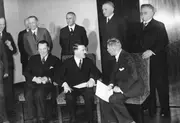
    Hitler met the leaders of the Catholic Centre Party, failed to win their consent to a year-long adjournment of the Reichstag, and told his cabinet that new elections were unavoidable; he promised that they would be the last. A presidential decree handed Papen the Reich’s powers over Prussia. In Berlin the flu epidemic accelerated, and Ufa’s U-boat film Morgenrot had its premiere in Essen.
  2. Day 3 Wednesday 1 February 1933

    Reichstag dissolved and Hitler asks the nation for four years in his first radio address

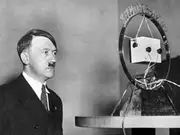
    At Hitler’s request Hindenburg dissolved the Reichstag and set new elections for 5 March. The cabinet agreed to make life harder for new parties, and at 22:00 every German station broadcast the government’s “Appeal to the German People”, read by Hitler. In Berlin a damp spell drove the flu epidemic higher, a new bus route opened to Lankwitz, and a landlord collecting rents in Pankow was shot dead by car-borne robbers.

  3. Day 8 Monday 6 February 1933

    Presidential decree removes Prussia’s elected government; Papen dissolves the Landtag

    Hindenburg transferred the last powers of Otto Braun’s elected Prussian government to the Reich Commissioner, Papen, who then dissolved the Prussian Landtag together with its president, Kerrl, over the objection of Konrad Adenauer. The same day Hindenburg assured Bavaria that no one planned to override the states. In Staßfurt a headmaster told his school of the murdered mayor; in Berlin the flu began, briefly, to ebb.

  4. Day 9 Tuesday 7 February 1933

    Social Democrats fill the Lustgarten as the KPD leadership meets in secret at Ziegenhals

    In rain and wind, the Social Democrats and the Iron Front marched into the Lustgarten for their largest rally of the campaign, where Otto Wels declared that the workers’ front stood unbroken. Outside Berlin, the Communist Party’s central committee met secretly in an inn at Ziegenhals to hear Ernst Thälmann. In the Reichstag building, Nazi deputies broke up the committee meant to guard parliament’s rights. In Berlin the flu returned with more than a thousand new cases in a day.

  5. Day 12 Friday 10 February 1933

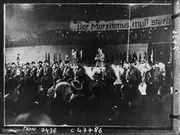
    Hitler’s Sportpalast speech goes out on every German radio station

    Hitler opened the NSDAP’s election campaign in the Berlin Sportpalast, and every German station carried the speech, introduced by Goebbels, as a government broadcast. Tens of thousands attended the funeral of three murdered Communist workers at Friedrichsfelde, though the police banned the procession. Thomas Mann gave his last lecture in Munich, the former Prussian culture minister Carl Heinrich Becker died in Berlin, and a gasholder exploded in Neunkirchen in the Saar, killing dozens.

  6. Day 13 Saturday 11 February 1933

    Hitler opens the Berlin motor show, promising tax relief and a road-building plan

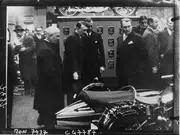
    Walking past ranks of SA men, Hitler opened the International Automobile and Motorcycle Exhibition at the Kaiserdamm, the first Chancellor, the industry noted, ever to do so, and promised motorists lower taxes, a great road-building plan and support for motor sport. That evening the radio carried Hugenberg’s speech to the new German Nationalist and Stahlhelm alliance in the Sportpalast. In a Berlin dairy shop, a milkman told a customer that half the street was living on potatoes.

  7. Day 15 Monday 13 February 1933

    Göring widens the purge of Prussia’s republican police chiefs

    Göring, as Reich Commissioner for the Prussian Ministry of the Interior, sent more officials loyal to the Republic on forced leave, among them the police presidents of Dortmund, Oberhausen, Stettin, Frankfurt and Breslau. The Stahlhelm told its members the coming election was a plebiscite on the “national government”. Away from politics, Bayreuth marked the fiftieth anniversary of Richard Wagner’s death and Berlin radio filled the evening with his operas.

  8. Day 16 Tuesday 14 February 1933

    Nazi deputies break up a Reichstag committee as farm foreclosures are halted

    The cabinet approved, and Hindenburg signed, a decree stopping forced auctions of farms until the end of October. In the Reichstag, Nazi members drove the chairman of the committee that guarded parliament’s rights from his seat and Julius Streicher struck a People’s Party deputy; that evening the political police searched Communist rooms in the building. Neunkirchen in the Saar buried the victims of the gas-holder explosion, Göring opened a show of modern Italian painting and the geneticist Carl Correns died in Dahlem.

  9. Day 18 Thursday 16 February 1933

    The states protest in the Reichsrat as Göring vows no Social Democrat will stay in office

    In the Reichsrat Bavaria and the southern states protested against Prussia being represented by Göring’s and Papen’s appointees and voted to limit the chamber to urgent business until the constitutional court had ruled. That evening Göring told journalists that no Social Democrat would be tolerated in the Prussian administration. The Reichsgericht lifted an earlier ban on Vorwärts, and the cabinet discussed taking away the court’s power to do so. At the Sportpalast the American ice hockey team beat Germany 7–2.

  10. Day 21 Sunday 19 February 1933

    Police break up the “Free Word” congress at the Kroll Opera

    More than a thousand writers, scholars and politicians met at the Kroll Opera to defend freedom of speech, the press, assembly and art; police dissolved the meeting when the former Prussian minister Wolfgang Heine mocked the regime. Frick told a Dresden rally that the government would not give up power even without a majority, Hitler spoke against the Centre Party in Cologne and the Reichsbanner marched in the Lustgarten. Berliners took sledges and skis to the snowbound Grunewald.

  11. Day 22 Monday 20 February 1933

    Hitler and Göring ask leading industrialists to pay for the election

    At Göring’s official residence opposite the Reichstag, Hitler told about two dozen leading industrialists and bankers that private enterprise could not survive in a democracy; Göring added that the coming election would surely be the last for ten years, perhaps a hundred, and Hjalmar Schacht proposed a three-million-mark election fund. The same day the Prussian press service released Göring’s “shooting decree”. Göring also banned the sale of spirits on polling days, and the perjury trial of a former Berlin transport director in the Sklarek scandal opened to packed public benches.

  12. Day 23 Tuesday 21 February 1933

    Rust suspends the head of the Karl-Marx-Schule; Frick bans Communist marches in Saxony

    Rust ordered the reorganisation of the Karl-Marx-Schule in Neukölln, one of the Weimar Republic’s leading reform schools, sent its head Fritz Karsen on leave and suspended three senior Berlin school officials. Frick used the decree of 4 February to ban Communist open-air meetings and marches in Saxony, and the trade union federation protested to Hindenburg against Göring’s police decree. In Berlin, thermometers on the city’s edge fell to 18 degrees below zero overnight, and the creditors of the theatre impresarios Rotter learned they would get nothing.

  13. Day 28 Sunday 26 February 1933

    Uniformed police wear swastika armbands at a Nazi rally in the Lustgarten

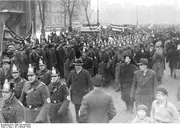
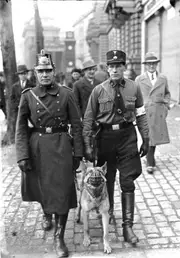
    On the last Sunday of February uniformed Berlin police officers marched with swastika armbands at the first mass rally of the National Socialist factory cells in the Lustgarten, while police president Levetzow looked in to cheers. Police broke up a Social Democratic cultural rally in Neukölln and led the speaker Friedrich Stampfer away to the station; across the Reich, election marches ended in shootings and stabbings. Berliners went tobogganing on a second snowy Sunday, and in Prague the United States took the ice hockey world title from Canada for the first time.

  14. Day 29 Monday 27 February 1933

    The Reichstag burns, and the Nazi leadership blames a Communist uprising

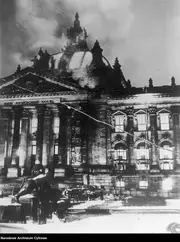
    On the evening of Monday 27 February the Reichstag building in Berlin was set alight; a young Dutchman, Marinus van der Lubbe, was arrested inside, and before the night was out Göring had declared the fire the signal for a Communist revolt, banned the left-wing press in Prussia and ordered arrests. Earlier that day the cabinet had approved a harsh new decree against ‘treason’, and SA men had fired into the flat of a Social Democratic deputy in Neukölln. In Cologne the Rosenmontag carnival procession went ahead in the sunshine.

  15. Day 32 Thursday 2 March 1933

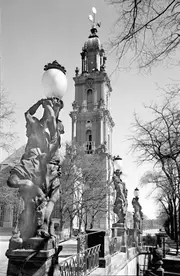
    Cabinet picks Potsdam’s Garrison Church for the opening of the new Reichstag

    With the Reichstag a burnt shell, the cabinet agreed that the new parliament should be opened in the Garrison Church at Potsdam, the germ of the ‘Day of Potsdam’. Göring told ministers of an alleged Communist plan of attack and complained of foreign papers accusing him of the fire; Hitler said the outcry would have died if the arsonist had been hanged at once. To win votes, the cabinet agreed to hand out cheap bread and butter to the unemployed in distressed areas. That evening Hitler spoke in the Sportpalast before members of the diplomatic corps, while in Bremen a Reichsbanner man died after a night of shooting.

  16. Day 34 Saturday 4 March 1933

    Election eve: Hitler speaks from Königsberg and Otto Braun leaves for Switzerland

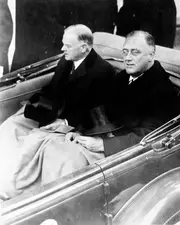
    On the eve of the election the Nazi party staged its ‘Day of the Awakening Nation’: Hitler flew to Königsberg and spoke there in a broadcast relayed to marching columns and loudspeakers across Germany. Otto Braun, the Social Democrat who had governed Prussia for most of the Weimar years, crossed the Swiss border that afternoon and did not come back. In Hamburg the Nazis demanded control of the police, in Vienna all three presidents of the Austrian parliament resigned, and in Washington Franklin D. Roosevelt took office. Hamburg’s port saw the season’s first Mediterranean cruise sail.

  17. Day 35 Sunday 5 March 1933

    Reichstag election under the emergency decree: 43.9 per cent for the NSDAP

    On a grey, rainy Sunday nearly 89 per cent of Germany’s voters went to the polls in an election held under the emergency decree, with Communist leaders in prison or in hiding and the left-wing press silenced. The NSDAP won 43.9 per cent, short of an absolute majority, but with the nationalist ‘Combat Front Black-White-Red’ the government had a majority of seats; the Social Democrats held 18.3 per cent and the Communists 12.3. That night the Reich interior minister ordered Hamburg’s police handed to a Nazi, and SA men raised the swastika on town halls. In Hamburg, Altona 93 won the city football championship in the rain.

  18. Day 37 Tuesday 7 March 1933

    Hitler tells the cabinet the election was a ‘revolution’ and calls for an Enabling Act

    Two days after the election Hitler told his ministers that 5 March had been a revolution, that Marxism would disappear and that an Enabling Act with a two-thirds majority was needed; he and Frick demanded that van der Lubbe be hanged, retroactively if need be. At Hindenburg’s residence the Reichstag’s opening in Potsdam’s Garrison Church was planned in detail. In Dresden, Nazi supporters whistled the conductor Fritz Busch off the podium of the State Opera. Abroad, Dollfuss began governing Austria without parliament, and the Netherlands reinforced its border against German refugees.

  19. Day 42 Sunday 12 March 1933

    Hindenburg puts the swastika beside black-white-red; Hitler orders ‘blindest discipline’

    On Remembrance Day, with black-white-red flags at half-mast, Hindenburg decreed that from the next day the old imperial flag and the swastika flag were to be flown together on public buildings. Hitler announced the decree on the radio and told the SA and SS that the struggle to ‘cleanse’ the Reich would now be directed from above and that all individual actions must stop. Hindenburg and Hitler attended the Volksbund ceremony in the State Opera in Berlin. In Prussia’s municipal and provincial elections the government parties won majorities in most places, including Berlin. In Washington Roosevelt gave his first fireside chat.

  20. Day 45 Wednesday 15 March 1933

    Cabinet plans the Enabling Act; police and SA raid Berlin’s artists’ colony

    The cabinet discussed how to pass an enabling law: Interior Minister Frick counted the deputies needed for a two-thirds majority and suggested that Communists might be put in labour camps. Police and SA auxiliaries sealed off the artists’ colony in Wilmersdorf, searched flats and arrested fourteen people, while Goebbels told the press that its task was to ‘instruct’. In the auction rooms, Kändler’s Meissen porcelain birds went under the hammer at what a reporter called crisis prices.

  21. Day 50 Monday 20 March 1933

    Himmler announces the first concentration camp, at Dachau; cabinet adopts the Enabling Act

    At a midday press briefing in Munich, Heinrich Himmler announced that a concentration camp for 5,000 Communist, Reichsbanner and Social Democratic functionaries would open near Dachau on Wednesday. In Berlin Hitler met Centre Party leaders and the cabinet approved the final text of the Enabling Act, which went to the Reichstag as a bill. Berlin renamed Reichskanzlerplatz after Hitler, Jewish prosecutors were barred from courtrooms, Robert Siodmak’s last German film opened, and the publisher Louis Ullstein died.

  22. Day 51 Tuesday 21 March 1933

    The Day of Potsdam: the new Reichstag opens in the Garrison Church

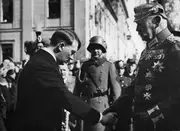
    The new Reichstag was opened with a state ceremony in Potsdam’s Garrison Church, where Hindenburg and Hitler spoke above the tombs of the Prussian kings. In the afternoon the deputies met in Berlin’s Kroll Opera House and re-elected Göring as president, and in the evening a torchlight procession filled the city centre while Wagner’s Meistersinger was performed at the State Opera. The same day Hindenburg signed decrees creating special courts, punishing ‘malicious’ criticism of the government and amnestying crimes committed for the ‘national uprising’.

  23. Day 52 Wednesday 22 March 1933

    First prisoners arrive at Dachau as the new Prussian Landtag meets

    The first transports of prisoners reached the new concentration camp at Dachau, set up on the grounds of a disused powder and munitions factory. In Berlin the Prussian Landtag opened under its 84-year-old Nazi senior member, who called it ‘the Landtag of the Hitler spring’, and a Reichstag committee changed the rules so that absent deputies could be counted as present. The decrees on ‘malicious attacks’ and special courts were published, and the Deutschlandsender began using the Garrison Church carillon as its interval signal.

  24. Day 53 Thursday 23 March 1933

    The Reichstag passes the Enabling Act; only the Social Democrats vote against

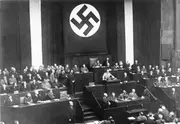
    In the Kroll Opera House, ringed by the SS and watched from inside by armed SA men, the Reichstag passed the Enabling Act, giving Hitler’s government the power to make laws without parliament. Otto Wels explained the Social Democrats’ ‘no’; the Centre and the smaller middle parties voted yes. The former Prussian interior minister Karl Severing was arrested on his way into the building, and the Reichsrat gave its consent that evening.