Day 28 of 100
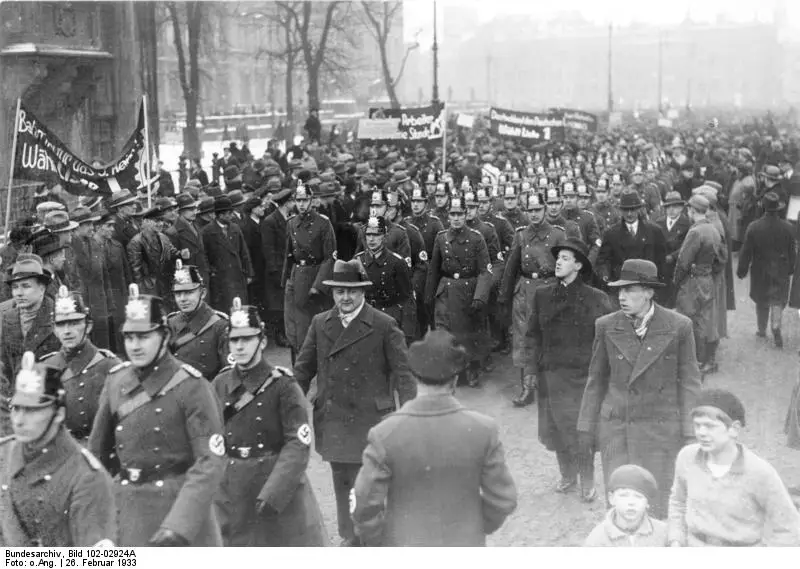
Uniformed police wear swastika armbands at a Nazi rally in the Lustgarten
On the last Sunday of February uniformed Berlin police officers marched with swastika armbands at the first mass rally of the National Socialist factory cells in the Lustgarten, while police president Levetzow looked in to cheers. Police broke up a Social Democratic cultural rally in Neukölln and led the speaker Friedrich Stampfer away to the station; across the Reich, election marches ended in shootings and stabbings. Berliners went tobogganing on a second snowy Sunday, and in Prague the United States took the ice hockey world title from Canada for the first time.

Politics and power
Government, terror and persecution
-
Propaganda midday, Berlin, Lustgarten
Police march with the Nazi factory cells
The National Socialist Factory Cell Organisation (Nationalsozialistische Betriebszellenorganisation, NSBO) of Greater Berlin held its first mass rally in the Lustgarten. The column that drew most attention was made up of uniformed officers of the Prussian protection police (Schutzpolizei), wearing swastika armbands and marching behind their own flags, which carried the police star beside the swastika; they were cheered as they arrived. Several thousand employees of the Berlin transport company BVG came in their work uniforms, with a group from the Post Office. Police president von Levetzow looked in briefly and was warmly greeted. The procession, tens of thousands strong, then marched for several hours through the east of the city, where the police had taken extensive precautions because the route passed through strongly Communist streets, to rallies on the Küstriner Platz and the Schleidenplatz; at the Schleidenplatz the Berlin SA leader Count Helldorf spoke.1,2
Sources disagree. Reports differ on the number of police officers: one gave about 1,200, the Telegraphen-Union report spoke of thousands.
-
Opposition Berlin-Neukölln, Neue Welt
A Social Democratic cultural rally is dissolved
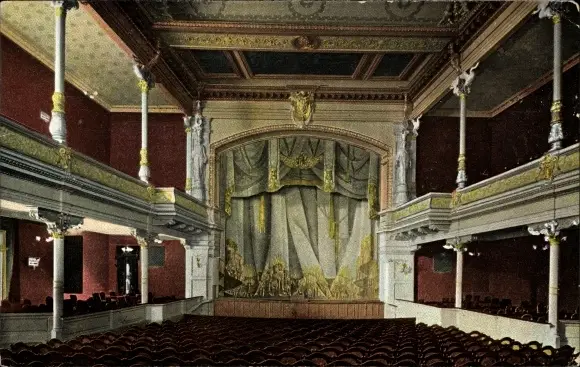
At a rally of the Socialist Cultural League in the Neue Welt hall in Neukölln, under the slogan “For freedom, people and socialism”, Grimme, whom Vorwärts still called Prussia’s constitutional education minister, thanked Thomas Mann for his courage and attacked the removal of Heinrich Mann and Käthe Kollwitz from the Academy of Arts and of Fritz Karsen from the Karl-Marx-Schule. When Friedrich Stampfer spoke after him, the supervising police officer first warned him and then dissolved the meeting; Stampfer was taken to the police station on Hermannplatz and released after about half an hour once his particulars had been taken. Elsewhere in Berlin, Social Democratic columns marched for two hours from Innsbrucker Platz through Schöneberg to Steglitz, and a Reichsbanner band played to a large crowd on the Leopoldplatz in Wedding after an Iron Front march there had been banned.3,9
-
Terror Berlin
Shots in Berlin’s streets
The police reported that Communist groups trying to demonstrate in the north of the city had fired on officers in the Stralsunder Straße and the Reinickendorfer Straße; no police were hurt, but two demonstrators were seriously wounded by police bullets and taken to the state hospital as prisoners. Shortly after 11 p.m. armed groups fired on two Social Democratic pubs in the Matternstraße in the east of the city at the same time, wounding the landlady of one and the landlord of the other. No one was arrested.4
-
Terror
Marches, shootings and closed meetings across the Reich
In Wuppertal-Elberfeld a large National Socialist procession was fired on from houses and the police returned fire; two men were killed, one of them in his own flat by a ricochet. In Lindenfels in Hesse an 18-year-old SA man was stabbed to death in a clash. In Beuthen in Upper Silesia two SA units occupied the Social Democratic Volkshaus after a march and hoisted a swastika flag on its roof; in Altona, SA and SS men marching through the workers’ districts smashed more than twenty shop windows of the cooperative stores with stones. Police officers dissolved a Social Democratic rally in Dortmund’s Westfalenhalle when the former Reich interior minister Sollmann accused the National Socialists of storming the people’s houses, and closed a Centre Party meeting of 1,500 people in Bochum during the speech.5,6
-
The states Falkensee (Osthavelland)
The state takes over Falkensee’s police
After a Stahlhelm and NSDAP meeting in Falkensee, just west of Berlin, ended in clashes with Communists in which, according to the official account, revolver shots were fired and three National Socialists were hurt, the government president in Potsdam took police powers in the town into state hands, declaring that the local police authority had not proved equal to its task.5
-
Election midday, Berlin, Clou
Seldte at the Clou, Hugenberg by radio
Labour minister Franz Seldte, leader of the Stahlhelm, addressed a midday rally of the Stahlhelm’s workers’ organisation (Stahlhelm-Selbsthilfe) at the Clou; the former army chief Colonel-General Heye was among the guests. He called Marxism nothing but an error and declared support for an order built on occupational estates, with parties and classes eliminated. Hugenberg, too ill to travel to a rally in Kassel, spoke to it from his home in Dahlem over a radio link that let him hear the hall’s applause. According to Vorwärts, both speeches were imposed on every German station that afternoon as government broadcasts.7,8,5,9
Everyday life
What else was happening in Germany
-
Weather Berlin, Grunewald
A second snowy Sunday
For the second Sunday running there was snow in and around Berlin, and the trains to the Grunewald, to Friedrichshagen and Erkner and to the north were packed with people carrying toboggans and skis; anyone without them stood out. In the Grunewald hardly a patch of untouched snow was left, the runs were worn smooth in places and there were a number of accidents. At the Friedrichshain ice stadium Edith Michaelis and the men’s champion Haertel kept their Brandenburg figure-skating titles.10
-
Society night, Berlin, Kunstgewerbemuseum
Police clear a costume ball
During the night before Sunday the police broke up a costume party, the so-called Dachkahn festival, in the building of the Kunstgewerbemuseum. Officers of the theatre police, who had been watching it, reported “goings-on” in the studio rooms that mocked every notion of decency, with the women guests in “the most daring costumes”, and the detective inspector present ordered the rooms to be cleared.11
-
Theatre Berlin, Rose-Theater
Dance at the Rose-Theater, with a prelude in the street
The road to the Rose-Theater was blocked by a National Socialist procession that included uniformed police with swastika armbands; a man in brown uniform walked beside it with a collecting tin and led the chants of “Germany, awake!” and “Perish Judah!”. Inside, the Berthe Trümpy school gave a dance performance with Trümpy herself, Afrika Döring, Dora Bertonoff and Käthe Belling, which the Vorwärts critic said won the audience over.9
-
Sport evening
The United States end Canada’s ice hockey reign
In the final of the ice hockey world championship in Prague on Sunday evening, before more than 10,000 spectators, the United States beat Canada 2–1 after ten minutes of extra time. It was the first time in the history of the championship that Canada had not won. Earlier in the afternoon Czechoslovakia had beaten Austria after extra time to become European champions.12
-
Society Cologne
Cologne’s carnival goes ahead
On carnival Sunday the Cologne police president announced that, out of respect for the city’s tradition and “despite many warnings”, he had permitted all the planned carnival events: he had been promised that political differences would be put aside. But there was to be no blow, no stabbing and no shot, or the police would act with the utmost severity.13
Voices
A flood of political barbarism is sweeping across the whole of Germany. Dams that seemed unshakeable are swaying under the onslaught. It is not only the people’s rights that the working class won that are threatened; the very foundations of the rule of law are tottering.
Elsewhere in the world
-
China
Japan invades Jehol
The Japanese advance into the Chinese province of Jehol was in full swing, with three columns pushing inland and driving the weaker Chinese forces before them. The United States Secretary of State, Stimson, informed the League of Nations that his government agreed with the conclusions and recommendations of its report on the conflict between China and Japan.7
-
France
French deputies pass the budget
After a night sitting that lasted until five in the morning, the French Chamber of Deputies passed the finance bill, including the government’s proposed cuts in military credits, by 340 votes to 251, and the bill went back to the Senate.3,5
More pictures

Sources
- Massenaufmarsch im Lustgarten Hannoverscher Kurier, via Deutsche Digitale Bibliothek Zeitungsportal, 27 February 1933, p. 3
- Marsch der Betriebszellen (Telegraphen-Union report) Bergische Zeitung, via Deutsche Digitale Bibliothek Zeitungsportal, 27 February 1933, p. 2 (dated Berlin, 26 February)
- Kulturkundgebung aufgelöst. Stampfer zur Wache gebracht und wieder freigelassen; Dortmund; Paris Vorwärts, via Deutsche Digitale Bibliothek Zeitungsportal, 27 February 1933, evening edition, p. 2
- Nächtliche Straßenkämpfe; Polizei schießt! Vorwärts, via Deutsche Digitale Bibliothek Zeitungsportal, 27 February 1933, evening edition, p. 4
- Zwei Tote in Elberfeld; Ein Toter in Lindenfels; Zusammenstoß in Falkensee; Zentrumsversammlung geschlossen; Sollmann das Wort entzogen; Der unsichtbare Hugenberg; Paris Kölnische Zeitung, via Deutsche Digitale Bibliothek Zeitungsportal, 27 February 1933, morning edition, p. 2 (reports dated 26 February)
- SA. besetzt Volkshaus; Kriegsbild aus Altona Vorwärts, via Deutsche Digitale Bibliothek Zeitungsportal, 27 February 1933, evening edition, pp. 1–2
- Seldtes Programm; Die Offensive der Japaner; Amerika stimmt zu Kölnische Zeitung, via Deutsche Digitale Bibliothek Zeitungsportal, 27 February 1933, morning edition, p. 1 (reports dated 26 February)
- Seldte vor der Stahlhelm-Selbsthilfe Dresdner Nachrichten, via Deutsche Digitale Bibliothek Zeitungsportal, 27 February 1933, p. 1 (dated Berlin, 26 February)
- Denaturierte Geistigkeit; Aufmarsch des roten Berlin; Tanz mit Vorspiel Vorwärts, via Deutsche Digitale Bibliothek Zeitungsportal, 27 February 1933, evening edition, p. 3
- Noch einmal überall Wintersport; Kunstlaufmeisterschaften Vorwärts, via Deutsche Digitale Bibliothek Zeitungsportal, 27 February 1933, evening edition, p. 6
- Ein Kostümfest polizeilich aufgelöst Dresdner Nachrichten, via Deutsche Digitale Bibliothek Zeitungsportal, 27 February 1933, p. 2 (dated Berlin, 26 February)
- USA. Weltmeister im Eishockey Dresdner Nachrichten, via Deutsche Digitale Bibliothek Zeitungsportal, 27 February 1933, p. 9
- Die Kölner Karnevalsveranstaltungen genehmigt Hamburger Fremdenblatt (Reichsausgabe), via Deutsche Digitale Bibliothek Zeitungsportal, 27 February 1933, p. 1 (dated Cologne, 26 February)
Spotted a mistake? Send a correction.