Epilogue, the day after the hundredth
Books burn on the Opernplatz as the German Labour Front is founded
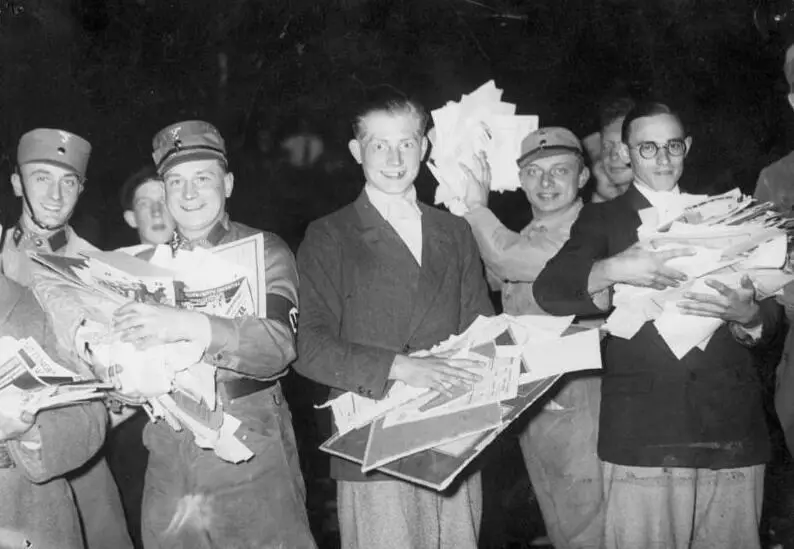
Late on Wednesday evening Berlin students burned an estimated 20,000 to 25,000 books on the Opernplatz, in pouring rain and in front of newsreel cameras; the works of Marx, Heinrich Mann, Kästner, Remarque, Tucholsky, Ossietzky and many others went into the fire, and Goebbels declared the age of “Jewish intellectualism” over. Books were burned in 21 other university towns the same night. That afternoon Hitler had addressed the first congress of the German Labour Front, which took the place of the destroyed trade unions under Robert Ley, and it was announced that the assets of the SPD, its newspapers and the Reichsbanner had been seized.
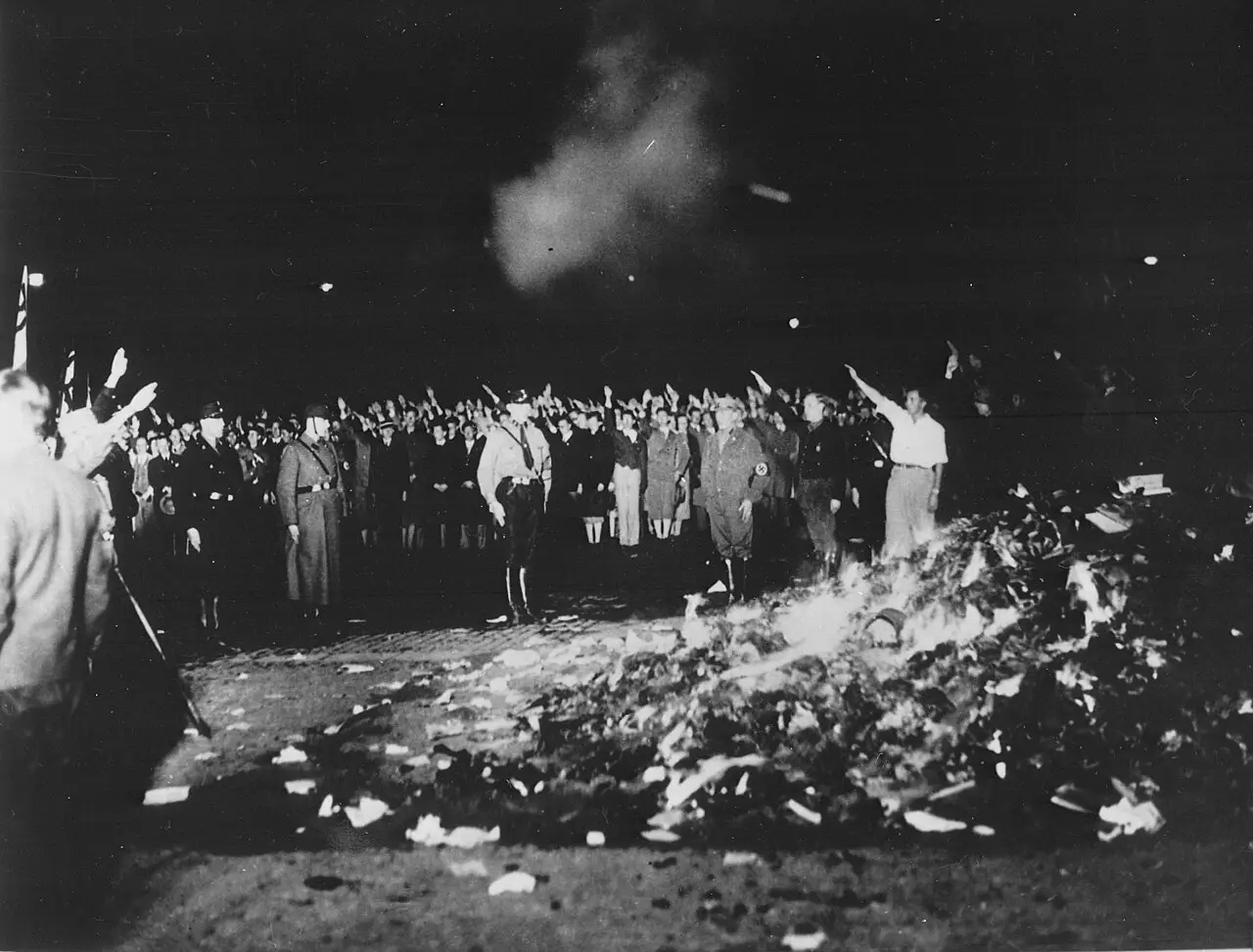

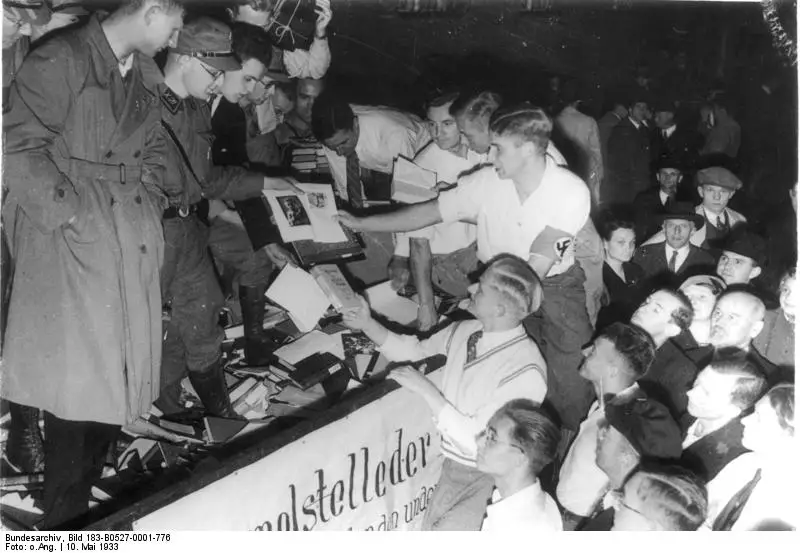
The burning on the Opernplatz was the climax of the “Action against the Un-German Spirit”, which the German Student Union (Deutsche Studentenschaft) had begun on 12 April, calling on students to purge university libraries and their own shelves of the writing it denounced. In Berlin the evening opened at 7 p.m. with the inaugural lecture of Alfred Baeumler, newly appointed professor of political education, before students in SA uniform. Afterwards they lit torches on the Hegelplatz behind the university, collected an estimated 20,000 to 25,000 volumes already loaded on lorries at the Student House in Oranienburger Straße, and at 10 p.m. set off for the Opernplatz by way of the Brandenburg Gate. Professors in gowns marched with them, as did the physical-education students who had plundered Magnus Hirschfeld’s Institute for Sexual Science; they carried a bust of Hirschfeld, which was thrown into the fire.
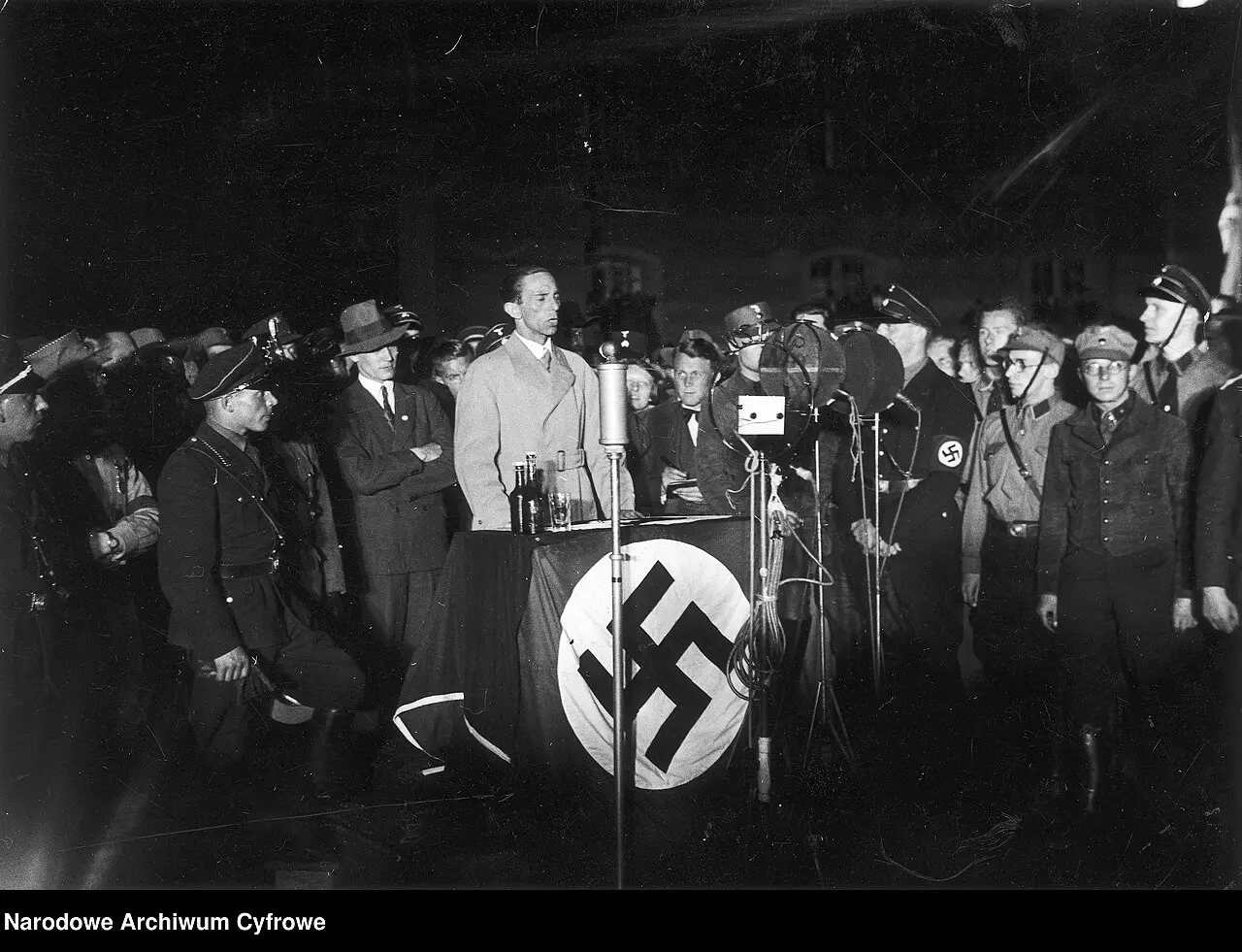
Firemen had doused the pyre with petrol, and it burned on through a downpour. At about 11.30 p.m. students stepped one by one to a microphone, shouted a “fire oath” and threw in the books of the author it named. “Against class struggle and materialism, for the national community and an idealistic outlook on life” consigned Marx and Kautsky to the flames; the oaths went on to name Heinrich Mann, Ernst Glaeser, Erich Kästner, Friedrich Wilhelm Foerster, Emil Ludwig, Werner Hegemann, Theodor Wolff, Georg Bernhard, Erich Maria Remarque, Alfred Kerr, Kurt Tucholsky and Carl von Ossietzky. Goebbels then spoke under floodlights, in front of newsreel cameras and press photographers.
Students burned books in 21 other university towns the same night, in rituals staged much alike. Other places followed, Halle on 12 May and Hamburg on 15 May among them, and between March and November 1933 books were burned in more than 165 places within Germany’s present borders. After the event the booksellers’ trade paper, the Börsenblatt, printed a list of 131 authors whose works were to be removed from libraries and bookshops. Many of them emigrated; others were persecuted and killed. Erich Mühsam was murdered by SS men in Oranienburg concentration camp in 1934, Carl von Ossietzky died in 1938 from the effects of his long imprisonment in the Esterwegen camp, and Gertrud Kolmar was deported to Auschwitz in 1943.
A few hours before the fire, the first congress of the German Labour Front (Deutsche Arbeitsfront, DAF) met in the former Prussian House of Lords, a few days after the trade unions had been destroyed. Membership was nominally voluntary but expected, and the DAF, a compulsory community of employees and employers, became the largest mass organisation in the Reich, with 25 million members in 1942. It was financed partly from the confiscated union assets and from contributions deducted from wages, and it allowed the regime to control and indoctrinate working people at work and in their leisure; its leisure organisation, “Strength through Joy”, followed in November 1933.
Politics and power
Government, terror and persecution
-
Persecution late evening, Berlin, Opernplatz
Books burned on the Opernplatz
Students of the Berlin–Brandenburg district of the German Student Union burned the books they had collected on a pyre of beech logs built on sand in the middle of the Opernplatz. Their procession, several thousand strong, included an SA flag group, fraternity students in full regalia and lorries of books gathered by the young German Nationalists’ league in a parallel campaign “against the bad book”. Despite heavy rain the crowd stood several rows deep behind ropes and police cordons. The student leader Herbert Gutjahr spoke, and after the fire oaths Goebbels told the students that for fourteen years they had had to endure the humiliations of the “November Republic”.2,1,4
-
Propaganda Frankfurt am Main and other university towns
Burnings in the university towns
Similar burnings took place in 21 other university towns. In Frankfurt am Main students, SA and SS burned a dung cart full of books, drawn by oxen, on the Römer square before more than 15,000 onlookers.3,7
-
Economy from 5 p.m., Berlin, Leipziger Straße, former Prussian House of Lords
First congress of the German Labour Front
Hitler entered the plenary hall of the Prussian State Council a few minutes after 5 p.m. to a raised-arm salute. Some 600 delegates, most from the now coordinated unions and many in SA uniform, sat with members of the Reich and state governments and of the diplomatic corps. Ley declared that the workers’ organisations could not have remained untouched islands in the revolutionary sea and called class struggle the mortal enemy of the worker. In a long speech Hitler said that the Marxist “apostles” of the workers were not workers at all but “literati alien to the people”. Labour Minister Seldte, speaking after him, noted that Hitler had taken the Labour Front under his patronage, and the congress closed with the Horst Wessel song.5,6
-
Government Berlin
Ley made leader of the Labour Front
By an order of Hitler’s, Robert Ley, chief of staff of the Nazi Party’s political organisation, became leader of the German Labour Front; the Danzig Gauleiter Forster was made leader of the salaried employees’ associations and the NSBO leader Schuhmann leader of the workers’ associations.7
-
Opposition Berlin
SPD and Reichsbanner assets seized
The assets of the whole SPD, its newspapers and the Reichsbanner were seized. The step, taken in agreement between the public prosecutor general and the corruption department of the Prussian Justice Ministry, was justified by alleged breach of trust in payments from the unions and the workers’ bank to the party, and a prosecution of “Leipart and associates” was expected. It rested on §1 of the Reichstag Fire Decree of 28 February, under which property could be seized even where the conditions of the Code of Criminal Procedure were not met.2,9
Sources disagree. The Friedrich-Ebert-Stiftung’s SPD chronicle dates the seizure to 9 May; the newspapers reported it from Berlin under 10 May.
-
Terror Berlin
Salaried employees’ union leaders arrested
The former chairmen of the Central Association of Salaried Employees (ZdA), Ucko and Urban, and its new chairman Ehlers were taken into “protective custody” on the grounds that they might destroy evidence; the former Reichstag deputy Friedrich Schröder escaped arrest by flight.2
Everyday life
What else was happening in Germany
-
Weather evening, Berlin
Downpour over the torchlight procession
Very heavy rain set in just as the torchlight procession left for the Opernplatz. It did not drive the crowd away, and the petrol-soaked pyre went on burning in the downpour.2,1
-
Education Berlin
Rust: one world-view above all others
Opening a meeting of the university officials of all the German states, Prussia’s culture minister Rust said that coordination meant the new German world-view must hold the commanding position over all others. He would not allow a lecturer who had failed to make his way through scholarly merit to do so now on the strength of political credentials.7
-
Society Berlin
Hindenburg an honorary citizen of Bavaria
Bavaria’s Minister-President Siebert presented Reich President von Hindenburg with the certificate making him an honorary citizen of the Free State of Bavaria; the field marshal was reported to be deeply moved.7
-
Society Berlin
Göring becomes patron of Germany’s hunters
Prussia’s Minister-President Göring accepted the patronage of all German hunters, which had been offered to him.7
Voices
The age of an overblown Jewish intellectualism is over, and the breakthrough of the German revolution has cleared the way once more for the German spirit too.
You are now going out to burn books in which a spirit alien to us has used the German word to fight us. … What we cast off today are poisons that have accumulated in a time of false tolerance.
I shall have no greater pride in my life than to be able to say at the end of my days: I have won the German worker for the German Reich!
Elsewhere in the world
-
Paraguay
Paraguay declares war on Bolivia
The government of Paraguay formally declared war on Bolivia. A presidential decree cited Bolivian acts of war that violated Paraguay’s territorial sovereignty and said that all efforts to restore peace had failed. Fighting between Bolivian and Paraguayan troops in the forests of the Gran Chaco had gone on despite the efforts of the League of Nations and a neutral commission of American states; Bolivia sought access through the region to the navigable Paraguay river and so to the Atlantic.2
In Berlin today
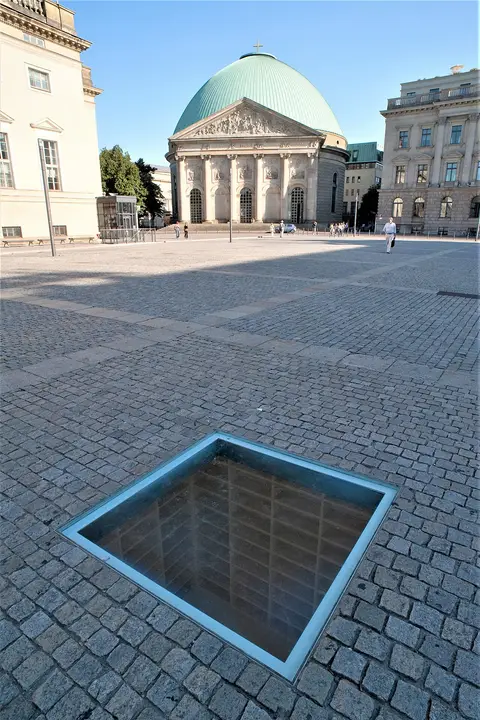

Bebelplatz and the "Library" memorial
Bebelplatz, 10117 Berlin-Mitte
- Then
- Then called the Opernplatz. Late on 10 May 1933 students burned an estimated 20,000 to 25,000 books on a pyre in the middle of the square, and Goebbels spoke at the fire. The square was renamed Bebelplatz in 1947.4,1,3
- Today
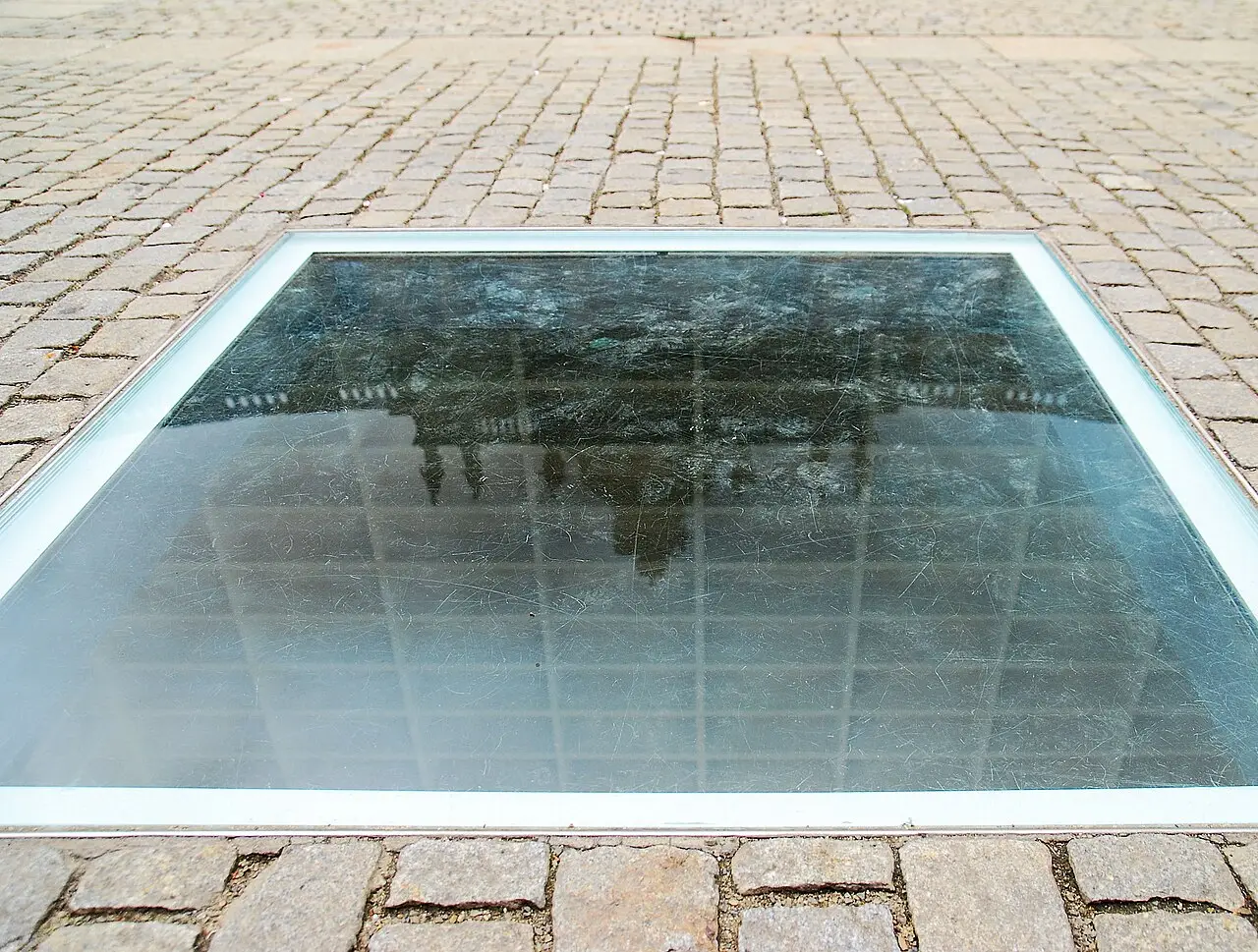
- The square lies between the State Opera, St Hedwig’s Cathedral and the “Kommode”, the Humboldt University’s law faculty. Since 1995 Micha Ullman’s memorial “Library” has lain beneath a glass plate in its centre: an underground room painted white, whose empty bookshelves stand for the cultural loss caused by the Nazi dictatorship. The Berlin Senate took up the idea of a memorial soon after reunification.
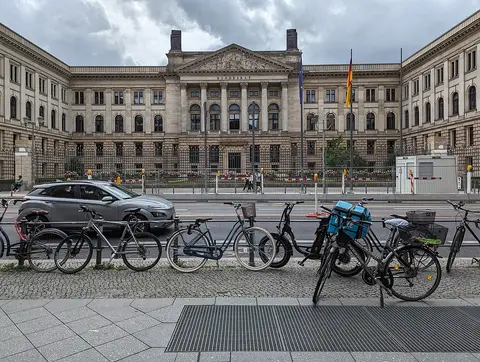

Former Prussian House of Lords (Bundesrat)
Leipziger Straße 3–4, 10117 Berlin-Mitte
- Then
- Built for the Prussian House of Lords and completed in 1904. On the afternoon of 10 May 1933 its plenary hall, then used by the Prussian State Council, held the first congress of the German Labour Front, at which Hitler spoke.10,5,6
- Today
- Partly destroyed in the Second World War and later used by East German institutions, the building was converted from 1997 and has been the seat of the Bundesrat, the chamber of the federal states, since September 2000. The plenary hall, almost entirely destroyed in the war, was rebuilt as a modern chamber.
More pictures




Sources
- Das Beispiel Berlin – mediale Propaganda verbrannte-buecher.de (Digitale Bibliothek verbrannter Bücher)
- Kölnische Zeitung, morning edition, 11 May 1933 Deutsche Digitale Bibliothek, Zeitungsportal, p. 1, "'Wider den undeutschen Geist'. Die Verbrennung undeutscher Bücher durch Berliner Studenten und Jugendbünde" (Berlin, 10 May); p. 3, "Krieg zwischen Bolivien und Paraguay" (Asunción, 10 May); p. 10, reports on the seizure of SPD assets and the ZdA (Berlin, 10 May)
- Nicht nur in Berlin. Die vergessenen Orte der Bücherverbrennung 1933 Jan Schenck, Deutschland Archiv, Bundeszentrale für politische Bildung
- Denkmal zur Erinnerung an die Bücherverbrennung Gedenkstättenportal Memorial Museums, Stiftung Denkmal für die ermordeten Juden Europas
- Hamburger Fremdenblatt, Reichsausgabe, evening edition, 11 May 1933 Deutsche Digitale Bibliothek, Zeitungsportal, p. 14 (Seite 10), "Adolf Hitlers Mahnung zur sozialen Verständigung. Der erste Kongreß der deutschen Arbeitsfront" (Berlin, 10 May)
- Hamburgischer Correspondent, morning edition, 11 May 1933 Deutsche Digitale Bibliothek, Zeitungsportal, p. 1, "Der deutsche Arbeiter im Deutschen Reich. Hitlers Bekenntnis" (Berlin, 10 May)
- Erzgebirgischer Volksfreund, 11 May 1933 Deutsche Digitale Bibliothek, Zeitungsportal, p. 2, "Die neuen Arbeiterführer. Eine Verfügung Hitlers", Rust's address, "Wider den undeutschen Geist. Bücherverbrennungen" and short reports (Berlin and Frankfurt, 10 May)
- Deutsche Arbeitsfront (DAF) LeMO, Deutsches Historisches Museum
- Chronik der deutschen Sozialdemokratie, Band 2: Stichtag 9. Mai 1933 Franz Osterroth and Dieter Schuster; electronic edition, Friedrich-Ebert-Stiftung Library
- Das Gebäude Bundesrat
Spotted a mistake? Send a correction.