Themes

Refusal and exile

People who resisted, refused or fled.

14 days

  1. Day 9 Tuesday 7 February 1933

    Social Democrats fill the Lustgarten as the KPD leadership meets in secret at Ziegenhals

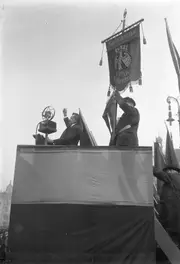
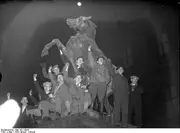
    In rain and wind, the Social Democrats and the Iron Front marched into the Lustgarten for their largest rally of the campaign, where Otto Wels declared that the workers’ front stood unbroken. Outside Berlin, the Communist Party’s central committee met secretly in an inn at Ziegenhals to hear Ernst Thälmann. In the Reichstag building, Nazi deputies broke up the committee meant to guard parliament’s rights. In Berlin the flu returned with more than a thousand new cases in a day.
  2. Day 17 Wednesday 15 February 1933

    Käthe Kollwitz and Heinrich Mann forced out of the Prussian Academy of Arts

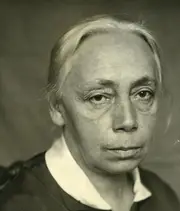
    Under threat that the Academy would be dissolved, Käthe Kollwitz and Heinrich Mann left the Prussian Academy of Arts, and the Prussian commissioners confirmed a sweeping purge of police chiefs, naming a retired rear admiral as police president of Berlin. Vorwärts and the 8-Uhr-Abendblatt were banned for a week, and in Stuttgart someone cut the cable carrying Hitler’s speech to the radio. Abroad, Thomas Mann lectured on Wagner in Brussels and an assassin fired on Franklin D. Roosevelt in Miami.

  3. Day 21 Sunday 19 February 1933

    Police break up the “Free Word” congress at the Kroll Opera

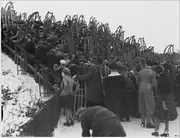
    More than a thousand writers, scholars and politicians met at the Kroll Opera to defend freedom of speech, the press, assembly and art; police dissolved the meeting when the former Prussian minister Wolfgang Heine mocked the regime. Frick told a Dresden rally that the government would not give up power even without a majority, Hitler spoke against the Centre Party in Cologne and the Reichsbanner marched in the Lustgarten. Berliners took sledges and skis to the snowbound Grunewald.

  4. Day 30 Tuesday 28 February 1933

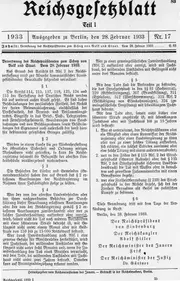
    The Reichstag Fire Decree suspends basic rights ‘until further notice’

    The morning after the fire the cabinet met twice, and by the end of the day Hindenburg had signed and the government had published the decree ‘for the protection of people and state’, which suspended the Weimar constitution’s guarantees of personal liberty, free speech, a free press and assembly. Across Prussia the police and their SA auxiliaries arrested Communists and left-wing intellectuals, among them Carl von Ossietzky and Hans Litten, and the SA hoisted the swastika over the Communist headquarters. It was Shrove Tuesday: Cologne’s carnival corps paraded once more, while in Berlin Göring had the museums closed.

  5. Day 34 Saturday 4 March 1933

    Election eve: Hitler speaks from Königsberg and Otto Braun leaves for Switzerland

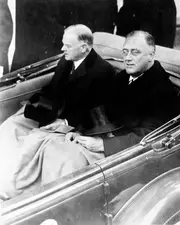
    On the eve of the election the Nazi party staged its ‘Day of the Awakening Nation’: Hitler flew to Königsberg and spoke there in a broadcast relayed to marching columns and loudspeakers across Germany. Otto Braun, the Social Democrat who had governed Prussia for most of the Weimar years, crossed the Swiss border that afternoon and did not come back. In Hamburg the Nazis demanded control of the police, in Vienna all three presidents of the Austrian parliament resigned, and in Washington Franklin D. Roosevelt took office. Hamburg’s port saw the season’s first Mediterranean cruise sail.

  6. Day 44 Tuesday 14 March 1933

    The Weltbühne banned for six months as Goebbels is sworn in

    Berlin’s police president banned the left-wing weekly Die Weltbühne for half a year, Munich banned Das Tage-Buch, and the ban on the Social Democratic press in Prussia was extended overnight. Hindenburg swore in Goebbels as Propaganda Minister, while the Berlin papers reported that Theodor Wolff and Rudolf Olden had left for Paris. The Reichsbahn announced spring track work for some 90,000 men, and in London the Hamburg-born operetta star Anny Ahlers died after a fall.

  7. Day 58 Tuesday 28 March 1933

    Nazi party orders a nationwide boycott of Jewish businesses from 1 April

    From Munich the Nazi party leadership published its call for a boycott of Jewish shops, goods, doctors and lawyers, to begin ‘at a stroke’ on Saturday 1 April at 10:00 under a central committee led by Julius Streicher. The Catholic bishops withdrew their warnings against the Nazi movement, and Albert Einstein, landing in Belgium, broke with Prussia. In Berlin Goebbels told the film industry which films he admired.

  8. Day 64 Monday 3 April 1933

    Max Reinhardt ousted from the Deutsches Theater; Germans now need exit visas

    The management of the Deutsches Theater announced, after a meeting with a Prussian ministry commissioner, that Max Reinhardt would have no further part in its artistic direction. The coordination law came into force, and the Interior Minister required every German leaving the country to obtain an exit visa. The pro-Nazi ‘German Christians’ opened their first national conference in Berlin. Hindenburg presented the aviator Elly Beinhorn with the Hindenburg Cup.

  9. Day 66 Wednesday 5 April 1933

    Hitler Youth takes over the youth associations; the Rotter brothers ambushed in exile

    The Hitler Youth occupied the offices of the Reich Committee of German Youth Associations in Berlin, and Baldur von Schirach took over its leadership. Einstein wrote to the Prussian Academy rejecting its charges; Hitler answered Hindenburg on the Jewish veterans and spoke to the farmers’ council; Kerrl told Jewish notaries to stop working. In Liechtenstein the Berlin theatre impresarios Alfred and Fritz Rotter were ambushed; Alfred and his wife fell to their deaths. Prussia ordered a strict Good Friday.

  10. Day 78 Monday 17 April 1933

    Nobel laureate James Franck resigns his Göttingen chair in protest

    On Easter Monday the physicist James Franck, a Nobel laureate protected from dismissal as a front-line veteran, asked to be released from his chair at Göttingen in protest at the treatment of Jewish Germans. In Berlin three directors of the Reichsbahn’s transport credit bank were arrested at home. At Tempelhof, holiday crowds at the Easter air show watched Ernst Udet’s aerobatics and then, unexpectedly, the aviator Hans Bertram landing at the end of his flight home from the Dutch East Indies, after his rescue in northern Australia the previous July.

  11. Day 79 Tuesday 18 April 1933

    Bavaria reports 5,400 people taken into ‘protective custody’ since 9 March

    A semi-official statement from Munich put the number of people taken into ‘protective custody’ (imprisonment without trial) in Bavaria since 9 March at about 5,400, of whom some 1,630 had been released, partly after Cardinal Faulhaber asked for fathers to be freed for Easter. In Rome, Göring spoke at a broadcast celebration of Hitler’s coming birthday held in his and Papen’s honour, and in Lugano Thomas Mann received the Munich ‘protest’ that settled his decision not to return. The deaths were announced of Albrecht von Graefe, a former völkisch member of the Reichstag, and of Count Dietlof von Arnim-Boitzenburg, the last president of the Prussian House of Lords.

  12. Day 95 Thursday 4 May 1933

    Purge extended to public employees; SPD leaders decide to set up an office abroad

    A second ordinance under the civil service law told public employers to give “non-Aryan” salaried employees and workers one month’s notice. At its first and last full meeting the new SPD executive decided to send Otto Wels, Hans Vogel and other members abroad to build an office in exile. Ley’s committee declared that the “German Labour Front” now stood, Hitler called for a foundation for the families of workers killed at work, and an ADGB leader escaped from “protective custody”.

  13. Day 100 Tuesday 9 May 1933

    Frick tells the states that schools must form “the political human being”

    At a meeting of the states’ education ministers in the Reich Interior Ministry, Frick set out the principles of future school policy: schools were to teach race studies, warn against mixing German with “alien”, above all Jewish, blood, and prepare the young for military service. Rust handed sex education back to parents and stopped grants to Jewish trainee teachers. The Berlin guard troops mounted their first guard at the war memorial on Unter den Linden, two convicted murderers were executed at Plötzensee, Joseph Schmidt’s film “Ein Lied geht um die Welt” had its premiere, and from France Klaus Mann wrote to Gottfried Benn.

  14. Epilogue Wednesday 10 May 1933

    Books burn on the Opernplatz as the German Labour Front is founded

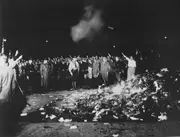
    Late on Wednesday evening Berlin students burned an estimated 20,000 to 25,000 books on the Opernplatz, in pouring rain and in front of newsreel cameras; the works of Marx, Heinrich Mann, Kästner, Remarque, Tucholsky, Ossietzky and many others went into the fire, and Goebbels declared the age of “Jewish intellectualism” over. Books were burned in 21 other university towns the same night. That afternoon Hitler had addressed the first congress of the German Labour Front, which took the place of the destroyed trade unions under Robert Ley, and it was announced that the assets of the SPD, its newspapers and the Reichsbanner had been seized.