Day 30 of 100
The Reichstag Fire Decree suspends basic rights ‘until further notice’
The morning after the fire the cabinet met twice, and by the end of the day Hindenburg had signed and the government had published the decree ‘for the protection of people and state’, which suspended the Weimar constitution’s guarantees of personal liberty, free speech, a free press and assembly. Across Prussia the police and their SA auxiliaries arrested Communists and left-wing intellectuals, among them Carl von Ossietzky and Hans Litten, and the SA hoisted the swastika over the Communist headquarters. It was Shrove Tuesday: Cologne’s carnival corps paraded once more, while in Berlin Göring had the museums closed.

When the cabinet met at 11:00 Hitler told his ministers that the moment had come for a ruthless reckoning with the Communists, one that must not be held back by legal scruples, and said he no longer doubted that the government would now win 51 per cent at the election. Göring, dismissing van der Lubbe’s statement that he had acted alone, claimed there had been at least six or seven arsonists and listed the measures he had already taken in Prussia: Communist and Social Democratic newspapers banned, Communist meeting places shut, every Communist deputy and official who could be found arrested, and 2,000 SA and SS men sent to march through Berlin in support of the police. Frick then read out the draft of a new emergency decree.
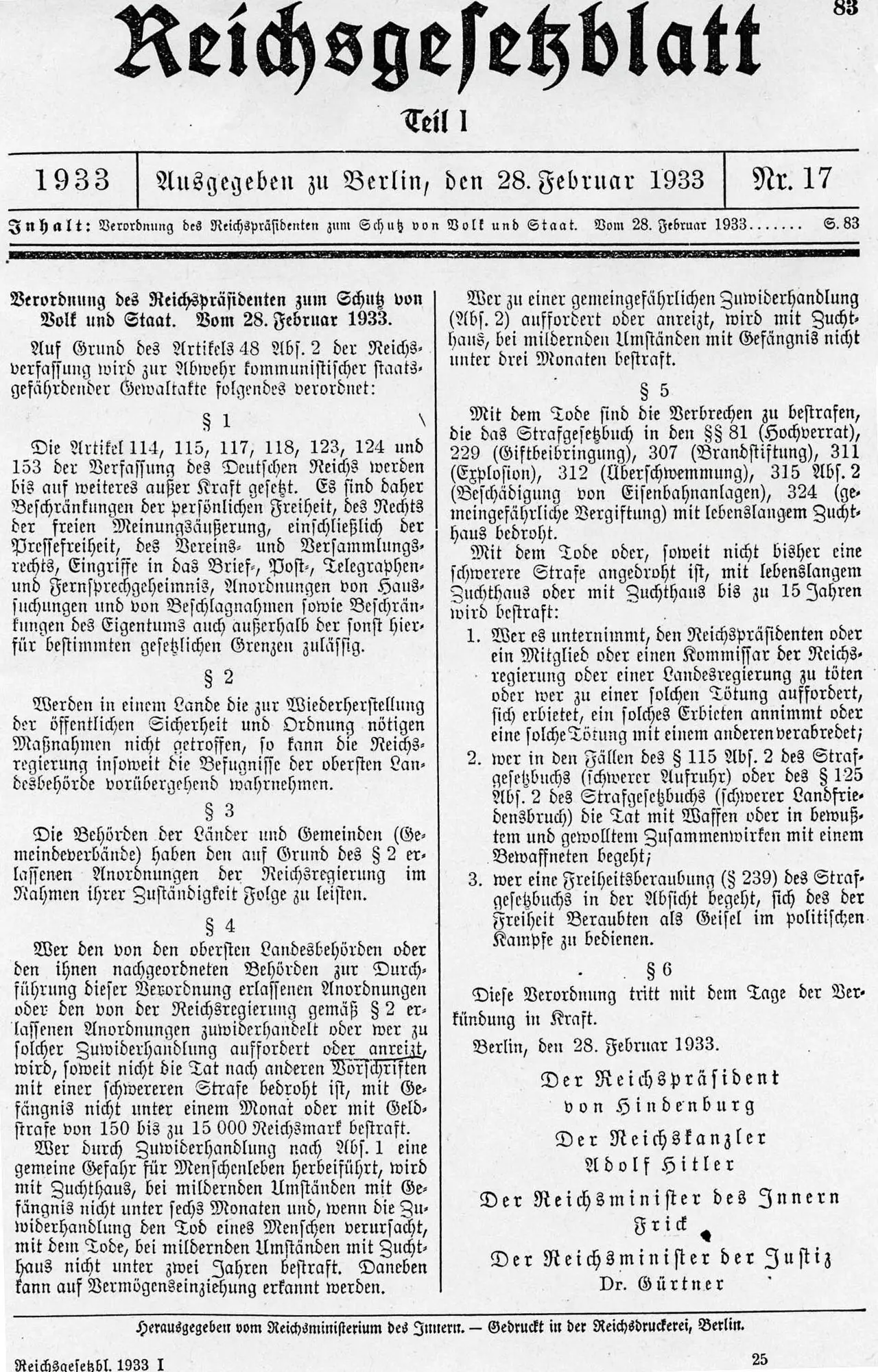
The decree, adopted at a second meeting at 16:15 and signed by Hindenburg the same day, was issued under Article 48 of the constitution ‘to ward off Communist acts of violence endangering the state’. It suspended seven articles of the constitution until further notice, permitting arrest without legal limits, censorship, the opening of letters and tapping of telephones, house searches and confiscations. It allowed the Reich government to take over the powers of any state government that failed to restore ‘public security and order’, a clause Vice-Chancellor von Papen warned would provoke the south German states, and it extended the death penalty. Published in the Reichsgesetzblatt that day, it took effect at once.
The decree supplied the legal basis for ‘protective custody’ (Schutzhaft), imprisonment without charge or court order, and for the bans on newspapers and meetings of the weeks that followed, while its second paragraph gave the Reich government a lever against state governments that resisted. In April the Reich interior ministry’s intelligence office judged in an internal memorandum that the two decrees of 28 February had worked ‘quickly and beneficially’ against the Communist movement, and urged that the offensive be continued.
Laws and decrees
Verordnung des Reichspräsidenten zum Schutz von Volk und Staat
Reichstag Fire Decree (Decree of the Reich President for the Protection of People and State)
Signed, published and in force on 28 February. Suspended until further notice Articles 114, 115, 117, 118, 123, 124 and 153 of the Weimar constitution (personal liberty, the inviolability of the home, the secrecy of post and telephone, free expression and the press, assembly, association and property). Allowed the Reich government to take over the powers of a state government (§ 2), and imposed the death penalty for high treason, arson of public buildings and other serious crimes previously punishable by life imprisonment.1,3
Verordnung des Reichspräsidenten gegen Verrat am Deutschen Volke und hochverräterische Umtriebe
Decree against Treason against the German People and Treasonable Activities
Signed on 28 February and published on 1 March. Made serious betrayal of military secrets punishable by death, punished the publication of state secrets whether true or false, and made printing or distributing writings that incited violence against the state or a political general strike an offence; it also allowed special investigating judges at the Reich Court and simplified treason proceedings.2
Politics and power
Government, terror and persecution
-
Government 11:00, Berlin, Reich Chancellery
Cabinet hears Hitler call for a ruthless reckoning with the Communists
At the morning meeting Hitler proposed thanking the police and fire brigade, rebuilding the Reichstag at once, holding the election on 5 March as planned and convening the new Reichstag in the Potsdam City Palace; he put the damage at three to four million marks. Göring repeated the claim that witnesses had seen the arsonist with the Communist deputy Ernst Torgler, and said he had temporarily closed museums and palaces, tightened control of the government quarter and had Communist deputies and officials arrested wherever they could be found. Frick read the draft decree; Papen objected to the clause allowing the Reich to take over powers in the states.3
-
Government 16:15, Berlin
Decree adopted, signed and published the same day
At 16:15 the cabinet adopted the decree ‘for the protection of people and state’. Papen again warned that the clause on the states would provoke resistance, mentioning talk in Bavaria of proclaiming Crown Prince Rupprecht king, and at his suggestion the power to intervene was given to the Reich government as a whole rather than to the interior minister. Hindenburg signed it, together with the decree against ‘treason against the German people’ approved the day before, and the Reichstag Fire Decree appeared in issue 17 of the Reichsgesetzblatt, dated 28 February.1,2,3,4
-
Terror Berlin
Arrests of Communists and left-wing intellectuals
Within hours of the fire the pacifist journalist Carl von Ossietzky, editor of Die Weltbühne, was arrested, and on 28 February the lawyer Hans Litten, who had cross-examined Hitler in court in 1931, was taken into ‘protective custody’. About 130 Communists arrested in Berlin were held without any court order; with the police prison full, some were moved to the cell prison in Moabit. The police closed about a hundred Communist pubs in Berlin, and there were arrests, house searches and bans across Prussia. Ossietzky died in 1938 from the effects of his imprisonment; Litten took his own life in Dachau in 1938.5,6,7
-
Opposition Berlin
Ernst Torgler goes to the police
Ernst Torgler, chairman of the Communist group in the Reichstag and one of the last deputies to leave the building on the evening of the fire, went to the police to answer the accusations against him and was arrested. That day he was confronted with van der Lubbe and denied ever having seen him. He was later tried with van der Lubbe and acquitted.5,8
Sources disagree. Torgler’s biographers say he gave himself up voluntarily, against his party’s wishes, to clear his name; the Prussian press service insisted he had only asked through his lawyer for safe conduct once escape had become impossible.
-
Propaganda 18:30, Berlin
Swastika over the Karl-Liebknecht-Haus
At about 18:30, according to Goebbels’s newspaper Der Angriff, an SA unit lined up in front of the Karl-Liebknecht-Haus, the closed Communist headquarters, and hoisted the swastika flag over it. The Social Democratic party’s press service lost its licence to send news to its papers by radio, and the Reich interior minister banned two Strasbourg newspapers in Germany until 31 May for attacking the government.5,9
Everyday life
What else was happening in Germany
-
Art Prussia
Museums and palaces closed
Göring told the cabinet that he had ordered the temporary closure of the museums and palaces under his authority, claiming that material seized from the Communists showed plans to set fire to public buildings.3
-
Society Cologne
Carnival Tuesday in Cologne
On the last day of carnival Cologne’s carnival corps paraded through the city once more, recovered from the exertions of Rosenmontag: the Rote Funken in their red and white, the Prince’s Guard escorting the carnival Prince, Peasant and Maiden with decorated cars and cabs, and the other societies. There were flowers for the ladies and sweets for the children, and children’s carnival parties as well.9
-
Theatre
Brecht and Helene Weigel leave for Prague
The playwright Bertolt Brecht and the actress Helene Weigel left Berlin for exile in Prague on the day after the fire.4
Voices
The fight against them must not be made to depend on legal considerations.
In Berlin today
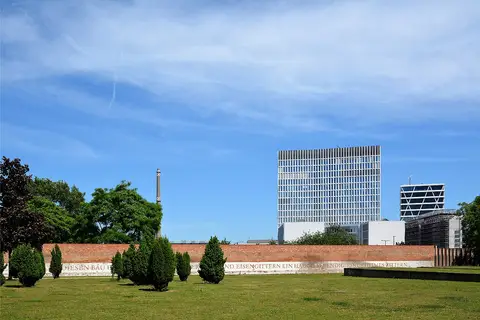

Former Moabit cell prison (Zellengefängnis Lehrter Straße)
Lehrter Straße, Berlin-Moabit
- Then
- With the police prison overflowing, some of the Communists arrested in Berlin after the fire were taken to the Moabit cell prison and held there in ‘protective custody’ without any court order.5,10
- Today
- Most of the prison was demolished in 1957–58. Since 2006 the site has been the Geschichtspark Ehemaliges Zellengefängnis Moabit, a park and memorial with the surviving prison wall, a walk-in cell sculpture and fragments of Albrecht Haushofer’s poem ‘In Fesseln’.
More pictures


Sources
- Verordnung des Reichspräsidenten zum Schutz von Volk und Staat [Reichstagsbrandverordnung] (28.02.1933) documentArchiv.de, Reichsgesetzblatt 1933 I, S. 83; promulgated 28 February 1933
- Verordnung des Reichspräsidenten gegen Verrat am Deutschen Volke und hochverräterische Umtriebe (28.02.1933) documentArchiv.de, Reichsgesetzblatt 1933 I, S. 85–87; promulgated 1 March 1933
- Akten der Reichskanzlei. Regierung Hitler 1933–1945, Bd. I: Nr. 32, Ministerbesprechung vom 28. Februar 1933, 11 Uhr; Nr. 34, Ministerbesprechung vom 28. Februar 1933, 16.15 Uhr Historische Kommission bei der Bayerischen Akademie der Wissenschaften / Bundesarchiv, Band I, pp. 128–131 (Nr. 32) and pp. 132–133 (Nr. 34, online at /protokoll/arh01d034)
- Jahreschronik 1933 LeMO, Deutsches Historisches Museum, entries for 27 and 28 February
- Hamburger Fremdenblatt, Reichsausgabe, Abend-Ausgabe Nr. 60, 1 March 1933 Deutsche Digitale Bibliothek, Zeitungsportal, p. 7: text of the decree, official report on the fire, 'Die Hakenkreuzfahne auf dem Liebknechthaus', 'Die Aktion gegen die Kommunisten'
- Carl von Ossietzky (biography) Gedenkstätte Deutscher Widerstand
- Hans Litten (biography) Gedenkstätte Deutscher Widerstand
- Ernst Torgler (biography) LeMO, Deutsches Historisches Museum
- Kölnische Zeitung, 1 March 1933 Deutsche Digitale Bibliothek, Zeitungsportal, p. 3: 'Kappenfahrt und Kinderkarneval', press bans
- Geschichtspark Ehemaliges Zellengefängnis in Berlin-Moabit Bundeszentrale für politische Bildung (bpb)
Spotted a mistake? Send a correction.