DecreeReich President, under Article 48 of the Reich Constitution
Treason Decree
Verordnung des Reichspräsidenten gegen Verrat am Deutschen Volke und hochverräterische Umtriebe
Decree of the Reich President against Treason against the German People and Activities of High Treason
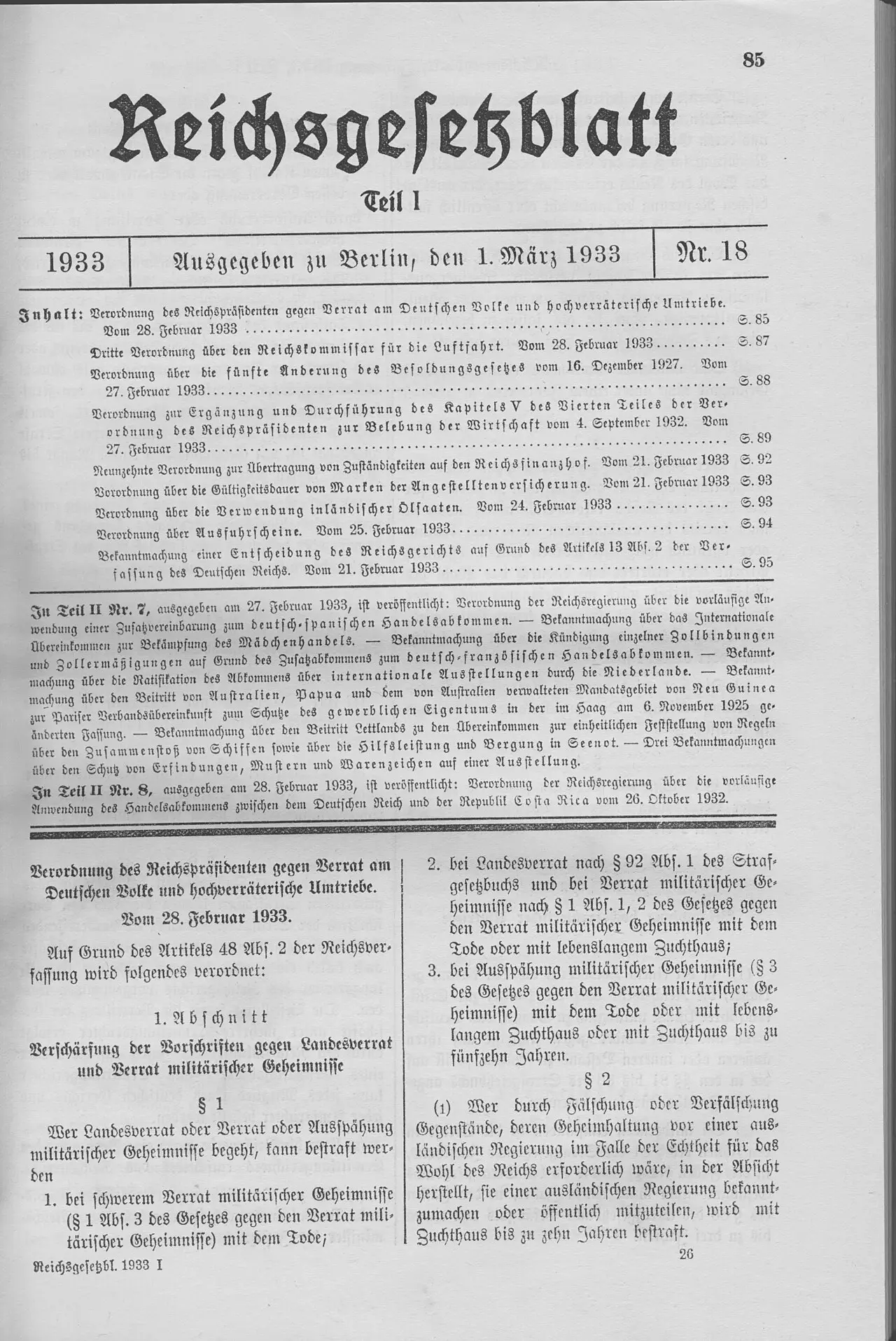
The second emergency decree signed on the day after the Reichstag fire, published a day later than the first. It made serious betrayal of military secrets punishable by death, punished the publication of secrets damaging to the Reich whether they were true or false, and made it an offence to print, distribute or stock any publication that called for violent struggle against the state or a political mass strike. It also let the Reich Court use special investigating judges, sped up the seizure of publications and allowed preliminary judicial investigation to be dropped in simple cases.
Dated
Tuesday 28 February 1933
Published in
Reichsgesetzblatt Teil I, no. 18, Wednesday 1 March 1933, pp. 85–87
Citation
RGBl. I S. 85
In force
§ 6 on the day after promulgation (2 March 1933); the rest on the fourth day after promulgation (5 March 1933)
Verordnung des Reichspräsidenten gegen Verrat am Deutschen Volke und hochverräterische Umtriebe.
Decree of the Reich President against Treason against the German People and Activities of High Treason.
Vom 28. Februar 1933.
Of 28 February 1933.
Auf Grund des Artikels 48 Abs. 2 der Reichsverfassung wird folgendes verordnet:
On the basis of Article 48, para. 2, of the Reich Constitution, the following is decreed:
1. Abschnitt · Verschärfung der Vorschriften gegen Landesverrat und Verrat militärischer Geheimnisse
Part 1 · Tightening of the Provisions against Treason and Betrayal of Military Secrets
§ 1Wer Landesverrat oder Verrat oder Ausspähung militärischer Geheimnisse begeht, kann bestraft werden
§ 1Whoever commits treason, or betrayal or espionage of military secrets, may be punished
1.bei schwerem Verrat militärischer Geheimnisse (§ 1 Abs. 3 des Gesetzes gegen den Verrat militärischer Geheimnisse) mit dem Tode;
1.in the case of serious betrayal of military secrets (§ 1, para. 3, of the Law against the Betrayal of Military Secrets), with death;
2.bei Landesverrat nach § 92 Abs. 1 des Strafgesetzbuchs und bei Verrat militärischer Geheimnisse nach § 1 Abs. 1, 2 des Gesetzes gegen den Verrat militärischer Geheimnisse mit dem Tode oder mit lebenslangem Zuchthaus;
2.in the case of treason under § 92, para. 1, of the Criminal Code and of betrayal of military secrets under § 1, paras. 1 and 2, of the Law against the Betrayal of Military Secrets, with death or with penal servitude for life;
3.bei Ausspähung militärischer Geheimnisse (§ 3 des Gesetzes gegen den Verrat militärischer Geheimnisse) mit dem Tode oder mit lebenslangem Zuchthaus oder mit Zuchthaus bis zu fünfzehn Jahren.
3.in the case of espionage of military secrets (§ 3 of the Law against the Betrayal of Military Secrets), with death or with penal servitude for life or with penal servitude for up to fifteen years.
§ 2(1) Wer durch Fälschung oder Verfälschung Gegenstände, deren Geheimhaltung vor einer ausländischen Regierung im Falle der Echtheit für das Wohl des Reichs erforderlich wäre, in der Absicht herstellt, sie einer ausländischen Regierung bekanntzumachen oder öffentlich mitzuteilen, wird mit Zuchthaus bis zu zehn Jahren bestraft.
§ 2(1) Whoever, by forgery or falsification, produces objects whose secrecy from a foreign government would, if they were genuine, be necessary for the welfare of the Reich, with the intention of making them known to a foreign government or communicating them publicly, shall be punished with penal servitude for up to ten years.
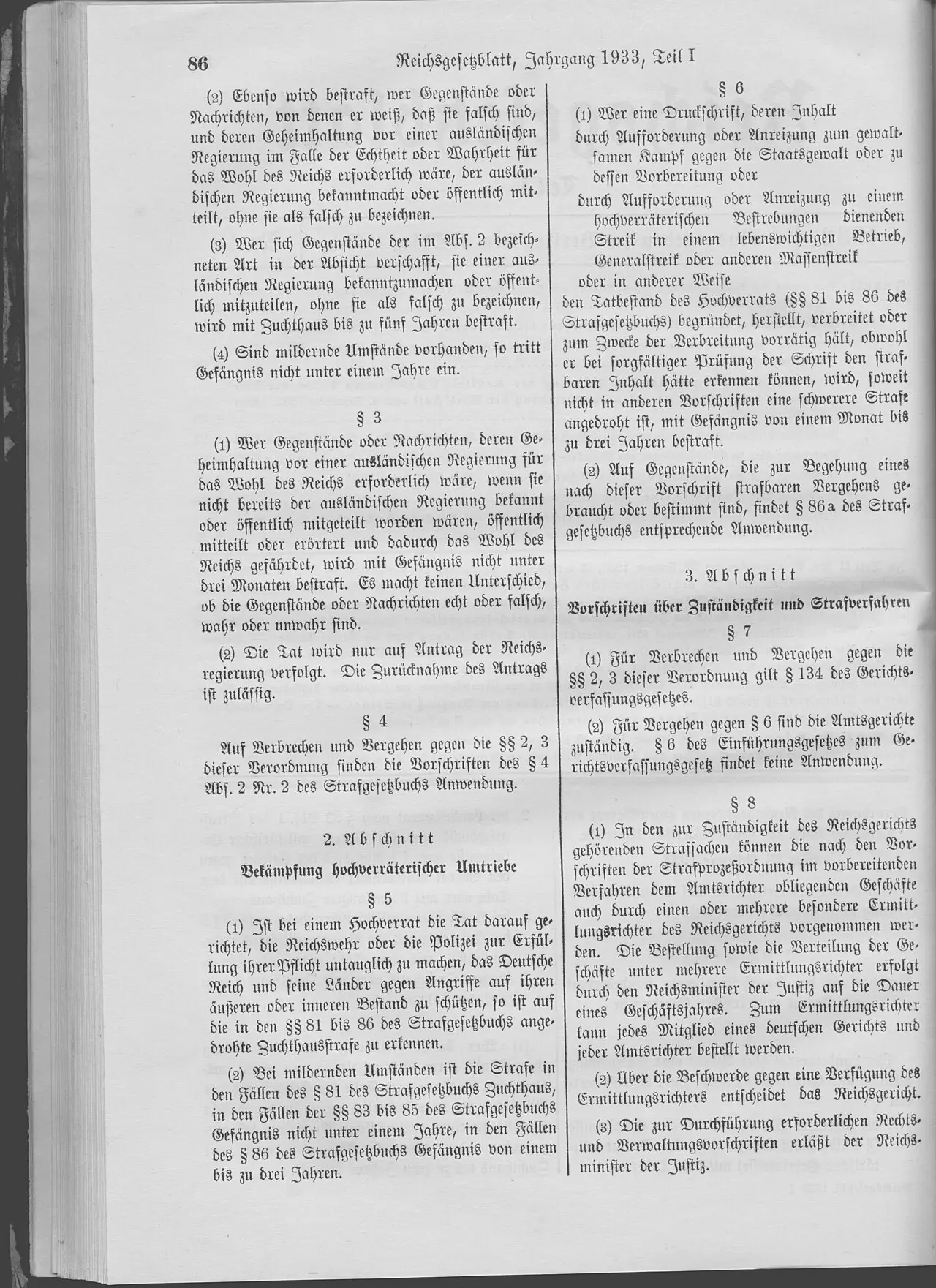
(2) Ebenso wird bestraft, wer Gegenstände oder Nachrichten, von denen er weiß, daß sie falsch sind, und deren Geheimhaltung vor einer ausländischen Regierung im Falle der Echtheit oder Wahrheit für das Wohl des Reichs erforderlich wäre, der ausländischen Regierung bekanntmacht oder öffentlich mitteilt, ohne sie als falsch zu bezeichnen.
(2) The same punishment applies to whoever makes known to the foreign government, or communicates publicly, objects or information that he knows to be false and whose secrecy from a foreign government would, if they were genuine or true, be necessary for the welfare of the Reich, without describing them as false.
(3) Wer sich Gegenstände der im Abs. 2 bezeichneten Art in der Absicht verschafft, sie einer ausländischen Regierung bekanntzumachen oder öffentlich mitzuteilen, ohne sie als falsch zu bezeichnen, wird mit Zuchthaus bis zu fünf Jahren bestraft.
(3) Whoever procures objects of the kind described in para. 2 with the intention of making them known to a foreign government or communicating them publicly without describing them as false shall be punished with penal servitude for up to five years.
(4) Sind mildernde Umstände vorhanden, so tritt Gefängnis nicht unter einem Jahre ein.
(4) If there are mitigating circumstances, the penalty is imprisonment of not less than one year.
§ 3(1) Wer Gegenstände oder Nachrichten, deren Geheimhaltung vor einer ausländischen Regierung für das Wohl des Reichs erforderlich wäre, wenn sie nicht bereits der ausländischen Regierung bekannt oder öffentlich mitgeteilt worden wären, öffentlich mitteilt oder erörtert und dadurch das Wohl des Reichs gefährdet, wird mit Gefängnis nicht unter drei Monaten bestraft. Es macht keinen Unterschied, ob die Gegenstände oder Nachrichten echt oder falsch, wahr oder unwahr sind.
§ 3(1) Whoever publicly communicates or discusses objects or information whose secrecy from a foreign government would be necessary for the welfare of the Reich if they had not already been made known to the foreign government or communicated publicly, and thereby endangers the welfare of the Reich, shall be punished with imprisonment of not less than three months. It makes no difference whether the objects or information are genuine or false, true or untrue.
(2) Die Tat wird nur auf Antrag der Reichsregierung verfolgt. Die Zurücknahme des Antrags ist zulässig.
(2) The act is prosecuted only on the application of the Reich Government. The application may be withdrawn.
§ 4Auf Verbrechen und Vergehen gegen die §§ 2, 3 dieser Verordnung finden die Vorschriften des § 4 Abs. 2 Nr. 2 des Strafgesetzbuchs Anwendung.
§ 4The provisions of § 4, para. 2, no. 2, of the Criminal Code apply to crimes and offences against §§ 2 and 3 of this decree.
§ 5(1) Ist bei einem Hochverrat die Tat darauf gerichtet, die Reichswehr oder die Polizei zur Erfüllung ihrer Pflicht untauglich zu machen, das Deutsche Reich und seine Länder gegen Angriffe auf ihren äußeren oder inneren Bestand zu schützen, so ist auf die in den §§ 81 bis 86 des Strafgesetzbuchs angedrohte Zuchthausstrafe zu erkennen.
§ 5(1) If, in a case of high treason, the act is directed at making the Reichswehr or the police unfit to fulfil their duty of protecting the German Reich and its states against attacks on their external or internal existence, the sentence shall be the penal servitude prescribed in §§ 81 to 86 of the Criminal Code.
(2) Bei mildernden Umständen ist die Strafe in den Fällen des § 81 des Strafgesetzbuchs Zuchthaus, in den Fällen der §§ 83 bis 85 des Strafgesetzbuchs Gefängnis nicht unter einem Jahre, in den Fällen des § 86 des Strafgesetzbuchs Gefängnis von einem bis zu drei Jahren.
(2) Under mitigating circumstances the penalty is penal servitude in the cases of § 81 of the Criminal Code, imprisonment of not less than one year in the cases of §§ 83 to 85 of the Criminal Code, and imprisonment of one to three years in the cases of § 86 of the Criminal Code.
§ 6(1) Wer eine Druckschrift, deren Inhalt durch Aufforderung oder Anreizung zum gewaltsamen Kampf gegen die Staatsgewalt oder zu dessen Vorbereitung oder durch Aufforderung oder Anreizung zu einem hochverräterischen Bestrebungen dienenden Streik in einem lebenswichtigen Betrieb, Generalstreik oder anderen Massenstreik oder in anderer Weise den Tatbestand des Hochverrats (§§ 81 bis 86 des Strafgesetzbuchs) begründet, herstellt, verbreitet oder zum Zwecke der Verbreitung vorrätig hält, obwohl er bei sorgfältiger Prüfung der Schrift den strafbaren Inhalt hätte erkennen können, wird, soweit nicht in anderen Vorschriften eine schwerere Strafe angedroht ist, mit Gefängnis von einem Monat bis zu drei Jahren bestraft.
§ 6(1) Whoever produces, distributes or keeps in stock for the purpose of distribution a publication whose content constitutes the offence of high treason (§§ 81 to 86 of the Criminal Code) by calling for or inciting violent struggle against the authority of the state or its preparation, or by calling for or inciting a strike serving the aims of high treason in an essential enterprise, a general strike or another mass strike, or in any other way, although on careful examination of the publication he could have recognised its punishable content, shall, unless a more severe penalty is prescribed in other provisions, be punished with imprisonment of one month to three years.
(2) Auf Gegenstände, die zur Begehung eines nach dieser Vorschrift strafbaren Vergehens gebraucht oder bestimmt sind, findet § 86 a des Strafgesetzbuchs entsprechende Anwendung.
(2) § 86 a of the Criminal Code applies correspondingly to objects used or intended for committing an offence punishable under this provision.
3. Abschnitt · Vorschriften über Zuständigkeit und Strafverfahren
Part 3 · Provisions on Jurisdiction and Criminal Procedure
§ 7(1) Für Verbrechen und Vergehen gegen die §§ 2, 3 dieser Verordnung gilt § 134 des Gerichtsverfassungsgesetzes.
§ 7(1) § 134 of the Courts Constitution Act applies to crimes and offences against §§ 2 and 3 of this decree.
(2) Für Vergehen gegen § 6 sind die Amtsgerichte zuständig. § 6 des Einführungsgesetzes zum Gerichtsverfassungsgesetz findet keine Anwendung.
(2) The local courts have jurisdiction over offences against § 6. § 6 of the Introductory Act to the Courts Constitution Act does not apply.
§ 8(1) In den zur Zuständigkeit des Reichsgerichts gehörenden Strafsachen können die nach den Vorschriften der Strafprozeßordnung im vorbereitenden Verfahren dem Amtsrichter obliegenden Geschäfte auch durch einen oder mehrere besondere Ermittlungsrichter des Reichsgerichts vorgenommen werden. Die Bestellung sowie die Verteilung der Geschäfte unter mehrere Ermittlungsrichter erfolgt durch den Reichsminister der Justiz auf die Dauer eines Geschäftsjahres. Zum Ermittlungsrichter kann jedes Mitglied eines deutschen Gerichts und jeder Amtsrichter bestellt werden.
§ 8(1) In criminal cases within the jurisdiction of the Reich Court, the tasks that the Code of Criminal Procedure assigns to the local court judge in the preparatory proceedings may also be carried out by one or more special investigating judges of the Reich Court. The appointment, and the distribution of business among several investigating judges, is made by the Reich Minister of Justice for the duration of a business year. Any member of a German court and any local court judge may be appointed investigating judge.
(2) Über die Beschwerde gegen eine Verfügung des Ermittlungsrichters entscheidet das Reichsgericht.
(2) The Reich Court decides on complaints against an order of the investigating judge.
(3) Die zur Durchführung erforderlichen Rechts- und Verwaltungsvorschriften erläßt der Reichsminister der Justiz.
(3) The Reich Minister of Justice issues the legal and administrative regulations required for implementation.
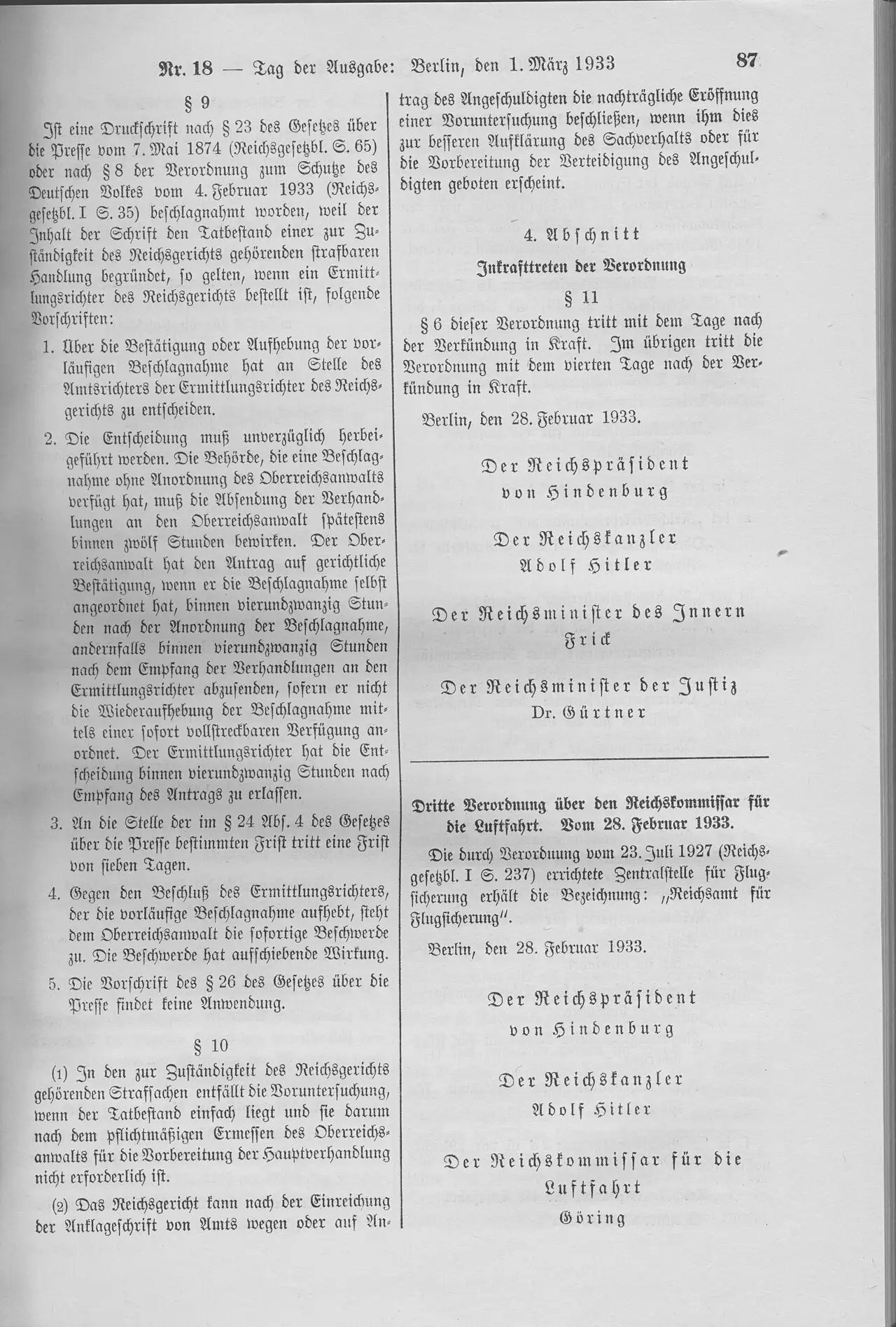
§ 9Ist eine Druckschrift nach § 23 des Gesetzes über die Presse vom 7. Mai 1874 (Reichsgesetzbl. S. 65) oder nach § 8 der Verordnung zum Schutze des Deutschen Volkes vom 4. Februar 1933 (Reichsgesetzbl. I S. 35) beschlagnahmt worden, weil der Inhalt der Schrift den Tatbestand einer zur Zuständigkeit des Reichsgerichts gehörenden strafbaren Handlung begründet, so gelten, wenn ein Ermittlungsrichter des Reichsgerichts bestellt ist, folgende Vorschriften:
§ 9If a publication has been seized under § 23 of the Press Law of 7 May 1874 (Reich Law Gazette p. 65) or under § 8 of the Decree for the Protection of the German People of 4 February 1933 (Reich Law Gazette I p. 35) because its content constitutes a punishable act within the jurisdiction of the Reich Court, the following provisions apply when an investigating judge of the Reich Court has been appointed:
1.Über die Bestätigung oder Aufhebung der vorläufigen Beschlagnahme hat an Stelle des Amtsrichters der Ermittlungsrichter des Reichsgerichts zu entscheiden.
1.The investigating judge of the Reich Court, instead of the local court judge, shall decide on the confirmation or lifting of the provisional seizure.
2.Die Entscheidung muß unverzüglich herbeigeführt werden. Die Behörde, die eine Beschlagnahme ohne Anordnung des Oberreichsanwalts verfügt hat, muß die Absendung der Verhandlungen an den Oberreichsanwalt spätestens binnen zwölf Stunden bewirken. Der Oberreichsanwalt hat den Antrag auf gerichtliche Bestätigung, wenn er die Beschlagnahme selbst angeordnet hat, binnen vierundzwanzig Stunden nach der Anordnung der Beschlagnahme, andernfalls binnen vierundzwanzig Stunden nach dem Empfang der Verhandlungen an den Ermittlungsrichter abzusenden, sofern er nicht die Wiederaufhebung der Beschlagnahme mittels einer sofort vollstreckbaren Verfügung anordnet. Der Ermittlungsrichter hat die Entscheidung binnen vierundzwanzig Stunden nach Empfang des Antrags zu erlassen.
2.The decision must be obtained without delay. An authority that has ordered a seizure without an order of the Chief Reich Prosecutor must dispatch the record of proceedings to the Chief Reich Prosecutor within twelve hours at the latest. The Chief Reich Prosecutor must send the application for judicial confirmation to the investigating judge within twenty-four hours of the order for the seizure if he ordered it himself, and otherwise within twenty-four hours of receiving the record, unless he orders the seizure to be lifted by an immediately enforceable order. The investigating judge must give his decision within twenty-four hours of receiving the application.
3.An die Stelle der im § 24 Abs. 4 des Gesetzes über die Presse bestimmten Frist tritt eine Frist von sieben Tagen.
3.The time limit laid down in § 24, para. 4, of the Press Law is replaced by a time limit of seven days.
4.Gegen den Beschluß des Ermittlungsrichters, der die vorläufige Beschlagnahme aufhebt, steht dem Oberreichsanwalt die sofortige Beschwerde zu. Die Beschwerde hat aufschiebende Wirkung.
4.The Chief Reich Prosecutor may lodge an immediate complaint against a ruling of the investigating judge that lifts the provisional seizure. The complaint has suspensive effect.
5.Die Vorschrift des § 26 des Gesetzes über die Presse findet keine Anwendung.
5.The provision of § 26 of the Press Law does not apply.
§ 10(1) In den zur Zuständigkeit des Reichsgerichts gehörenden Strafsachen entfällt die Voruntersuchung, wenn der Tatbestand einfach liegt und sie darum nach dem pflichtmäßigen Ermessen des Oberreichsanwalts für die Vorbereitung der Hauptverhandlung nicht erforderlich ist.
§ 10(1) In criminal cases within the jurisdiction of the Reich Court, the preliminary judicial investigation is dispensed with if the facts are simple and it is therefore, in the dutiful discretion of the Chief Reich Prosecutor, not necessary for the preparation of the main trial.
(2) Das Reichsgericht kann nach der Einreichung der Anklageschrift von Amts wegen oder auf Antrag des Angeschuldigten die nachträgliche Eröffnung einer Voruntersuchung beschließen, wenn ihm dies zur besseren Aufklärung des Sachverhalts oder für die Vorbereitung der Verteidigung des Angeschuldigten geboten erscheint.
(2) After the indictment has been filed, the Reich Court may, of its own motion or on the application of the accused, decide to open a preliminary judicial investigation retrospectively if this appears to it necessary for a better clarification of the facts or for the preparation of the defence of the accused.
4. Abschnitt · Inkrafttreten der Verordnung
Part 4 · Entry into Force of the Decree
§ 11§ 6 dieser Verordnung tritt mit dem Tage nach der Verkündung in Kraft. Im übrigen tritt die Verordnung mit dem vierten Tage nach der Verkündung in Kraft.
§ 11§ 6 of this decree comes into force on the day after its promulgation. In all other respects the decree comes into force on the fourth day after its promulgation.
Berlin, den 28. Februar 1933.
Berlin, 28 February 1933.
Der Reichspräsident von Hindenburg
The Reich President von Hindenburg
Der Reichskanzler Adolf Hitler
The Reich Chancellor Adolf Hitler
Der Reichsminister des Innern Frick
The Reich Minister of the Interior Frick
Der Reichsminister der Justiz Dr. Gürtner
The Reich Minister of Justice Dr Gürtner
About this text
The full text is given.
Transcribed from the RGBl. scans (issue 18, pp. 85–87); compared word by word with documentArchiv.de, which reads ‘Artikel’ for ‘Artikels’ in the preamble, drops ‘2’ from ‘§ 1 Abs. 1, 2’ and ‘mit’ before ‘lebenslangem Zuchthaus’ in § 1 no. 2, omits ‘vor einer ausländischen Regierung’ and misprints ‘Reichs’ in § 3 (1), and reads ‘pflichtmäßigem’ and ‘nachträglich’ in § 10; all were corrected from the scan. The three alternatives in § 6 (1), set as indented lines in the gazette, are given as running text, and each Part’s number and heading are joined in one heading block.
The English translation was made for this site and is not an official translation. ‘Landesverrat’ (betrayal of state secrets to a foreign power) is translated ‘treason’ and ‘Hochverrat’ (an attempt to overthrow the constitution or the state by force) ‘high treason’, following the shared glossary; the title’s ‘Verrat am Deutschen Volke’ is rendered literally.
German laws and decrees are official works and not protected by copyright (§ 5 UrhG).
Terms
Landesverrat / Hochverrat
German law distinguished treason against the state’s external security (Landesverrat, chiefly betraying secrets to foreign governments) from high treason (Hochverrat, the violent overthrow of the constitution or territory, §§ 81–86 of the Criminal Code).
Gesetz gegen den Verrat militärischer Geheimnisse
The Law against the Betrayal of Military Secrets of 3 June 1914. Its § 1 dealt with passing on military secrets, para. 3 with serious cases, and § 3 with spying them out.
Oberreichsanwalt
The Chief Reich Prosecutor, the public prosecutor at the Reich Court in Leipzig, which tried high treason and treason at first instance.
Voruntersuchung
The preliminary judicial investigation: a formal inquiry by a judge before trial, which gave the accused certain rights. The decree allowed it to be skipped.
Ermittlungsrichter
An investigating judge: here a judge specially appointed to handle the pre-trial business of Reich Court cases, such as warrants and confirming seizures of publications.
Druckschrift
Any printed publication: newspapers, leaflets, posters and pamphlets. § 6 made the political opposition’s press and leaflets punishable on a test of negligence.