Day 59 of 100
Retroactive death-penalty law signed; Ufa resolves to part with its Jewish staff
Back from Munich, Hitler told his ministers that the boycott of Jewish businesses had to be organised, and the cabinet discussed the bill to ‘coordinate’ the states. A law dated this day made the death penalty retroactive, clearing the way to hang the alleged Reichstag arsonist. In the film world the censors banned Fritz Lang’s Das Testament des Dr. Mabuse, and Ufa’s board decided in principle to end its contracts with Jewish employees.
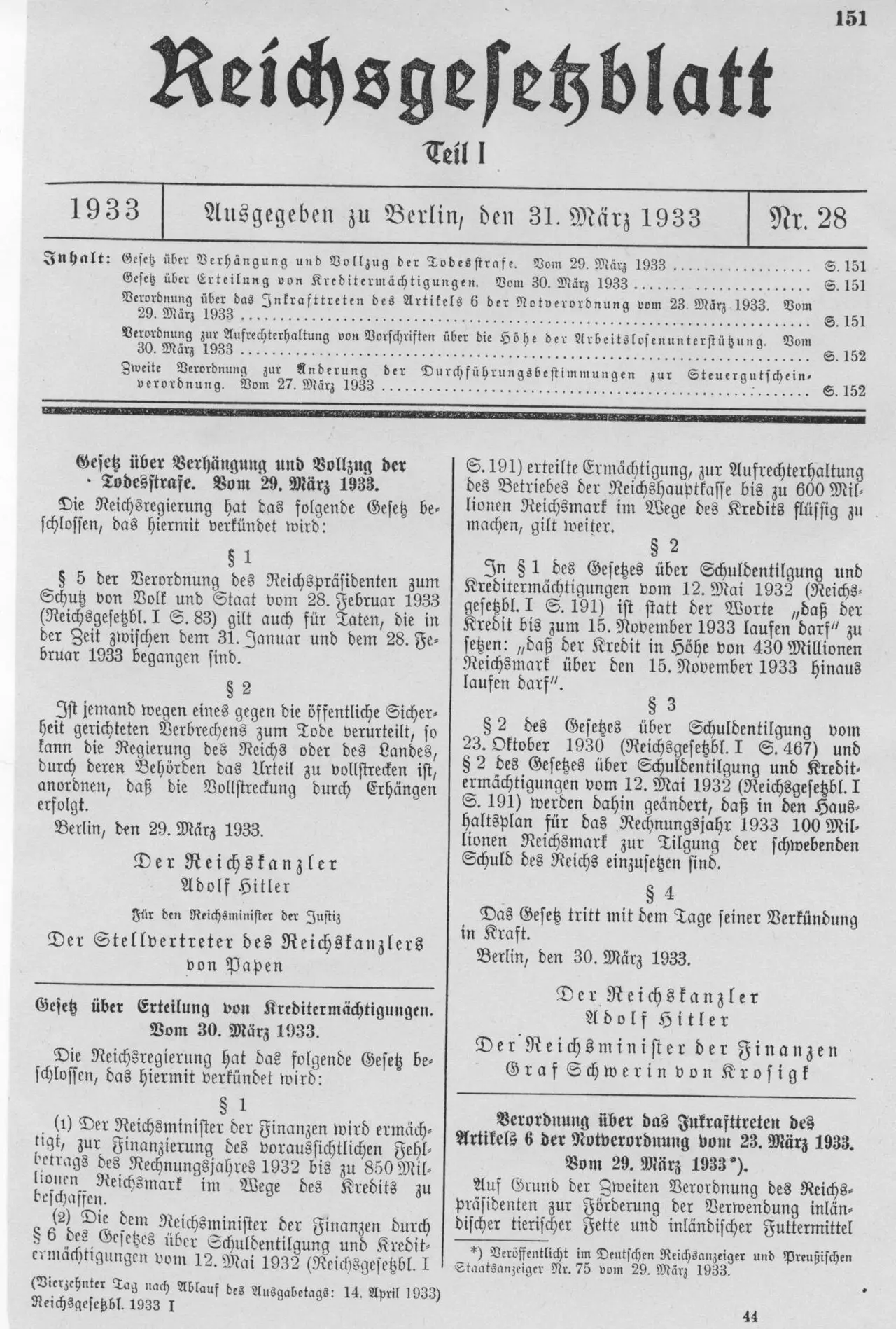

The law on the imposition and execution of the death penalty, known as the ‘Lex van der Lubbe’, broke a basic principle of criminal law by applying the harsher penalties of the Reichstag Fire Decree of 28 February to acts committed since 31 January, and allowed death sentences to be carried out by hanging. It was signed by Hitler and, for the Justice Minister, by Vice-Chancellor Papen. Its popular name, ‘Lex van der Lubbe’, showed whom it was aimed at: Marinus van der Lubbe, held for the Reichstag fire.
Laws and decrees
Gesetz über Verhängung und Vollzug der Todesstrafe
Law on the Imposition and Execution of the Death Penalty ('Lex van der Lubbe')
Extended Article 5 of the Reichstag Fire Decree of 28 February 1933, which raised many crimes to capital offences, retroactively to acts committed between 31 January and 28 February 1933, and allowed the Reich or a state government to order that a death sentence for a crime against public security be carried out by hanging.1
Politics and power
Government, terror and persecution
-
Government 12:00, Berlin, Reich Chancellery
Hitler tells the cabinet the boycott must be organised
Hitler flew back from Munich at 08:00, landed in Berlin at 10:25 and opened a ministerial meeting at noon, attended also by Labour Minister Seldte and Reichsbank President Schacht. He declared the Braunschweig Stahlhelm affair settled and said the ‘defence’ against ‘Jewish atrocity propaganda’ abroad had to be organised, otherwise it would take undesirable forms; he claimed this would prevent personal harassment and violence. According to a press report of his remarks, international Jewry was to know that the struggle would hit Jews living in Germany ‘in the sharpest way’.2,3,4
-
Government Berlin
Frick presents the bill to ‘coordinate’ the states
Interior Minister Frick laid before the ministers his bill on the coordination (Gleichschaltung) of the states with the Reich. All state parliaments except the Prussian Landtag were to be dissolved and refilled, without new elections, in proportion to the votes cast in each state at the Reichstag election of 5 March. The cabinet also agreed to extend the import of carnations from Italy until 1 May.3
-
Persecution Berlin
German Jews appeal to Hindenburg against the boycott
The national representative body of German Jews (Reichsvertretung der deutschen Juden) and the board of the Berlin Jewish community wrote to the Reich President, the Chancellor and the Reich ministers that German Jews were deeply shaken by the Nazi party’s boycott call. They protested that they were to be punished for the misdeeds of a few for which they bore no responsibility, and recalled that 12,000 of Germany’s 500,000 Jews had given their lives in the World War.5
-
Persecution Görlitz; Münster
SA raids on courts in Görlitz and Münster
In the weeks before the boycott SA men repeatedly occupied court buildings and arrested or assaulted individual judges and lawyers; on 29 March this happened in Görlitz and Münster, following similar raids in Frankfurt, Duisburg, Dortmund and Hagen the day before.10
Everyday life
What else was happening in Germany
-
Film Berlin
Censors ban Fritz Lang’s Testament of Dr Mabuse
The Berlin film censorship office, chaired by Regierungsrat Zimmermann, banned the Nero-Film production Das Testament des Dr. Mabuse, which was due to open in a large Berlin cinema within days. Following expert opinions from the Reich Interior Ministry, the Reich Health Office and the Berlin police, it ruled that the film’s portrayal of organised crime against society was so instructive and enticing that it endangered public order and security. The film was cleared only for export.6,7
-
Film Berlin
Ufa’s board decides to drop its Jewish employees
Meeting in Berlin, the board of Germany’s largest film company resolved ‘in principle’ to end, wherever possible, its contracts with Jewish staff, leaving each board member to decide who in his department should go at once and who gradually. It agreed to cancel the contracts of the director Erik Charell and the producer Erich Pommer and to part with Robert Liebmann, but resolved to plead with the government for Werner Richard Heymann, because he was a baptised Protestant who had served at the front.8
-
Transport Berlin
A committee to motorise Germany
The new working committee on motor transport, chaired by the Duke of Saxe-Coburg and Gotha, met for the first time at the Reich Transport Ministry. Its programme included a Reich roads law, a national highway code covering everyone from pedestrians to lorry drivers, and cuts in motor tax and garage costs to make car ownership cheaper, as well as help for the taxi trade.9
Voices
Because of the misdeeds of a few, for which we bear no responsibility whatever, we German Jews, who feel bound to our German homeland with every fibre of our hearts, are to be brought to economic ruin.
In view of the question of the continued employment of Jewish collaborators and employees at Ufa, which has come to the fore as a result of the national upheaval in Germany, the board resolves in principle that contracts with Jewish collaborators and employees are to be dissolved wherever possible.
More pictures

Sources
- Reichsgesetz über Verhängung und Vollzug der Todesstrafe [“Lex van der Lubbe”] (29.03.1933) documentArchiv.de, RGBl. 1933 I, S. 151
- Bergedorfer Zeitung, 29 March 1933: Hitler’s return to Berlin and the cabinet meeting Deutsche Digitale Bibliothek, Zeitungsportal, p. 1
- Honnefer Volkszeitung, 30 March 1933: ‘Die heutige Ministerbesprechung’ (CNB/WTB, Berlin, 29 March) Deutsche Digitale Bibliothek, Zeitungsportal, p. 1
- Schwäbischer Merkur, 30 March 1933: report on the ministerial meeting Deutsche Digitale Bibliothek, Zeitungsportal, p. 1
- Rheinisches Volksblatt, 31 March 1933: ‘Ein Schreiben der Reichsvertretung der deutschen Juden’ (Berlin, 29 March) Deutsche Digitale Bibliothek, Zeitungsportal, p. 1
- Das Testament des Dr. Mabuse (1933) filmportal.de (DFF – Deutsches Filminstitut & Filmmuseum), Zensur (DE): 29.03.1933, B.33537, Verbot
- Gütersloher Volks-Zeitung, 30 March 1933: ‘Verbot des Films Das Testament des Dr. Mabuse’ (TU, Berlin, 29 March) Deutsche Digitale Bibliothek, Zeitungsportal, p. 3
- Der Ufa-Vorstand zum Ausschluss der jüdischen Mitarbeiter (minutes of the Ufa board meeting of 29 March 1933) filmportal.de, after Klaus Kreimeier, Die UFA-Story (1992), p. 248
- Bergedorfer Zeitung, 30 March 1933: ‘Deutschland wird motorisiert’ Deutsche Digitale Bibliothek, Zeitungsportal, p. 5
- Tillmann Krach, Georg D. Falk, Sebastian Felz: ‘NS-Terror gegen jüdische Richter und Rechtsanwälte’ Legal Tribune Online
Spotted a mistake? Send a correction.