Themes

Terror

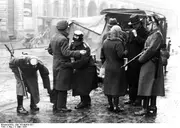
SA and SS violence, arrests, improvised camps and Dachau.

51 days

  1. Day 1 Monday 30 January 1933

    Hindenburg appoints Hitler Reich Chancellor at the head of a coalition cabinet

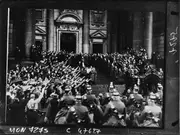
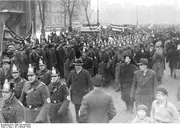
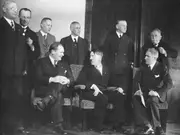
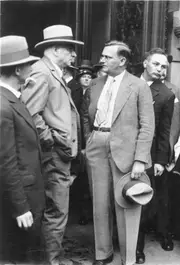
    Reich President Paul von Hindenburg appointed Adolf Hitler Reich Chancellor of a cabinet in which only two other National Socialists sat. That evening SA, SS and Stahlhelm columns carried torches through the government quarter, and late that night a police officer and an SA man were shot dead in Charlottenburg. Elsewhere in Berlin a flu epidemic was closing school classes and the police caught two long-sought robbers.
  2. Day 6 Saturday 4 February 1933

    Hindenburg signs a decree allowing bans on newspapers and political meetings

    Hindenburg signed the “Decree for the Protection of the German People”, which let the authorities ban political meetings and newspapers and hold suspects in police custody for up to three months. The Prussian Landtag refused to dissolve itself, and the Reich’s commissioners in Prussia dissolved every municipal council instead. Two young Communists were shot dead in Berlin overnight, and that evening the Social Democratic mayor of Staßfurt was shot in front of his house. In Berlin, new flu cases passed a thousand a day.

  3. Day 7 Sunday 5 February 1933

    A state funeral in Berlin Cathedral for an SA leader and a police officer

    Hitler and Göring attended a state funeral in Berlin Cathedral for the SA leader Hans Maikowski and police officer Josef Zauritz, killed on the night of 30 January; the radio carried the ceremony. That night SA men raided a Communist pub in Friedenau and shot its landlady, Anna Röder, dead, and in Staßfurt the mayor Hermann Kasten died of his wounds. Berliners saw the first motor-paced cycle races in the Sportpalast.

  4. Day 8 Monday 6 February 1933

    Presidential decree removes Prussia’s elected government; Papen dissolves the Landtag

    Hindenburg transferred the last powers of Otto Braun’s elected Prussian government to the Reich Commissioner, Papen, who then dissolved the Prussian Landtag together with its president, Kerrl, over the objection of Konrad Adenauer. The same day Hindenburg assured Bavaria that no one planned to override the states. In Staßfurt a headmaster told his school of the murdered mayor; in Berlin the flu began, briefly, to ebb.

  5. Day 9 Tuesday 7 February 1933

    Social Democrats fill the Lustgarten as the KPD leadership meets in secret at Ziegenhals

    In rain and wind, the Social Democrats and the Iron Front marched into the Lustgarten for their largest rally of the campaign, where Otto Wels declared that the workers’ front stood unbroken. Outside Berlin, the Communist Party’s central committee met secretly in an inn at Ziegenhals to hear Ernst Thälmann. In the Reichstag building, Nazi deputies broke up the committee meant to guard parliament’s rights. In Berlin the flu returned with more than a thousand new cases in a day.

  6. Day 14 Sunday 12 February 1933

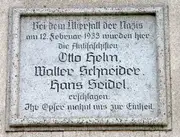
    “Bloody Sunday” in Eisleben: SA and SS storm Communist premises, killing three

    In the mining town of Eisleben, in Prussian Saxony, some 600 SA and SS men on a “propaganda march” stormed the local Communist headquarters and a workers’ sports hall, killing three Communists; an SS man also died. In Berlin about 5,000 officials of the Iron Front heard the trade union leader Peter Graßmann warn that a war of annihilation had been declared on the Republic. Sunday crowds of 65,000 filled the motor show, and the radio carried Leipzig’s commemoration of Richard Wagner.

  7. Day 16 Tuesday 14 February 1933

    Nazi deputies break up a Reichstag committee as farm foreclosures are halted

    The cabinet approved, and Hindenburg signed, a decree stopping forced auctions of farms until the end of October. In the Reichstag, Nazi members drove the chairman of the committee that guarded parliament’s rights from his seat and Julius Streicher struck a People’s Party deputy; that evening the political police searched Communist rooms in the building. Neunkirchen in the Saar buried the victims of the gas-holder explosion, Göring opened a show of modern Italian painting and the geneticist Carl Correns died in Dahlem.

  8. Day 17 Wednesday 15 February 1933

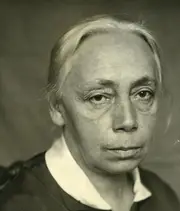
    Käthe Kollwitz and Heinrich Mann forced out of the Prussian Academy of Arts

    Under threat that the Academy would be dissolved, Käthe Kollwitz and Heinrich Mann left the Prussian Academy of Arts, and the Prussian commissioners confirmed a sweeping purge of police chiefs, naming a retired rear admiral as police president of Berlin. Vorwärts and the 8-Uhr-Abendblatt were banned for a week, and in Stuttgart someone cut the cable carrying Hitler’s speech to the radio. Abroad, Thomas Mann lectured on Wagner in Brussels and an assassin fired on Franklin D. Roosevelt in Miami.

  9. Day 19 Friday 17 February 1933

    Göring orders the Prussian police to shoot and promises to cover them

    Göring sent all Prussian police authorities a circular telling them to cooperate with the SA, SS and Stahlhelm, to act against “enemies of the state” with the harshest means and to use their firearms without hesitation, promising to cover any officer who did. The Bavarian People’s Party leader Fritz Schäffer warned Hindenburg against Reich commissioners in the states, and uniformed students broke up an examination at the State Art School in Schöneberg. In the evening 4,000 people watched boxing at the Sportpalast.

  10. Day 22 Monday 20 February 1933

    Hitler and Göring ask leading industrialists to pay for the election

    At Göring’s official residence opposite the Reichstag, Hitler told about two dozen leading industrialists and bankers that private enterprise could not survive in a democracy; Göring added that the coming election would surely be the last for ten years, perhaps a hundred, and Hjalmar Schacht proposed a three-million-mark election fund. The same day the Prussian press service released Göring’s “shooting decree”. Göring also banned the sale of spirits on polling days, and the perjury trial of a former Berlin transport director in the Sklarek scandal opened to packed public benches.

  11. Day 24 Wednesday 22 February 1933

    Göring makes the SA, SS and Stahlhelm an auxiliary police in Prussia

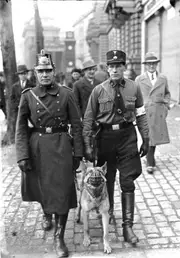
    Göring signed a decree allowing the Prussian police to call up “auxiliary police” from the ranks of “nationally minded” Germans: in practice men of the SA, SS and Stahlhelm, wearing a white armband over their own uniforms and holding full police powers while on duty. The Prussian commissioners pensioned off another wave of senior officials and began closing the secular schools, and Hitler told his followers that the enemy to be beaten on 5 March was “Marxism”. In Berlin the first film directed by Friedrich Hollaender, Ich und die Kaiserin, opened at the Gloria-Palast.

  12. Day 25 Thursday 23 February 1933

    Police search the Communist headquarters and break up the KPD’s Sportpalast rally

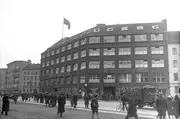
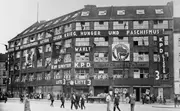
    In the afternoon the political police occupied and searched the Karl-Liebknecht-Haus, the Communist Party’s headquarters; in the evening a police officer dissolved the KPD’s rally in the Sportpalast while Wilhelm Pieck was speaking. Overnight men in Nazi uniform had shot a Reichsbanner leader in Großbeeren and burned down the poorhouse where he lived. Göring ordered tougher action against the opposition press. In Berlin the motor show closed after more than 400,000 visits, and Prussia relaxed its rules on men’s bathing trunks.

  13. Day 26 Friday 24 February 1933

    The Karl-Liebknecht-Haus is closed and the auxiliary police decree made public

    The police closed the Communist headquarters, the Karl-Liebknecht-Haus, “until further notice”, and the official Prussian press service released Göring’s decree creating an auxiliary police. Rudolf Diels took charge of the political police with its own new strike squads, and the jurist Robert Kempner was removed from the Prussian Interior Ministry. Hitler spoke to a huge crowd in Munich on the anniversary of the party programme. In Geneva the League of Nations condemned Japan’s actions in Manchuria and the Japanese delegation walked out; Max Ophüls’s Liebelei opened in Vienna.

  14. Day 27 Saturday 25 February 1933

    Police claim to find tunnels and treasonable leaflets under the Karl-Liebknecht-Haus

    Diels’s political police announced that the closed Communist headquarters had yielded secret cellars, a tunnel and hundredweights of leaflets calling for armed revolt. The Reichsgericht lifted or shortened a series of newspaper bans, Adenauer settled his protest over Göring’s police decrees in a meeting with Göring, and Rust ordered that the secular schools take no new pupils. Berlin learned from a League of Nations report how much weight its unemployed had lost, and the Sklarek perjury trial ended with a year’s prison for the former transport director Fritz Brolat.

  15. Day 28 Sunday 26 February 1933

    Uniformed police wear swastika armbands at a Nazi rally in the Lustgarten

    On the last Sunday of February uniformed Berlin police officers marched with swastika armbands at the first mass rally of the National Socialist factory cells in the Lustgarten, while police president Levetzow looked in to cheers. Police broke up a Social Democratic cultural rally in Neukölln and led the speaker Friedrich Stampfer away to the station; across the Reich, election marches ended in shootings and stabbings. Berliners went tobogganing on a second snowy Sunday, and in Prague the United States took the ice hockey world title from Canada for the first time.
  16. Day 29 Monday 27 February 1933

    The Reichstag burns, and the Nazi leadership blames a Communist uprising

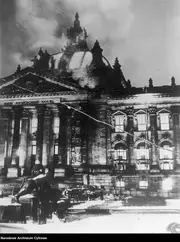
    On the evening of Monday 27 February the Reichstag building in Berlin was set alight; a young Dutchman, Marinus van der Lubbe, was arrested inside, and before the night was out Göring had declared the fire the signal for a Communist revolt, banned the left-wing press in Prussia and ordered arrests. Earlier that day the cabinet had approved a harsh new decree against ‘treason’, and SA men had fired into the flat of a Social Democratic deputy in Neukölln. In Cologne the Rosenmontag carnival procession went ahead in the sunshine.

  17. Day 30 Tuesday 28 February 1933

    The Reichstag Fire Decree suspends basic rights ‘until further notice’

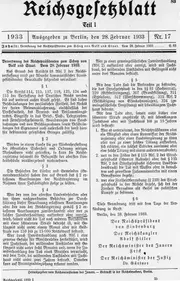
    The morning after the fire the cabinet met twice, and by the end of the day Hindenburg had signed and the government had published the decree ‘for the protection of people and state’, which suspended the Weimar constitution’s guarantees of personal liberty, free speech, a free press and assembly. Across Prussia the police and their SA auxiliaries arrested Communists and left-wing intellectuals, among them Carl von Ossietzky and Hans Litten, and the SA hoisted the swastika over the Communist headquarters. It was Shrove Tuesday: Cologne’s carnival corps paraded once more, while in Berlin Göring had the museums closed.
  18. Day 32 Thursday 2 March 1933

    Cabinet picks Potsdam’s Garrison Church for the opening of the new Reichstag

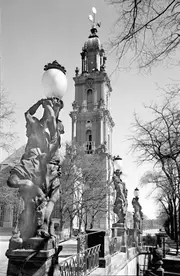
    With the Reichstag a burnt shell, the cabinet agreed that the new parliament should be opened in the Garrison Church at Potsdam, the germ of the ‘Day of Potsdam’. Göring told ministers of an alleged Communist plan of attack and complained of foreign papers accusing him of the fire; Hitler said the outcry would have died if the arsonist had been hanged at once. To win votes, the cabinet agreed to hand out cheap bread and butter to the unemployed in distressed areas. That evening Hitler spoke in the Sportpalast before members of the diplomatic corps, while in Bremen a Reichsbanner man died after a night of shooting.
  19. Day 33 Friday 3 March 1933

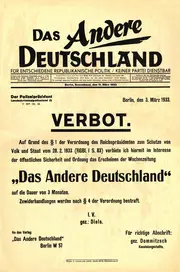
    Ernst Thälmann is arrested in Berlin; Göring vows ‘to destroy and exterminate’

    The Communist party’s leader, Ernst Thälmann, was arrested in a flat in Charlottenburg on Friday afternoon; he never regained his freedom. In Frankfurt Göring told a mass meeting that his measures would not be hampered by legal scruples, and in Hamburg the Social Democratic senators left the city government rather than ban their party’s newspaper. In Berlin tens of thousands queued in the pouring rain, between lines of SA men, to look at the burnt-out Reichstag chamber, and a Jewish weekly urged every Jewish voter to go to the polls on Sunday.

  20. Day 35 Sunday 5 March 1933

    Reichstag election under the emergency decree: 43.9 per cent for the NSDAP

    On a grey, rainy Sunday nearly 89 per cent of Germany’s voters went to the polls in an election held under the emergency decree, with Communist leaders in prison or in hiding and the left-wing press silenced. The NSDAP won 43.9 per cent, short of an absolute majority, but with the nationalist ‘Combat Front Black-White-Red’ the government had a majority of seats; the Social Democrats held 18.3 per cent and the Communists 12.3. That night the Reich interior minister ordered Hamburg’s police handed to a Nazi, and SA men raised the swastika on town halls. In Hamburg, Altona 93 won the city football championship in the rain.

  21. Day 36 Monday 6 March 1933

    The morning after: Reich commissioners and swastikas in Bremen, Lübeck and Hesse

    On the day after the election the Reich began taking over the states that the Nazis did not yet control. Frick used the Reichstag Fire Decree to seize police powers in Bremen and Hesse, where SA men occupied ministries and the homes of the Social Democratic state president and interior minister overnight; in Lübeck the Social Democratic senators were pushed out, and Thuringia banned the Central Association of German Jews. In Altona a 20-year-old bystander was shot dead during an SA torchlight parade. In Hamburg Karl Muck conducted Also sprach Zarathustra, and in Washington Roosevelt closed every bank in the country.

  22. Day 38 Wednesday 8 March 1933

    Reich takes the police in Baden, Württemberg and Saxony; Hamburg gets a Nazi mayor

    Frick took over police powers in Baden, Württemberg, Saxony and Schaumburg-Lippe and installed Nazi commissioners, leaving Bavaria as the only large state not yet under Reich control. Hamburg’s parliament elected a Senate led by the Nazi Carl Vincent Krogmann, SA men occupied the trade union house in Breslau after a shooting, and Social Democratic deputies complained in vain about the beating of prisoners. The Reich Institute reported six million unemployed at the end of February. At the Cologne opera, Nazi hecklers disrupted Fidelio after the general music director stayed away for fear of Nazi demonstrations.

  23. Day 40 Friday 10 March 1933

    Munich SA parade a Jewish lawyer barefoot; Göring will not protect ‘Jewish stores’

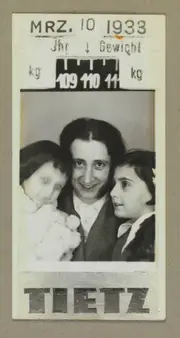
    In Munich SA auxiliary police beat the Jewish lawyer Michael Siegel, who had come to complain about a client’s arrest, and marched him barefoot through the streets with a placard round his neck. In Essen Göring declared that he would not let the police become ‘a protective force for Jewish department stores’, and SA men forced department stores to close in Mönchengladbach. Hitler told the SA and SS that the ‘national uprising’ was now to be directed from above and that harassment and disruption of business must stop. The trade unions appealed to Hindenburg. In Frankfurt, Edith Frank and her daughters had their picture taken in a department-store photo booth.

  24. Day 41 Saturday 11 March 1933

    Cabinet agrees a propaganda ministry; SA drive Jewish lawyers from Breslau’s courts

    At Hitler’s insistence the cabinet agreed to create a Reich Ministry for Popular Enlightenment and Propaganda, expected to go to Goebbels. On the eve of Remembrance Day and the Prussian local elections, SA men and crowds forced department stores and chain stores to close in Hamburg, Breslau, Frankfurt and other cities, and in Breslau SA men ordered Jewish judges and lawyers out of the courts. Magdeburg’s mayor and union leaders in Bochum were taken into ‘protective custody’ (Schutzhaft, imprisonment without trial). Hitler spoke at a rally broadcast from Berlin, and in Cologne a play about front-line soldiers had its first local performance.

  25. Day 45 Wednesday 15 March 1933

    Cabinet plans the Enabling Act; police and SA raid Berlin’s artists’ colony

    The cabinet discussed how to pass an enabling law: Interior Minister Frick counted the deputies needed for a two-thirds majority and suggested that Communists might be put in labour camps. Police and SA auxiliaries sealed off the artists’ colony in Wilmersdorf, searched flats and arrested fourteen people, while Goebbels told the press that its task was to ‘instruct’. In the auction rooms, Kändler’s Meissen porcelain birds went under the hammer at what a reporter called crisis prices.

  26. Day 48 Saturday 18 March 1933

    Emergency decrees speed up treason trials and withdraw the four-pfennig coin

    Hindenburg signed two emergency decrees: one shortened procedure in treason cases, the other bundled financial, economic and legal measures, including a reform of the coinage that withdrew the four-pfennig piece. Goebbels opened the exhibition ‘Die Frau’ at the Kaiserdamm halls, Schacht spoke on the radio as the new Reichsbank president, and Frick banned the Soviet papers Izvestia and Pravda. Berlin and Potsdam were declared closed airspace for the day of the Reichstag’s opening.

  27. Day 50 Monday 20 March 1933

    Himmler announces the first concentration camp, at Dachau; cabinet adopts the Enabling Act

    At a midday press briefing in Munich, Heinrich Himmler announced that a concentration camp for 5,000 Communist, Reichsbanner and Social Democratic functionaries would open near Dachau on Wednesday. In Berlin Hitler met Centre Party leaders and the cabinet approved the final text of the Enabling Act, which went to the Reichstag as a bill. Berlin renamed Reichskanzlerplatz after Hitler, Jewish prosecutors were barred from courtrooms, Robert Siodmak’s last German film opened, and the publisher Louis Ullstein died.

  28. Day 51 Tuesday 21 March 1933

    The Day of Potsdam: the new Reichstag opens in the Garrison Church

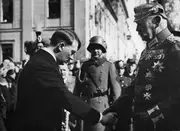
    The new Reichstag was opened with a state ceremony in Potsdam’s Garrison Church, where Hindenburg and Hitler spoke above the tombs of the Prussian kings. In the afternoon the deputies met in Berlin’s Kroll Opera House and re-elected Göring as president, and in the evening a torchlight procession filled the city centre while Wagner’s Meistersinger was performed at the State Opera. The same day Hindenburg signed decrees creating special courts, punishing ‘malicious’ criticism of the government and amnestying crimes committed for the ‘national uprising’.

  29. Day 52 Wednesday 22 March 1933

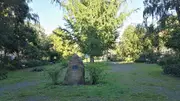
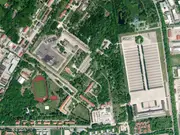
    First prisoners arrive at Dachau as the new Prussian Landtag meets

    The first transports of prisoners reached the new concentration camp at Dachau, set up on the grounds of a disused powder and munitions factory. In Berlin the Prussian Landtag opened under its 84-year-old Nazi senior member, who called it ‘the Landtag of the Hitler spring’, and a Reichstag committee changed the rules so that absent deputies could be counted as present. The decrees on ‘malicious attacks’ and special courts were published, and the Deutschlandsender began using the Garrison Church carillon as its interval signal.

  30. Day 53 Thursday 23 March 1933

    The Reichstag passes the Enabling Act; only the Social Democrats vote against

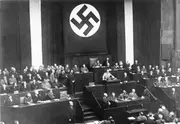
    In the Kroll Opera House, ringed by the SS and watched from inside by armed SA men, the Reichstag passed the Enabling Act, giving Hitler’s government the power to make laws without parliament. Otto Wels explained the Social Democrats’ ‘no’; the Centre and the smaller middle parties voted yes. The former Prussian interior minister Karl Severing was arrested on his way into the building, and the Reichsrat gave its consent that evening.

  31. Day 57 Monday 27 March 1933

    New York rallies against Nazi antisemitism; Berlin gives the party a free hand

    In New York more than 20,000 people packed Madison Square Garden, with tens of thousands more in the streets outside, to protest against the persecution of Jews in Germany. In Berlin the government let it be known that it would not obstruct the Nazi party’s planned ‘defence’ against foreign ‘atrocity propaganda’, and named a boycott of Jewish shops as one of its means. Meanwhile Kruckenberg’s rebuilt rail Zeppelin glided into Berlin and shoppers were warned about dearer margarine.

  32. Day 59 Wednesday 29 March 1933

    Retroactive death-penalty law signed; Ufa resolves to part with its Jewish staff

    Back from Munich, Hitler told his ministers that the boycott of Jewish businesses had to be organised, and the cabinet discussed the bill to ‘coordinate’ the states. A law dated this day made the death penalty retroactive, clearing the way to hang the alleged Reichstag arsonist. In the film world the censors banned Fritz Lang’s Das Testament des Dr. Mabuse, and Ufa’s board decided in principle to end its contracts with Jewish employees.

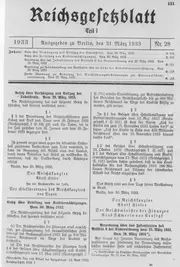
  33. Day 61 Friday 31 March 1933

    First coordination law dissolves state parliaments; SA drives Jewish judges from courts

    The Reich government enacted the provisional law to ‘coordinate’ the states with the Reich, dissolving every state parliament except Prussia’s and refilling them by the Reichstag vote without new elections. In Berlin crowds and SA men forced Jewish judges and lawyers out of the courts, and that evening Kerrl ordered Jewish judges in Prussia to take leave. Goebbels announced that the boycott would start next morning. In the cinemas Lamprecht’s Spione am Werk opened, and Erich Pommer left Ufa.

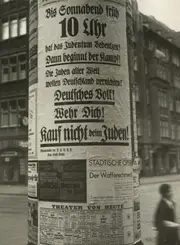
  34. Day 62 Saturday 1 April 1933

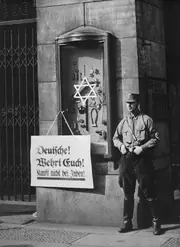
    Nazi boycott of Jewish shops, doctors and lawyers: SA pickets stand across Germany

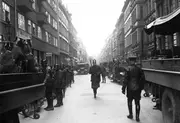
    At 10:00 SA and SS men took up posts outside Jewish-owned shops, department stores, surgeries and law offices throughout Germany, carrying placards reading ‘Germans! Defend yourselves! Don’t buy from Jews!’. In Berlin some 60,000 to 70,000 SA men were deployed; Tietz, Wertheim and Israel shut their doors, and only a small quota of Jewish lawyers was readmitted to the courts. In Kiel the Jewish lawyer Friedrich Schumm was murdered in police custody. The flags also flew for Bismarck’s birthday, and Viktoria 89 won a football final.

  35. Day 65 Tuesday 4 April 1933

    Boycott called off; Hindenburg asks Hitler to spare Jewish war veterans

    The government announced that the boycott would not be resumed, claiming it had silenced the foreign ‘agitation’. Hindenburg wrote to Hitler that Jewish judges and lawyers who had been wounded in the war should not be dismissed, and the cabinet adopted a law extending the death penalty for political violence and a ban on slaughter without stunning. Police sealed off Berlin’s Jewish Scheunenviertel; the Jüdische Rundschau told its readers to wear the ‘yellow badge’ with pride. The rail Zeppelin ran to Hamburg at 130 km/h.

  36. Day 66 Wednesday 5 April 1933

    Hitler Youth takes over the youth associations; the Rotter brothers ambushed in exile

    The Hitler Youth occupied the offices of the Reich Committee of German Youth Associations in Berlin, and Baldur von Schirach took over its leadership. Einstein wrote to the Prussian Academy rejecting its charges; Hitler answered Hindenburg on the Jewish veterans and spoke to the farmers’ council; Kerrl told Jewish notaries to stop working. In Liechtenstein the Berlin theatre impresarios Alfred and Fritz Rotter were ambushed; Alfred and his wife fell to their deaths. Prussia ordered a strict Good Friday.

  37. Day 68 Friday 7 April 1933

    Civil Service law purges Jews and opponents; Reich governors take over the states

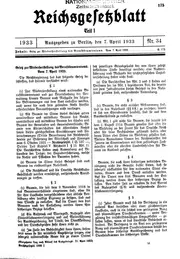
    In a cabinet session lasting into the night, Hitler’s government adopted the law ‘for the Restoration of the Professional Civil Service’, which forced officials ‘not of Aryan descent’ into retirement and allowed political opponents to be dismissed, and a second coordination law placing Reich governors over the states. Berlin’s new Special Court gave its first sentence, a year in prison for a Jewish market trader. Unemployment was reported down by 337,000 in a fortnight, and Berlin radio chose a Nazi fighting song for its interval signal.

  38. Day 69 Saturday 8 April 1933

    Hitler addresses the SA in the Sportpalast; the clairvoyant Hanussen is found shot dead

    Before almost 18,000 SA and SS men in the Sportpalast, and by radio to the rest of the country, Hitler called the storm troopers the unshakeable fighting troop of the ‘national revolution’. The Civil Service law came into force, and Berlin’s bar commissioner published the list of only 35 Jewish lawyers still allowed into the city’s courts. The body found near Baruth was identified as that of the clairvoyant Erik Jan Hanussen, and the publisher of the Berliner Tageblatt gave up the running of the Mosse house.

  39. Day 72 Tuesday 11 April 1933

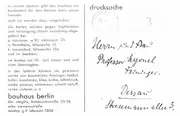
    Police and SA search and seal the Bauhaus in Berlin-Steglitz

    Police and SA searched the Bauhaus school in its converted telephone factory in Berlin-Steglitz, sealed the building and arrested 32 students; the school never taught there again. The first implementing ordinance of the Civil Service law defined anyone with a single Jewish grandparent as ‘non-Aryan’, Göring was named Prussian Minister President, and the SS took over the Dachau camp. Newspapers printed Goebbels’s reply to the conductor Wilhelm Furtwängler, who had objected to artists such as Bruno Walter being driven from the platform, and most Jewish members of the Berlin club Tennis Borussia left it.

  40. Day 73 Wednesday 12 April 1933

    SS guards murder Jewish prisoners at Dachau, the camp’s first killings

    On the second day of SS control at Dachau, guards led away four Jewish prisoners and shot them: Rudolf Benario, Ernst Goldmann and Arthur Kahn died, Erwin Kahn survived for four days. The same day the German Student Union opened its month-long ‘Action against the Un-German Spirit’, Prussia ruled that only students of ‘German descent’ could belong to the student body, and Theodor Lewald stood down as head of German sport. In cinemas, Frank Wisbar’s film Anna und Elisabeth had its premiere.

  41. Day 77 Sunday 16 April 1933

    Easter: Erwin Kahn dies of his Dachau wounds; Munich publishes its attack on Thomas Mann

    Early on Easter Sunday Erwin Kahn, the one survivor of the Dachau shootings of 12 April, died under guard in a Munich clinic, killed by force to his larynx. The Easter edition of the Münchner Neueste Nachrichten carried the ‘Protest of the Richard Wagner City of Munich’ against Thomas Mann, signed by more than forty people including Richard Strauss, and the satirical weekly Simplicissimus was brought into line. Protestant pulpits in Prussia read out a message welcoming the ‘new Germany’; in Berlin, burglars cleared out the C&A store on Königstraße, and a gusty wind troubled the Easter air show at Tempelhof.

  42. Day 79 Tuesday 18 April 1933

    Bavaria reports 5,400 people taken into ‘protective custody’ since 9 March

    A semi-official statement from Munich put the number of people taken into ‘protective custody’ (imprisonment without trial) in Bavaria since 9 March at about 5,400, of whom some 1,630 had been released, partly after Cardinal Faulhaber asked for fathers to be freed for Easter. In Rome, Göring spoke at a broadcast celebration of Hitler’s coming birthday held in his and Papen’s honour, and in Lugano Thomas Mann received the Munich ‘protest’ that settled his decision not to return. The deaths were announced of Albrecht von Graefe, a former völkisch member of the Reichstag, and of Count Dietlof von Arnim-Boitzenburg, the last president of the Prussian House of Lords.

  43. Day 82 Friday 21 April 1933

    Kosher slaughter banned across the Reich; Hess named Hitler’s deputy in the party

    A Reich law banning the slaughter of animals without prior stunning, and with it Jewish ritual slaughter, was signed and published, and Hitler named Rudolf Hess his deputy in the NSDAP. In Berlin the Reichskanzlerplatz became Adolf-Hitler-Platz, the university’s rector objected to the students’ anti-Jewish theses, and police officials put the number of Communists in custody at 18,000; in Freiburg, Heidegger was elected rector. On the Rot-Weiss courts the visiting King of Sweden played doubles with Daniel Prenn, Germany’s leading player, whom the press already expected to be replaced in the Davis Cup team.

  44. Day 87 Wednesday 26 April 1933

    Göring’s Prussia creates the Secret State Police Office, the Gestapo

    A Prussian law dated 26 April set up the Secret State Police Office (Geheimes Staatspolizeiamt, Gestapa) under Göring as interior minister, separating political policing from the ordinary administration; Rudolf Diels led it. The same day the Social Democrats held a Reich conference in their group’s rooms in the Reichstag building and elected Otto Wels and Hans Vogel as chairmen. Goebbels toured the Ufa film studios at Neubabelsberg, and in Munich Arno Penzias, a future Nobel laureate, was born into a Jewish family.

  45. Day 88 Thursday 27 April 1933

    Seldte joins the Nazi Party; ex-deputy Albert Funk dies in police custody

    In an evening radio address the Stahlhelm leader and Reich Labour Minister Franz Seldte announced that he was joining the Nazi Party and placing himself under Hitler. In Recklinghausen the Communist former Reichstag deputy Albert Funk died after interrogation and abuse at police headquarters. Hitler asked towns to stop renaming historic streets after him, and at Berlin Zoo a small boy lost his forearm to a bear.

  46. Day 89 Friday 28 April 1933

    SA and SS given their own disciplinary law; Wolfgang Köhler’s protest appears in print

    The cabinet passed and published a one-sentence law putting SA and SS men under a disciplinary code to be issued by Hitler as supreme SA leader, approved the return of military courts and turned the aviation commissariat into a ministry for Göring. In the Deutsche Allgemeine Zeitung the psychologist Wolfgang Köhler defended his dismissed Jewish colleagues in what was later called the last openly anti-Nazi article published in Germany. Frick named von Tschammer und Osten Reich Sports Commissioner, and the Reichsbahn showed off a road trailer that could carry railway wagons to the door.

  47. Day 90 Saturday 29 April 1933

    Hindenburg watches Göring christen the giant Junkers airliner at Tempelhof

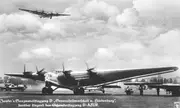
    In bright sunshine at Tempelhof airport, Göring christened a new four-engined Junkers airliner “Generalfeldmarschall von Hindenburg” in front of the President, on his first visit to the airport. The Interior Ministry ordered German merchant ships to fly the swastika flag from 1 May, the new Secret State Police Office took over the power to ban Berlin newspapers, and Göring founded an Air Defence League. Goebbels inspected the stands going up on the Tempelhofer Feld for Monday’s rally.

  48. Day 93 Tuesday 2 May 1933

    SA and SS occupy the trade union offices across Germany; union leaders arrested

    At ten in the morning, the day after the “Day of National Labour”, SA and SS men occupied every building of the free trade unions in Germany, together with their newspapers and their bank. Theodor Leipart, Peter Graßmann and other leaders were taken into “protective custody”, the unions’ property was seized and Nazi commissioners took over. In Duisburg four union officials were murdered. The Hoppegarten racecourse opened its season the same afternoon.

  49. Day 94 Wednesday 3 May 1933

    The remaining union federations submit to Hitler; Göring defines the Gestapo’s powers

    Ley announced that the Christian trade unions, the Hirsch-Duncker union ring and other employees’ federations had placed themselves unconditionally under Hitler and his action committee. A circular from Göring set out the new Secret State Police Office’s tasks and its headquarters at Prinz-Albrecht-Straße 8, and the Berlin daily Tägliche Rundschau was banned until the end of May. The German National People’s Party renamed itself the “German National Front”. In Berlin a football play-off ended 3–3 after extra time.

  50. Day 97 Saturday 6 May 1933

    Students ransack Magnus Hirschfeld’s Institute for Sexual Science

    On Saturday morning about a hundred students of the Berlin College of Physical Education, with a brass band and SA students, occupied and wrecked Magnus Hirschfeld’s Institute for Sexual Science and carted off its books and archives for burning. Student squads went on to purge Berlin’s public lending libraries. The Centre Party elected the former Chancellor Brüning as its leader in place of Prelate Kaas, and the censors passed the Joseph Schmidt film “Ein Lied geht um die Welt”.

  51. Day 99 Monday 8 May 1933

    Goebbels tells Germany’s theatre directors what the “revolution” expects of the stage

    In the evening Goebbels spoke to theatre directors and actors from across Germany at the Hotel Kaiserhof, with Göring present; the upheaval, he said, was not only political but reached into every area of public life. In Breslau the left-wing lawyer Ernst Eckstein was murdered in the Dürrgoy concentration camp, and in Halle booksellers gave their “word of honour” not to sell blacklisted authors. The Reich Sports Commissioner spoke on all German radio stations, a gas explosion wrecked a house in Zehlendorf, and Gandhi began a three-week fast.