Day 82 of 100
Kosher slaughter banned across the Reich; Hess named Hitler’s deputy in the party
A Reich law banning the slaughter of animals without prior stunning, and with it Jewish ritual slaughter, was signed and published, and Hitler named Rudolf Hess his deputy in the NSDAP. In Berlin the Reichskanzlerplatz became Adolf-Hitler-Platz, the university’s rector objected to the students’ anti-Jewish theses, and police officials put the number of Communists in custody at 18,000; in Freiburg, Heidegger was elected rector. On the Rot-Weiss courts the visiting King of Sweden played doubles with Daniel Prenn, Germany’s leading player, whom the press already expected to be replaced in the Davis Cup team.

The slaughter law was framed as a rule about stunning animals before slaughter, the one thing Jewish religious law on slaughter (shechita) did not allow. For decades Jewish representatives of every tendency had defended kosher slaughter as protected by religious freedom; Saxony had banned it on 22 March and Baden and other states followed in early April. From 1 May the Reich law ended kosher slaughter throughout Germany, a deep intervention in the religious life of Jewish communities presented as animal protection.
Laws and decrees
Gesetz über das Schlachten von Tieren
Law on the Slaughter of Animals
Banned the slaughter of animals without prior stunning, and with it Jewish ritual slaughter (Schächten), which religious law requires to be carried out without stunning, throughout the Reich. Signed and published on 21 April, it came into force on 1 May 1933. An implementing ordinance on the slaughter of animals of the same date appeared in the same issue.1,2
Politics and power
Government, terror and persecution
-
Government Munich
Rudolf Hess becomes ‘Deputy of the Führer’
Hitler appointed Rudolf Hess as ‘Deputy of the Führer’ (Stellvertreter des Führers) in the party leadership. The NSDAP’s leaders were gathering in Munich for a conference that opened with a meeting of the Gauleiters the same morning.3,5
-
Terror Berlin
18,000 Communists in custody, police officials say
Senior officials of the political department of the Prussian Interior Ministry told journalists that 12,000 Communists were held in ‘protective custody’ (Schutzhaft, imprisonment without trial) in Prussia and 18,000 across the Reich, nearly all former party leaders among them, and that they expected Communist propaganda to be wiped out within a year. In Württemberg the state criminal police reported that of about 3,000 people taken into custody, over 1,000 had been released after short detention, and some 400 of the more than 2,000 taken to the Heuberg camp had been freed at Easter.4,5
-
Propaganda Berlin-Charlottenburg
Reichskanzlerplatz renamed Adolf-Hitler-Platz
With the consent of the Prussian state ministry and after hearing the mayor, the Berlin police president renamed the Reichskanzlerplatz in Charlottenburg ‘Adolf-Hitler-Platz’. In the same days towns such as Bad Oeynhausen and Bad Kösen made Hitler an honorary citizen.5
-
Persecution Berlin, Friedrich-Wilhelms-Universität, Unter den Linden
Berlin’s rector objects to the theses poster
When representatives of the German Student Union asked to hang the poster of the twelve theses ‘against the un-German spirit’ in the vestibule of the Berlin university, the rector, Professor Kohlrausch, refused permission because of two theses: ‘When the Jew writes German, he lies’ and the demand that Jewish works appear only in Hebrew. The students put the poster up anyway; Kohlrausch said he would ask the minister whether it should be taken down.6
-
Government Freiburg im Breisgau
Heidegger elected rector at Freiburg
At the University of Freiburg the rector elected the previous December, Professor von Möllendorff, resigned ‘of his own free decision’ and proposed Professor Heidegger as his successor ‘in view of the great tasks’ facing the universities in the ‘national uprising’ (nationale Erhebung, the Nazis’ name for their takeover). The plenary assembly agreed by a large majority.7
-
Government Berlin
Hitler back in Berlin; lunch with the King of Sweden
Hitler arrived at the Anhalter Bahnhof at 9.20 am on the scheduled train from Munich. At 12.45 he and Hindenburg were to lunch with King Gustaf V of Sweden at the Swedish legation, and in the afternoon Hindenburg received him to discuss pending questions, probably the appointment of Reich governors in the smaller states. Papen handed over his powers as Reich Commissioner for Prussia to Göring, who was given a ceremonial welcome at Tempelhof on landing from Italy at 2.15 pm.8,5
Everyday life
What else was happening in Germany
-
Sport afternoon, Berlin-Grunewald, Rot-Weiss tennis club
‘Mr G.’ and Daniel Prenn beat von Cramm on the Rot-Weiss courts
During a few hours in Berlin on his travels, the elderly, tennis-loving King Gustaf V of Sweden, who played under the name ‘Mr G.’, played a practice doubles on the Rot-Weiss courts on Friday afternoon. With Daniel Prenn as his partner he beat the Berlin pair Gottfried von Cramm and Dr H. Kleinschroth 6–2, 5–7, 6–2. The Hamburger Fremdenblatt had written the day before that Germany’s Davis Cup team could only hope to succeed if it found an equal replacement for Prenn.4,9
-
Crime night, Berlin
Boxer Erwin Volkmar shot dead
The Berlin professional boxer Erwin Volkmar, a former amateur champion of Brandenburg, was shot in the stomach during what the press called a non-political street quarrel in the night to Friday, and died a few hours later in the hospital at Buckow.4
-
Society morning, Berlin, Invalidenfriedhof
Richthofen remembered at the Invalidenfriedhof
On the fifteenth anniversary of the death of the fighter pilot Manfred von Richthofen, the Ring of German Aviators laid a wreath at his grave in the Invalidenfriedhof, where an honour guard of its members and of SA, SS and Stahlhelm flying squads stood until evening, joined by a Reichswehr delegation.5
-
Economy morning
A 50,000-mark ticket in the state lottery
In the morning draw of the first class of the state class lottery, two prizes of 50,000 marks fell on ticket no. 297,501.5
Elsewhere in the world
-
United States
Luther presents his credentials; MacDonald arrives
The new German ambassador, Dr Luther, was received by President Roosevelt and told him that the German revolution was the expression of a deep spiritual movement and that the Reich government stood for world peace. Prime Minister MacDonald arrived in Washington and spoke to the press at Roosevelt’s desk about the world economic crisis.5
In Berlin today
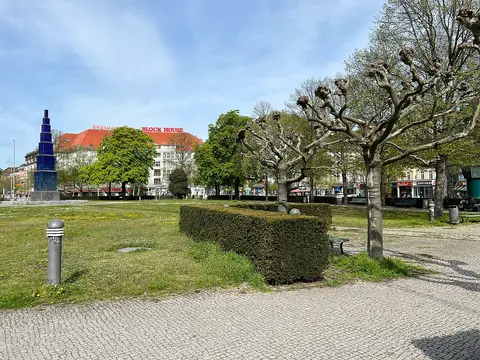

Theodor-Heuss-Platz (Adolf-Hitler-Platz 1933–1945)
Theodor-Heuss-Platz, 14052 Berlin-Westend
- Then
- The Reichskanzlerplatz, laid out in 1906 in the new Neu-Westend district, was renamed Adolf-Hitler-Platz, as announced on 21 April 1933. It was later meant to mark the western end of the east–west axis planned for Hitler’s ‘world capital Germania’.5,10
- Today
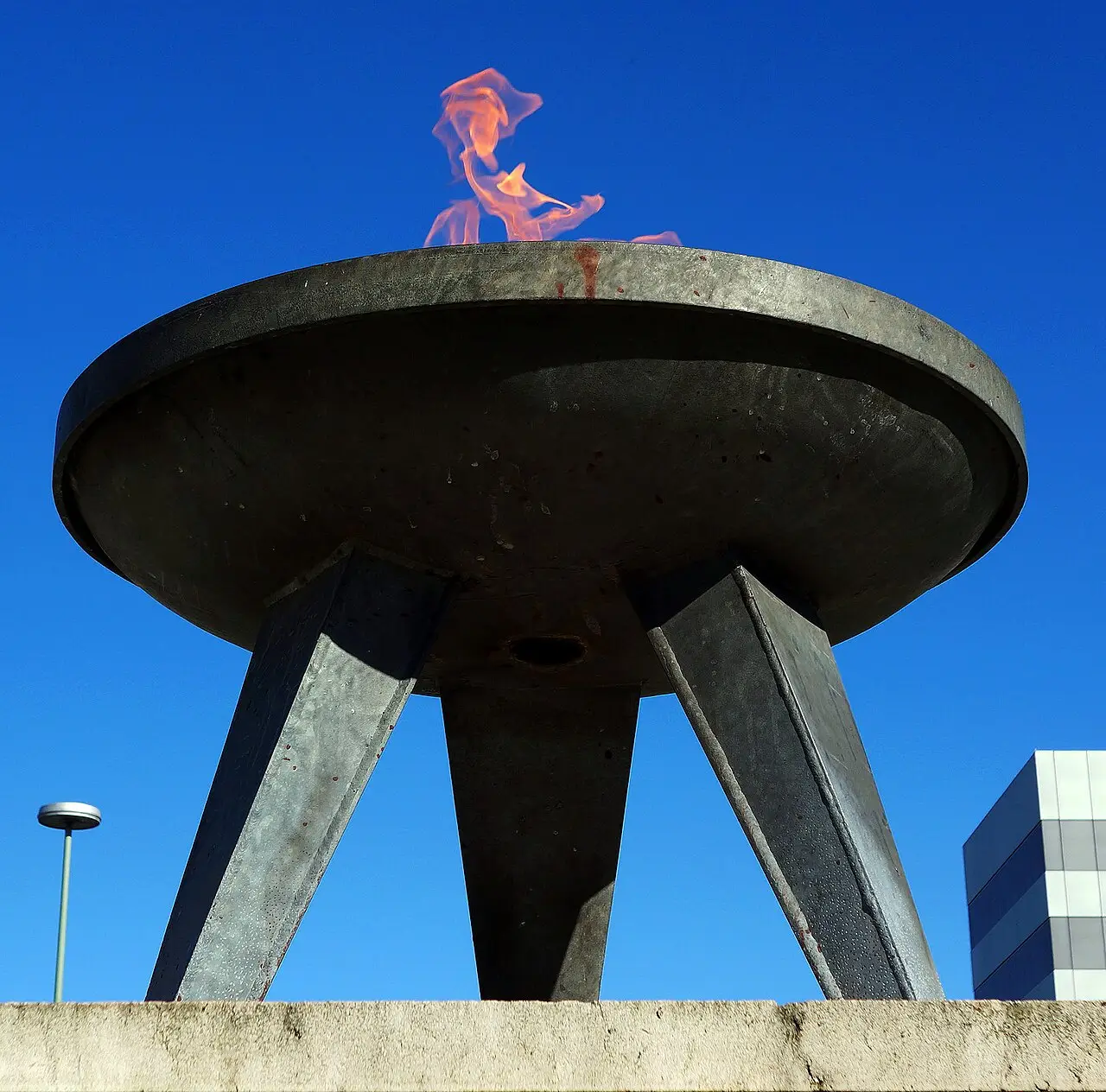
- In 1963, after the death of Theodor Heuss, Berlin renamed it Theodor-Heuss-Platz. Since 1955 an ‘Eternal Flame’ has burned there for the victims of flight and expulsion; Heuss inaugurated the memorial.
More pictures


Sources
- Rundbrief der Vereinigung traditionell-gesetzestreuer Rabbiner Deutschlands zum rituellen Schlachten Jüdisches Museum Berlin, Online-Schaukasten 1933
- Deutscher Reichsanzeiger und Preußischer Staatsanzeiger, 24 April 1933 Deutsche Digitale Bibliothek, Zeitungsportal (Universitätsbibliothek Mannheim), p. 2, notice on Reichsgesetzblatt Part I No. 39, issued 21 April 1933
- Rudolf Heß (biography) Deutsches Historisches Museum, LeMO, 1933: '21. April: Ernennung zum „Stellvertreter des Führers“'
- Hamburger Fremdenblatt, 22 April 1933 Deutsche Digitale Bibliothek, Zeitungsportal, p. 11 (political police on Communists in custody); p. 12 ('Schwedens König spielte in Berlin'; 'Erwin Volkmar †')
- Kölnische Zeitung, 22 April 1933 Deutsche Digitale Bibliothek, Zeitungsportal, Morning edition, p. 1 (Hindenburg receives Hitler; Papen; Göring's return), p. 2 (Württemberg; 'München, 21. April': NSDAP leaders' conference), p. 3 ('Adolf-Hitler-Platz in Berlin'), p. 4 (Richthofen; lottery); evening edition, p. 11 (Luther; MacDonald)
- Deutsche Reichs-Zeitung (Bonn), 26 April 1933 Deutsche Digitale Bibliothek, Zeitungsportal, p. 1, 'Die 12 Thesen' (statement by Rector Kohlrausch, Berlin, 25 April, on 'last Friday')
- Durlacher Tagblatt, 22 April 1933 Deutsche Digitale Bibliothek, Zeitungsportal, p. 2, 'Freiburg, 21. April' (rectorship)
- Kölnische Zeitung, 21 April 1933 Deutsche Digitale Bibliothek, Zeitungsportal, Evening edition, p. 7 (Hitler's arrival; lunch with the King of Sweden)
- Hamburger Fremdenblatt, 20 April 1933 Deutsche Digitale Bibliothek, Zeitungsportal, Sports page: Davis Cup prospects ('für Prenn einen geeigneten und gleichwertigen Ersatz')
- Theodor-Heuss-Platz Berliner Zentrum Industriekultur
Spotted a mistake? Send a correction.