Day 39 of 100
Bavaria falls: General von Epp made Reich commissioner over Held’s refusal
After a day of pressure in Munich from Röhm, Gauleiter Wagner and Himmler, and with the Bavarian government refusing their demands, the Reich used the Reichstag Fire Decree to hand the powers of Bavaria’s government to General Ritter von Epp; Württemberg protested to Hindenburg against the same treatment. In Berlin the Reich Chancellery, on Hitler’s behalf, asked Frick to prepare ‘völkisch’ laws against Eastern European Jews. In Washington Roosevelt signed the Emergency Banking Act. Dresden’s opera, its music director just driven out, staged Graener’s Friedemann Bach.
_NAC,_Poland_PD.jpg)
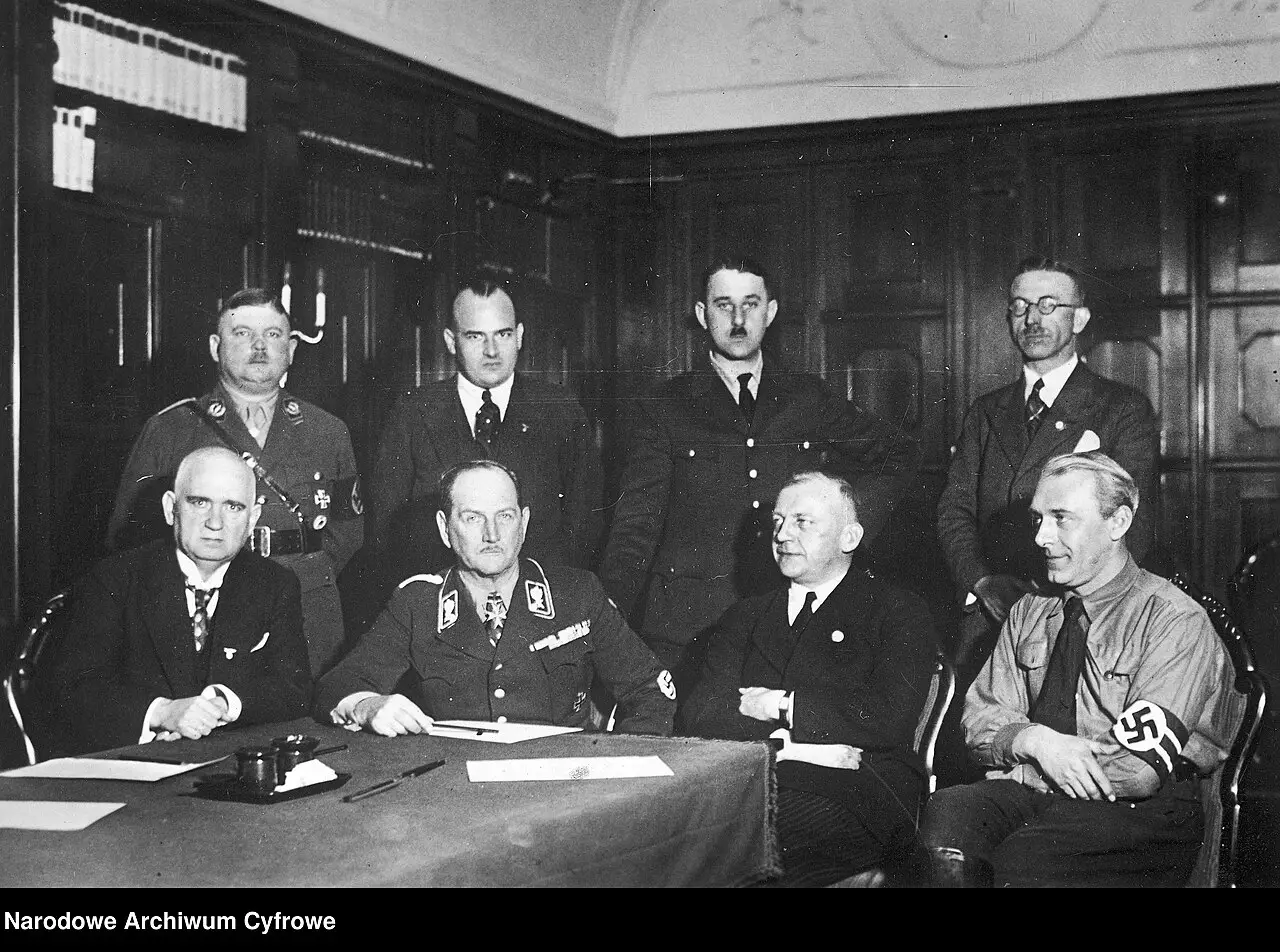
Bavaria was the last large state whose police and government had not yet been taken over. On 9 March the Nazi leaders in Munich forced the issue. When Minister-President Held, after hours of telephone calls between Munich and Berlin, would not give way to their demands, the Reich interior minister transferred the powers of the Bavarian state authority to General von Epp under paragraph 2 of the Reichstag Fire Decree, a decision reportedly taken after Hitler and Papen had reported to Hindenburg. Held telegraphed a protest to Hitler. On the same day Württemberg’s government complained to the President that the decree was being used against a state where there had been no Communist violence at all.
Politics and power
Government, terror and persecution
-
The states 13:00 to evening, Munich; Berlin
Epp appointed Reich commissioner for Bavaria
At 13:00 the Bavarian SA chief of staff Röhm, Gauleiter Wagner and the Reichsführer-SS Himmler called on Minister-President Held; the Bavarian cabinet then met, and at 16:30 Röhm and General von Epp went to Held together. A compromise by which Held himself would have named Epp general state commissioner was dropped because the Bavarian People’s Party would not accept it, and the Nazi demands were rejected. The Reich then transferred the powers of the supreme state authority in Bavaria to Epp under the Reichstag Fire Decree; the decision was reported to have been taken after Hitler and Papen had seen Hindenburg. Held protested by telegram to Hitler.1
-
Persecution Berlin, Reich Chancellery
Hitler asks for ‘völkisch’ laws against Eastern European Jews
On Hitler’s instructions, State Secretary Lammers sent Frick, in a personal and confidential letter, proposals from State Secretary Bang that ‘the time has now come’ to prepare ‘consciously völkisch legislation’: a law against the continuing immigration of Eastern European Jews, justified if possible on grounds of population policy and public health; the reversal of all changes of name made since November 1918; and the expulsion of at least some of the Eastern European Jews who had immigrated without being naturalised.2
-
The states Stuttgart
Württemberg protests to Hindenburg
The Württemberg government telegraphed Hindenburg that the appointment of the Reichstag deputy von Jagow as Reich commissioner was an obvious breach of his own decree: there had been no Communist violence in the state, the only disturbances since election day had been caused by Nazi demonstrations, it had not even been consulted, and it had already set about forming a new government in line with the election result.3
-
Propaganda Frankfurt am Main
Frick welcomes the Centre’s support
Speaking in Frankfurt am Main, Frick said the government would gladly accept the Centre party’s readiness to support it, especially in passing changes to the constitution.1
Everyday life
What else was happening in Germany
-
Music 20:30, Dresden
Friedemann Bach at the Dresden State Opera
Two days after Fritz Busch had been whistled off its podium, the Dresden State Opera gave its first performance of Paul Graener’s Friedemann Bach, an opera closely bound up with Dresden in its subject, which some thirty theatres had already staged; curtain-up was put back to 20:30. The same day the actor Alexis Posse took over the running of the Saxon state theatres ‘on behalf of the party leadership of the NSDAP’; the Intendant Alfred Reucker was dismissed, and whether Busch went on conducting was left ‘to him’.4,5,6
-
Theatre Berlin
Max Alsberg’s Konflikt comes to Berlin
Konflikt, a play by the celebrated Berlin defence lawyer Max Alsberg asking whether an advocate may seek the acquittal of a client he believes guilty, was announced for its Berlin premiere on 9 March with Albert Bassermann and Tilla Durieux.7,8
Elsewhere in the world
-
United States
The Emergency Banking Act
Congress passed and Roosevelt signed in the night, in the presence of Treasury Secretary Woodin, an emergency banking law that senators had had only two hours to study. Its stated purpose was to weed out unsound banks and let the sound ones reopen; senators called it revolutionary, but the conservative Senator Glass, author of the Federal Reserve Act, gave it his full approval.1
More pictures

Sources
- Hamburger Fremdenblatt, Reichsausgabe, Nr. 69, 10 March 1933 Deutsche Digitale Bibliothek, Zeitungsportal, p. 1: 'Tagesschau', 'Roosevelts Kampf gegen die Banken', 'Neuer Rechtszustand in Bayern'
- Akten der Reichskanzlei. Regierung Hitler 1933–1945, Bd. I: Nr. 50, Staatssekretär Lammers an den Reichsminister des Innern, 9. März 1933 Historische Kommission bei der Bayerischen Akademie der Wissenschaften / Bundesarchiv, Band I, pp. 182–183
- Akten der Reichskanzlei. Regierung Hitler 1933–1945, Bd. I: Nr. 51, Das Württembergische Staatsministerium an den Reichspräsidenten, Stuttgart, 9. März 1933 Historische Kommission bei der Bayerischen Akademie der Wissenschaften / Bundesarchiv, Band I, pp. 184–185
- Dresdner Nachrichten, Abendausgabe, 9 March 1933 Deutsche Digitale Bibliothek, Zeitungsportal, p. 2, 'Mitteilungen der Sächsischen Staatstheater'
- Dresdner neueste Nachrichten, 11 March 1933 Deutsche Digitale Bibliothek, Zeitungsportal, p. 2, review 'Graeners Friedemann Bach'
- Hamburger Fremdenblatt, Reichsausgabe, Nr. 69, 10 March 1933 (page 3) Deutsche Digitale Bibliothek, Zeitungsportal, p. 3, announcement of the Saxon state theatres
- Hannoverscher Kurier, Morgen-Blatt, 9 March 1933 Deutsche Digitale Bibliothek, Zeitungsportal, p. 6, theatre notes
- Kölnische Zeitung, 14 March 1933 Deutsche Digitale Bibliothek, Zeitungsportal, p. 2, 'Berliner Theater: Max Alsberg, Konflikt'
Spotted a mistake? Send a correction.