Day 14 of 100
“Bloody Sunday” in Eisleben: SA and SS storm Communist premises, killing three
In the mining town of Eisleben, in Prussian Saxony, some 600 SA and SS men on a “propaganda march” stormed the local Communist headquarters and a workers’ sports hall, killing three Communists; an SS man also died. In Berlin about 5,000 officials of the Iron Front heard the trade union leader Peter Graßmann warn that a war of annihilation had been declared on the Republic. Sunday crowds of 65,000 filled the motor show, and the radio carried Leipzig’s commemoration of Richard Wagner.
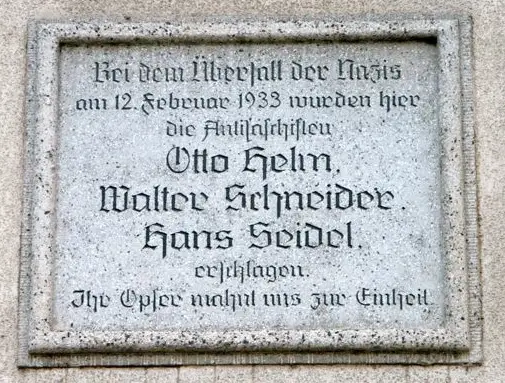

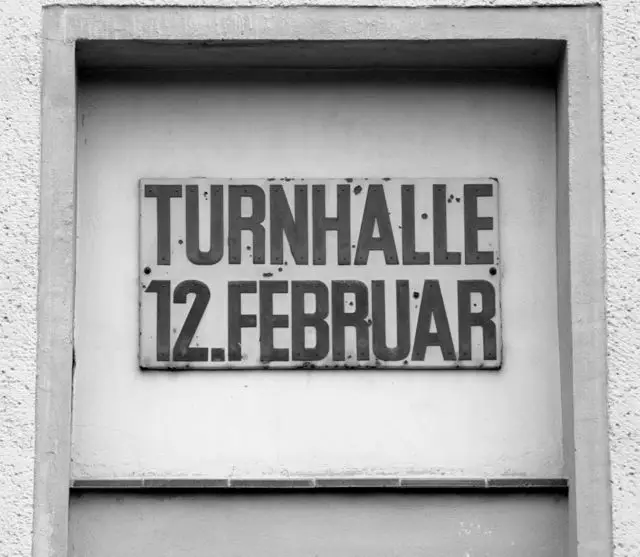
Eisleben, a mining and industrial town in the Mansfeld district of the Prussian province of Saxony, was a stronghold of the Socialists and Communists. On 12 February about 600 SA and SS men marched through the town and stormed the building the KPD called its “House of Class Struggle” and the gymnasium of the workers’ sports club. Three workers and KPD members, Hans Seidel, Walter Schneider and Otto Helm, were killed by gunfire and blows from spades. The SS man Paul Berck was also killed, by Eduard Rechner on the stairs of the Communist building. The NSDAP turned Berck into a “blood witness” (Blutzeuge, the party’s term for its dead), renamed the building the “Paul-Berck-Haus” and named many streets after him; thousands of National Socialists attended his funeral.
The official inquiry was inconsistent from the start, later claiming that Communists had first fired from the roof. In March 1933 the senior prosecutor closed it, finding no evidence of a planned Communist attack on the march, but the justice ministry pressed for prosecution of the Communists and for their imprisonment in “protective custody” (Schutzhaft, detention without trial). Only Rechner was tried, for manslaughter; he was imprisoned and later sent to the Mauthausen and Dachau concentration camps. In August 1949 the regional court in Halle, under Soviet occupation law, tried former members of the SA, SS and police for the attack, with sentences ranging from one year to life.
Politics and power
Government, terror and persecution
-
Terror Eisleben, Breiter Weg 30 and the workers' gymnasium
SA and SS attack in Eisleben
About 600 SA and SS men on a “propaganda march” through Eisleben stormed the KPD’s offices at Breiter Weg 30 and the gymnasium of the workers’ sports club. The Communists Hans Seidel, Walter Schneider and Otto Helm were shot or beaten to death with spades; the SS man Paul Berck was killed in the stairwell of the KPD building. The local police chief afterwards reported intercepting Communist post to suppress the party.1
Sources disagree. Nazi accounts claimed the Communists fired first from the roof; the public prosecutor found no proof of a planned Communist attack and closed the case in March 1933.
-
Opposition morning, Berlin, Clou
Iron Front leaders’ assembly at the Clou
The Berlin leadership of the Iron Front held a morning assembly of some 5,000 officials of the unions, the Reichsbanner, the SPD and the workers’ sports clubs in the Clou hall. After a minute’s silence for the victims of the Neunkirchen explosion, the chairman of the Berlin trade union council recalled the workers killed in recent weeks, and Peter Graßmann of the General German Trade Union Federation (ADGB) spoke.2
Everyday life
What else was happening in Germany
-
Transport Berlin, exhibition halls at the Funkturm
65,000 at the motor show
On its first Sunday the motor show in the exhibition halls by the radio tower drew 65,000 visitors by closing time at 20:00, despite an admission charge of two marks. Many came by car or coach from the provinces, from Saxony, Hamburg and Pomerania to Upper Silesia and the Rhineland.3
-
Sport evening, Berlin, Sportpalast
Metze wins the Sportpalast Grand Prix
The second meeting of motor-paced racing in the Sportpalast, this time with four riders in each heat, drew a slightly larger crowd than the premiere a week earlier. Metze of Dortmund won the Grand Prix of the Sportpalast over three 20-kilometre heats, ahead of Möller, Sawall and Lohmann, who survived a heavy fall in a pursuit race unhurt.2
-
Music Leipzig and Berlin
A Wagner Sunday
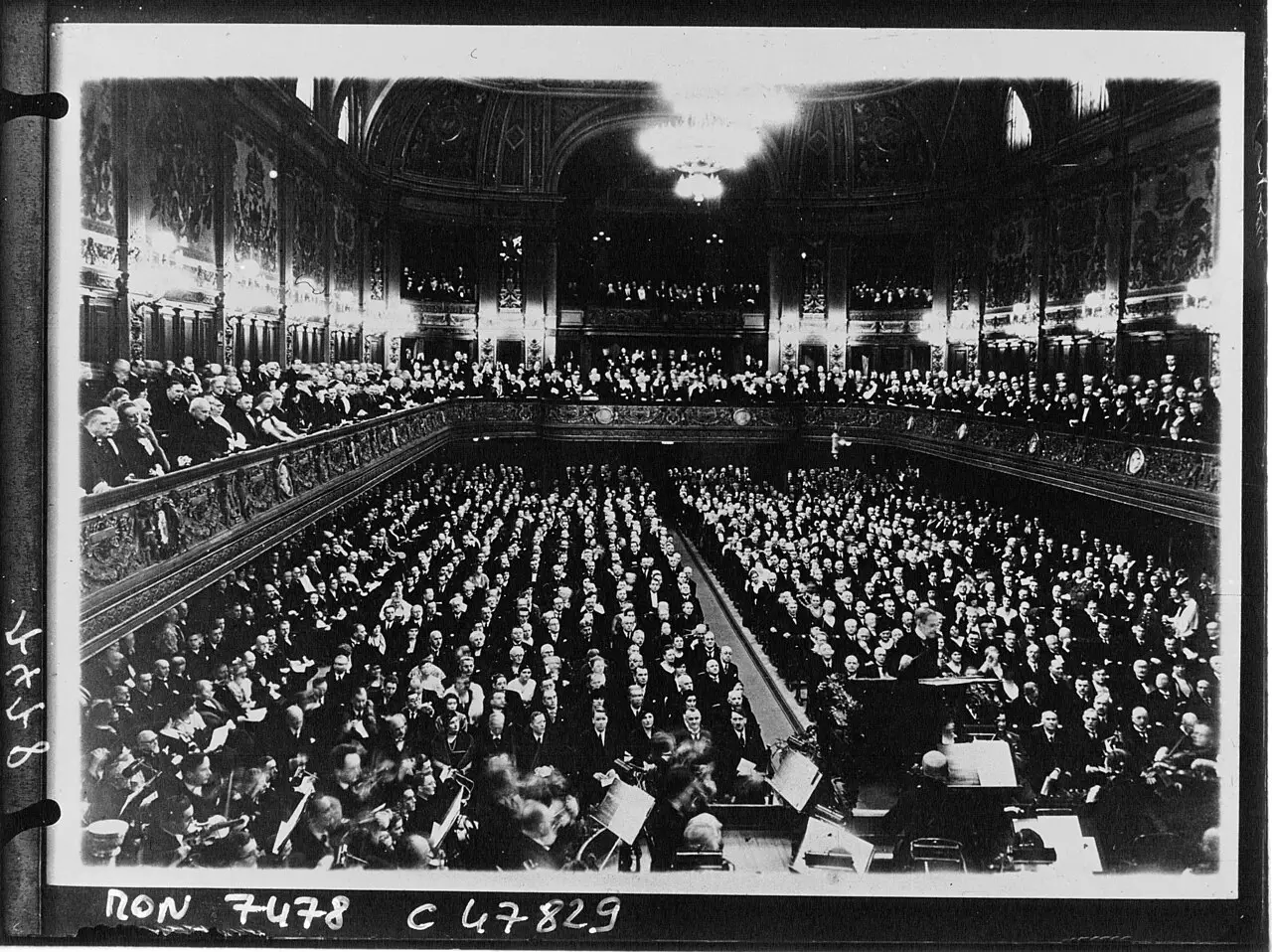
The weekly radio programme printed in the Vorwärts listed a Richard Wagner commemoration relayed from Leipzig at noon, and the Berlin State Opera announced a new production of Tannhäuser for the Sunday. The dancers Lotte Goslar and Erika Lindner were advertised for a matinee at 11:30 at the Theater am Bülowplatz.4,5,6
Voices
War to the point of annihilation has been declared on republican and democratic Germany, and above all on its working people.
More pictures


Sources
- Machtübernahme und frühe NS-Verbrechen: „Eisleber Blutsonntag“ (Geschichte erleben, Heft 1) Landesarchiv Sachsen-Anhalt, chapter 1, introduction and sources Q 1a–b
- Vorwärts, Abendausgabe Nr. 74, 13 February 1933 Deutsche Digitale Bibliothek, Zeitungsportal, p. 2, 'Eiserne Front steht! Der Führerappell im Clou'; p. 6, 'Metze guter Sieger bei den Steherrennen im Sportpalast'
- Vorwärts, Morgenausgabe Nr. 75, 14 February 1933 Deutsche Digitale Bibliothek, Zeitungsportal, p. 7, '65000 Besucher auf der Autoschau'
- Vorwärts, Morgenausgabe Nr. 73, 12 February 1933 Deutsche Digitale Bibliothek, Zeitungsportal, p. 14, weekly radio programme (Sunday 12.00: 'Aus Leipzig: Richard-Wagner-Gedächtnisfeier')
- Vorwärts, Abendausgabe Nr. 72, 11 February 1933 Deutsche Digitale Bibliothek, Zeitungsportal, p. 4, theatre week ('Erstaufführungen Sonntag. Staatsoper: Tannhäuser')
- Vorwärts, Morgenausgabe Nr. 59–63, 7 February 1933 Deutsche Digitale Bibliothek, Zeitungsportal, p. 16, advertisement for the dance matinee of Lotte Goslar and Erika Lindner, Sunday 12 February, Theater am Bülowplatz
Spotted a mistake? Send a correction.