Day 42 of 100
Hindenburg puts the swastika beside black-white-red; Hitler orders ‘blindest discipline’
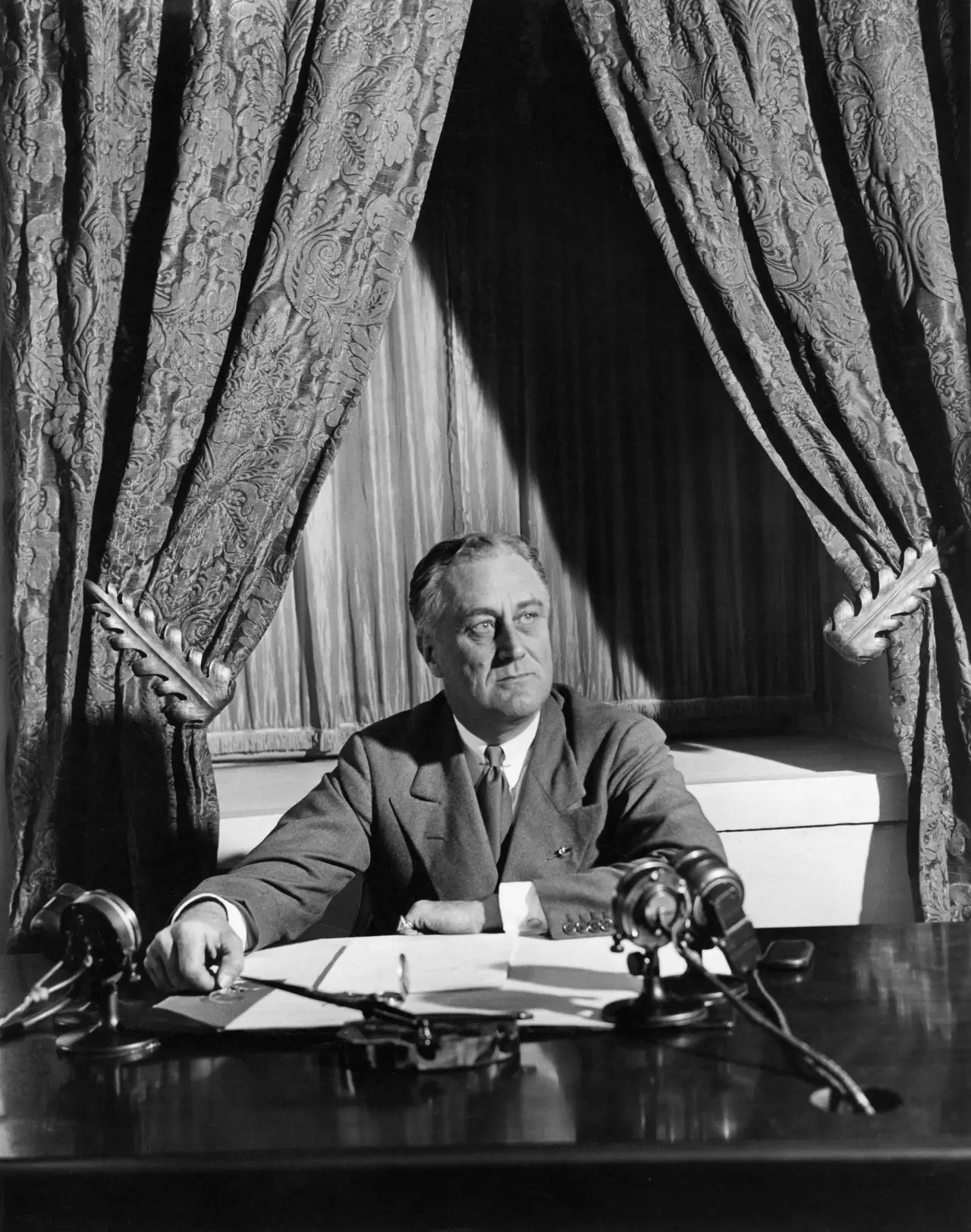
On Remembrance Day, with black-white-red flags at half-mast, Hindenburg decreed that from the next day the old imperial flag and the swastika flag were to be flown together on public buildings. Hitler announced the decree on the radio and told the SA and SS that the struggle to ‘cleanse’ the Reich would now be directed from above and that all individual actions must stop. Hindenburg and Hitler attended the Volksbund ceremony in the State Opera in Berlin. In Prussia’s municipal and provincial elections the government parties won majorities in most places, including Berlin. In Washington Roosevelt gave his first fireside chat.
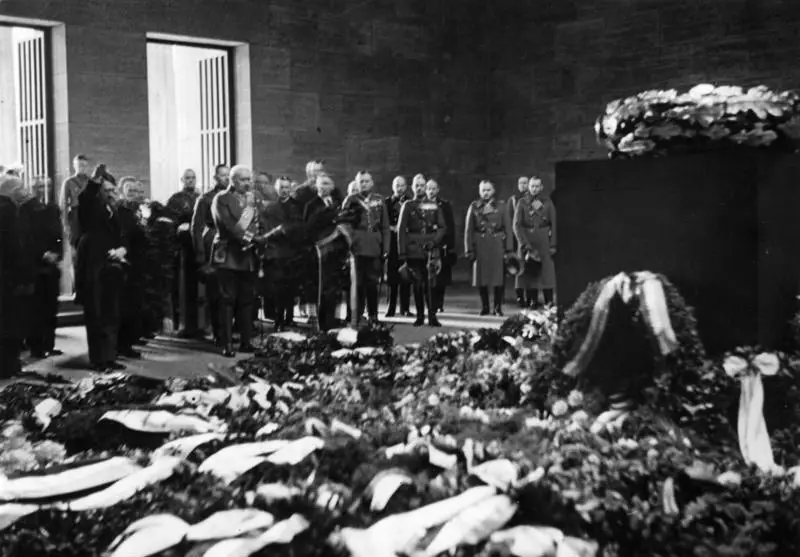

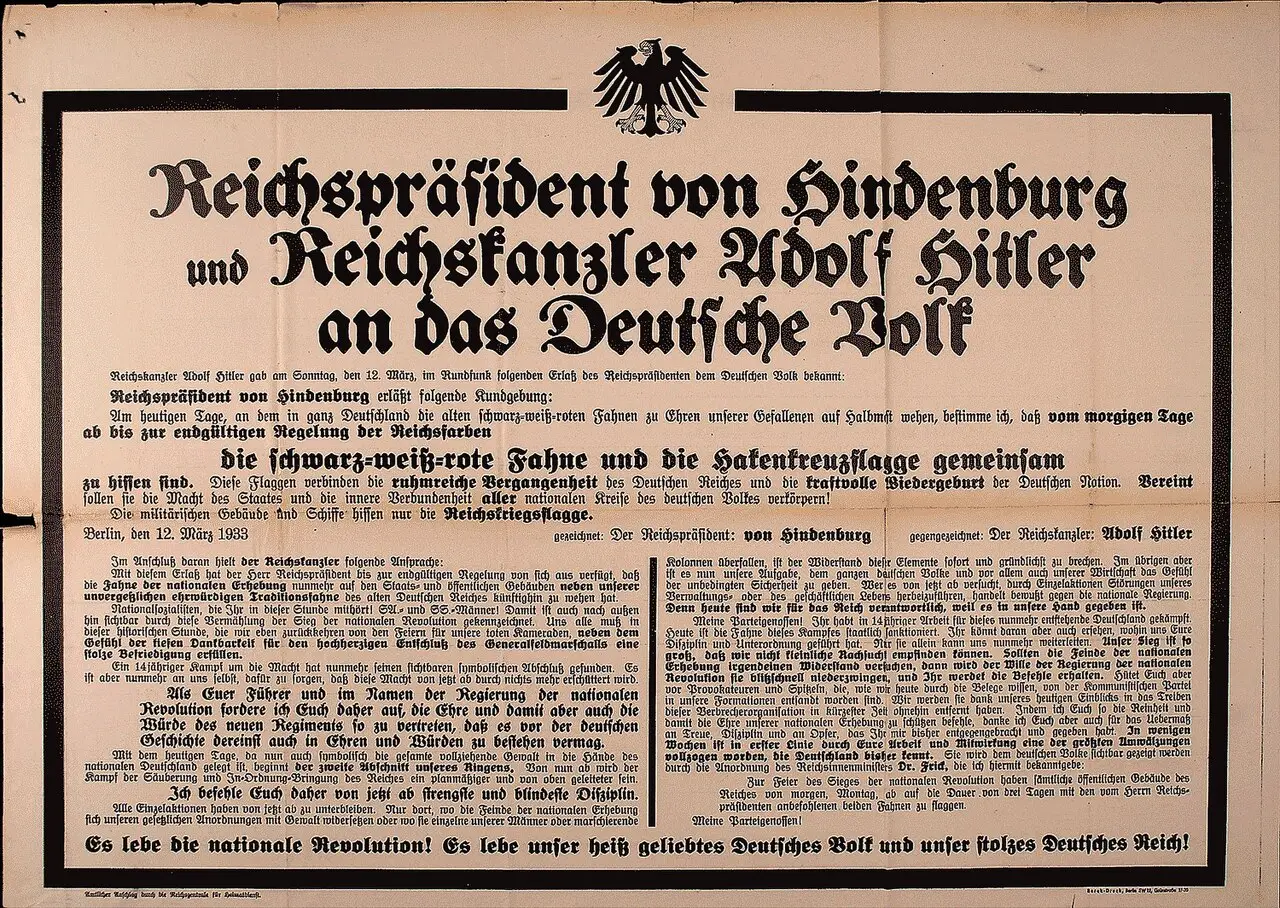
The government used Remembrance Day (Volkstrauertag), the annual day of mourning for the dead of the First World War, to stage its own symbolic victory. The Reich’s public buildings flew the black-white-red flag of the Empire at half-mast, and Hindenburg’s decree, read out by Hitler on all German stations at 14:00, made the swastika banner a flag of the state alongside it until the Reich colours were finally settled. Hitler declared that the fourteen-year struggle for power had now reached its ‘visible, symbolic conclusion’, that the whole of the executive power had passed into the hands of ‘national Germany’, and that a second phase of planned ‘cleansing’ directed from above was beginning. The same day’s Prussian local elections carried the result of 5 March down into town halls and provincial assemblies.
Laws and decrees
Erlaß des Reichspräsidenten über die vorläufige Regelung der Flaggenhissung
Flag Decree (provisional regulation of the hoisting of flags)
Ordered that from 13 March, until the Reich colours were finally settled, the black-white-red flag and the swastika flag were to be hoisted together; military buildings and ships were to fly only the Reich war flag. The decree claimed the two flags joined ‘the glorious past’ of the Reich with the ‘powerful rebirth’ of the nation. Announced by Hitler on the radio on 12 March and published in the Reichsgesetzblatt on 17 March.1,2
Politics and power
Government, terror and persecution
-
Propaganda 12:00, Berlin, State Opera and war memorial Unter den Linden
Remembrance Day in the State Opera
The Volksbund Deutsche Kriegsgräberfürsorge, the war graves commission, held its central commemoration this year in the State Opera Unter den Linden instead of the Reichstag. At 12:00 Hindenburg, in field marshal’s uniform, arrived with the cabinet and sat in the former imperial box beside Hitler, Blomberg, Göring, Papen and Frick; Goebbels and Lieutenant-Colonel Duesterberg were among the other guests, and Reichswehr soldiers with regimental colours, SA men and Stahlhelm members stood on the stage. After a minute’s silence, ‘Ich hatt’ einen Kameraden’ and the tattoo, the ceremony ended with the Deutschlandlied. Tens of thousands outside cheered Hindenburg and Hitler; Hindenburg inspected the honour company and the nationalist associations and laid a wreath in the war memorial nearby.3,2
-
Propaganda 14:00, Berlin; Munich
Hitler: ‘strictest and blindest discipline’
At 14:00 Hitler read Hindenburg’s flag decree over all German stations and then addressed Nazi party members, SA and SS. The swastika’s place on state buildings, he said, marked the victory of the ‘national revolution’; with the whole executive power now in the hands of ‘national Germany’, the struggle to cleanse the Reich and put it in order would be planned and directed from above. He ordered an end to all individual actions except where opponents resisted by force, said business and administration must feel completely secure, and warned against provocateurs he claimed the Communists had sent into Nazi formations. In the afternoon he arrived in Munich, where the commissarial Bavarian government gave him a formal welcome.2
-
Election Prussia; Berlin; Cologne
Prussia’s local and provincial elections
Prussia elected its town and district councils and provincial assemblies. Turnout was lower than on 5 March, and the Communists lost most heavily. According to the press, the two government lists, the Nazis and the German Nationalists’ Black-White-Red Front, won absolute majorities in the great majority of Prussian towns and provinces; in Berlin they gained a majority of one seat, their vote rising from 1.3 to 1.36 million while the Communists lost 229,000 votes, the Social Democrats 82,000 and the Centre about 28,000. The Nazis won absolute majorities in the provincial assemblies of Brandenburg and Lower Silesia, but in Westphalia and the Rhine Province the Centre kept its key position. In Cologne the city council majority of the Centre and the Social Democrats was broken.2,4,3
Everyday life
What else was happening in Germany
-
Society Hamburg
Remembrance Sunday in Hamburg
The day dawned over Hamburg with bright sun and a blue spring sky, and flags flew at half-mast or draped in black crape. Church bells called thousands to morning services at 10:00, and Ohlsdorf cemetery saw an unusually large stream of mourners carrying wreaths and spring flowers until late in the afternoon. At 14:30 the Volksbund’s Hamburg ceremony at the cemetery’s war graves drew the Stahlhelm, the SA, veterans’ associations and First Mayor Krogmann, while eight aircraft of Hamburg’s flying clubs circled overhead and dropped a wreath.2
-
Sport Hamburg
Trollmann against Hartkopp
At a Sunday boxing matinee in Hamburg, the Hanover boxer Trollmann, billed as ‘Gipsy’ Trollmann, met Helmuth Hartkopp of Berlin. Trollmann dominated the first round; in the second Hartkopp landed a blow below the belt, Trollmann went down and said he could not continue, and Hartkopp was disqualified. The crowd was angry, and Walter Rothenburg, trying to calm it, announced first that a doctor had found a swelling and then that Trollmann had boxed without the required protective cup. The Hamburger Fremdenblatt’s reporter was openly hostile to Trollmann and called his collapse theatrical.2
-
Theatre 20:00, Dresden, Central-Theater
Last night of Im weißen Rößl in Dresden
The Central-Theater in Dresden gave the musical play (Singspiel) Im weißen Rößl (The White Horse Inn) at 20:00 for the last time, with its premiere cast; no further performances were possible because an Italian touring company had bought the production’s entire sets and costumes.5
Voices
From now on the struggle to cleanse the Reich and bring it into order will be planned and directed from above. I therefore order you from now on to observe the strictest and blindest discipline. All individual actions must cease from now on.
I can assure you that it is safer to keep your money in a reopened bank than under the mattress.
Elsewhere in the world
-
United States
Roosevelt’s first fireside chat
In a radio talk to the American people Roosevelt explained the banking holiday and the new emergency banking law, and announced that sound banks would reopen in stages from Monday, first in the twelve Federal Reserve cities, then in about 250 cities with clearing houses, and then in smaller places. He asked listeners not to be stampeded by rumours, saying confidence mattered more than currency or gold.6
-
Austria
Government by emergency decree in Vienna
After deliberating all Sunday, the Austrian government issued twelve emergency decrees overnight under the war-economy enabling law of 1917. They met long-standing demands of small business, which had been showing growing discontent: new firms were barred from overcrowded trades and chain stores were banned for a limited period.2
In Berlin today
.jpg)
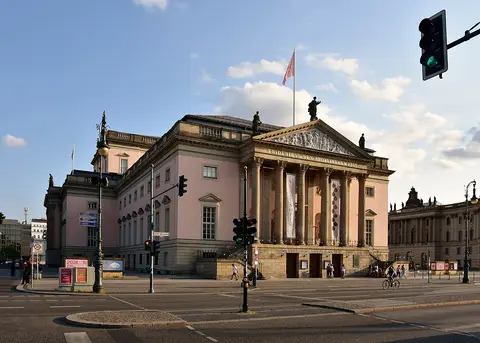
State Opera Unter den Linden
- Then
- At noon the Volksbund’s Remembrance Day ceremony, held here instead of in the Reichstag, was attended by Hindenburg, Hitler and the cabinet, with crowds of tens of thousands outside.3,7
- Today
- Twice destroyed by bombing in the Second World War, the opera house reopened in 1955 and again in autumn 2017 after seven years of reconstruction; it is still home to the Staatsoper Unter den Linden.
.jpg)
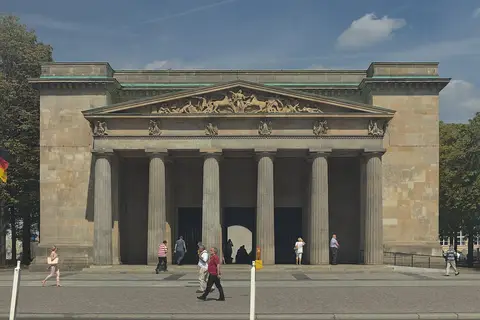
Neue Wache (war memorial Unter den Linden)
Unter den Linden 4, Berlin-Mitte
- Then
- After the ceremony in the State Opera, Hindenburg inspected an honour company and the nationalist associations and laid a wreath in the memorial to the dead of the First World War, set up in Schinkel’s guardhouse in 1931.3,8
- Today
- Since 1993 the Central Memorial of the Federal Republic of Germany for the Victims of War and Dictatorship, with Käthe Kollwitz’s sculpture ‘Mother with her Dead Son’ inside.
More pictures


Sources
- Erlaß des Reichspräsidenten über die vorläufige Regelung der Flaggenhissung (12.03.1933) documentArchiv.de, RGBl. 1933 I, S. 103; note on publication, 17 March 1933
- Hamburger Fremdenblatt, Reichsausgabe, Nr. 72, 13 March 1933 Deutsche Digitale Bibliothek, Zeitungsportal, p. 1 ('Tagesschau'; election results; 'Der Mahnruf des Kanzlers'); p. 2 ('Notverordnungen in Oesterreich'); p. 5 ('Der Volkstrauertag in Hamburg'); p. 8 ('Flaggenkundgebung des Reichspräsidenten. Hitler verbietet Einzelaktionen'); p. 10 (boxing)
- Hamburgischer Correspondent, Abendausgabe, 13 March 1933 Deutsche Digitale Bibliothek, Zeitungsportal, p. 2 (election results); p. 3 ('Volkstrauertag in Berlin')
- Kölnische Zeitung, Abend-Ausgabe, 13 March 1933 Deutsche Digitale Bibliothek, Zeitungsportal, p. 1 (flags on Remembrance Day; Cologne city council election)
- Dresdner neueste Nachrichten, 12 March 1933 Deutsche Digitale Bibliothek, Zeitungsportal, p. 3, 'Mitteilung des Centraltheaters'
- Franklin D. Roosevelt, Fireside Chat on Banking, March 12, 1933 The American Presidency Project, UC Santa Barbara
- Staatsoper Unter den Linden: History Staatsoper Unter den Linden
- Neue Wache Bundeszentrale für politische Bildung
Spotted a mistake? Send a correction.