Day 73 of 100
SS guards murder Jewish prisoners at Dachau, the camp’s first killings
On the second day of SS control at Dachau, guards led away four Jewish prisoners and shot them: Rudolf Benario, Ernst Goldmann and Arthur Kahn died, Erwin Kahn survived for four days. The same day the German Student Union opened its month-long ‘Action against the Un-German Spirit’, Prussia ruled that only students of ‘German descent’ could belong to the student body, and Theodor Lewald stood down as head of German sport. In cinemas, Frank Wisbar’s film Anna und Elisabeth had its premiere.
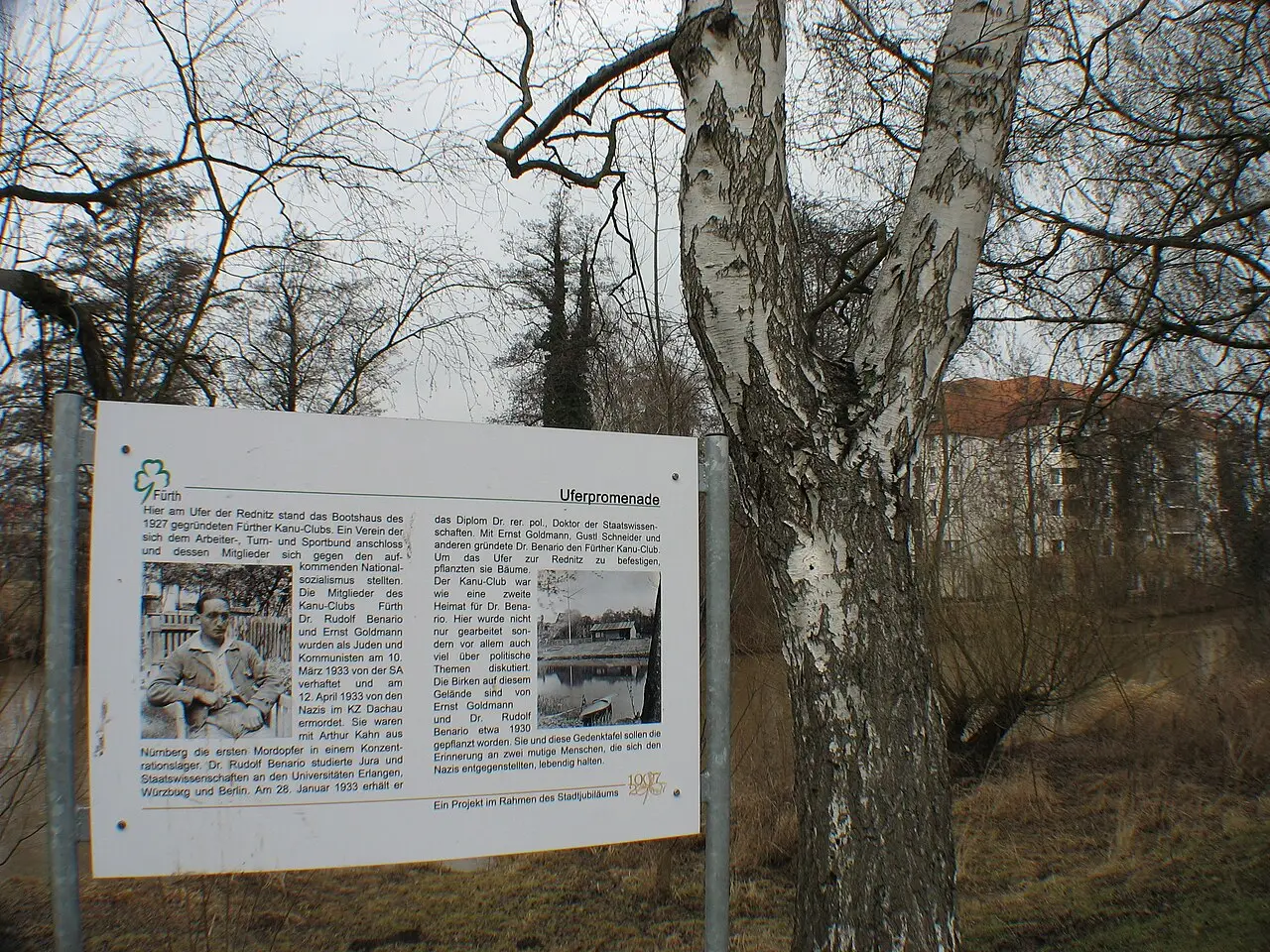

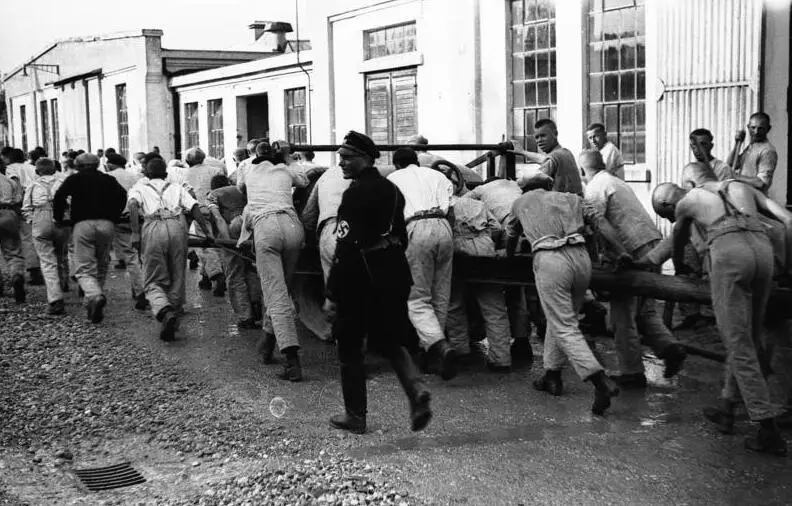
The murders of 12 April were the first killings in the Dachau camp, carried out the day after the SS had taken it over from the Bavarian state police. All four victims were Jewish and had been held as political opponents since March. They spent the morning shovelling refuse under blows from the guards; around midday an SS officer had them led away, the camp sirens sounded, and other prisoners, ordered into their huts, heard shots. Next morning the prisoners were told the four had been ‘shot while trying to escape’, the formula the Bavarian press repeated.
Erwin Kahn, shot twice in the head, survived because a police lieutenant who was present, Emil Schuler, prevented the SS men from firing a final shot, and he was taken to the surgical clinic in Munich. He described what had happened to his wife on 15 April and died early the next morning; the autopsy found he had been killed by force to the larynx, probably strangled by his guards.
Laws and decrees
Gesetz über die Durchführung einer Volks-, Berufs- und Betriebszählung 1933
Law on the Conduct of a Population, Occupational and Business Census in 1933
Ordered a combined population, occupational and business census across the Reich. Dated 12 April, it was published in the Reichsgesetzblatt the following day.9
Politics and power
Government, terror and persecution
-
Terror afternoon, Dachau
Four Jewish prisoners shot at Dachau
SS guards at Dachau separated four Jewish prisoners after a morning of forced labour and beatings, led them away and shot them. Rudolf Benario, 24, a doctor of political science from Fürth; Ernst Goldmann, 24, a trained merchant from Fürth and a member of the KPD; and Arthur Kahn, 21, a medical student at Würzburg, were killed. Erwin Kahn, 32, a Munich insurance agent who had told his family he had never belonged to any party, was gravely wounded. The death certificate for Arthur Kahn gave ‘shot in the head’ at 5 pm.1,2,3,4
Sources disagree. The official version, repeated in the Bavarian press, was that the men had been ‘shot while trying to escape’; the Dachau memorial site and the Munich memorial book treat the killings as deliberate murder.
-
Propaganda
Students open the ‘Action against the Un-German Spirit’
The German Student Union (Deutsche Studentenschaft), dominated since 1932 by the National Socialist students’ league, began a four-week campaign ‘against the un-German spirit’ (wider den undeutschen Geist), planned to run from 12 April to 10 May. Its circulars named ‘the Jewish spirit’ and liberalism as targets, announced that twelve theses would be posted publicly from 13 April, and set out a collection of ‘subversive’ books in the third week, ending with their burning at every university on 10 May.5
-
Persecution Berlin
Prussia restricts the student body to ‘German descent’
A decree issued that day by Rust, the Reich commissioner running the Prussian Ministry of Culture, laid down that only fully enrolled students ‘of German descent and mother tongue’ formed the student body (Studentenschaft) of a university. At matriculation each student had to declare on his word of honour whether his parents and grandparents were of German descent, and the student leader decided on membership.6,7
-
Terror morning, Berlin-Tegel and Borsigwalde
Police raid allotment colonies in Tegel and Borsigwalde
In a surprise operation that morning, the political police, supported by a special police unit and auxiliary police, raided the allotment colonies in Tegel and Borsigwalde in the north of Berlin, areas the press described as largely Communist. The operation was still under way at midday.8
-
Persecution Berlin
Special court sentences a man for an ‘atrocity story’
Berlin’s newly formed special court (Sondergericht) tried several people accused of spreading ‘atrocity stories’ and illegal leaflets. A 25-year-old former KPD member named Grupe had told people in a bar that he had seen an old Jewish man’s beard torn out; he said he had only heard of it and had been drunk, and was sentenced to eight months in prison. Two Communist women from Senftenberg, Frieda Haske and Martha Seelig, were tried for distributing leaflets.7
Everyday life
What else was happening in Germany
-
Sport afternoon, Berlin
Theodor Lewald steps down as head of German sport
At an extraordinary general meeting of the German Reich Committee for Physical Exercise in Berlin, its chairman since 1919, Theodor Lewald, 72, resigned, citing Hitler’s call for a renewal of German associations. Duisburg’s mayor Jarres took the chair, and the meeting adopted a resolution welcoming the ‘national uprising’ (nationale Erhebung, the Nazis’ name for their takeover). The German Gymnastics Federation stayed away. Late in the session the football federation’s chairman, Linnemann, announced that on the government’s instructions no successor was to be elected. Lewald remained head of the organising committee for the 1936 Berlin Olympics.7,8
-
Film
Premiere of Anna und Elisabeth
Frank Wisbar’s feature film Anna und Elisabeth, the story of a farm girl believed to work miracles and the gravely ill landowner who comes to depend on her, had its German premiere. Hertha Thiele played Anna and Dorothea Wieck Elisabeth; the music was by Paul Dessau.10
-
Transport evening, Berlin
Torchlight for Hermann Köhl
On the evening of the fifth anniversary of his east-west flight across the Atlantic, the SA’s Berlin-Brandenburg air squadron held a torchlight procession for the aviator Hermann Köhl, who spoke on comradeship and was then sworn in as a member of the SA.6
-
Economy
Cheaper freight for work-creation projects
The Reichsbahn announced a 20 per cent reduction in freight charges, from 18 April, for all goods carried for projects under the government’s work-creation programme.6
Voices
I assure you once again that I do not know why I have been arrested. I have never in my life belonged to any party.
Elsewhere in the world
-
Soviet Union
Metropolitan-Vickers trial opens in Moscow
Before the Supreme Court in Moscow, in the Trade Union House where the Shakhty trial had been held in 1928, the trial began of 18 defendants, among them British engineers of the Metropolitan-Vickers company, accused of sabotage at power stations. About 300 spectators, including diplomats and foreign journalists, were admitted.6
-
United Kingdom
Labour protest in the Albert Hall
The Labour movement held a national protest meeting in the Royal Albert Hall against fascism and the Hitler government. The Hamburger Fremdenblatt quoted the Morning Post’s claim that the hall was more than half empty. The same evening the President of the Board of Trade, Runciman, announced an Anglo-German trade agreement in the Commons.7
More pictures

Sources
- Häftlinge im Porträt: Rudolf Benario KZ-Gedenkstätte Dachau
- Erwin Elias Kahn Biografisches Gedenkbuch der Münchner Juden 1933–1945, Stadtarchiv München, Biography by Björn Mensing
- Wie der junge Arthur Kahn aus der Semmelstraße das erste Würzburger Todesopfer der Nazis wurde Schreib das auf – Würzburger Geschichten, Section 'Arthur Kahns letzte Stunden'
- Für Rudolf Benario und Ernst Jakob Goldmann Jüdische Allgemeine
- Die Organisation der Aktion „Wider den undeutschen Geist“ verbrannte-buecher.de, Quotations from the DSt circulars of 6 and 8 April 1933
- Kölnische Zeitung, 13 April 1933 Deutsche Digitale Bibliothek, Zeitungsportal, Morning edition, p. 1 (Prussian student law; Moscow trial; Reichsbahn freight); evening edition, p. 9 (Köhl)
- Hamburger Fremdenblatt, 13 April 1933 Deutsche Digitale Bibliothek, Zeitungsportal, p. 2 (student law; Albert Hall); p. 10 ('Lewalds Rücktritt'); p. 13 (trade agreement); p. 16 (special court)
- Hamburger Fremdenblatt, 12 April 1933 Deutsche Digitale Bibliothek, Zeitungsportal, p. 1 (raid in Tegel and Borsigwalde); p. 15 ('Lewald tritt zurück')
- Deutscher Reichsanzeiger und Preußischer Staatsanzeiger, 18 April 1933 Deutsche Digitale Bibliothek, Zeitungsportal (Universitätsbibliothek Mannheim), p. 1, notice on Reichsgesetzblatt Part I No. 38, issued 13 April 1933
- Anna und Elisabeth (1933) filmportal.de (Deutsches Filminstitut & Filmmuseum), Credits; 'Uraufführung (DE): 12.04.1933'
Spotted a mistake? Send a correction.