Day 95 of 100
Purge extended to public employees; SPD leaders decide to set up an office abroad
A second ordinance under the civil service law told public employers to give “non-Aryan” salaried employees and workers one month’s notice. At its first and last full meeting the new SPD executive decided to send Otto Wels, Hans Vogel and other members abroad to build an office in exile. Ley’s committee declared that the “German Labour Front” now stood, Hitler called for a foundation for the families of workers killed at work, and an ADGB leader escaped from “protective custody”.
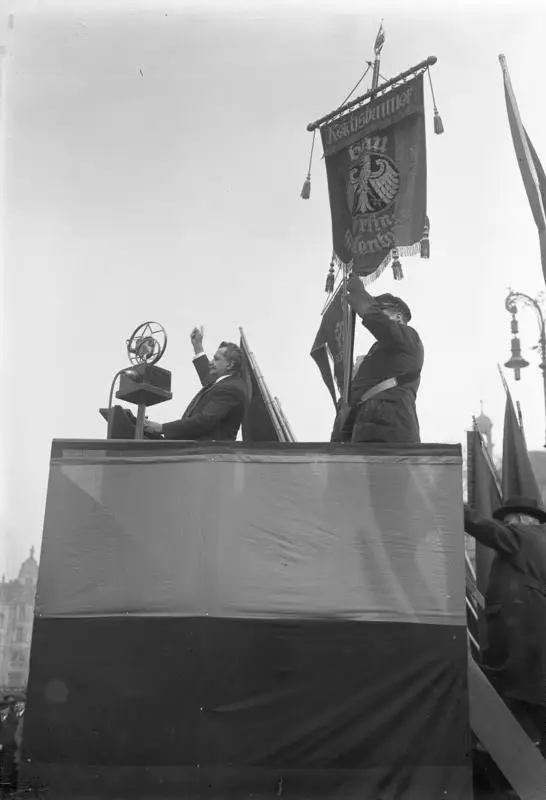

The SPD executive elected on 26 April met for the first and, as it turned out, only time with all its members. It decided to send Siegmund Crummenerl, Paul Hertz, Erich Ollenhauer, Friedrich Stampfer, Hans Vogel and Otto Wels abroad to set up a foreign office of the party, while Berlin was to remain the executive’s seat. The group went first to Saarbrücken. It was the start of the SPD’s leadership in exile.
Laws and decrees
Zweite Verordnung zur Durchführung des Gesetzes zur Wiederherstellung des Berufsbeamtentums
Second implementing ordinance to the Law for the Restoration of the Professional Civil Service
Applied the civil service law to salaried employees and workers in public service: contracts with “non-Aryan” employees to be terminated at one month’s notice, with three months’ pay and then reduced payments; contracts with “unqualified” post-1918 appointees to be ended immediately.1
Politics and power
Government, terror and persecution
-
Persecution
Dismissals extended to public employees and workers
The second implementing ordinance to the civil service law of 7 April extended it to the salaried employees and workers of the Reich, the states, the municipalities and other public bodies. Contracts with “non-Aryan” employees were to be terminated with one month’s notice; contracts concluded after November 1918 with people lacking the usual qualifications could be ended without notice.1
-
Opposition Berlin
SPD leaders decide to go abroad
The new SPD executive decided to send several of its members, among them the chairmen Wels and Vogel, abroad to establish an office of the party there; they went first to Saarbrücken.2
-
Economy Berlin
“The German Labour Front stands”
After the DHV, an employees’ association, joined, Ley’s action committee declared in a statement signed by Biallas that “the German Labour Front stands”. Ley promised in the party press that union members’ benefits and claims were secure.5
-
Opposition
Union leader escapes from custody
The Nazi press reported that Furtwängler, a member of the ADGB’s federal executive, had escaped from “protective custody” in a manner not yet explained; requests for his release had been refused. Another union chairman, Karl Schrader, was released after the new treasurer found his union’s books in order.3
-
Propaganda
Hitler calls for a “Foundation for Victims of Labour”
In an appeal Hitler cited the seven miners killed “on the eve of 1 May” and called for a national foundation to provide for the families of all “soldiers of labour” who died at work.4
-
Foreign policy Berlin
Rosenberg leaves for London
Alfred Rosenberg, head of the Nazi Party’s foreign policy office, left Berlin for London, according to the Völkischer Beobachter.3
Everyday life
What else was happening in Germany
-
Sport
No freelance “coordination” of sport
The Reich Interior Minister reported that efforts were under way all over Germany to bring sports bodies, especially the national federations, into line, and ordered that no such steps be taken without the express consent of the new Reich Sports Commissioner, whose guidelines were to follow.6
-
Transport London, Croydon
The “Hindenburg” airliner in London
Lufthansa’s giant airliner “Generalfeldmarschall von Hindenburg” was reported to have been much admired on its arrival at Croydon; it was to fly first on the Berlin–London route.7
More pictures


Sources
- Zweite Verordnung zur Durchführung des Gesetzes zur Wiederherstellung des Berufsbeamtentums vom 4. Mai 1933 documentArchiv.de, text after RGBl. 1933 I S. 233–235
- Chronik der deutschen Sozialdemokratie, Band 2: Stichtag 4. Mai 1933 Franz Osterroth and Dieter Schuster; electronic edition, Friedrich-Ebert-Stiftung Library
- Weißeritz-Zeitung, 5 May 1933 Deutsche Digitale Bibliothek, Zeitungsportal, p. 4, "Furtwängler aus der Schutzhaft entflohen" and "Rosenberg in London" (Berlin, 4 May)
- Marbacher Zeitung (Bottwartal-Bote), 5 May 1933 Deutsche Digitale Bibliothek, Zeitungsportal, p. 1, "Adolf Hitler will eine Stiftung für Opfer der Arbeit" (Berlin, 4 May)
- Dresdner Nachrichten, early edition, 5 May 1933 Deutsche Digitale Bibliothek, Zeitungsportal, p. 1, "Die deutsche Arbeitsfront steht!" (Berlin, 4 May)
- Gelsenkirchener allgemeine Zeitung, 5 May 1933 Deutsche Digitale Bibliothek, Zeitungsportal, p. 5, the interior minister's announcement on sport
- Der Ammerländer, 5 May 1933 Deutsche Digitale Bibliothek, Zeitungsportal, p. 2, "Das neue Riesenflugzeug im Flugdienst Berlin–London"
Spotted a mistake? Send a correction.