OrdinanceReich Minister of the Interior (Frick) and Reich Minister of Finance (Schwerin von Krosigk), under § 17 of the Civil Service Law
Second Implementing Ordinance to the Civil Service Law
Zweite Verordnung zur Durchführung des Gesetzes zur Wiederherstellung des Berufsbeamtentums
Second Ordinance for the Implementation of the Law for the Restoration of the Professional Civil Service
Carried the Civil Service Law over to the salaried employees and workers of the Reich, the states, the municipalities, other public bodies and publicly owned enterprises, as § 15 of the law allowed. Contracts of ‘non-Aryan’ employees were to be terminated at one month’s notice to the end of a month, with three months’ pay and then three quarters of their pay at most until their ordinary notice would have run out; employees hired after 8 November 1918 without the usual qualifications were to be dismissed without notice; the politically ‘unreliable’ could be dismissed at once. Veterans of the front and those whose fathers or sons had fallen were exempt from the ‘Aryan’ rule. Protections for long-serving staff, works councillors and the severely disabled did not apply, and the courts were barred from reviewing the dismissals.
Dated
Thursday 4 May 1933
Published in
Reichsgesetzblatt Teil I, no. 46, Thursday 4 May 1933, pp. 233–235
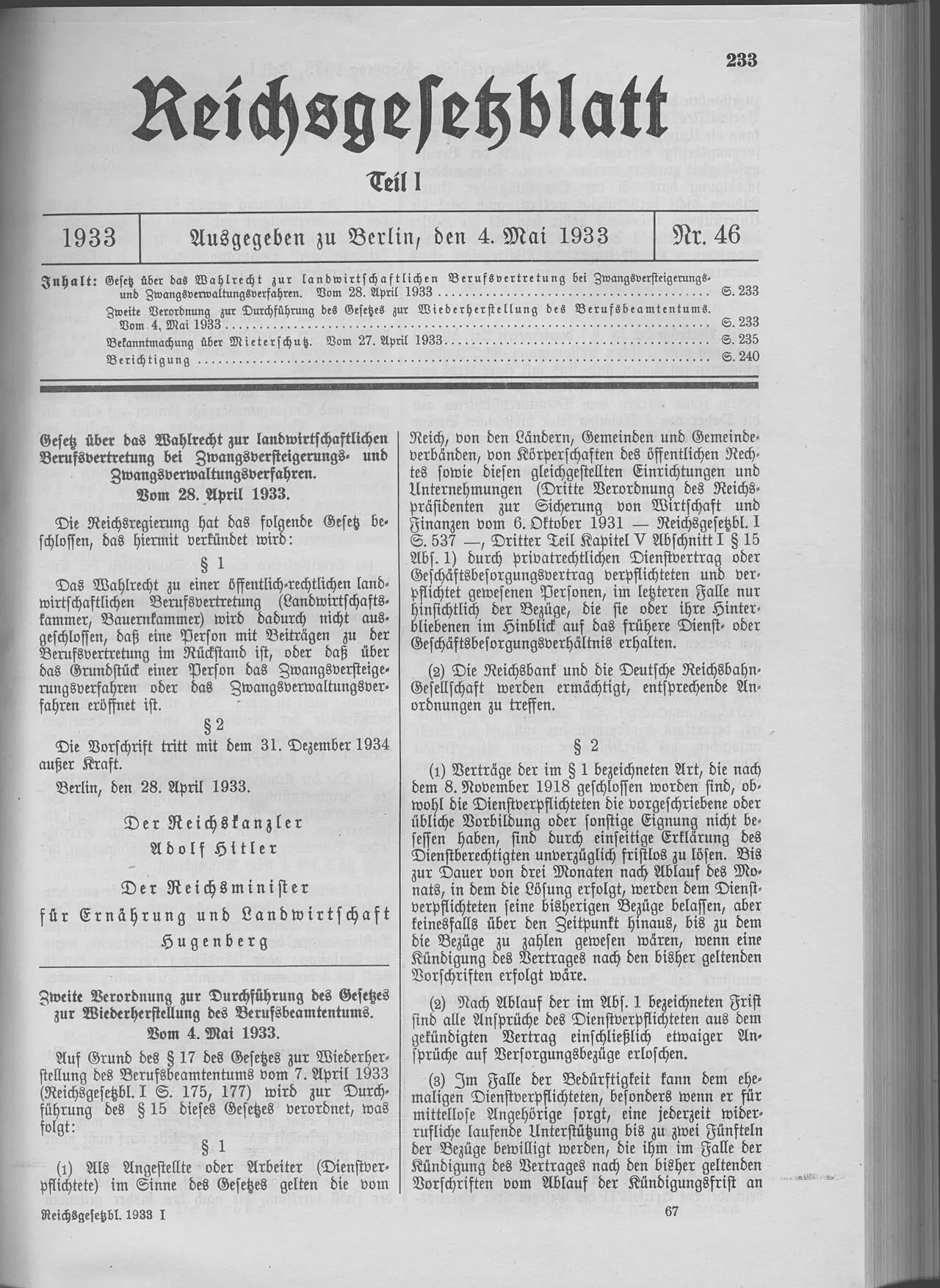
Zweite Verordnung zur Durchführung des Gesetzes zur Wiederherstellung des Berufsbeamtentums.
Second Ordinance for the Implementation of the Law for the Restoration of the Professional Civil Service.
Vom 4. Mai 1933.
Of 4 May 1933.
Auf Grund des § 17 des Gesetzes zur Wiederherstellung des Berufsbeamtentums vom 7. April 1933 (Reichsgesetzbl. I S. 175, 177) wird zur Durchführung des § 15 dieses Gesetzes verordnet, was folgt:
On the basis of § 17 of the Law for the Restoration of the Professional Civil Service of 7 April 1933 (Reichsgesetzbl. I pp. 175, 177), the following is ordained for the implementation of § 15 of that law:
§ 1(1) Als Angestellte oder Arbeiter (Dienstverpflichtete) im Sinne des Gesetzes gelten die vom Reich, von den Ländern, Gemeinden und Gemeindeverbänden, von Körperschaften des öffentlichen Rechtes sowie diesen gleichgestellten Einrichtungen und Unternehmungen (Dritte Verordnung des Reichspräsidenten zur Sicherung von Wirtschaft und Finanzen vom 6. Oktober 1931 — Reichsgesetzbl. I S. 537 —, Dritter Teil Kapitel V Abschnitt I § 15 Abs. 1) durch privatrechtlichen Dienstvertrag oder Geschäftsbesorgungsvertrag verpflichteten und verpflichtet gewesenen Personen, im letzteren Falle nur hinsichtlich der Bezüge, die sie oder ihre Hinterbliebenen im Hinblick auf das frühere Dienst- oder Geschäftsbesorgungsverhältnis erhalten.
§ 1(1) Salaried employees or workers (persons bound to service) within the meaning of the law are persons who are or have been bound by a contract of service or contract for the management of affairs under private law to the Reich, the states, municipalities and associations of municipalities, corporations under public law, and institutions and enterprises treated as equivalent to them (Third Decree of the Reich President for the Securing of the Economy and Finances of 6 October 1931, Reichsgesetzbl. I p. 537, Part Three, Chapter V, Section I, § 15, para. 1); in the latter case, only with regard to the emoluments that they or their surviving dependants receive in respect of the former service or management relationship.
(2) Die Reichsbank und die Deutsche Reichsbahn-Gesellschaft werden ermächtigt, entsprechende Anordnungen zu treffen.
(2) The Reichsbank and the German Reich Railway Company are empowered to make corresponding arrangements.
§ 2(1) Verträge der im § 1 bezeichneten Art, die nach dem 8. November 1918 geschlossen worden sind, obwohl die Dienstverpflichteten die vorgeschriebene oder übliche Vorbildung oder sonstige Eignung nicht besessen haben, sind durch einseitige Erklärung des Dienstberechtigten unverzüglich fristlos zu lösen. Bis zur Dauer von drei Monaten nach Ablauf des Monats, in dem die Lösung erfolgt, werden dem Dienstverpflichteten seine bisherigen Bezüge belassen, aber keinesfalls über den Zeitpunkt hinaus, bis zu dem die Bezüge zu zahlen gewesen wären, wenn eine Kündigung des Vertrages nach den bisher geltenden Vorschriften erfolgt wäre.
§ 2(1) Contracts of the kind described in § 1 that were concluded after 8 November 1918 although the persons bound to service did not possess the prescribed or customary training or other suitability are to be dissolved immediately and without notice by unilateral declaration of the employer. The person bound to service keeps his previous emoluments for up to three months after the end of the month in which the dissolution takes place, but in no case beyond the date up to which the emoluments would have been payable had the contract been terminated under the provisions in force until now.
(2) Nach Ablauf der im Abs. 1 bezeichneten Frist sind alle Ansprüche des Dienstverpflichteten aus dem gekündigten Vertrag einschließlich etwaiger Ansprüche auf Versorgungsbezüge erloschen.
(2) On expiry of the period specified in para. 1, all claims of the person bound to service arising from the terminated contract, including any claims to pension payments, are extinguished.
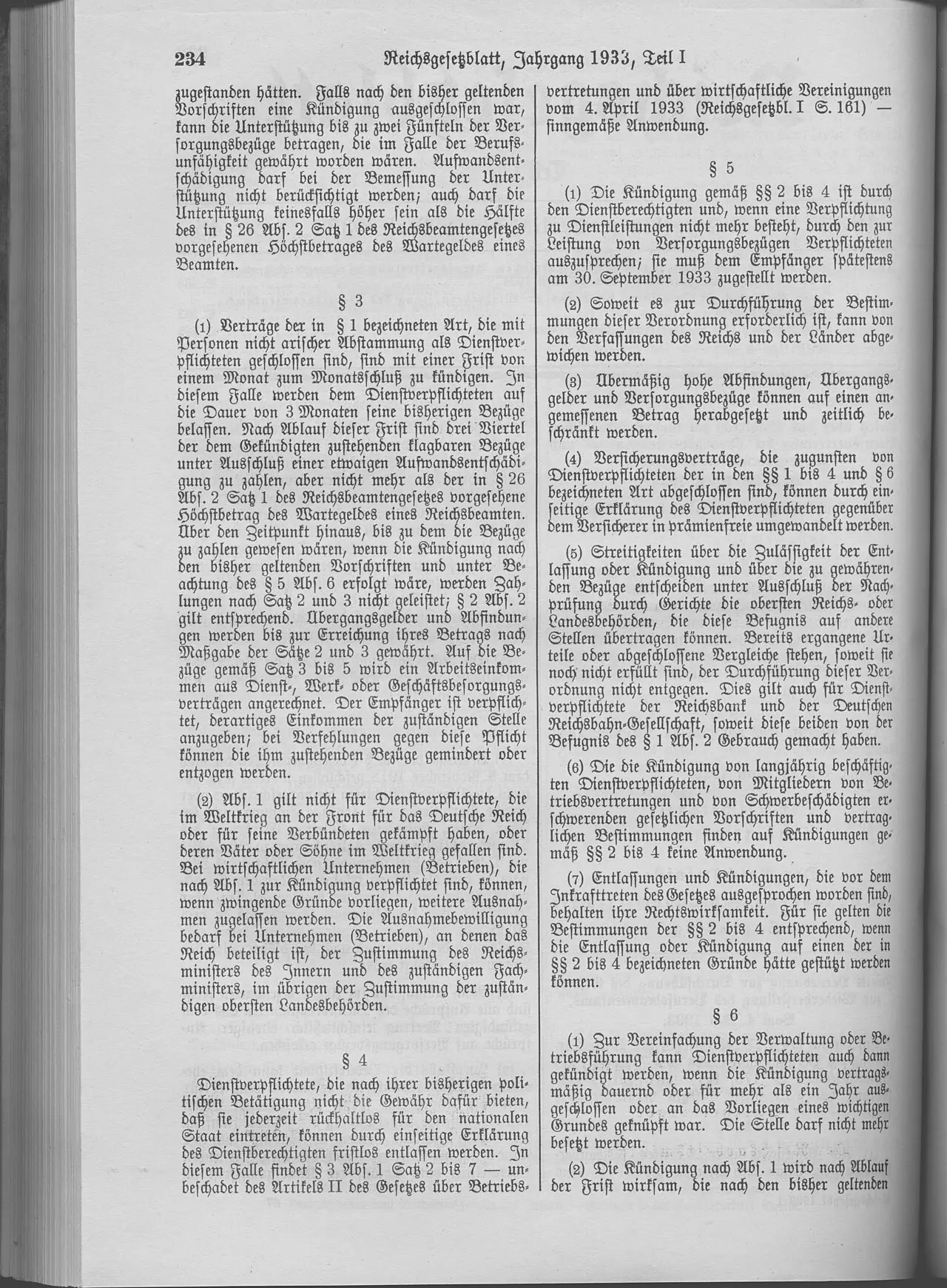
(3) Im Falle der Bedürftigkeit kann dem ehemaligen Dienstverpflichteten, besonders wenn er für mittellose Angehörige sorgt, eine jederzeit widerrufliche laufende Unterstützung bis zu zwei Fünfteln der Bezüge bewilligt werden, die ihm im Falle der Kündigung des Vertrages nach den bisher geltenden Vorschriften vom Ablauf der Kündigungsfrist an zugestanden hätten. Falls nach den bisher geltenden Vorschriften eine Kündigung ausgeschlossen war, kann die Unterstützung bis zu zwei Fünfteln der Versorgungsbezüge betragen, die im Falle der Berufsunfähigkeit gewährt worden wären. Aufwandsentschädigung darf bei der Bemessung der Unterstützung nicht berücksichtigt werden; auch darf die Unterstützung keinesfalls höher sein als die Hälfte des in § 26 Abs. 2 Satz 1 des Reichsbeamtengesetzes vorgesehenen Höchstbetrages des Wartegeldes eines Beamten.
(3) In case of need, the former person bound to service, especially if he supports dependants without means, may be granted a continuing allowance, revocable at any time, of up to two fifths of the emoluments to which he would have been entitled from the end of the notice period had the contract been terminated under the provisions in force until now. If termination was excluded under the provisions in force until now, the allowance may amount to up to two fifths of the pension payments that would have been granted in the event of incapacity for work. Expense allowances may not be taken into account in assessing the allowance; nor may the allowance in any case exceed half the maximum amount of a civil servant’s waiting pay provided for in § 26, para. 2, sentence 1, of the Reich Civil Servants Law.
§ 3(1) Verträge der im § 1 bezeichneten Art, die mit Personen nicht arischer Abstammung als Dienstverpflichteten geschlossen sind, sind mit einer Frist von einem Monat zum Monatsschluß zu kündigen. In diesem Falle werden dem Dienstverpflichteten auf die Dauer von 3 Monaten seine bisherigen Bezüge belassen. Nach Ablauf dieser Frist sind drei Viertel der dem Gekündigten zustehenden klagbaren Bezüge unter Ausschluß einer etwaigen Aufwandsentschädigung zu zahlen, aber nicht mehr als der in § 26 Abs. 2 Satz 1 des Reichsbeamtengesetzes vorgesehene Höchstbetrag des Wartegeldes eines Reichsbeamten. Über den Zeitpunkt hinaus, bis zu dem die Bezüge zu zahlen gewesen wären, wenn die Kündigung nach den bisher geltenden Vorschriften und unter Beachtung des § 5 Abs. 6 erfolgt wäre, werden Zahlungen nach Satz 2 und 3 nicht geleistet; § 2 Abs. 2 gilt entsprechend. Übergangsgelder und Abfindungen werden bis zur Erreichung ihres Betrags nach Maßgabe der Sätze 2 und 3 gewährt. Auf die Bezüge gemäß Satz 3 bis 5 wird ein Arbeitseinkommen aus Dienst-, Werk- oder Geschäftsbesorgungsverträgen angerechnet. Der Empfänger ist verpflichtet, derartiges Einkommen der zuständigen Stelle anzugeben; bei Verfehlungen gegen diese Pflicht können die ihm zustehenden Bezüge gemindert oder entzogen werden.
§ 3(1) Contracts of the kind described in § 1 that have been concluded with persons of non-Aryan descent as persons bound to service are to be terminated with one month’s notice to the end of a month. In this case the person bound to service keeps his previous emoluments for a period of 3 months. After this period, three quarters of the actionable emoluments due to the person given notice are to be paid, excluding any expense allowance, but not more than the maximum amount of a Reich civil servant’s waiting pay provided for in § 26, para. 2, sentence 1, of the Reich Civil Servants Law. No payments under sentences 2 and 3 are made beyond the date up to which the emoluments would have been payable had notice been given under the provisions in force until now and with due regard to § 5, para. 6; § 2, para. 2, applies accordingly. Transitional payments and severance payments are granted, up to their full amount, in accordance with sentences 2 and 3. Earned income from contracts of service, contracts for work or contracts for the management of affairs is counted against the emoluments under sentences 3 to 5. The recipient is obliged to declare such income to the competent office; if he fails in this duty, the emoluments due to him may be reduced or withdrawn.
(2) Abs. 1 gilt nicht für Dienstverpflichtete, die im Weltkrieg an der Front für das Deutsche Reich oder für seine Verbündeten gekämpft haben, oder deren Väter oder Söhne im Weltkrieg gefallen sind. Bei wirtschaftlichen Unternehmen (Betrieben), die nach Abs. 1 zur Kündigung verpflichtet sind, können, wenn zwingende Gründe vorliegen, weitere Ausnahmen zugelassen werden. Die Ausnahmebewilligung bedarf bei Unternehmen (Betrieben), an denen das Reich beteiligt ist, der Zustimmung des Reichsministers des Innern und des zuständigen Fachministers, im übrigen der Zustimmung der zuständigen obersten Landesbehörden.
(2) Para. 1 does not apply to persons bound to service who fought at the front in the World War for the German Reich or for its allies, or whose fathers or sons were killed in the World War. In commercial enterprises (businesses) that are obliged under para. 1 to give notice, further exceptions may be permitted if compelling reasons exist. In enterprises (businesses) in which the Reich has a holding, permission for an exception requires the consent of the Reich Minister of the Interior and of the competent departmental minister, and otherwise the consent of the competent supreme state authorities.
§ 4Dienstverpflichtete, die nach ihrer bisherigen politischen Betätigung nicht die Gewähr dafür bieten, daß sie jederzeit rückhaltlos für den nationalen Staat eintreten, können durch einseitige Erklärung des Dienstberechtigten fristlos entlassen werden. In diesem Falle findet § 3 Abs. 1 Satz 2 bis 7 — unbeschadet des Artikels II des Gesetzes über Betriebsvertretungen und über wirtschaftliche Vereinigungen vom 4. April 1933 (Reichsgesetzbl. I S. 161) — sinngemäße Anwendung.
§ 4Persons bound to service who, by reason of their previous political activity, do not offer a guarantee that they will at all times support the national state without reservation may be dismissed without notice by unilateral declaration of the employer. In this case § 3, para. 1, sentences 2 to 7, applies mutatis mutandis, without prejudice to Article II of the Law on Works Councils and on Economic Associations of 4 April 1933 (Reichsgesetzbl. I p. 161).
§ 5(1) Die Kündigung gemäß §§ 2 bis 4 ist durch den Dienstberechtigten und, wenn eine Verpflichtung zu Dienstleistungen nicht mehr besteht, durch den zur Leistung von Versorgungsbezügen Verpflichteten auszusprechen; sie muß dem Empfänger spätestens am 30. September 1933 zugestellt werden.
§ 5(1) Notice under §§ 2 to 4 is to be given by the employer and, where an obligation to perform services no longer exists, by the party obliged to pay pension benefits; it must be served on the recipient by 30 September 1933 at the latest.
(2) Soweit es zur Durchführung der Bestimmungen dieser Verordnung erforderlich ist, kann von den Verfassungen des Reichs und der Länder abgewichen werden.
(2) In so far as is necessary for carrying out the provisions of this ordinance, the constitutions of the Reich and of the states may be departed from.
(3) Übermäßig hohe Abfindungen, Übergangsgelder und Versorgungsbezüge können auf einen angemessenen Betrag herabgesetzt und zeitlich beschränkt werden.
(3) Excessively high severance payments, transitional payments and pension payments may be reduced to an appropriate amount and limited in time.
(4) Versicherungsverträge, die zugunsten von Dienstverpflichteten der in den §§ 1 bis 4 und § 6 bezeichneten Art abgeschlossen sind, können durch einseitige Erklärung des Dienstverpflichteten gegenüber dem Versicherer in prämienfreie umgewandelt werden.
(4) Insurance contracts concluded for the benefit of persons bound to service of the kind described in §§ 1 to 4 and § 6 may be converted into paid-up policies by unilateral declaration of the person bound to service to the insurer.
(5) Streitigkeiten über die Zulässigkeit der Entlassung oder Kündigung und über die zu gewährenden Bezüge entscheiden unter Ausschluß der Nachprüfung durch Gerichte die obersten Reichs- oder Landesbehörden, die diese Befugnis auf andere Stellen übertragen können. Bereits ergangene Urteile oder abgeschlossene Vergleiche stehen, soweit sie noch nicht erfüllt sind, der Durchführung dieser Verordnung nicht entgegen. Dies gilt auch für Dienstverpflichtete der Reichsbank und der Deutschen Reichsbahn-Gesellschaft, soweit diese beiden von der Befugnis des § 1 Abs. 2 Gebrauch gemacht haben.
(5) Disputes over the admissibility of the dismissal or notice and over the emoluments to be granted are decided by the supreme Reich or state authorities, to the exclusion of review by the courts; these authorities may delegate this power to other offices. Judgments already given or settlements already concluded do not, in so far as they have not yet been satisfied, stand in the way of the implementation of this ordinance. This also applies to persons bound to service of the Reichsbank and of the German Reich Railway Company, in so far as these two have made use of the power under § 1, para. 2.
(6) Die die Kündigung von langjährig beschäftigten Dienstverpflichteten, von Mitgliedern von Betriebsvertretungen und von Schwerbeschädigten erschwerenden gesetzlichen Vorschriften und vertraglichen Bestimmungen finden auf Kündigungen gemäß §§ 2 bis 4 keine Anwendung.
(6) The statutory provisions and contractual terms that make it harder to give notice to persons bound to service with long years of employment, to members of works councils and to the severely disabled do not apply to notice given under §§ 2 to 4.
(7) Entlassungen und Kündigungen, die vor dem Inkrafttreten des Gesetzes ausgesprochen worden sind, behalten ihre Rechtswirksamkeit. Für sie gelten die Bestimmungen der §§ 2 bis 4 entsprechend, wenn die Entlassung oder Kündigung auf einen der in §§ 2 bis 4 bezeichneten Gründe hätte gestützt werden können.
(7) Dismissals and notices given before the law came into force retain their legal effect. The provisions of §§ 2 to 4 apply to them accordingly if the dismissal or notice could have been based on one of the grounds specified in §§ 2 to 4.
§ 6(1) Zur Vereinfachung der Verwaltung oder Betriebsführung kann Dienstverpflichteten auch dann gekündigt werden, wenn die Kündigung vertragsmäßig dauernd oder für mehr als ein Jahr ausgeschlossen oder an das Vorliegen eines wichtigen Grundes geknüpft war. Die Stelle darf nicht mehr besetzt werden.
§ 6(1) To simplify the administration or the running of an enterprise, persons bound to service may be given notice even where notice was excluded by contract permanently or for more than a year, or was conditional on the existence of good cause. The post may not be filled again.
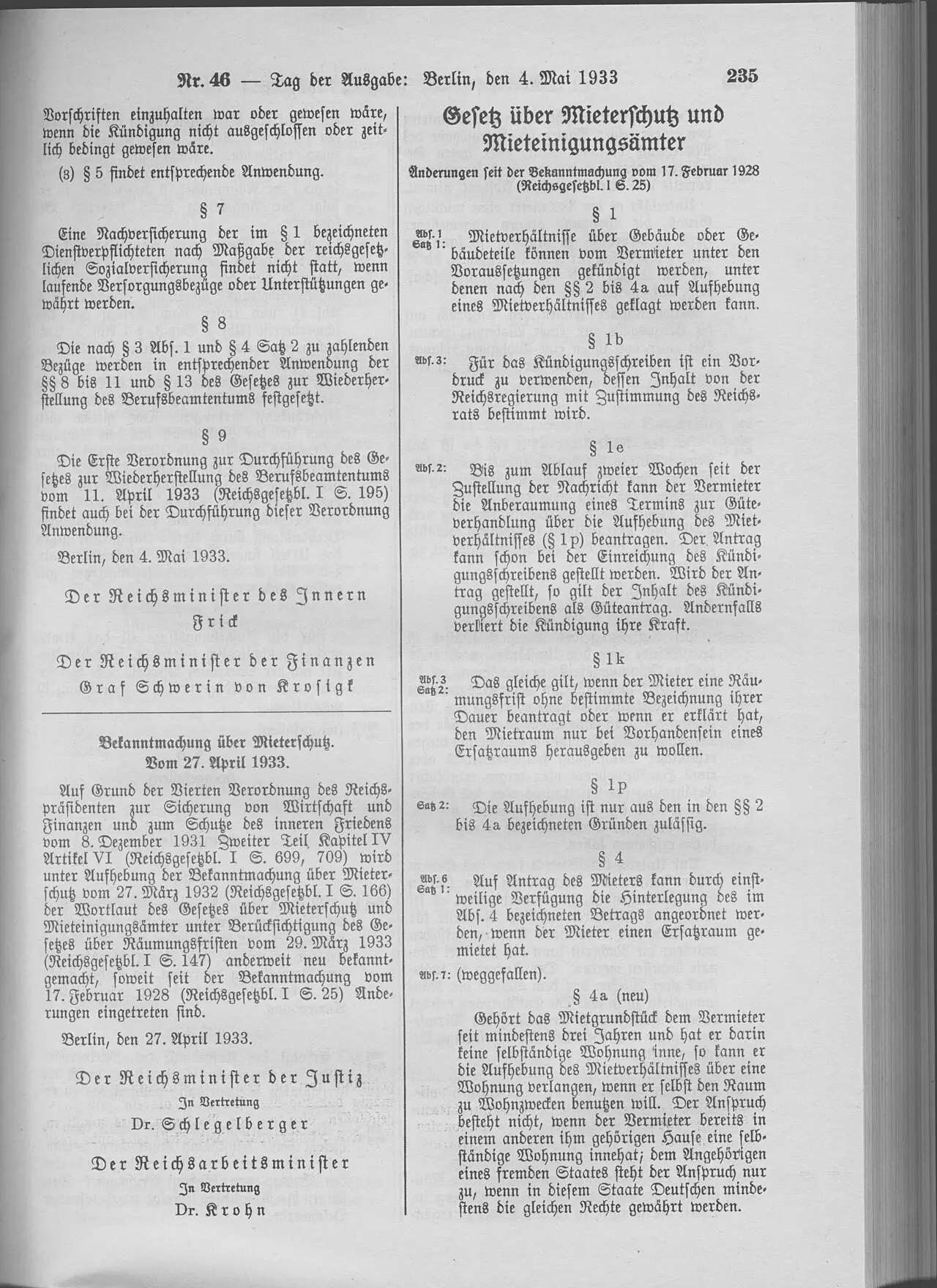
(2) Die Kündigung nach Abs. 1 wird nach Ablauf der Frist wirksam, die nach den bisher geltenden Vorschriften einzuhalten war oder gewesen wäre, wenn die Kündigung nicht ausgeschlossen oder zeitlich bedingt gewesen wäre.
(2) Notice under para. 1 takes effect on expiry of the period that had to be observed under the provisions in force until now, or would have had to be observed had notice not been excluded or subject to a time condition.
(3) § 5 findet entsprechende Anwendung.
(3) § 5 applies accordingly.
§ 7Eine Nachversicherung der im § 1 bezeichneten Dienstverpflichteten nach Maßgabe der reichsgesetzlichen Sozialversicherung findet nicht statt, wenn laufende Versorgungsbezüge oder Unterstützungen gewährt werden.
§ 7Retroactive insurance of the persons bound to service described in § 1 under the Reich statutory social insurance does not take place if continuing pension payments or allowances are granted.
§ 8Die nach § 3 Abs. 1 und § 4 Satz 2 zu zahlenden Bezüge werden in entsprechender Anwendung der §§ 8 bis 11 und § 13 des Gesetzes zur Wiederherstellung des Berufsbeamtentums festgesetzt.
§ 8The emoluments payable under § 3, para. 1, and § 4, sentence 2, are fixed by applying §§ 8 to 11 and § 13 of the Law for the Restoration of the Professional Civil Service accordingly.
§ 9Die Erste Verordnung zur Durchführung des Gesetzes zur Wiederherstellung des Berufsbeamtentums vom 11. April 1933 (Reichsgesetzbl. I S. 195) findet auch bei der Durchführung dieser Verordnung Anwendung.
§ 9The First Ordinance for the Implementation of the Law for the Restoration of the Professional Civil Service of 11 April 1933 (Reichsgesetzbl. I p. 195) also applies in the implementation of this ordinance.
Berlin, den 4. Mai 1933.
Berlin, 4 May 1933.
Der Reichsminister des Innern Frick
The Reich Minister of the Interior Frick
Der Reichsminister der Finanzen Graf Schwerin von Krosigk
The Reich Minister of Finance Graf Schwerin von Krosigk
About this text
The full text is given.
Transcribed from the RGBl. scans (issue 46, pp. 233–235); compared word by word with documentArchiv.de, which differs from the gazette in about a dozen places (among them ‘Versicherungsbeträge’ for ‘Versicherungsverträge’ in § 5 (4), ‘§ 1 Abs. 1’ for ‘§ 1 Abs. 2’ in § 5 (5), ‘§ 4 Abs. 2’ for ‘§ 4 Satz 2’ in § 8, and ‘S. 175’ for ‘S. 175, 177’ in the preamble); all were corrected from the scan.
The English translation was made for this site and is not an official translation. ‘Dienstverpflichtete’ (literally ‘persons bound to service’) are the employees and workers, ‘Dienstberechtigter’ the employing body. ‘Wartegeld’ (‘waiting pay’) is the reduced pay of a civil servant placed in temporary retirement.
German laws and decrees are official works and not protected by copyright (§ 5 UrhG).
Terms
nicht arischer Abstammung
‘Of non-Aryan descent’, as defined in the First Implementing Ordinance of 11 April 1933, which § 9 makes applicable here: one Jewish parent or grandparent was enough.
8. November 1918
The eve of the revolution of 9 November 1918. Like § 2 of the Civil Service Law, § 2 here targets people hired under the Republic, which the regime portrayed as having filled public posts with unqualified party appointees.
nationaler Staat
‘The national state’: the regime’s term for itself. The test of political reliability in § 4 mirrors § 4 of the Civil Service Law.
Gesetz über Betriebsvertretungen
The law of 4 April 1933 that let the authorities remove works councillors considered hostile to the state and dismiss employees for ‘activity hostile to the state’.