Day 74 of 100
Students post the twelve theses ‘against the un-German spirit’; first professors suspended
From Maundy Thursday the German Student Union began posting its twelve theses ‘against the un-German spirit’, which declared the Jew the most dangerous enemy and demanded that Jewish writers publish only in Hebrew. Prussia suspended sixteen university teachers, among them Kelsen, Tillich, Horkheimer and Mannheim, and the main Jewish organisations founded a joint committee for help and reconstruction. In the House of Commons, Austen Chamberlain attacked the new regime, while restaurants learned they would have to post notices declaring whether they cooked with margarine.
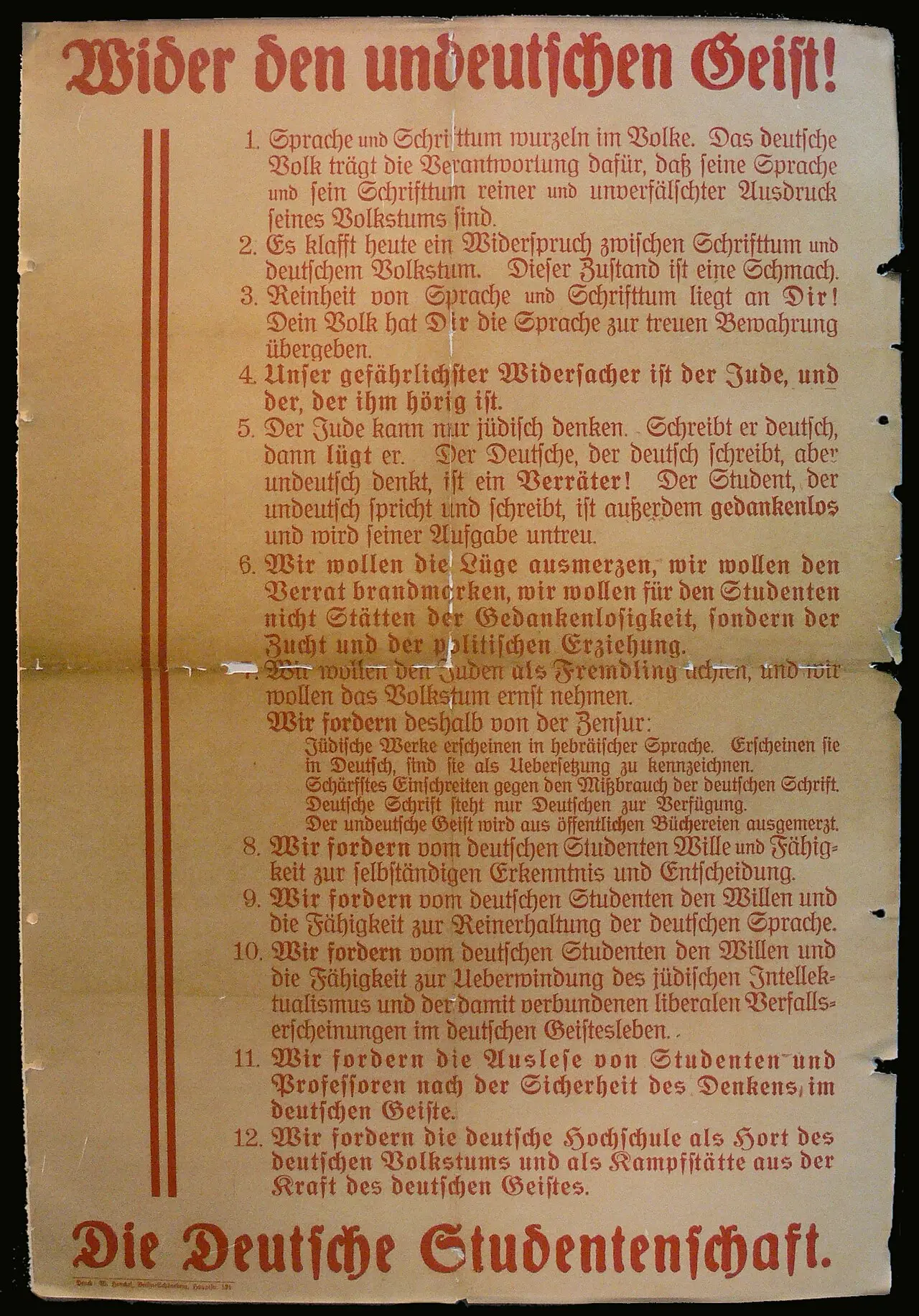

The theses were the opening move of the students’ four-week campaign that ended in the book burnings of 10 May. Printed in red Fraktur and signed ‘Die Deutsche Studentenschaft’, they called for language and literature ‘rooted in the people’, named the Jew ‘our most dangerous adversary’ and demanded censorship that would force Jewish works into Hebrew or label them as translations. The same day the Prussian Ministry of Culture announced its first list of suspended professors, with more to follow: the purge of ‘un-German’ thought at the universities was not confined to posters.
Laws and decrees
Verordnung über den Verkehr mit Erzeugnissen der Margarinefabriken und Ölmühlen
Ordinance on the Trade in Products of Margarine Factories and Oil Mills
Part of the new regime for fats, which had made margarine scarce; the stated aim was to keep margarine for those who could not afford German fats by reducing its use where German fats could replace it. Restaurants, bars and eating houses had to display notices, and mark menus and price lists, saying whether they used margarine, artificial cooking fats, hardened oils, vegetable fats or hardened whale oil; bakers and confectioners had to do the same.4,3,8
Gesetz über die Durchführung einer Volks-, Berufs- und Betriebszählung 1933
Law on the Conduct of a Population, Occupational and Business Census in 1933
Ordered a Reich-wide population, occupational and business census, signed on 12 April and published on 13 April.8
Politics and power
Government, terror and persecution
-
Propaganda
The twelve theses go up
As announced in its circulars, the German Student Union (Deutsche Studentenschaft) began publicly posting its twelve theses ‘against the un-German spirit’ from 13 April. Thesis 5 declared that ‘the Jew can only think Jewish’ and that when he writes German, he lies; thesis 7 demanded that the censor require Jewish works to appear in Hebrew, or be marked as translations if published in German. The posters were put up at universities and reprinted in many newspapers.1,2,9
-
Persecution Berlin
Sixteen university teachers suspended in Prussia
Citing the Civil Service law, Rust, the Reich commissioner for the Prussian Ministry of Culture, suspended with immediate effect a first group of sixteen university teachers, listed in the press by surname: Bonn (Berlin Commercial College), Cohn, Löwenstein and Marck (Breslau), Dehn (Halle), Feiler (Königsberg Commercial College), Heller, Horkheimer, Löwe, Mannheim, Sinzheimer and Tillich (Frankfurt am Main), Kantorowicz (Bonn), Kantorowicz (Kiel), Kelsen (Cologne) and Lederer (Berlin). The announcement said further suspensions would follow.3
-
Persecution Berlin
Hugenberg suspends Flatow and Weichmann
As Reich commissioner for the Prussian Ministry of Economics and Labour, Hugenberg suspended two senior officials, the ministerial counsellors Flatow and Weichmann, with immediate effect, and removed Ministerial Director Arnoldi from the Prussian Agriculture Ministry.4
-
Persecution
Jewish organisations found a committee for help and reconstruction
The main German Jewish organisations, among them the Central Association of German Citizens of Jewish Faith, the Zionist Federation for Germany, the Central Welfare Office of German Jews and the Aid Association of German Jews, together with the Central Office for Jewish Economic Aid and the Palestine Office of the Jewish Agency, founded a joint Central Committee for Help and Reconstruction (Zentralausschuss für Hilfe und Aufbau).5
-
Propaganda
A ‘modest’ birthday for Hitler announced
The Völkischer Beobachter published an appeal that Hitler’s birthday on 20 April should, at his wish, be marked without lavish festivities, which would not suit his movement or ‘the hardship of the German people’. Hitler himself left Munich on Maundy Thursday afternoon by car for his country house on the Obersalzberg to spend Easter there.6,7
Everyday life
What else was happening in Germany
-
Film
Frick on the cinema screen
In a sound-film address to the German people, the Reich Interior Minister, Frick, said that the laws of recent weeks had served to secure Reich authority, ‘coordinate’ (gleichschalten, bring into line) the state governments and parliaments and ‘cleanse’ the administration, and that this would soon be complete.3
-
Economy Berlin
Two hundred thousand barrels for American beer
An American commission was in Berlin negotiating the purchase of about 200,000 German beer barrels, worth some 4 million marks, for delivery to the United States. The Reich Association of German Crafts asked the Economics Ministry to make sure that coopers’ workshops, not only barrel factories, shared in the orders.3
-
Radio
The Deutschlandsender to become the Reich’s station
The Deutschlandsender was to be rebuilt within weeks as the representative station of the Reich, with more ‘popular entertainment’, fewer rehearsed jokes and, perhaps, afternoon broadcasts of successful stage comedies cut for radio. The announcement promised an end to the ‘kitsch’ Goebbels had condemned.4
-
Transport
Holiday tickets for 1 May
The Reichsbahn announced that its Sunday return tickets, a third cheaper than the normal fare, would also be sold for the new 1 May holiday, valid from Saturday 29 April at noon.3
-
Weather Berlin
Fine weather at the Berlin market
The Berlin egg market reported fine weather and a quiet market on the eve of the Easter holiday.6
Elsewhere in the world
-
United Kingdom
Commons debate on Germany; Palestine certificates for German Jews
In the foreign affairs debate before the Easter recess, the Labour member Attlee said his party opposed any concessions to the Hitler government, and Sir Austen Chamberlain likened the spirit of German National Socialism to that of old Prussia ‘reinforced by racial pride’ and warned against treaty revision. The Foreign Secretary, Simon, said the debate showed British feeling over the treatment of minorities, including Jews, in Germany. The Prime Minister, MacDonald, announced that the High Commissioner for Palestine had set aside 200 immigration permits, issued by the British passport office in Berlin, for German Jews with at least £1,000 in capital, and would look favourably on others with £250 and a trade.3,4
More pictures

Sources
- Die Organisation der Aktion „Wider den undeutschen Geist“ verbrannte-buecher.de, DSt circular of 8 April 1933: theses 'ab 13. April zum öffentlichen Anschlag'
- Deutsche Reichs-Zeitung (Bonn), 26 April 1933 Deutsche Digitale Bibliothek, Zeitungsportal, p. 1, 'Die 12 Thesen' (statement by Rector Kohlrausch quoting theses 5 and 7)
- Hamburger Fremdenblatt, 14 April 1933 Deutsche Digitale Bibliothek, Zeitungsportal, Morning edition, p. 1 (Commons debate); p. 2 (suspended professors; margarine ordinance; Frick sound film); p. 3 (beer barrels; holiday tickets)
- Kölnische Zeitung, 14 April 1933 Deutsche Digitale Bibliothek, Zeitungsportal, Morning edition, p. 1 (Commons debate); p. 2 (Flatow and Weichmann; Deutschlandsender; fat regime)
- Chronik der ZWST 1917–2017 Zentralwohlfahrtsstelle der Juden in Deutschland, Verena Buser, chronicle, p. 11, entry '13.4.1933'
- Kölnische Zeitung, 13 April 1933 Deutsche Digitale Bibliothek, Zeitungsportal, Evening edition, p. 9 (Völkischer Beobachter appeal); p. 11 (Berlin egg market)
- Hamburger Fremdenblatt, 15 April 1933 Deutsche Digitale Bibliothek, Zeitungsportal, p. 1, 'München, 15. April' (Hitler to the Obersalzberg)
- Deutscher Reichsanzeiger und Preußischer Staatsanzeiger, 18 April 1933 Deutsche Digitale Bibliothek, Zeitungsportal (Universitätsbibliothek Mannheim), p. 1, notice on Reichsgesetzblatt Part I No. 38, issued 13 April 1933
- Wider den undeutschen Geist! (poster of the Deutsche Studentenschaft, 1933), facsimile Wikimedia Commons (original: Staatsarchiv Würzburg, Akten der Deutschen Studentenschaft, I 21 C 14/I), Full poster text, theses 1–12; file description
Spotted a mistake? Send a correction.