OrdinanceReich Minister of Food and Agriculture and Reich Minister of Economics (Hugenberg), with the Reich Minister of the Interior
Ordinance on the Trade in Products of Margarine Factories and Oil Mills
Verordnung über den Verkehr mit Erzeugnissen der Margarinefabriken und Ölmühlen
Part of the spring 1933 measures to protect German butter and lard producers against cheap margarine and vegetable fats. From 15 May 1933 restaurants, bars, eating houses, bakers and confectioners had to say on a notice, and on menus and price lists, whether their food was made with margarine, compound cooking fat, hardened oils, vegetable fats or hardened whale or fish oil. Packaging of these fats had to state the percentage of each oil or fat used. Breaches carried fines of up to 10,000 Reichsmarks.
Dated
Thursday 13 April 1933
Published in
Reichsgesetzblatt Teil I, no. 38, Thursday 13 April 1933, p. 201
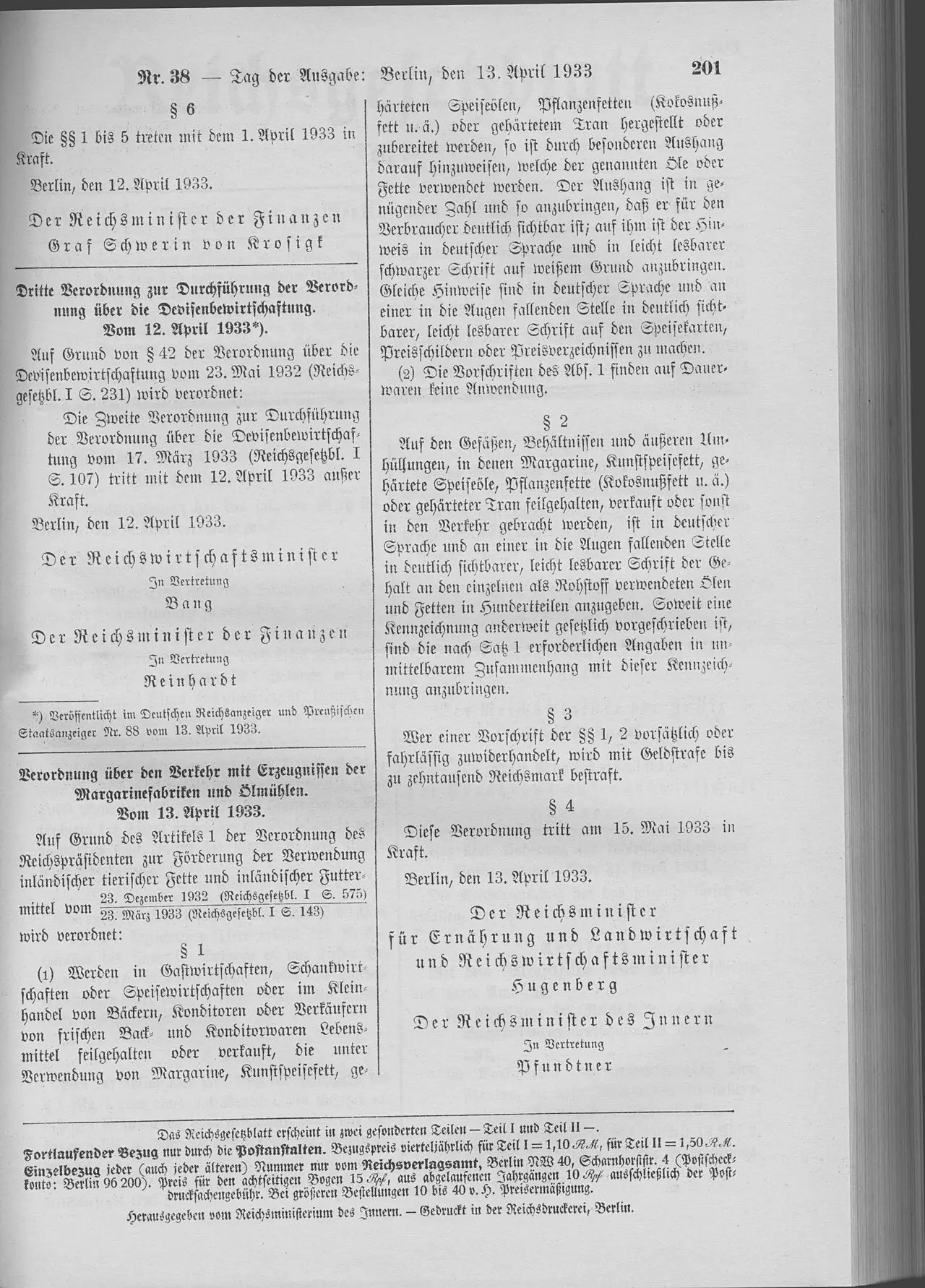
Verordnung über den Verkehr mit Erzeugnissen der Margarinefabriken und Ölmühlen.
Ordinance on the Trade in Products of Margarine Factories and Oil Mills.
Vom 13. April 1933.
Of 13 April 1933.
Auf Grund des Artikels 1 der Verordnung des Reichspräsidenten zur Förderung der Verwendung inländischer tierischer Fette und inländischer Futtermittel vom 23. Dezember 1932 (Reichsgesetzbl. I S. 575) / 23. März 1933 (Reichsgesetzbl. I S. 143) wird verordnet:
On the basis of Article 1 of the Decree of the Reich President for the Promotion of the Use of Domestic Animal Fats and Domestic Animal Feed of 23 December 1932 (Reichsgesetzbl. I p. 575) / 23 March 1933 (Reichsgesetzbl. I p. 143), it is ordained:
§ 1(1) Werden in Gastwirtschaften, Schankwirtschaften oder Speisewirtschaften oder im Kleinhandel von Bäckern, Konditoren oder Verkäufern von frischen Back- und Konditorwaren Lebensmittel feilgehalten oder verkauft, die unter Verwendung von Margarine, Kunstspeisefett, gehärteten Speiseölen, Pflanzenfetten (Kokosnußfett u. ä.) oder gehärtetem Tran hergestellt oder zubereitet werden, so ist durch besonderen Aushang darauf hinzuweisen, welche der genannten Öle oder Fette verwendet werden. Der Aushang ist in genügender Zahl und so anzubringen, daß er für den Verbraucher deutlich sichtbar ist; auf ihm ist der Hinweis in deutscher Sprache und in leicht lesbarer schwarzer Schrift auf weißem Grund anzubringen. Gleiche Hinweise sind in deutscher Sprache und an einer in die Augen fallenden Stelle in deutlich sichtbarer, leicht lesbarer Schrift auf den Speisekarten, Preisschildern oder Preisverzeichnissen zu machen.
§ 1(1) Where foodstuffs made or prepared using margarine, compound cooking fat, hardened edible oils, vegetable fats (coconut fat and the like) or hardened train oil are offered for sale or sold in inns, public houses or eating houses, or in the retail trade of bakers, confectioners or sellers of fresh baked goods and confectionery, a special notice shall indicate which of the said oils or fats are used. The notice shall be put up in sufficient numbers and in such a way that it is clearly visible to the consumer; the indication on it shall be in the German language and in easily legible black lettering on a white ground. The same indications shall be made in the German language, at a conspicuous place and in clearly visible, easily legible lettering, on menus, price labels or price lists.
(2) Die Vorschriften des Abs. 1 finden auf Dauerwaren keine Anwendung.
(2) The provisions of para. 1 do not apply to goods with a long shelf life.
§ 2Auf den Gefäßen, Behältnissen und äußeren Umhüllungen, in denen Margarine, Kunstspeisefett, gehärtete Speiseöle, Pflanzenfette (Kokosnußfett u. ä.) oder gehärteter Tran feilgehalten, verkauft oder sonst in den Verkehr gebracht werden, ist in deutscher Sprache und an einer in die Augen fallenden Stelle in deutlich sichtbarer, leicht lesbarer Schrift der Gehalt an den einzelnen als Rohstoff verwendeten Ölen und Fetten in Hundertteilen anzugeben. Soweit eine Kennzeichnung anderweit gesetzlich vorgeschrieben ist, sind die nach Satz 1 erforderlichen Angaben in unmittelbarem Zusammenhang mit dieser Kennzeichnung anzubringen.
§ 2On the vessels, containers and outer wrappings in which margarine, compound cooking fat, hardened edible oils, vegetable fats (coconut fat and the like) or hardened train oil are offered for sale, sold or otherwise put on the market, the content of each of the oils and fats used as raw material shall be stated in percentages, in the German language, at a conspicuous place and in clearly visible, easily legible lettering. Where a marking is prescribed by law elsewhere, the particulars required under sentence 1 shall be placed directly together with that marking.
§ 3Wer einer Vorschrift der §§ 1, 2 vorsätzlich oder fahrlässig zuwiderhandelt, wird mit Geldstrafe bis zu zehntausend Reichsmark bestraft.
§ 3Whoever intentionally or negligently contravenes a provision of §§ 1 and 2 shall be punished with a fine of up to ten thousand Reichsmarks.
§ 4Diese Verordnung tritt am 15. Mai 1933 in Kraft.
§ 4This ordinance comes into force on 15 May 1933.
Berlin, den 13. April 1933.
Berlin, 13 April 1933.
Der Reichsminister für Ernährung und Landwirtschaft und Reichswirtschaftsminister Hugenberg
The Reich Minister of Food and Agriculture and Reich Minister of Economics Hugenberg
Der Reichsminister des Innern In Vertretung Pfundtner
The Reich Minister of the Interior, by deputy, Pfundtner
About this text
The full text is given.
Transcribed from the RGBl. scan (issue 38, p. 201); no independent transcription was found to compare against.
The English translation was made for this site and is not an official translation. The preamble’s two dates are printed one above the other, like a fraction: the gazette’s way of citing a decree (23 December 1932) in its amended form (23 March 1933).
German laws and decrees are official works and not protected by copyright (§ 5 UrhG).
Terms
Kunstspeisefett
Compound cooking fat: a manufactured blend of edible fats sold as a cheaper alternative to lard.
Tran
Train oil: oil rendered from whale or fish blubber, which, once hardened, was a common raw material for margarine.
Dauerwaren
Goods made to keep, such as biscuits and rusks, as opposed to fresh bread and cakes.
In Vertretung
‘By deputy’: Hans Pfundtner, state secretary in the Reich Ministry of the Interior, signed for the minister, Wilhelm Frick. Alfred Hugenberg held both the agriculture and the economics ministries until June 1933.