Day 67 of 100
Hitler tells doctors’ leaders he will purge ‘alien influence’ from Germany’s professions
Receiving the newly ‘coordinated’ leadership of the medical profession, Hitler spoke of removing the ‘excess’ of Jewish intellectuals from German cultural life. In the evening he and Goebbels addressed the foreign press, with the papal nuncio at the head of the diplomatic corps. The civil servants’ federation dissolved itself and the Protestant church protested at Kube’s remarks to the German Christians. Duelling was legalised again in Prussia, and the Propaganda Ministry warned against ‘patriotic kitsch’.

Politics and power
Government, terror and persecution
-
Persecution Berlin, Reich Chancellery
Hitler to the doctors: an end to ‘alien’ influence
Hitler received Gerhard Wagner, the Nazi commissioner now in charge of the doctors’ associations, and then their boards under Geheimrat Stauder, who pledged the ‘coordinated’ profession’s cooperation. According to the press report, Hitler spoke at length of his intention to ‘cleanse’ the nation, and especially its intellectual class, of ‘alien’ influence, and of eliminating the ‘excess number’ of Jewish intellectuals from Germany’s cultural and intellectual life.1
-
Propaganda evening, Berlin, Propaganda Ministry, Wilhelmplatz
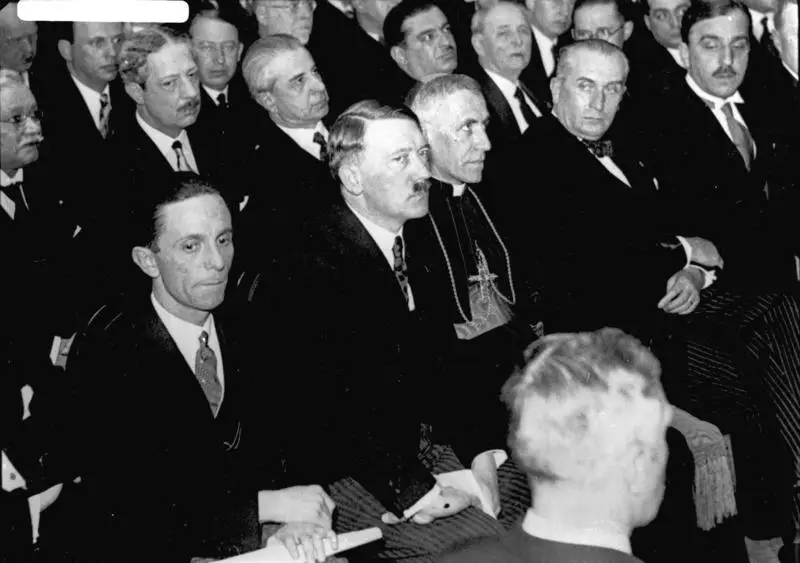
Hitler and Goebbels before the foreign press
At a reception given by the Berlin Association of the Foreign Press in the Propaganda Ministry on Wilhelmplatz, attended by almost the whole cabinet, the heads of the diplomatic missions led by the papal nuncio Orsenigo, Reichsbank president Schacht and many business leaders, Goebbels said that government and press must now build a firm relationship of trust, and Hitler also spoke. The association’s chairman, Dr Thum, asked the government for a ‘just solution’ to the worries the changes were causing journalists.2,3
-
Churches Berlin
Protestant church protests at Kube’s remarks
The Protestant Church Federation announced that the Evangelical Supreme Church Council had approached the state authorities over remarks made by Wilhelm Kube, Oberpräsident of Brandenburg and Berlin, at the German Christians’ conference, because they touched the basic relationship between state and church.4
-
Opposition Berlin
The civil servants’ federation dissolves itself
After a number of its member unions had left, the federal committee of the General German Civil Servants’ Federation (Allgemeiner Deutscher Beamtenbund) decided to dissolve it.5
Everyday life
What else was happening in Germany
-
Education Prussia
Student duelling legal again in Prussia
Kerrl lifted the ban on student fencing duels (Mensuren) throughout Prussia in an instruction to the public prosecutors. Duelling, the decree said, sprang from a fighting spirit that should be encouraged in academic youth; it steeled personal courage, demanded self-control and strengthened the will.5
-
Society Berlin
Propaganda Ministry warns against ‘patriotic kitsch’
The Propaganda Ministry announced that the ‘national renewal’ must not be smothered in ‘patriotic kitsch’: tasteless use of its symbols and their commercial exploitation harmed Germany’s reputation, and the government would act against such ‘culturally harmful’ trade, including the ‘kitschification’ of history and national symbols.4
-
Radio evening
Rosenberg’s ‘Hour of the Nation’
In the evening’s ‘Hour of the Nation’ on the radio, Alfred Rosenberg, editor of the Völkischer Beobachter, spoke on ‘the German myth’, developing the ideas of his book The Myth of the Twentieth Century about race and ‘blood ties’ against the ‘individualism’ of the past.6
-
Books
Remarque safe in Switzerland
Responding to rumours that the writer Erich Maria Remarque had come to harm, officials said the German mission in Lugano had established that he was safe and well at his country house there.4
More pictures

Sources
- Marbacher Zeitung, 7 April 1933: Hitler receives the leaders of the medical profession (Berlin, 6 April) Deutsche Digitale Bibliothek, Zeitungsportal, p. 1
- Stadtanzeiger für Castrop-Rauxel, 7 April 1933: ‘Hitler und Goebbels vor der Presse’ (Berlin, 6 April) Deutsche Digitale Bibliothek, Zeitungsportal, p. 2
- Neue Mannheimer Zeitung, midday edition, 7 April 1933: ‘Goebbels’ Leitsätze’ (Wolff, Berlin, 6 April) Deutsche Digitale Bibliothek, Zeitungsportal, p. 1
- Biberacher Zeitung, 7 April 1933: ‘Gegen patriotischen Kitsch’; Remarque; statement of the Protestant Supreme Church Council (Berlin, 6 April) Deutsche Digitale Bibliothek, Zeitungsportal, p. 2
- Billstedter Zeitung, 6 April 1933: ‘Mensurverbot in Preußen aufgehoben’; ‘Auflösung des ADB’ (Berlin, 6 April) Deutsche Digitale Bibliothek, Zeitungsportal, p. 6
- Weißeritz-Zeitung, 7 April 1933: ‘Alfred Rosenberg über den deutschen Mythos’ (Berlin, 6 April) Deutsche Digitale Bibliothek, Zeitungsportal, p. 4
Spotted a mistake? Send a correction.